Search results for "Sally Hopgood"
Items in stock - 4 working days delivery time

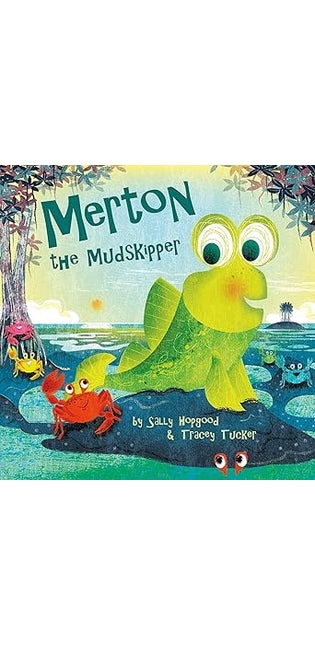
Merton the Mudskipper
So all the other fish teased him. But one day when all the other fish got caught in a net. Merton swam and there's where he met a new friend. My little boy likes this book and it's a nice story about friendship.
R 50.00
Items we need to order for you
See You Later, Alligator
A silly story with bright, engaging illustrations and expressive, rhyming text that children will want to read--and giggle through--again and again. A departing tortoise has his bags packed and is almost ready to set out on an adventure, but he can't leave until he says good-bye to each of his animal friends. The tortoise stops for every last timid mouse and bumblebee, shouting his rhyming good-byes, making you wonder if, perhaps, he's stalling the start of his trip. His animal friends appear startled as he suddenly pops up on each page to say adieu--especially the perplexed rhinoceros the tortoise mistakes for a unicorn! With each farewell, the tortoise's good-byes get sillier and more creative. When will the good-byes end and the adventure begin?
R 388.00
R 638.00
R 684.00
R 766.04
R 2,440.00
R 348.03
R 1,524.00
R 367.00
R 685.14
R 458.00
R 1,829.00
R 1,284.74
R 748.00
R 1,088.87
R 652.00
Sally Rand
She would appear in more than thirty films and be named after a Road Atlas by Cecil B Demille. A football play would be named after her. She would appear on To Tell the Truth. She would be arrested six times in one day for indecency. She would be immortalized in the final scene of The Right Stuff, cartoons, popular culture, and live on as the iconic symbol of the Chicago World’s Fair of 1933. She would pave the way for every sex symbol to follow from Marilyn Monroe to Lady Gaga. She would die penniless and in debt. In the end, Sammy Davis Jr. would write her a $10,000 check when she had nothing left. Her name was Sally Rand. You can draw a line from her to Lana Turner, Marilyn Monroe, Raquel Welch, Ann Margret, Madonna, and Lady Gaga. She broke the mold in 1933, by proclaiming the female body as something beautiful and taking it out of the strip club with her ethereal fan dance. She was a poor girl from the Ozarks who ran away with a carnival, then joined the circus, and finally made it to Hollywood where Cecil B Demille set her on the road to fame with silent movies. When the talkies came her career collapsed, and she ended up in Chicago, broke, sleeping in alleys. Two ostrich feathers in a second-hand store rescued her from obscurity.
R 609.35
R 214.00
R 1,252.53
R 883.01
R 1,041.00
Sally Wainwright
The first and only book length study of British screenwriter, director and producer Sally Wainwright. Authors Gorton and Johnson brings together Wainwright’s key television series and television films with theoretical work on the concept of emotion and feminist television criticism, exploring Wainwright's contributions to British television through the heroic female characters she creates. The book covers a wide range of theoretical work on melodrama, genre and emotion to explore Wainwright’s televisual texts, offering analysis of globally recognised television series such as Happy Valley, Last Tango in Halifax, and Gentleman Jack.
R 4,732.49
R 1,547.00
R 967.00
Endtimes of Human Rights
"We are living through the endtimes of the civilizing mission. The ineffectual International Criminal Court and its disastrous first prosecutor, Luis Moreno-Ocampo, along with the failure in Syria of the Responsibility to Protect are the latest pieces of evidence not of transient misfortunes but of fatal structural defects in international humanism. Whether it is the increase in deadly attacks on aid workers, the torture and 'disappearing' of al-Qaeda suspects by American officials, the flouting of international law by states such as Sri Lanka and Sudan, or the shambles of the Khmer Rouge tribunal in Phnom Penh, the prospect of one world under secular human rights law is receding. What seemed like a dawn is in fact a sunset. The foundations of universal liberal norms and global governance are crumbling."—from The Endtimes of Human RightsIn a book that is at once passionate and provocative, Stephen Hopgood argues, against the conventional wisdom, that the idea of universal human rights has become not only ill adapted to current realities but also overambitious and unresponsive. A shift in the global balance of power away from the United States further undermines the foundations on which the global human rights regime is based. American decline exposes the contradictions, hypocrisies and weaknesses behind the attempt to enforce this regime around the world and opens the way for resurgent religious and sovereign actors to challenge human rights.Historically, Hopgood writes, universal humanist norms inspired a sense of secular religiosity among the new middle classes of a rapidly modernizing Europe. Human rights were the product of a particular worldview (Western European and Christian) and specific historical moments (humanitarianism in the nineteenth century, the aftermath of the Holocaust). They were an antidote to a troubling contradiction—the coexistence of a belief in progress with horrifying violence and growing inequality. The obsolescence of that founding purpose in the modern globalized world has, Hopgood asserts, transformed the institutions created to perform it, such as the International Committee of the Red Cross and recently the International Criminal Court, into self-perpetuating structures of intermittent power and authority that mask their lack of democratic legitimacy and systematic ineffectiveness. At their best, they provide relief in extraordinary situations of great distress; otherwise they are serving up a mixture of false hope and unaccountability sustained by "human rights" as a global brand.The Endtimes of Human Rights is sure to be controversial. Hopgood makes a plea for a new understanding of where hope lies for human rights, a plea that mourns the promise but rejects the reality of universalism in favor of a less predictable encounter with the diverse realities of today's multipolar world.
R 882.00
R 766.54
R 1,286.06
Endtimes of Human Rights
"We are living through the endtimes of the civilizing mission. The ineffectual International Criminal Court and its disastrous first prosecutor, Luis Moreno-Ocampo, along with the failure in Syria of the Responsibility to Protect are the latest pieces of evidence not of transient misfortunes but of fatal structural defects in international humanism. Whether it is the increase in deadly attacks on aid workers, the torture and 'disappearing' of al-Qaeda suspects by American officials, the flouting of international law by states such as Sri Lanka and Sudan, or the shambles of the Khmer Rouge tribunal in Phnom Penh, the prospect of one world under secular human rights law is receding. What seemed like a dawn is in fact a sunset. The foundations of universal liberal norms and global governance are crumbling."—from The Endtimes of Human RightsIn a book that is at once passionate and provocative, Stephen Hopgood argues, against the conventional wisdom, that the idea of universal human rights has become not only ill adapted to current realities but also overambitious and unresponsive. A shift in the global balance of power away from the United States further undermines the foundations on which the global human rights regime is based. American decline exposes the contradictions, hypocrisies and weaknesses behind the attempt to enforce this regime around the world and opens the way for resurgent religious and sovereign actors to challenge human rights.Historically, Hopgood writes, universal humanist norms inspired a sense of secular religiosity among the new middle classes of a rapidly modernizing Europe. Human rights were the product of a particular worldview (Western European and Christian) and specific historical moments (humanitarianism in the nineteenth century, the aftermath of the Holocaust). They were an antidote to a troubling contradiction—the coexistence of a belief in progress with horrifying violence and growing inequality. The obsolescence of that founding purpose in the modern globalized world has, Hopgood asserts, transformed the institutions created to perform it, such as the International Committee of the Red Cross and recently the International Criminal Court, into self-perpetuating structures of intermittent power and authority that mask their lack of democratic legitimacy and systematic ineffectiveness. At their best, they provide relief in extraordinary situations of great distress; otherwise they are serving up a mixture of false hope and unaccountability sustained by "human rights" as a global brand.The Endtimes of Human Rights is sure to be controversial. Hopgood makes a plea for a new understanding of where hope lies for human rights, a plea that mourns the promise but rejects the reality of universalism in favor of a less predictable encounter with the diverse realities of today's multipolar world.
R 478.00
Cyril the Lonely Cloud
It is sad but true that no one is ever pleased to see Cyril the cloud. He's always being blamed for ruining everyone's fun: casting shadows over everywhere he goes, and making things look dull and miserable. So, one day, Cyril drifts far, far away in search of a friendly face: over farmland, towns, and an ocean . . . Eventually he arrives in a new land whose ground is baking hot. Here everyone welcomes the shade Cyril gives. This makes Cyril so happy that he criesbig glorious tears of joy. And his tears soak the land and everything seems to smile. And that is all Cyril ever wanted - to look down on the world and see a happy smile. A beautiful story that taps right into what Tim Hopgood's books are all about: celebrating the natural world and promoting a positive outlook on life.
R 247.00
R 521.00
R 397.00
R 365.00
R 411.00
What a Wonderful World Book and CD
This is a stunningly beautiful book featuring the lyrics from What a Wonderful World, accompanied by joyful illustrations from award-winning illustrator Tim Hopgood. It follows one little boy as he discovers just how wonderful this world of ours can be. The book comes with an accompanying CD which includes the much-loved recording of the song by Louis Armstrong and an exclusive reading by Sophie Aldred.
R 309.00
R 882.86
R 1,090.34
R 458.00
R 829.00
R 273.00
WOW! Said the Owl
At night, when we are feeling tired and ready for bed, owls are just waking up. But one curious little owl decides to stay awake all day, instead of all night, and discovers a world bursting with colour! Yet when the night-time comes around again, the stars above her head are still the most beautiful of all.WOW! Said the Owl is an engaging book about colours from Tim Hopgood, the winner of the Best Emerging Illustrator, Booktrust Early Years Award.
R 247.00
R 763.00
R 587.00
R 296.00
R 950.00
R 433.00
R 867.00
R 526.00