Contemporary South Africa

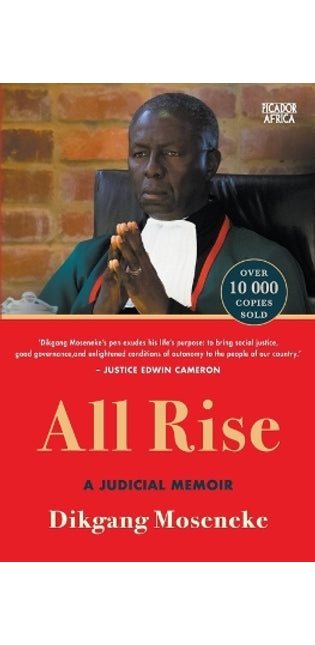
All Rise
Law as a profession was not Dikgang Moseneke’s first choice. As a small boy he told his aunt that he wanted to be a traffic officer, but life had other plans for him. At the young age of 15, he was imprisoned for participating in anti-apartheid activities. During his ten years of incarceration, he completed his schooling by correspondence and earned two university degrees. Afterwards he studied law at the University of South Africa. Practising law during apartheid South Africa brought with it unique challenges, especially to professionals of colour, within a fraught political climate. After some years in general legal practice and at the Bar, and a brief segue into business, Moseneke was persuaded that he would best serve the country’s young democracy by taking judicial office. All Rise covers his years on the bench, with particular focus on his 15-year term as a judge at South Africa’s apex court, the Constitutional Court, including as the deputy chief justice. As a member of the team that drafted the interim Constitution, Moseneke was well placed to become one of the guardians of its final form. His insights into the Constitutional Court’s structures, the personalities peopling it, the values it embodies, the human dramas that shook it and the cases that were brought to it make for fascinating reading. All Rise offers a unique, insider’s view of how the judicial system operates at its best and how it responds when it is under fire. From the Constitutional Court of Arthur Chaskalson to the Mogoeng Mogoeng era, Moseneke’s understated but astute commentary is a reflection on the country’s ongoing but not altogether comfortable journey to a better life for all.
R 290.00
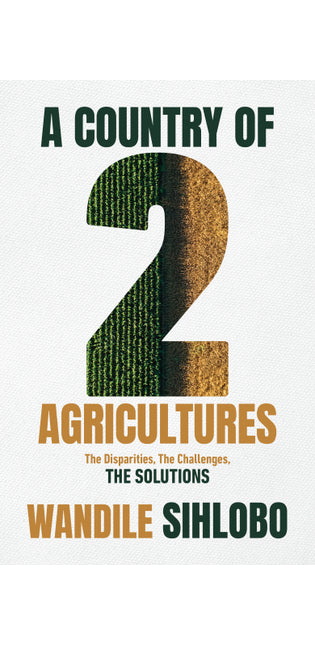
A Country of Two Agricultures
Nearly three decades after the dawn of democracy, South Africa has remained a country of ‘two agricultures’. On the one hand we have a subsistence, primarily non-commercial, black farming segment. On the other hand, however, we have a predominantly commercial and white farming sector that is well-resourced and has access to domestic and international trade networks. These disparities can be traced back to South Africa’s painful history where, for decades, black farmers were on the margins of government support and also experienced land dispossession and livestock plunder. A Country of Two Agricultures focuses less on history and more on the present and the future, explaining why these disparities have persisted in the democratic era, and what it will take to overcome them. It aims to contribute to a better understanding of the variety of agricultural forces, taking into account both questions of domestic political economy and external factors, as well as to bring to light new risks and opportunities. Wandile Sihlobo offers insights into the role of agriculture in the South African economy from an agricultural economy perspective, and provides political economy insights that are rooted in the experiences of farming communities on the ground and right through the value chain. Beyond insights on the realities this book offers the government, the private sector, and anyone interested in the betterment of the South African economy, tools to grapple with this duality, and proposes a framework for bolstering the black farming segment for growth and competitiveness – and ultimately food security.
R 300.00
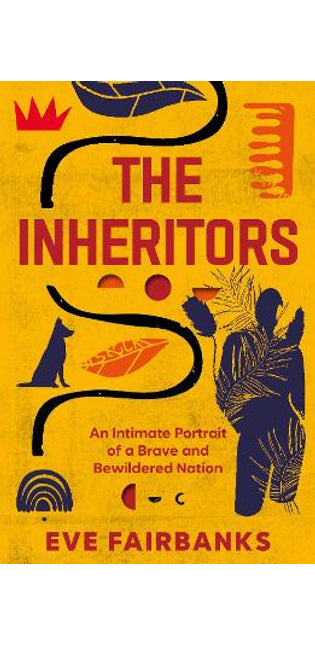
Inheritors
A dozen years in the making, The Inheritors weaves together the stories of three ordinary South Africans over five tumultuous decades in a sweeping and exquisite look at what really happens when a country resolves to end white supremacy. ]•Political activist Dipuo, who fought to take down history’s strictest segregationist system. •Dipuo’s daughter Malaika, who excels brilliantly after segregation’s collapse but wrestles with her relationship to her mother and her duty to her country. •And Christo, one of the last White South Africans drafted to fight for apartheid as it crumbled around him. All three, and many others, had to remake their own lives while facing huge questions: What do we owe to history? And what will people who care about being good do when the meaning of right action changes nearly overnight? Observing subtle truths about race and power that extend well beyond national borders, Fairbanks explores questions that preoccupy so many of us today: How can we let go of our pasts, as individuals and as countries? How should historical debts be paid? And how can a person live an honorable life in a society that–for better or worse–they no longer recognise? ‘Brave ... ambitious ... [a story of] admirable people, brave in the face of unbearable poverty and determined to rise out of it ... [Fairbanks’s characters] are also capable of savage introspection and, at times, willing to laugh about themselves.’–Rian Malan, Compact Magazine
R 330.00
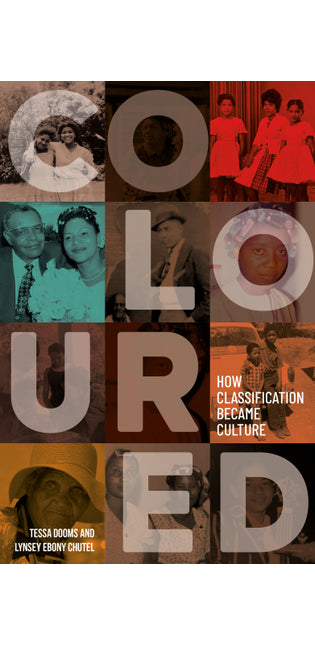
Coloured: How Classification Became Culture
Coloured as an ethnicity and racial demographic is intertwined in the creation of the South Africa we have today. Yet often, Coloured communities are disdained as people with no clear heritage or culture — ‘not being black enough or white enough. Coloured challenges this notion and presents a different angle to that narrative. It delves into the history of Coloured people as descendants of indigenous Africans and a people whose identity was shaped by colonisation, slavery, and the racial political hierarchy it created. Although rooted in a difficult history, this book is also about the culture that Coloured communities have created for themselves through food, music, and shared lived experiences in communities such as Eldorado Park, Eersterus, and Wentworth. Coloured culture is an act of defiance and resilience. Coloured is a reflection on, and celebration of Coloured identities as lived experiences. It is a call to Coloured communities to reclaim their identity and an invitation to understand the history and place of Coloured people in the making of South Africa’s future.
R 305.00
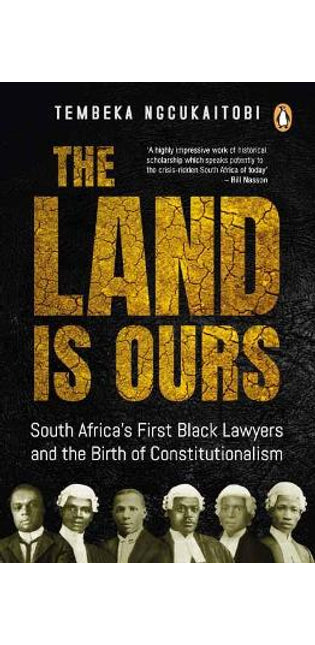
The Land Is Ours
The Land Is Ours tells the story of South Africa’s first black lawyers, who operated in the late nineteenth and early twentieth centuries. In an age of aggressive colonial expansion, land dispossession and forced labour, these men believed in a constitutional system that respected individual rights and freedoms, and they used the law as an instrument against injustice. The book follows the lives, ideas and careers of Henry Sylvester Williams, Alfred Mangena, Richard Msimang, Pixley ka Isaka Seme, Ngcubu Poswayo and George Montsioa, who were all members of the ANC. It analyses the legal cases they took on, explores how they reconciled the law with the political upheavals of the day, and considers how they sustained their fidelity to the law when legal victories were undermined by politics. The Land Is Ours shows that these lawyers developed the concept of a Bill of Rights, which is now an international norm. The book is particularly relevant in light of current calls to scrap the Constitution and its protections of individual rights: it clearly demonstrates that, from the beginning, the struggle for freedom was based on the idea of the rule of law.
R 435.00
Capture in the Court
Since populist factions claim to be the people, judges confronting them do not just decide against the people; they are against the people. The judiciary faces a barrage of attacks not just from the ruling ANC but from other political parties clamouring for power. There comes a predictable phase in the cycle of politics where this is most likely to occur. Dan Mafora provides much-needed insight.
R 150.00
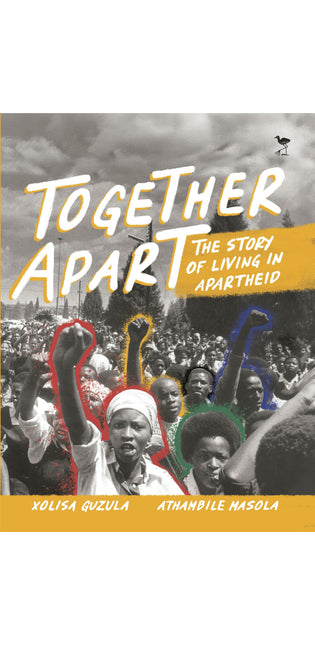
Together Apart
Discover the gripping tale of Together Apart: The Story of Living in Apartheid, that explores South Africa’s struggle against one of history’s most notorious systems of racial segregation. Through the reflections of an elder who lived through it, this book invites readers to dive into the complex and heartbreaking history of apartheid, a time when courage and resilience shone brightly in the face of oppression. What was lifelike under apartheid? How did colonisation erase the rich histories and cultures of the indigenous people? From the denial of voting rights to the harsh segregation laws that controlled people’s daily lives − where they lived, worked, and even who they could marry − it spread through every aspect of life from education to sports. In the world of work, apartheid created a system of migrant labour and domestic slavery. Meet the brave individuals and organisations that fought tirelessly for equality and justice and whose stories of strength, love and revolution are woven together showing the triumph of the human spirit against overwhelming odds. While apartheid may have officially ended, its impact still resonates today. This book serves as a vital reminder of the sacrifices made and the ongoing journey toward a truly inclusive society. Together Apart is more than just a history book − it’s a call to action for a new generation to understand the past and shape a better future.
R 305.00
Rattling the Cage
Most South Africans have strong views on our past and present, often based on how we have been personally affected by history, and an understanding of the challenges that face us as a country. But how well-examined and solid are these positions? Have your views been properly thought through? Are you correctly informed? Do you even have the facts straight? Rattling the Cage takes the reader on an informed tour of the South African reality: from the highs and lows, the successes and failures, FW de Klerk’s gaffes to Fees Must Fall, the Oscar Pistorius trial, the 2010 FIFA World Cup, triple BEE, global warming, the Covid-19 pandemic, gay rights in Africa, and veganism. Among the questions Meersman asks are: Do South Africans still believe in their Constitution and democracy? Why do so many young South Africans say Nelson Mandela was a sell-out and the Truth and Reconciliation Commission was a dismal failure? Is outlawing hate speech and criminalising racist behaviour really a good idea? Why do communities still burn down their schools? How did the Marikana massacre happen in the democratic era? Why are African immigrants increasingly unwelcome in South Africa? Can our media be trusted to tell us the truth? And how do we embrace climate change? History, big-picture philosophy, grassroots journalism and a novelist’s eye – animated by a genuine sense of moral indignation at the current state of the nation – come together in these essays to provide critical perspectives on and insights into South Africa’s recent past and current political, economic and social undercurrents. No matter what your views are, you are sure to find your understanding of the country deepened, challenged and sometimes changed.
R 310.00
Maye! Maye!
Kwa Mai Mai is the embodiment of everything Johannesburg is meant to be – the City of Gold, a place where dreams deferred come true. It is a constellation of people’s cultures, imbued with beautiful memories of life in villages left behind but cherished by those who refuse to forget. This book tells the story of how cultural memory, sacredly preserved and transported to new geographies, can be used both as a cultural weapon to resist subjugation and as an economic weapon to turn those priceless traditions into tradeable commodities. The book explores how the keepers of cultural memory can use it not only to survive but to invoke the entrepreneurial and creative spirit buried deep within their souls. Moreover, it builds on the assumption that if cultural memory can be stored and retrieved through artefacts, sites, ceremonies, myths and rituals, then Kwa Mai Mai is the place where these elements converge in inspiring displays of craftsmanship, worship and healing. Yet, Kwa Mai Mai has a darker side. It is a place of painful memories and ignored pleas – where its members are in a constant battle to be acknowledged by the city that created it. This book reveals how the subversive, socio-economic order that epitomised Kwa Mai Mai turned class theory upside down. In an interesting reversal of roles, the Kwa Mai Mai community, who used to be a migrant working class, wrested the power and control over the means of production from the dominant class. Through their heightened cultural consciousness, this marginalised migrant community has reimagined new economic realities and possibilities, forever distancing themselves from the painful, repressive past.
R 320.00