


Search results for "9780241618837"
Items we need to order for you

Security Protocols XXV
This book constitutes the thoroughly refereed post-workshop proceedings of the 25th International Workshop on Security Protocols, held in Cambridge, UK, in March 2017. The volume consists of 16 thoroughly revised invited papers presented together with the respective transcripts of discussions. The theme of this year's workshop was multi-objective security and the topics covered included security and privacy, formal methods and theory of security, systems security, network security, software and application security, human and societal aspects of security and privacy, security protocols, web protocol security, and mobile and wireless security.
R 2,057.00
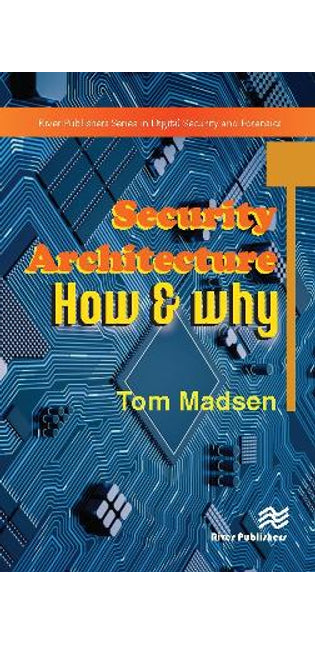
Security Architecture – How & Why
Security Architecture, or Enterprise Information security architecture, as it was originally coined by Gartner back in 2006, has been applied to many things and different areas, making a concrete definition of Security architecture a difficult proposition. But having an architecture for the cyber security needs of an organization is important for many reasons, not least because having an architecture makes working with cyber security a much easier job, since we can now build on a, hopefully, solid foundation. Developing a security architecture is a daunting job, for almost anyone, and in a company that has not had a cyber security program implemented before, the job becomes even harder. The benefits of having a concrete cyber security architecture in place cannot be overstated! The challenge here is that a security architecture is not something that can stand alone, it absolutely must be aligned with the business in which is being implemented. This book emphasizes the importance, and the benefits, of having a security architecture in place. The book will be aligned with most of the sub frameworks in the general framework called SABSA, or Sherwood Applied Business Security Architecture. SABSA is comprised of several individual frameworks and there are several certifications that you can take in SABSA. Aside from getting a validation of your skills, SABSA as a framework focusses on aligning the Security Architecture with the business and its strategy. Each of the chapters in this book will be aligned with one or more of the components in SABSA, the components will be described along with the introduction to each of the chapters.
R 4,863.00
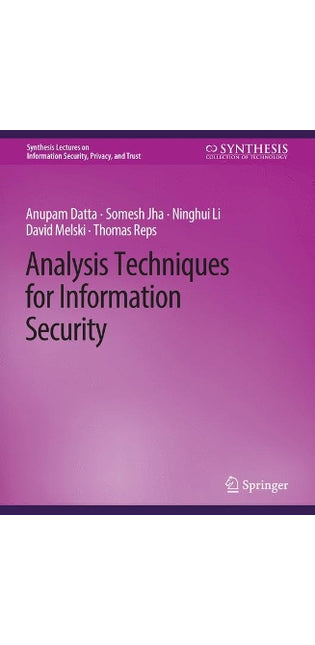
Analysis Techniques for Information Security
Increasingly our critical infrastructures are reliant on computers. We see examples of such infrastructures in several domains, including medical, power, telecommunications, and finance. Although automation has advantages, increased reliance on computers exposes our critical infrastructures to a wider variety and higher likelihood of accidental failures and malicious attacks. Disruption of services caused by such undesired events can have catastrophic effects, such as disruption of essential services and huge financial losses. The increased reliance of critical services on our cyberinfrastructure and the dire consequences of security breaches have highlighted the importance of information security. Authorization, security protocols, and software security are three central areas in security in which there have been significant advances in developing systematic foundations and analysis methods that work for practical systems. This book provides an introduction to this work, covering representative approaches, illustrated by examples, and providing pointers to additional work in the area. Table of Contents: Introduction / Foundations / Detecting Buffer Overruns Using Static Analysis / Analyzing Security Policies / Analyzing Security Protocols
R 1,422.00