


Search results for "9780241376942"
Items in stock - 4 working days delivery time

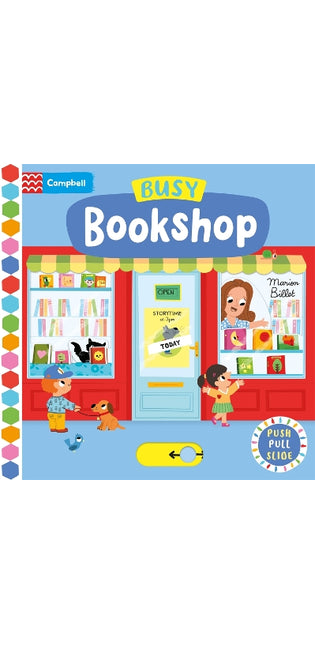
Busy Bookshop
Push, pull and slide the scenes to bring the Busy Bookshop to life! Slide the wheel for more illustrations, make a dinosaur pop up or turn the pages with a push.Perfect for toddlers who like to play as they read, this bright and colourful board book will delight little ones with gentle rhyming text, easy-to-handle mechanisms and wonderful illustrations by Marion Billet, which is part of the popular Busy Book series.Listen along to an audio recording of this story by scanning the QR code on the back cover.Discover more days out with Busy Airport, Busy Swimming and Busy Zoo.
R 230.00
Items we need to order for you
R 312.00
R 442.00
R 437.00
R 560.00
R 312.00
R 982.00
R 624.00
R 312.00
Book of Numbers
In the tradition of Chester Himes and Walter Mosley, Robert Deane Pharr's novel tells the tale of two black men, Dave and Blueboy, traveling waiters who establish themselves as numbers runners in a fictionalized Richmond of the 1930s. Published to great acclaim in 1969, The Book of Numbers centers on powerful themes of truth and illusion, myth and legend, and vividly conveys a sense of African American life on the periphery of white society. The new Virginia edition complements Pharr's text with an afterword by the Washington Post editor Jabari Asim.
R 827.00
R 698.00
R 349.00
R 405.00
R 624.00
R 592.00
R 1,296.00
R 536.00
R 489.00
R 622.00
R 312.00
R 631.00
R 692.00
R 395.00
R 281.00
R 842.00
Constructing Number
The book synergizes research on number across two disciplines—mathematics education and psychology. The underlying problem the book addresses is how the brain constructs number. The opening chapter frames the problem in terms of children’s activity, including mental and physical actions. Subsequent chapters are organized into sections that address specific domains of number: natural numbers, fractions, and integers. Chapters within each section address ways that children build upon biological primitives (e.g., subitizing) and prior constructs (e.g., counting sequences) to construct number. The book relies on co-authored chapters and commentaries at the end of each section to create dialogue between junior faculty and senior researchers, as well as between psychologists and mathematics educators. The final chapter brings this work together around the framework of children’s activity and additional themes that arise in the collective work. The book is aimed to appeal to mathematics educators, mathematics teacher educators, mathematics education researchers, educational psychologists, cognitive psychologists, and developmental psychologists.
R 7,481.00
R 242.00
R 311.00
R 4,957.00
R 312.00
R 2,803.00
R 830.00
Politics of Mathematics Education
The development of knowledge is never easy. One doesn’t want to go over old ground again, but yet one needs to establish the new in the context of the old. One is also anxious about the novelty of the ideas are they new enough, or are they too ‘way out’ to be acceptable? In some fields perhaps these criteria are less important than in others. In education, I sense that ‘novelty’ is a tricky criterion, varying in value from society to society. In some societies the new ideas have to justify their adoption in the face to the old, tried and tested ideas. (Better the devil you know than the devil you don’t!) In other societies the old ways have to justify their continuation in the face of the new, promising and exciting ideas. (I can’t find a good proverb for this! Perhaps proverbs are all about preserving the past?) In any case, some people will argue, there is nothing new to be said about education anyway the problems are the same and it is only the context which changes. Mellin Olsen develops the reader’s knowledge through this book in ways that are both novel and challenging. Their novelty is not in question, judging by reactions to them which vary from “they have nothing to do with mathematics education” to “they concern everything that is done in mathematics education”.
R 6,359.00
Books IV to VII of Diophantus’ Arithmetica
This edition of Books IV to VII of Diophantus' Arithmetica, which are extant only in a recently discovered Arabic translation, is the outgrowth of a doctoral dissertation submitted to the Brown University Department of the History of Mathematics in May 1975. Early in 1973, my thesis adviser, Gerald Toomer, learned of the existence of this manuscript in A. Gulchln-i Macanl's just-published catalogue of the mathematical manuscripts in the Mashhad Shrine Library, and secured a photographic copy of it. In Sep tember 1973, he proposed that the study of it be the subject of my dissertation. Since limitations of time compelled us to decide on priorities, the first objective was to establish a critical text and to translate it. For this reason, the Arabic text and the English translation appear here virtually as they did in my thesis. Major changes, however, are found in the mathematical com mentary and, even more so, in the Arabic index. The discussion of Greek and Arabic interpolations is entirely new, as is the reconstruction of the history of the Arithmetica from Diophantine to Arabic times. It is with the deepest gratitude that I acknowledge my great debt to Gerald Toomer for his constant encouragement and invaluable assistance.
R 4,863.00
R 558.00
R 764.00
R 2,179.00
R 279.00
R 1,070.00
R 406.00
R 1,026.00
R 2,803.00