Search results for "Christopher Catledge"
Items we need to order for you

R 524.00
R 296.00
R 820.00
Put on Your Boots and Go
Put On Your Boots and Go is a collection of four stories that span over 30 years of traipsing around in the backcountry. The love of the outdoors permeates these stories of decades-old friendships, miles and miles of trails walked, and shared challenges and accomplishments, both on and off the trail.
R 531.00
28 Dog Years
28 Dog Years is a reminiscence of another time and place. Set in the Mississippi Delta in the late 1950's and early 1960's, it is the story of a young boy, his grandparents, and the homely little dog that they all loved.
R 989.00
Put on Your Boots and Go
Put On Your Boots and Go is a collection of four stories that span over 30 years of traipsing around in the backcountry. The love of the outdoors permeates these stories of decades-old friendships, miles and miles of trails walked, and shared challenges and accomplishments, both on and off the trail.
R 1,153.00
R 540.00
28 Dog Years
28 Dog Years is a reminiscence of another time and place. Set in the Mississippi Delta in the late 1950's and early 1960's, it is the story of a young boy, his grandparents, and the homely little dog that they all loved.
R 390.00
R 622.93
R 2,595.00
R 305.00
R 3,029.00
R 305.00
R 489.00
Principal Characters
As the grandson of actress Ivy Close and son of director Ronald Neame (Straight from the Horse's Mouth; Scarecrow, 2003), Christopher Neame's roots in the film business were already firmly established by the time he joined the family profession. In his first memoir, Rungs on a Ladder, Neame gave readers an insider's look into a number of productions of the 1960s and 70s produced by Hammer Studios. Christopher followed this with A Take on British TV Drama, in which he recounted the challenges and rewards of working on some of the most distinguished works of British television, including The Flame Trees of Thika, Monsignor Quixote, and Danger: U.X.B. In Principal Characters, Neame fills in the gaps of his illustrious career by providing brief intimate portraits of the many important film figures he has worked with. In this charming collection of anecdotes, he asks and answers questions about the stars, who reveal both their carefree and vulnerable moments alike: Was Richard Harris really such a hell-raiser as a young man? What was Peter Sellers like to work with? How did Robert Mitchum find himself in trouble? How many faces did Alec Guinness have? What was behind Peter O'Toole and a bomb threat in Paris? Looking behind the camera lens, Neame captures director Karel Reisz (This Sporting Life) wearing a producer's hat, marvels at cinematographer Geoffrey Unsworth 'painting' Cabaret with light, discloses Kenneth Tynan's unusual predilection, and weighs in on the culinary skills of Ismail Merchant (A Room with a View). Throughout these accounts, Christopher looks both acutely and often amusingly at many who are household names, and when he feels it is appropriate to do so, he doesn't pull punches. This work is a fitting conclusion to an autobiographical "trilogy," and will be of interest to all those curious about the film industry and especially the stars and directors Christopher Neame has worked with over the years.
R 2,746.00
R 911.00
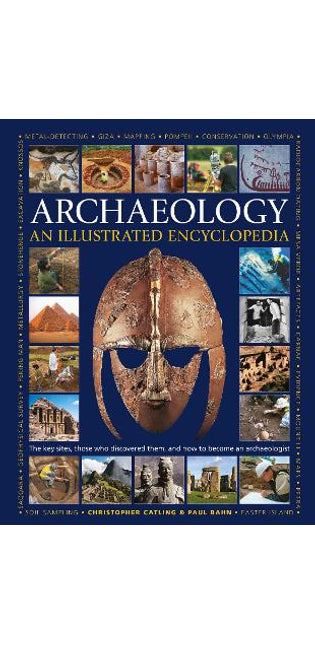
Illustrated Encyclopedia of Archaeology
A professional field guide and practical companion to archaeology, packed with information to take the amateur or student from beginner to advanced level. Features how-to photographic sequences of field surveys and step-by-step excavations, plus guidance on handling and recording finds and dating artefacts. Explores a wide range of the world’s most important archaeological sites, spanning every period. Includes fascinating profiles of some of the world’s most famous archaeologists, such as J.F Champollion, decoder of the Rosetta Stone, and Howard Carter, discoverer of Tutankhamen’s tomb. Authoritative but highly accessible text, illustrated with over 1200 photographs and site maps. The first part of the book explores the many fields of archaeology, from forensics applied to burial sites through to the deciphering of ancient languages. The techniques involved in an excavation are unravelled, from the initial surface sampling of a site to the post-excavation practice of dating finds and building matrices. The book then looks at the people who have been responsible for many of the most important discoveries in world archaeology, and the final section of the book is an overview ofthe world’s greatest archaeological sites broken down into sections on specific geographic regions.
R 619.00
Church History
The history of the Christian church is far more than a dull list of dates. This brief summary will whet your appetite to discover more about the story of Christianity.
R 592.29
Rungs on a Ladder
Rungs on a Ladder looks at part of the movie industry from a unique perspective. Christopher Neame, son of director Ronald, started his career (in the early 1960s) at the very bottom, but determinedly made his way to the top. Neame fondly recalls his learning years at Bray Studios and beyond. Simply and often amusingly, he recounts his days with Hammer Films and observes many of the characters both in front of and behind the camera—names synonymous with those classic tales of Gothic horror: director Terrence Fisher, producers Anthony Hinds, Michael Carreras and Anthony Nelson Keys, screenwriter/producer Jimmy Sangster, and of course, Peter Cushing and Christopher Lee. Along the way, he encounters those less obviously connected to Hammer like Joan Fontaine, Joseph Cotten, Norman Lloyd, and Bette Davis. Never the one to reserve his critical eye for others alone, Neame willingly says mea culpa when deserved. The book begins with his rude awakening to the "string and sealing wax" world of Dracula Prince of Darkness and follows his journey through sixteen subsequent productions including three Frankensteins, The Devil Rides Out (which American distributors thought was going to be a Western!), and a couple of Mummy films. Neame also shares stories of his participation in non-genre ventures like Quatermass and the Pit, The Anniversary, Demons of the Mind and Fear in the Night. Includes 16 pages of photos.
R 2,931.00
Winston Churchill
Winston Churchill has for decades been regarded as one of the greatest statesmen of the 20th century, not just in his home country Britain but in the USA as well, where he continues to be an inspiration to many to this day. In 2002 he was voted The Greatest Briton, and the 2016 movie The Darkest Hour continues his global iconic status as someone who stood up to tyranny in 1940, against all the odds, and prevailed. But while 1940 has deserved iconic status, Churchill’s 60 year political career saw as many downs as ups, disasters as well as triumphs, and had he died in 1939 he would, historians judge, have been seen as a failure not the hero he went on to become. So we need to see the whole of Churchill’s life to gain a proper perspective, and that is exactly what this book sets out to achieveIncludes a detailed chronology of Churchill’s life, family, and work.The A to Z section includes the major events, places, and people in Churchill’s life.The bibliography includes a list of publications concerning his life and work.The index thoroughly cross-references the chronological and encyclopedic entries.
R 2,198.00
Why Didn't Somebody Tell Me This Stuff?
3 million college degrees will be awarded this year. For these 3 million students and the millions more that will follow, great challenges await them. They will be challenged in finding a job. They will be challenged in obtaining a job. However, their greatest challenge will be learning how to "succeed" in that job. New employees must learn how to: assimilate into their new role as young professionals, navigate the inner workings of the corporate world, build a favorable image and reputation, create political capital and develop and leverage meaningful contacts. While thousands of books have been written with the aim toward helping someone find work and obtain work; this unique, enlightening and extremely valuable book takes a starkly different approach. "Why Didn't Somebody Tell Me This Stuff?" is written with the sole intent of helping one truly "succeed" in their career. This book is quite simply unlike any other career oriented resource available today.
R 548.00
If Memory Serves
The AIDS epidemic soured the memory of the sexual revolution and gay liberation of the 1970s, and prominent politicians, commentators, and academics instructed gay men to forget the sexual cultures of the 1970s in order to ensure a healthy future. But without memory there can be no future, argue Christopher Castiglia and Christopher Reed in this exploration of the struggle over gay memory that marked the decades following the onset of AIDS.Challenging many of the assumptions behind first-wave queer theory, If Memory Serves offers a new perspective on the emergence of contemporary queer culture from the suppression and repression of gay memory. Drawing on a rich archive of videos, films, television shows, novels, monuments, paintings, and sculptures created in the wake of the epidemic, the authors reveal a resistance among critics to valuing—even recognizing—the inscription of gay memory in art, literature, popular culture, and the built environment. Castiglia and Reed explore such topics as the unacknowledged ways in which the popular sitcom Will and Grace circulated gay subcultural references to awaken a desire for belonging among young viewers; the post-traumatic (un)rememberings of queer theory; and the generation of “ideality politics” in the art of Félix González-Torres, the film Chuck & Buck, and the independent video Video Remains. Inspired by Alasdair MacIntyre’s insight that “the possession of a historical identity and the possession of a social identity coincide,” Castiglia and Reed demonstrate that memory is crafted in response to inadequacies in the present—and therefore a constructive relation to the past is essential to the imagining of a new future.
R 824.00
R 367.00
R 456.00
Catawampus
catawampus: /kat-uh-wom-puh s/: Adj. 1: crooked; out of alignment 2: askew; awry No single word describes this collection of short stories better than the title itself: Catawampus. Told with Brandon Christopher's wry wit, unflinching humor and imaginative style, each story gives us a brief and sudden glimpse into the stranger side of ordinary lives. They beckon us to pull back the veneer of normalcy to dive headfirst into the odd, the eccentric, the heartbreaking, and the hilarious. From funeral crashers and Roman philosophers to feuding landlords and peculiar tea parties, Catawampus is a refreshing and strikingly original fiction collection.
R 553.00
R 586.00
Routledge Revivals: The Collected Poems of Christopher Smart (1949)
First published in 1949, this book presents the collected works of Christopher Smart, the eighteenth-century poet whose life has an attraction for the curioso of literature. There is the early marriage with Anne Vane, his secret marriage, eighteenth-century Cambridge life, the intrigues of Grub Street, and, finally, insanity and confinement in an asylum. Smart remains a strange, enigmatic figure, repulsive or attractive according to the temperament of the investigator. His poetry is not easy to disentangle from his character – egocentric, given to exhibitionism, childish, oscillating between the extremes of self-belittlement and self-glorification; but he has his own claim to fame. Few other poets match him in directness of expression. He is a poet with the eye of a painter, developed in an unusually high degree. He has a stereoscopic vision which makes the object leap to the eye, the painter’s sense of physical texture and his skill in composing a picture. Then again, there is his versatility. He practised almost every kind of poetry and gave to each kind his own personal inflection. It is the aim of this edition to present as complete a text as possible in the way that Smart himself would have seen it and, in giving some account of the poet’s life, to link his poetry with it. The book will be of interest to students of eighteenth-century literature and history.
R 2,388.98
Christopher Hitchens and His Critics
A provocative volume of the controversial radical thinkerChristopher Hitchens—political journalist, cultural critic, public intellectual and self-described contrarian—is one of the most controversial and prolific writers of his generation. His most recent book, God Is Not Great, was on the New York Times bestseller list in 2007 for months. Like his hero, George Orwell, Hitchens is a tireless opponent of all forms of cruelty, ideological dogma, religious superstition and intellectual obfuscation. Once a socialist, he now refers to himself as an unaffiliated radical. As a thinker, Hitchens is perhaps best viewed as post-ideological, in that his intellectual sources and solidarities are strikingly various (he is an admirer of both Leon Trotsky and Kingsley Amis) and cannot be located easily at any one point on the ideological spectrum. Since leaving Britain for the United States in 1981, Hitchens's thinking has moved in what some see as contradictory directions, but he remains an unapologetic and passionate defender of the Enlightenment values of secularism, democracy, free expression, and scientific inquiry. The global turmoil of the recent past has provoked intense dispute and division among intellectuals, academics, and other commentators. Hitchens's writing during this time, particularly after 9/11, is an essential reference point for understanding the genesis and meaning of that turmoil—and the challenges that accompany it. This volume brings together Hitchens's most incisive reflections on the war on terror, the war in Iraq, and the state of the contemporary Left. It also includes a selection of critical commentaries on his work from his former leftist comrades, a set of exchanges between Hitchens and various left-leaning interlocutors (such as Studs Terkel, Norman Finkelstein, and Michael Kazin), and an introductory essay by the editors on the nature and significance of Hitchens's contribution to the world of ideas and public debate. In response, Hitchens provides an original afterword, written for this collection. Whatever readers might think about Hitchens, he remains an intellectual force to be reckoned with. And there is no better place to encounter his current thinking than in this provocative volume.
R 1,509.00
R 487.00
Christopher Hitchens and His Critics
A provocative volume of the controversial radical thinkerChristopher Hitchens—political journalist, cultural critic, public intellectual and self-described contrarian—is one of the most controversial and prolific writers of his generation. His most recent book, God Is Not Great, was on the New York Times bestseller list in 2007 for months. Like his hero, George Orwell, Hitchens is a tireless opponent of all forms of cruelty, ideological dogma, religious superstition and intellectual obfuscation. Once a socialist, he now refers to himself as an unaffiliated radical. As a thinker, Hitchens is perhaps best viewed as post-ideological, in that his intellectual sources and solidarities are strikingly various (he is an admirer of both Leon Trotsky and Kingsley Amis) and cannot be located easily at any one point on the ideological spectrum. Since leaving Britain for the United States in 1981, Hitchens's thinking has moved in what some see as contradictory directions, but he remains an unapologetic and passionate defender of the Enlightenment values of secularism, democracy, free expression, and scientific inquiry. The global turmoil of the recent past has provoked intense dispute and division among intellectuals, academics, and other commentators. Hitchens's writing during this time, particularly after 9/11, is an essential reference point for understanding the genesis and meaning of that turmoil—and the challenges that accompany it. This volume brings together Hitchens's most incisive reflections on the war on terror, the war in Iraq, and the state of the contemporary Left. It also includes a selection of critical commentaries on his work from his former leftist comrades, a set of exchanges between Hitchens and various left-leaning interlocutors (such as Studs Terkel, Norman Finkelstein, and Michael Kazin), and an introductory essay by the editors on the nature and significance of Hitchens's contribution to the world of ideas and public debate. In response, Hitchens provides an original afterword, written for this collection. Whatever readers might think about Hitchens, he remains an intellectual force to be reckoned with. And there is no better place to encounter his current thinking than in this provocative volume.
R 3,149.00
R 717.73
Race and the Politics of Deception
What is the relationship between race and space, and how do racial politics inform the organization and development of urban locales?In Race and the Politics of Deception, Christopher Mele unpacks America’s history of dealing with racial problems through the inequitable use of public space. Mele focuses on Chester, Pennsylvania—a small city comprised of primarily low-income, black residents, roughly twenty miles south of Philadelphia. Like many cities throughout the United States, Chester is experiencing post-industrial decline. A development plan touted as a way to “save” the city, proposes to turn one section into a desirable waterfront destination, while leaving the rest of the struggling residents in fractured communities. Dividing the city into spaces of tourism and consumption versus the everyday spaces of low-income residents, Mele argues, segregates the community by creating a racialized divide. While these development plans are described as socially inclusive and economically revitalizing, Mele asserts that political leaders and real estate developers intentionally exclude certain types of people—most often, low-income people of color.Race and the Politics of Deception provides a revealing look at how our ever-changing landscape is being strategically divided along lines of class and race.
R 1,199.00
R 363.00
Practices of Hope
Offers a positive approach to literary criticism At a moment when the “hermeneutics of suspicion” is under fire in literary studies, The Practices of Hope encourages an alternative approach that, rather than abandoning critique altogether, relinquishes its commitment to disenchantment. As an alternative, Castiglia offers hopeful reading, a combination of idealism and imagination that retains its analytic edge yet moves beyond nay-saying to articulate the values that shape our scholarship and creates the possible worlds that animate genuine social critique. Drawing on a variety of critics from the Great Depression to the Vietnam War, from Granville Hicks and Constance Rourke to Lewis Mumford, C.L.R. James, Charles Feidelson, and Richard Poirier, Castiglia demonstrates that their criticism simultaneously denounced the social conditions of the Cold War United States and proposed ideal worlds as more democratic alternatives. Organized around a series of terms that have become anathema to critics—nation, liberalism, humanism, symbolism—The Practices of Hope shows how they were employed in criticism’s “usable past” to generate an alternative critique, a practice of hope.
R 2,884.00
R 1,138.30
R 493.61
R 1,139.00
R 336.00
Practices of Hope
Offers a positive approach to literary criticism At a moment when the “hermeneutics of suspicion” is under fire in literary studies, The Practices of Hope encourages an alternative approach that, rather than abandoning critique altogether, relinquishes its commitment to disenchantment. As an alternative, Castiglia offers hopeful reading, a combination of idealism and imagination that retains its analytic edge yet moves beyond nay-saying to articulate the values that shape our scholarship and creates the possible worlds that animate genuine social critique. Drawing on a variety of critics from the Great Depression to the Vietnam War, from Granville Hicks and Constance Rourke to Lewis Mumford, C.L.R. James, Charles Feidelson, and Richard Poirier, Castiglia demonstrates that their criticism simultaneously denounced the social conditions of the Cold War United States and proposed ideal worlds as more democratic alternatives. Organized around a series of terms that have become anathema to critics—nation, liberalism, humanism, symbolism—The Practices of Hope shows how they were employed in criticism’s “usable past” to generate an alternative critique, a practice of hope.
R 1,393.00
R 912.00
Ideographic Modernism
Ideographic Modernism offers a critical account of the ideograph (Chinese writing as imagined in the West) as a modernist invention. Through analyses of works by Claudel, Pound, Kafka, Benjamin, Segalen, and Valery, among others, Christopher Bush traces the interweaving of Western modernity's ethnographic and technological imaginaries, in which the cultural effects of technological media assumed "Chinese" forms, even as traditional representations of "theOrient" lived on in modernist-era responses to media. The book also makes a methodological argument, demonstrating new ways of recovering the generally overlooked presence of China in the text of Western modernism.
R 1,574.47
R 520.00