Search results for "Constantine Contogenis"
Items we need to order for you

R 539.00
R 764.00
Constantine
This text examines the reign of Constantine, the first Christian emperor and the founder of Constantinople from a variety of angles; historical, historiographical and mythical. The volume examines the circumstances of Constantine's reign and the historical problems surrounding them, the varied accounts of Constantine's life and the plethora of popular medieval legends surrounding the reign, to reveal the different visions and representations of the emperor from saint and patron of the Western church to imperial prototype. It presents a comprehensive study of this important and controversial emperor.
R 9,371.91
Constantine
Drawing on recent scholarly advances and new evidence, Timothy Barnes offers a fresh and exciting study of Constantine and his life. First study of Constantine to make use of Kevin Wilkinson's re-dating of the poet Palladas to the reign of Constantine, disproving the predominant scholarly belief that Constantine remained tolerant in matters of religion to the end of his reignClearly sets out the problems associated with depictions of Constantine and answers them with great clarityIncludes Barnes' own research into the marriage of Constantine's parents, Constantine's status as a crown prince and his father's legitimate heir, and his dynastic plansHonorable Mention for 2011 Classics & Ancient History PROSE award granted by the Association of American Publishers
R 1,057.00
R 1,018.72
R 961.00
R 1,057.00
R 1,057.00
Sons of Constantine, AD 337-361
This edited collection focuses on the Roman empire during the period from AD 337 to 361. During this period the empire was ruled by three brothers: Constantine II (337-340), Constans I (337-350) and Constantius II (337-361). These emperors tend to be cast into shadow by their famous father Constantine, the first Christian Roman emperor (306-337), and their famous cousin Julian, the last pagan Roman emperor (361-363). The traditional concentration on the historically renowned figures of Constantine and Julian is understandable but comes at a significant price: the neglect of the period between the death of Constantine and the reign of Julian and of the rulers who governed the empire in this period. The reigns of the sons of Constantine, especially that of the longest-lived Constantius II, mark a moment of great historical significance. As the heirs of Constantine they became the guardians of his legacy, and they oversaw the nature of the world in which Julian was to grow up. The thirteen contributors to this volume assess their influence on imperial, administrative, cultural, and religious facets of the empire in the fourth century.
R 3,876.82
Reign of Constantine, 306–337
This book explores the reign of Constantine the Great (306–337) and, more generally, the political history of the third century, thus putting Constantine's career and many of his decisions in context. It traces events under the first Tetrarchy and then explores Constantine's rise to power, his rule and reforms, and continuity and change with regard to his predecessors. It considers how he was able to transform the empire and establish his own dynasty, highlighting his political and military prowess, and therefore provides an essential overview of the political history of the period.
R 4,960.40
R 968.05
R 241.00
Constantine the Emperor
No Roman emperor had a greater impact on the modern world than did Constantine. The reason is not simply that he converted to Christianity, but that he did so in a way that brought his subjects along after him. Indeed, this major new biography argues that Constantine's conversion is but one feature of a unique administrative style that enabled him to take control of an empire beset by internal rebellions and external threats by Persians and Goths. The vast record ofConstantine's administration reveals a government careful in its exercise of power but capable of ruthless, even savage, actions. Constantine executed (or drove to suicide) his father-in-law, two brothers-in-law, his eldest son, and his once beloved wife. An unparalleled general throughout his life,planning a major assault on the Sassanian Empire in Persia even on his deathbed. Alongside the visionary who believed that his success came from the direct intervention of his God resided an aggressive warrior, a sometimes cruel partner, and an immensely shrewd ruler. These characteristics combined together in a long and remarkable career, which restored the Roman Empire to its former glory. Beginning with his first biographer Eusebius, Constantine's image has been subject to distortion. More recent revisions include John Carroll's view of him as the intellectual ancestor of the Holocaust (Constantine's Sword) and Dan Brown's presentation of him as the man who oversaw the reshaping of Christian history (The Da Vinci Code). In Constantine the Emperor, David Potter confronts each of these skewed and partial accounts to provide the most comprehensive, authoritative, and readableaccount of Constantine's extraordinary life.
R 869.61
R 181.00
Byzantine Constantinople
One of the most detailed works describing the walls of this renowned city, Alexander Van Milligen's Byzantine Constantinople: The Walls of the City and Adjoining Historical Sites (1899) is of use to anyone interested in Byzantine architecture, the Byzantine Empire, and medieval history more generally. Van Milligen uses his expertise as a historian who had lived and taught in Constantinople to provide a detailed account of the Byzantine capital before it fell in 1453. Complete with meticulous verbal descriptions, illustrations, maps and plans, Van Milligen combines historical accounts with physical surveys, tracing Constantinople's expansion. He describes how the city spread and how the walls adapted, pausing to outline the importance of certain structures within the city, and of the hierarchy of gates within the walls. He also includes a table of emperors to assist the general reader, while his painstaking detail makes the book useful to professional scholars as well.
R 2,619.93
Roman Revolution of Constantine
The reign of the emperor Constantine (306–337) was as revolutionary for the transformation of Rome's Mediterranean empire as that of Augustus, the first emperor three centuries earlier. The abandonment of Rome signaled the increasing importance of frontier zones in northern and central Europe and the Middle East. The foundation of Constantinople as a new imperial residence and the rise of Greek as the language of administration previewed the establishment of a separate eastern Roman empire. Constantine's patronage of Christianity required both a new theology of the Christian Trinity and a new political image of a Christian emperor. Raymond Van Dam explores and interprets each of these events. His book complements accounts of the role of Christianity by highlighting ideological and cultural aspects of the transition to a post-Roman world.
R 5,187.55
Lives of Saint Constantina
Constantina, daughter of the fourth-century emperor Constantine who so famously converted to Christianity, deserves a place of her own in the history of Christianity. As both poet and church-builder, she was an early patron of the Roman cult of the virgin martyr Agnes and was buried ad sanctam in a sumptuously mosaicked mausoleum that still stands. What has been very nearly forgotten is that the twice-married Constantina also came to be viewed as a virginsaint in her own right, said to have been converted and healed of leprosy by Saint Agnes. This volume publishes for the first time critical editions and English translations of three Latin hagiographies dedicated to the empress, offering an introduction and commentaries to contextualize these virtually unknownworks. The earliest and longest of them is the anonymous Life of Saint Constantina likely dating to the mid or late sixth century, reflecting a female monastic setting and featuring both a story of pope Silvester's instruction of Constantina and a striking dialogue between Constantina and twelve virgins who offer speeches in praise of virginity as the summum bonum. A second, slightly later work, On the Feast of Saint Constantia (the misnaming of the saint reflecting commonconfusion), is a more streamlined account apparently tailored for liturgical use in early seventh-century Rome; this text is reworked and expanded by the twelfth-century Roman scholar Nicolaus Maniacoria in his Life of the Blessed Constantia, including a question-and-answer dialogue between Constantina and her twovirginal charges Attica and Artemia. These works will be of great interest to students of late ancient and medieval saints' cults, hagiography, monasticism, and women's history.
R 8,189.00
R 2,316.00
Constantine the Great
Roman Emperor Constantine is one of the most momentous figures in the history of Christianity, a ruler whose conversion turned the cult of Jesus into a world religion. Classical scholar Baker tells of the changing Roman world in which Constantine rose to power—an empire where feudalism was replacing the old senatorial government and the lands of the empire were split into two regions. It was also a place where customs from the East were replacing the old Roman values, preparing the way for the Byzantine Empire. Baker describes Constantine's unique conversion (which apparently did not prevent him from sacrificing to idols), his wars to control first the Roman army and then the Germans and the lands of Asia Minor, and finally the founding of Constantinople and the establishment of the monarchial system that dominated Europe for over a thousand years.
R 598.59
R 1,356.00
R 1,658.00
R 1,410.00
R 672.00
R 1,365.01
R 1,827.00
Cambridge Companion to the Age of Constantine
The Cambridge Companion to the Age of Constantine offers students a comprehensive one-volume survey of this pivotal emperor and his times. Richly illustrated and designed as a readable survey accessible to all audiences, it also achieves a level of scholarly sophistication and a freshness of interpretation that will be welcomed by experts. The volume is divided into five sections that examine political history, religion, social and economic history, art and foreign relations during the reign of Constantine, who steered the Roman Empire on a course parallel with his own personal development. Each chapter examines the intimate interplay between emperor and empire, and between a powerful personality and his world. Collectively, they show how both were mutually affected in ways that shaped the world of Late Antiquity and even affect our own world today. This edition has been revised, the notes and bibliography have been updated and a new preface has been added.
R 5,142.54
R 652.32
Roman Revolution of Constantine
The reign of the emperor Constantine (306–337) was as revolutionary for the transformation of Rome's Mediterranean empire as that of Augustus, the first emperor three centuries earlier. The abandonment of Rome signaled the increasing importance of frontier zones in northern and central Europe and the Middle East. The foundation of Constantinople as a new imperial residence and the rise of Greek as the language of administration previewed the establishment of a separate eastern Roman empire. Constantine's patronage of Christianity required both a new theology of the Christian Trinity and a new political image of a Christian emperor. Raymond Van Dam explores and interprets each of these events. His book complements accounts of the role of Christianity by highlighting ideological and cultural aspects of the transition to a post-Roman world.
R 1,788.92
R 1,053.12
R 1,481.31
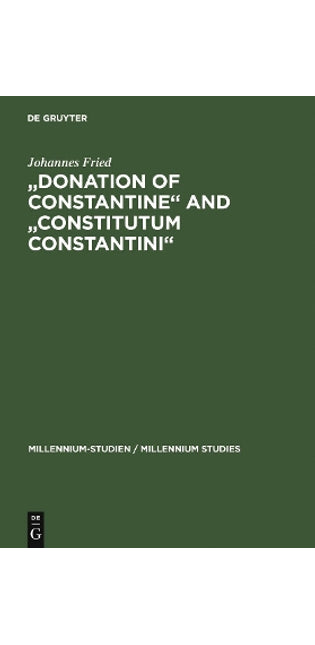
"Donation of Constantine" and "Constitutum Constantini"
The Donation of Constantine is the most outrageous and powerful forgery in world history. The question of its precise time of origin alone kept generations of researchers occupied. But, what exactly is the Donation of Constantine? To find the answer, it is necessary to approach the question on two different semantic levels: First, as the Constitutum Constantini, a fictitious privilege, in which, among other things, rights and presents were bestowed on the catholic church by a grateful Emperor Konstantin. Secondly, as a reflection of the Middle Age mindset, becoming part of the culture landscape midway through 11th century A.D. The author not only reinterprets the origin of this forgery (i.e. puts it down to the Franks’ opposition of Emperor Louis the Pious), but retells, as well, the history of its misinterpretation since the High Middle Ages. In an appendix, all relevant texts are printed in the original language, an English translation is provided.
R 5,266.47
R 1,175.33
R 767.00
R 1,331.91
R 564.15
Reign of Constantius II
Constantius II, son of Constantine the Great, ruled the Roman Empire between 337 and 361 CE. Constantius’ reign is characterised by a series of political and cultural upheavals and is rightly viewed as a time of significant change in the history of the fourth century. Constantius initially shared power with his brothers, Constantine II and Constans, but this arrangement lasted a short period of time before Constantine II was killed in a contest over authority by Constans. Further threats to the stability of the empire arose with the usurpation of the ambitious Roman general Magnentius between 350 and 353, and additional episodes of imperial instability occurred as Constantius’ relations with his junior Caesars, Gallus and Julian, deteriorated, the latter to the point where civil war would have been on the cards once again if Constantius had not died on 3 November 361. This book examines the dynastic, political and cultural impact of Constantius' reign as a member of the Constantinian family on the later empire, first as a joint ruler with his brothers and then as sole Augustus. The chapters investigate the involvement of Constantius in the imperial, administrative, legal, religious and cultural life of the Roman Empire in the fourth century. Constantius’ handling of various threats to Roman hegemony such as the ambitions of the neighbouring Sasanian Empire, and his relationships with Gallus and with Julian are explored. The book’s analysis is guided by the epigraphic, iconographic, literary and legal evidence of the Roman and Byzantine periods but it is not a conventional imperial ‘biography’. Rather, it examines the figure of Constantius in light of the numerous historiographical issues surrounding his memorialisation in the historical and literary sources, for instance as ‘Arian’ tyrant or as internecine murderer. The over-arching aim is to investigate power in the post-Constantine period, and the way in which imperial and episcopal networks related to one another with the ambition of participating in the exercise of power. The Reign of Constantius II will appeal to those interested in the Later Roman Empire, the Constantinian imperial family, Roman-Sasanian relations, and the role of religion in shaping imperial dynamics with Christianity.
R 9,974.07