Search results for "Defilippi"
Items we need to order for you

R 306.00
R 306.00
R 367.00
R 367.00
R 333.00
R 306.00
R 306.00
R 306.00
R 336.00
R 424.00
R 550.00
R 397.00
R 611.00
R 306.00
R 367.00
R 306.00
R 339.00
R 306.00
R 967.60
Signal Transduction by Integrins
Summarizes the vast available literature on the cell surface receptors for matrix proteins, now known to function in interactions between the cell and the matrix and in the adhesion between cells. Covers general aspects of integrin structure and function, several distinct pathways involved in the transmission of the signal from the membrane to the
R 4,637.97
R 244.00
R 636.00
R 470.00
De Filippo Four Plays
Plays by one of Italy's greatest dramatists Eduardo de Filippo was one of Italy's leading popular dramatists, a fearless social critic, a supreme man of the theatre, and a humane and compassionate writer. The four plays in this volume present different facets of his prolific output, which focused on the lives of the Neapolitan people, their dubious cunning nourished by centuries of hunger, their fantasies and their love of life. The Local Authority, Grand Magic and Filumena Marturano are translated by Carlo Ardito, and Napoli Milionaria was translated by Peter Tinniswood for the Royal National Theatre's production in 1991.
R 1,006.00
R 458.00
R 1,125.47
R 428.00
Filippino Lippi and Rome
A reconsideration of Filippino Lippi’s transformative Roman period and the ensuing evolution of his innovative style, as reflected in his Holy Family tondo in Cleveland—a masterpiece that exemplifies this pivotal phase in his career Between 1488 and 1493, leading Florentine artist Filippino Lippi (ca. 1457–1504) relocated to Rome to complete his celebrated frescoes in the funerary chapel of Neapolitan cardinal Oliviero Carafa in the major Dominican church of Santa Maria Sopra Minerva. During this time, Filippino also painted a magnificent tondo for Carafa: The Holy Family with Saint John the Baptist and Saint Margaret. Focusing on this seminal work in his oeuvre, Filippino Lippi and Rome traces the arc of the painter’s artistic practice before, during, and after his Roman period, illuminating the evolution of his processes and iconographic ingenuities. This in-depth study presents new scholarship on the inspiration Filippino found in the Eternal City and how The Holy Family tondo—the only known independent work produced by Filippino in Rome—influenced artists from Raffaellino del Garbo to Jan Gossaert to Leonardo da Vinci. Moreover, the essays and catalogue entries in this volume draw on recent technical analyses that had, for the first time, revealed the tondo’s underdrawing and pentimenti, shedding new light on Filippino’s painting techniques. These texts are accompanied by a chronicle of the work’s rediscovery at the start of the nineteenth century and the dramatic turn of events that led to its acquisition by the Cleveland Museum of Art in 1932. Distributed for the Cleveland Museum of Art Exhibition Schedule: Cleveland Museum of Art (November 30, 2025–February 22, 2026)
R 1,222.00
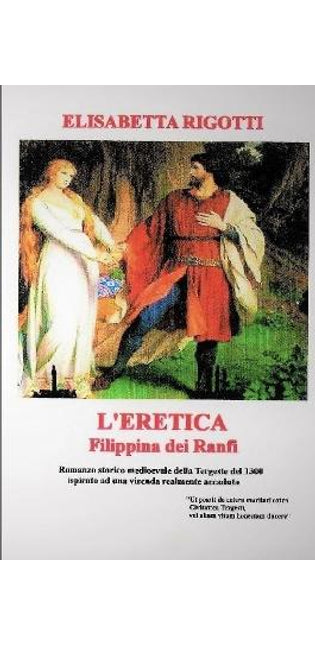
"L'eretica Filippina dei Ranfi"
Filippina dei Ranfi aveva solo tre anni nel 1313 quando venne nascosta nel "Monasterium Santa Maria Celle Tergesti" di San Giusto a Tergeste per sottrarla alle maglie dell'Inquisizione. Era l'unica sopravvissuta allo sterminio della nobile Casata dei Reifenberg, vivente entro le mura certamente fino all'anno 1333 quando negli Statuti apparve una legge pietosa per la povera giovane. La sua esistenza si consumo entro le mura di quel cenobio governato da una Abbadessa di nobile stirpe Carinziana imparentata con la sua famiglia. La ragazza conobbe ugualmente l'amore del giovane Johann della Torre che cerco di sottrarla alle persecuzioni dell'Inquisizione. Ne scaturisce una proposta d'amore inaccettabile per la morale del tempo; che pur tuttavia innesca il tormento della passione e la conseguente repressione. Dopo aver svelato l'enigma relativo al Templare Marcus Ranfo, l'Autrice vuole dare un'ulteriore testimonianza della storia di quella giovinetta pure essa sepolta nella dimenticanza dei secoli passati.
R 645.00
R 1,652.41
R 748.00
R 531.00
R 567.00
Filippino Lippi
Filippino Lippi (1457–1504), although one of the most original and gifted artists of the Florentine renaissance, has attracted less scholarly attention than his father Fra Filippo Lippi or his master Botticelli, and very little has been published on him in English. This book, authored by leading Renaissance art historians, covers diverse aspects of Filippino Lippi’s art: his role in Botticelli’s workshop; his Lucchese patrons; his responses to Netherlandish painting; portraits; space and temporality; the restoration of the Strozzi Chapel in Santa Maria Novella; his immediate artistic legacy; and, finally, his nineteenth-century critical reception.The fourteen chapters in this volume were originally presented at the international conference Filippino Lippi: Beauty, Invention and Intelligence, held at the Dutch University Institute (NIKI) in Florence in 2017. See inside the book.
R 8,314.00
R 1,441.18
R 1,212.06