Search results for "Patrick Collier"
Items we need to order for you

Modernism on Fleet Street
British modernism came of age at a time of great cultural anxiety about the state of journalism. The new newspapers, with their brief, flashy articles, striking visuals, hyperbolic headlines, and sensational news, stood at the center of debates about reading in the period, seeming to threaten the viability of representative democracy, the health and vitality of the language, and the very future of literature itself. Patrick Collier's study brings an impressive array of archival research to his exploration of modernism's relationship to the newspaper press. People who sought to make their way as writers could neither remain neutral on this issue nor abandon journalism, which offered an irreplaceable source of income and self-advertisement. Collier discusses five modern writers-T. S. Eliot, James Joyce, Virginia Woolf, Rebecca West, and Rose Macaulay-showing how their work takes part in contemporary debates about journalism and examining the role journalism played in establishing their careers. In doing so, he uncovers tensions and contradictions inherent in the identity of the 'serious artist' who relied on the ephemeral forms of journalism for money and reputation.
R 9,313.80
Teaching Literature in the Real World
Offering guidance and inspiration to English literature instructors, this book faces the challenges of real-life teaching and the contemporary higher education classroom head on. Whether you're teaching in a community college, a state school, a liberal arts college, or an Ivy League institution, this book offers valuable advice and insights which will help you to motivate, incentivize and inspire your students. Addressing questions such as: 'how do you articulate the value of literary education to students (and administrators, and parents)?', 'how can a class session with a fatigued and underprepared group of students be made productive?', and 'how do you incentivize overscheduled students to read energetically in preparation for class?', this book answers these universal quandaries and more, providing a usable philosophy of the value of literary education, articulating a set of learning goals for students of literature, and offering plenty of practical advice on pedagogical strategies, day-to-day coping, and more. In its sum, Teaching Literature in the Real World constitutes an experience-based philosophy of teaching literature that is practical and realistic, oriented towards helping students develop intellectual skills, and committed to pedagogy built on explicit, detailed, and observable learning objectives.
R 2,796.00
Teaching Literature in the Real World
Offering guidance and inspiration to English literature instructors, this book faces the challenges of real-life teaching and the contemporary higher education classroom head on. Whether you're teaching in a community college, a state school, a liberal arts college, or an Ivy League institution, this book offers valuable advice and insights which will help you to motivate, incentivize and inspire your students. Addressing questions such as: 'how do you articulate the value of literary education to students (and administrators, and parents)?', 'how can a class session with a fatigued and underprepared group of students be made productive?', and 'how do you incentivize overscheduled students to read energetically in preparation for class?', this book answers these universal quandaries and more, providing a usable philosophy of the value of literary education, articulating a set of learning goals for students of literature, and offering plenty of practical advice on pedagogical strategies, day-to-day coping, and more. In its sum, Teaching Literature in the Real World constitutes an experience-based philosophy of teaching literature that is practical and realistic, oriented towards helping students develop intellectual skills, and committed to pedagogy built on explicit, detailed, and observable learning objectives.
R 823.00
R 468.00
R 555.00
R 352.48
R 1,041.00
R 748.00
R 1,403.40
R 780.00
R 395.00
R 474.00
R 336.00
My Father’s Watch
The intensely moving memoir of Patrick Maguire, one of the ‘Maguire Seven’, wrongly imprisoned as a teenager for making bombs for the IRA. On the night of October 5 1974, an IRA unit left bombs in two Guildford pubs: five people were killed. On the night of December 3 1974, on the strength of fabricated testimony extracted under duress from Paul Hill and Gerard Conlon (whom the police mistakenly believed had planted the Guildford bombs), Anne and Paddy Maguire, two of their four children, Vincent and Patrick, plus other family members and friends, a total of seven in all, were arrested at their home in West London. On 22 October 1975, the Guildford Four were wrongfully convicted of bombing the two pubs in Guildford. On 4 March 1976, the Maguire Seven, as they had become known, were found guilty of possession of the nitro-glycerine used in those bombings. On 19 October 1989, the verdicts on the Guildford Four were quashed. On 26 June 1991, the convictions against the Maguire Seven of handling explosives were quashed and just over a year later, Sir John May, after producing a report on the Maguire Seven case, described it as the worst miscarriage of justice he had ever seen. Behind these dates lie human stories – ‘My Father's Watch’ tells that of Patrick, who was the youngest of the accused, at fourteen years old. He was sentenced to four years and when he came out he had no home and no family, as both of his parents were still in jail. This book takes us through Patrick's entire life, from his working-class childhood in West London to the difficult life he has led since prison, the roots of which go back to the wrongful convictions and the destruction of the family that followed. Patrick Maguire and the novelist Carlo Gébler have written ‘My Father's Watch’ jointly. It is not a ghosted work – told in Patrick's own voice, it is a lucid and inspiring account of one individual's experience of an appalling injustice, as well as a reminder, as the war against terror ratchets up, of just how much harm a state can do to its own innocent citizens in the name of security.
R 313.00
R 1,324.87
R 957.15
R 822.86
R 816.08
Plundered Planet
Paul Collier's The Bottom Billion was greeted as groundbreaking when it appeared in 2007, winning the Estoril Distinguished Book Prize, the Arthur Ross Book Award, and the Lionel Gelber Prize. Now, in The Plundered Planet, Collier builds upon his renowned work on developing countries and the world's poorest populations to confront the global mismanagement of natural resources. Proper stewardship of natural assets and liabilities is a matter of planetary urgency: natural resources have the potential either to transform the poorest countries or to tear them apart, while the carbon emissions and agricultural follies of the developed world could further impoverish them. The Plundered Planet charts a course between unchecked profiteering on the one hand and environmental romanticism on the other to offer realistic and sustainable solutions to dauntingly complex issues. Grounded in a belief in the power of informed citizens, Collier proposes a series of international standards that would help poor countries rich in natural assets better manage those resources, policy changes that would raise world food supply, and a clear-headed approach to climate change that acknowledges the benefits of industrialization while addressing the need for alternatives to carbon trading. Revealing how all of these forces interconnect, The Plundered Planet charts a way forward to avoid the mismanagement of the natural world that threatens our future.
R 684.00
R 702.00
Bottom Billion
Global poverty is falling rapidly, but in around fifty failing states, the world's poorest people face a tragedy that is growing inexorably worse. This bottom billion live on less than a dollar a day and while the rest of the world moves steadily forward, this forgotten billion is left further and further behind with potentially serious consequences not only for them but for the stability of the rest of the world. Why do the states these people live in defy all the attempts of the international aid community to help them? Why does nothing seem to make a difference? In The Bottom Billion, Paul Collier pinpoints the issues of corruption, political instability and resource management that lie at the root of the problem. He describes the battle raging in these countries between corrupt leaders and would-be reformers and the factors such as civil war, dependence on the export of natural resources and lack of good governance that trap them into a downward spiral of economic and social decline.Collier addresses the fact that conventional aid has been unable to tackle these problems and puts forward a radical new plan of action including a new agenda for the G8 which includes more effective anti-corruption measures, preferential trade policies and where necessary direct military intervention. All of these initiatives are carefully designed to help the forgotten bottom billion, one of the key challenges facing the world in the twenty first century.
R 1,219.85
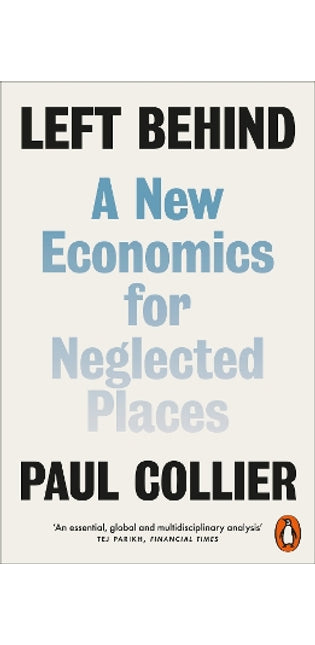
Left Behind
A FINANCIAL TIMES BEST BOOK OF 2024The world-renowned economist offers a ground-breaking new vision for inclusive prosperityLeft behind places can be found in prosperous countries—from South Yorkshire, integral to the industrial revolution and now England’s poorest county, to Barranquilla, once Colombia’s portal to the Caribbean and now struggling. More alarmingly, the poorest countries in the world are diverging further from the rest of humanity than they were at the start of this century. Why have these places fallen behind? And what can we do about it?World-renowned development economist Paul Collier has spent his life working in neglected communities. In this book he offers his candid diagnosis of why some regions and countries are failing, and a new vision for how they can catch up. Collier lays the blame for widening inequality on stale economic orthodoxies that prioritize market forces to revive left behind regions, and on the arrogant, hands-off and one-size fits all approach of centralized bureaucracies like the UK Treasury. As a result, Collier argues, the UK has become the most unequal and unfair society in the western world.Yet the core message of Left Behind is hopeful: bringing together encouraging case studies of recovery from around the world, Collier shows how renewal is achievable through a combination of collective learning, moral leadership and local agency. With keen insight, he draws lessons from such seemingly disparate fields as behavioural psychology, evolutionary biology and moral philosophy to share a bold, galvanizing vision for a more inclusive, prosperous world.
R 402.00
From Cranmer to Sancroft
Patrick Collinson is the leading historian of English religion in the years after the Reformation. The topics covered by this collection of essays ranges from Thomas Cranmer, who was burnt at the stake after repeated recantations in 1556, to William Sancroft, the only other post-Reformation archbishop of Canterbury to have been deprived of office. Patrick Collinson's work explores the complex interactions between the inclusive and exclusive tendencies in English Protestantism, focusing both on famous figures, such as John Foxe and Richard Hooker, and on the individual reactions of lesser figures to the religious challenges of the time. Two themes throughout are the importance of the Bible and the emergence of Puritanism inside the Church of England.
R 2,563.00
Secret of the Ages: And Other Essential Works
Robert Collier taught millions of people how to build a life of more - more success, more achievement, more prosperity - by tapping into the limitless power of the human mind. The Secret of the Ages contains three of Collier’s most powerful books combined in one volume:The Secret of the AgesRichest Within Your ReachThe Secret of GoldThe Secret of the Ages is part of The Library of Spiritual Wisdom, a beautifully designed series of curated classics written by some of the greatest spiritual teachers of all time. With books covering topics ranging from prosperity and motivation to the occult and metaphysical thought, The Library of Spiritual Wisdom is a definitive collection of texts from some of the most revolutionary thought leaders of the last two centuries and belongs on the shelves of home libraries everywhere.
R 570.00
Boy
This second collection, a follow-up to Patrick Phillips' award-winning debut, navigates the course of the male experience, and particularly young fatherhood. Like Virgil's Aeneas, the book's central figure is in the middle time of life, a grown man with an aging father on his shoulders and a young son at his hand. Phillips' plainspoken and moving lyrics add an important voice to the poetry of home as he struggles to reconcile fatherhood and boyhood, present and past, and the ache of loving what must be lost.'In sparse, deft, and elegant language, Phillips's remarkable second book of poems, ""Boy"", places the poet midway between the lives of his parents and the lives of his children, where 'the endless dream / of childhood' has given way to the reality that 'whole human beings / sprang from us.' From this vantage point, he celebrates the wonderful simultaneity of experience that allows him to be, all at once, father, son, and boy' - Michael Collier, author of ""Dark Wild Realm"".Patrick Phillips' first book, ""Chattahoochee"", was selected by Alice Quinn, Robert Wrigley, and Robert Pinsky for the 2005 Kate Tufts Discovery Award and also received a ""Discovery""/The Nation Prize from the Unterberg Poetry Center. He has been a Fulbright Scholar at the University of Copenhagen, and his translations of the Danish poet Paul la Cour received the Sjoberg Translation Prize of the American-Scandinavian Foundation. He is currently an assistant professor of English at Drew University.
R 501.00
Masculinity, Law and Family
"Masculinity, Law and Family" examines the construction of masculinity in a variety of areas of law pertaining to the family. Throughout, Richard Collier integrates recent theoretical developments in legal studies with a social theory of gender, the family and the social construction of masculinity. After an overview of theoretical positions and a critique of traditional legal theory, Richard Collier focuses on the legal regulation of homosexuality and transsexualism to show how confined the view of masculine sexuality is in legal discourse. These arguments are further elaborated in a discussion of non-consummation, adultery and divorce, as well as fatherhood and paternity.
R 3,005.61
R 1,269.00
R 385.00
R 992.00
R 690.39
R 502.00
R 458.00
R 1,174.00
R 613.48
R 1,432.00
Bottom Billion
In this elegant and impassioned synthesis from one of the world's leading experts on Africa and poverty, economist Paul Collier writes persuasively that although nearly five billion of the world's people are beginning to climb from desperate poverty and to benefit from globalization's reach to developing countries, there is a "bottom billion" of the world's poor whose countries, largely immune to the forces of global economy, are falling farther behind and are indanger of falling apart, separating permanently and tragically from the rest of the world. Collier identifies and explains the four traps that prevent the homelands of the world's billion poorest people from growing and receiving the benefits of globalization - civil war, the discovery and export ofnatural resources in otherwise unstable economies, being landlocked and therefore unable to participate in the global economy without great cost, and finally, ineffective governance. As he demonstrates that these billion people are quite likely in danger of being irretrievably left behind, Collier argues that we cannot take a "headless heart" approach to these seemingly intractable problems; rather, that we must harness our despair and our moral outrage at these inequities to a reasoned andthorough understanding of the complex and interconnected problems that the world's poorest people face.
R 433.00
R 773.00
R 856.00