



Search results for "Pybus"
Items in stock - 4 working days delivery time

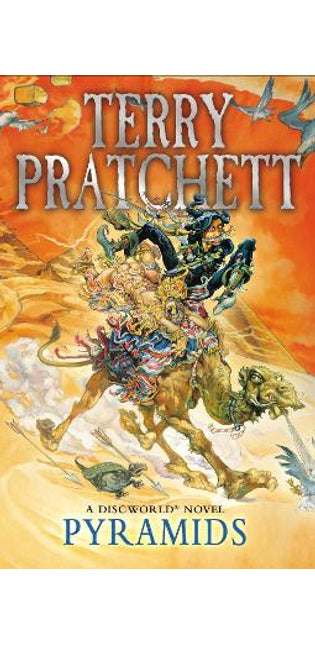
Pyramids
'Look after the dead', said the priests, 'and the dead will look after you.'Wise words in all probability, but a tall order when, like Teppic, you have just become the pharaoh of a small and penniless country rather earlier than expected, and your treasury is unlikely to stretch to the building of a monumental pyramid to honour your dead father. He’d had the best education money could buy of course, but unfortunately the syllabus at the Assassin's Guild in Ankh-Morpork did not cover running a kingdom and basic financial acumen...
R 285.00
Items we need to order for you
R 735.38
R 1,408.10
R 549.81
R 1,006.88
R 845.00
R 183.00
R 934.00
R 457.00
Transports of Delight
This book is a feast for the nose! Transports of Delight is a celebration through verse of man’s extraordinary sensory world of smell, connecting East and West. Here is a fascinating and delightful anthology, drawn from around the world and across the millennia, capturing a kaleidoscope of emotions, moods and memories, all of which are energized and enhanced by smells of every kind – ‘smells which match our moods, promote our passions, provoke a sense of awe in the natural world around us, and bring us closer to our gods’. The anthology, containing over a hundred poems and excerpts from literature including The Teachings of the Buddha and Ben Johnson’s intoxicating ‘Drink to me only with thine eyes’ (Ode to Celia), takes the reader from Japan to China, Tibet and the East Indies, on to India and the Levant, then to Europe and finally to the Americas. Transports of Delight will certainly help transport and delight the reader to another level of sensory pleasure – far removed from today’s audio-visual world of ipods, televisions, CDs and DVDs!
R 2,591.00
R 944.00
R 1,573.00
R 456.00
R 941.81
R 1,695.44
R 2,337.23
R 683.00
R 701.00
Black Founders
This work turns our assumption that the convicts who came to Australia were all white upside down. It is a great read - Cassandra Pybus is a wonderful storyteller. It picks up on an area of great and growing interest, as seen through the success of Inga Clendinnen's ""Dancing With Strangers"", Kate Grenville's ""The Secret River"", and Tom Keneally's ""Commonwealth of Thieves"". In this compelling new book, distinguished historian and writer, Cassandra Pybus, reveals that black convicts were among our first fleet settlers - a fact which profoundly complicates our understanding of race relations in early colonial Australia. Most of these black founders were originally slaves from America who had sought freedom with the British during the American Revolution only to find themselves abandoned and unemployed in England when the war was over. Pybus' stories include the notorious runaway ""Black Caesar"", who became our first bushranger, and the wonderfully subversive Billie Blue, who was the first ferryman on Sydney Harbour, after whom Blues Point is named.
R 1,410.37
Our Inheritance in the Great Pyramid
Charles Piazzi Smyth (1819–1900) was appointed to the post of Astronomer Royal for Scotland and Regius Professor of Astronomy at Edinburgh University in 1846. He was respected for his practical work, and his Teneriffe, an Astronomer's Experiment (1858) is also reissued in this series. However, this book, first published in 1864, is testimony to the author's interest in 'pyramidology', and although it was so popular in his own lifetime that it was reprinted five times, his eccentric interpretation of the data he had collected by measuring all aspects of the Great Pyramid of Giza damaged his scientific reputation. Smyth was convinced that the British measurement standard of an inch as a basic unit of length was associated with the sacred cubit of the Bible. This measure was supposedly incorporated in the Pyramid, which he claimed was built under divine guidance by the Ancient Israelites, and enshrined scientific information.
R 2,256.76
R 683.00
R 381.00
R 1,142.00
Pyramidal Systems for Computer Vision
This book contains the proceedings of the NATO Advanced Research Workshop held in Maratea (Italy), May 5-9, 1986 on Pyramidal Systems for Image Processing and Computer Vision. We had 40 participants from 11 countries playing an active part in the workshop and all the leaders of groups that have produced a prototype pyramid machine or a design for such a machine were present. Within the wide field of parallel architectures for image processing a new area was recently born and is growing healthily: the area of pyramidally structured multiprocessing systems. Essentially, the processors are arranged in planes (from a base to an apex) each one of which is generally a reduced (usually by a power of two) version of the plane underneath: these processors are horizontally interconnected (within a plane) and vertically connected with "fathers" (on top planes) and "children" on the plane below. This arrangement has a number of interesting features, all of which were amply discussed in our Workshop including the cellular array and hypercube versions of pyramids. A number of projects (in different parts of the world) are reported as well as some interesting applications in computer vision, tactile systems and numerical calculations.
R 3,197.35
Pyramidal Neural Networks
The application of neural networks to image processing and vision tasks was very popular. Originally published in 1995, this book dealt also with images and neural networks, but with a different goal. The primary focus was not on the application of neural networks to images but on the transfer of knowledge between image processing/computer vision and neural networks. In order to cope with the complexity inherent in most vision tasks, divide-and-conquer techniques had to be applied that naturally led to hierarchical structures. It is very important to exploit the capabilities of hierarchies in a systematic way. The approach taken in this book was by considering the similarity between hierarchical neural networks and image pyramids. Throughout this book, all aspects of this similarity are considered, and various results are presented that demonstrate the advantage of this approach. The neural networks resulting from this study have many similarities to image pyramids and are therefore called pyramidal neural networks.
R 5,165.00
R 580.00
R 798.00
R 916.00
Operations Carried On at the Pyramids of Gizeh in 1837: Volume 2
An army officer and politician, Richard William Howard Vyse (1784–53) also made his mark as an Egyptologist. This three-volume work, published in 1840–2, has remained an instructive resource in Egyptology up to the present day. Adopting the style of a journal, with illustrations and diagrams throughout, it narrates in detail his excavations at Giza, surveying and measuring the pyramids. Following Vyse's return to England, the work was continued by the engineer and surveyor John Shae Perring (1813–69). Vyse gives observations of his travels, and of the landscape, people and architecture he encountered, as well as details of the important work he carried out. Most notable was his discovery, using gunpowder, of four new chambers in the Great Pyramid containing 'quarry marks' - graffiti by the pyramid builders. Volume 2 (1840) contains detailed descriptions of the excavation of several pyramids and their contents, and appendices with extensive measurements.
R 2,611.09
R 709.00
R 1,139.00
Secret of the Great Pyramid
Eight years ago, Jean-Pierre Houdin, a successful French architect, became obsessed by the age-old mystery of how the Great Pyramid was built. He renounced his architectural practice, sold his Paris apartment, and for ten hours a day labored at his computer to create exquisitely detailed 3-D models of the interior of the Great Pyramid. After five years of effort, the images rotating on his computer screen provided irrefutable evidence of an astonishing secret. Corkscrewing up the inside of the Great Pyramid is a mile-long ramp, unseen for 4,500 years. The pyramid was built from the inside. The revelation casts a fresh light on the minds that founded earth's first civilization. The narration takes place in two time frames: ancient and modern. The ancient story explains how a nation of farmers that had only recently emerged from the Stone Age could construct one of the Seven Wonders of the Ancient World. To execute something as complex and massive as the Great Pyramid, Egypt needed architects, mathematicians, boat builders, stone masons, metallurgists. It took twenty years to build the Great Pyramid.By the time its capstone was laid in 2560 BC, the innovations born of the building quest had transformed agrarian Egypt into the world's most modern, most powerful nation. As we follow the progress of Hemienu, the innovative architect who planned, organized and oversaw construction of the Great Pyramid, we also follow Houdin working to discover how and why the ancient architect designed the pyramid as he did. Houdin works as a 'forensic' architect, aiming to reconstruct the lessons Hemienu had learned from construction of three previous pyramids and to visualise his blueprint for the massive stone building.
R 411.00
R 1,000.26
R 1,768.00
In the Shadow of Djoser’s Pyramid
The book presents the discoveries made by the Polish archaeological mission in Saqqara, the central part of the largest ancient Egyptian royal necropolis. The area adjacent to the Pyramid of King Djoser on the monument’s west side, so far neglected by archaeologists, turned out to be an important burial place of the Egyptian nobility from two periods of Pharaonic history: the Old Kingdom (the late third millennium BC) and the Ptolemaic Period (the late first millennium BC). The earlier, lower cemetery yielded rock-hewn tombs with splendid wall decoration in relief and painting. The book also describes methods of conservation applied to the discovered artefacts and episodes from the mission’s life.
R 2,232.00
R 554.00
R 214.00
R 397.00


