Search results for "Rajesh Kharche"
Items we need to order for you

R 642.00
R 685.24
R 607.75
R 842.00
R 873.46
R 565.35
R 3,176.00
R 1,099.53
R 449.00
R 1,049.55
R 919.16
R 1,049.55
R 559.24
R 526.73
R 954.08
R 1,155.00
R 770.00
R 481.00
R 262.00
R 738.00
R 469.52
R 637.19
R 314.55
R 553.93
R 1,074.08
R 591.43
Rapidex English Speaking Course
Prastut pustak 'Motapa Kaaran evam Nivaaran' nishchit roop se aapke motaape ko kam karke aapke jaavan ko badalne mein ek naayaab evam ahem role adaa karegi. Iss pustak mein lekhak ne apne 12 varsho ke gehen adhyan evam anubhavo ko sanjokar apne paathako mein baantne ka prayaas kiya hai taaki aao behad aasaan, kam kharchile evam kaargar tareeko ko apnakar apna swasthya sudhaar karke behtar zindagi jee sake. Iss bhautikwaadi yug mein motapa ek beemari hi nahi balki mahamari ban gayi hai. Iss mahamari se nizaat paane ke liye iss pustak ko avashya padhe.
R 843.40
R 487.33
R 994.00
R 417.00
R 449.00
R 361.00
R 271.00
Fighting Like a Guerrilla
This book deals with two significant issues: the peculiar and paradoxical question of why regular armies, better suited to fighting conventional high-intensity wars, adopt inappropriate measures when fighting guerilla wars; and the evolution of the Indian army’s counterinsurgency doctrine over the last decade. In addition, the book also includes the first detailed analysis of the trajectory of the army’s counterinsurgency doctrine, arguing that while it was consolidated only over the last decade, the essential elements of the doctrine may in fact be traced back to the army’s first confrontation with the Naga guerillas in the 1950s. It outlines the three essential elements that make up the Indian army’s counterinsurgency doctrine: that there are no military solutions to an insurgency; that military force can only help to reduce levels of violence to enable political solutions; and that there should be limited use of military force.Rajagopalan argues that international circumstances — particularly the need to counter conventional military threats from Pakistan and China — led to a counterinsurgency doctrine that had a strong conventional war bias. This bias also conditioned the organisational culture of the Indian army.
R 2,945.95
Subcontinental Drift
How domestic constraints hamper India’s foreign policy and its potential as a superpowerOne of the most important developments in today’s changing international system is the emergence of India as a rising power. However, Rajesh Basrur finds that India is hobbled by serious domestic constraints. Subcontinental Drift explains why India’s foreign policy is often characterized by multiple hesitations, delays, and diversions that may ultimately hamper its rise. Basrur analyzes the concept of policy drift through the lens of neoclassical realist theory to reveal why this drift occurs so regularly in Indian foreign policy and how it affects India’s quest for major power status. Using four cases—the India-US strategic partnership, India-Sri Lanka relations, India’s nuclear strategy, and crossborder terrorism—Basrur identifies two basic explanations for India’s indecision on critical issues. The first, involuntary drift, is related to the distribution of domestic material power, while the second, voluntary drift, is produced by a responsibility deficit. Basrur develops a fresh theoretical basis for understanding the relationship between India’s foreign and domestic policies and introduces a series of theoretical refinements to neoclassical realism. Subcontinental Drift also provides advice on how policy makers might lower the costs of policy drift. This innovative analysis is essential to understanding the constraints around India’s foreign and domestic security decisions and how they will affect its rise.
R 3,941.00
R 271.00
R 605.40
R 552.18
R 241.00
R 452.00
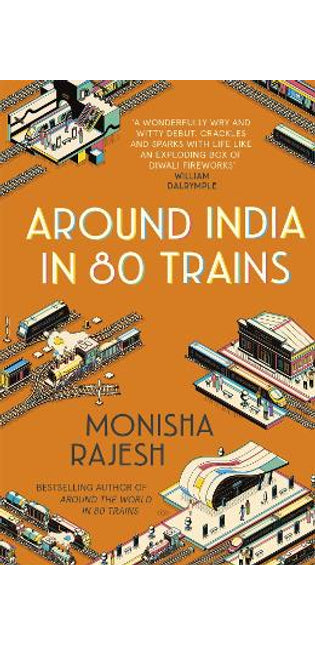
Around India in 80 Trains
'Crackles and sparks with life like an exploding box of Diwali fireworks' -William Dalrymple'One can only envy Monisha Rajesh as she embarks on this epic journey' -Tim ParksWhen she was a child, Monisha Rajesh's family uprooted to Madras in the hope of making India their home, but soon returned to England with a bitter taste in their mouths. Two decades on, Monisha turns to a map of the Indian Railways and takes a page out of Jules Verne's classic tale, embarking on an adventure around India in 80 trains, covering 40,000km - the circumference of the Earth.Her journey takes her on toy trains, luxury trains, Mumbai's infamous commuter trains and even a hospital on wheels. Along the way she meets a kaleidoscope of characters and discovers why the railways are considered the lifeline that keeps the country's heart beating. Most of all, she hopes that these 80 train journeys will lift the veil on a country that has become a stranger to her.
R 402.00
Patching Development
Diving into an original and unusually positive case study from India, Patching Development shows how development programs can be designed to work.How can development programs deliver benefits to marginalized citizens in ways that expand their rights and freedoms? Political will and good policy design are critical but often insufficient due to resistance from entrenched local power systems. In Patching Development, Rajesh Veeraraghavan presents an ethnography of one of the largest development programs in the world, the Indian National Rural Employment Guarantee Act (NREGA), and examines NREGA's implementation in the South Indianstate of Andhra Pradesh. He finds that the local system of power is extremely difficult to transform, not because of inertia, but because of coercive counter strategy from actors at the last mile and their ability to exploit information asymmetries. Upper-level NREGA bureaucrats in Andhra Pradesh do notpossess the capacity to change the power axis through direct confrontation with local elites, but instead have relied on a continuous series of responses that react to local implementation and information, a process of patching development. "Patching development" is a top-down, fine-grained, iterative socio-technical process that makes local information about implementation visible through technology and enlists participation from marginalized citizens through social audits. These processes areneither neat nor orderly and have led to a contentious sphere where the exercise of power over documents, institutions and technology is intricate, fluid and highly situated. A highly original account with global significance, this book casts new light on the challenges and benefits of usinginformation and technology in novel ways to implement development programs.
R 1,486.00
R 590.00
R 387.22