



Search results for "Sarah Kay How"
Items in stock - 4 working days delivery time

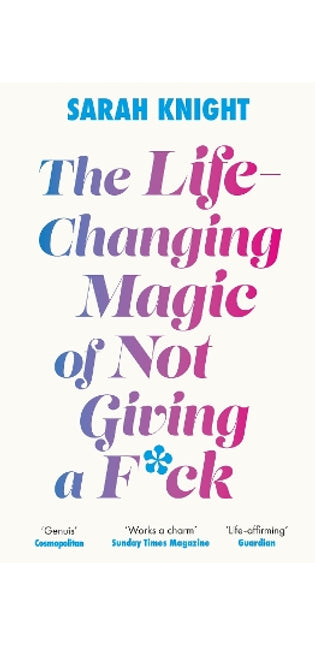
Life-Changing Magic of Not Giving a F**k
The bestselling book everyone is talking about, revealing the surprising art of caring less and getting more. 'Genius' Cosmopolitan'The best book I have read recently . . . Absolutely blinding. Read it. Do it' Mail on Sunday'The anti-guru' ObserverAre you stressed out, overbooked and underwhelmed by life? Fed up with pleasing everyone else before you please yourself? Then it's time to stop giving a f**k. This irreverent and practical book explains how to rid yourself of unwanted obligations, shame, and guilt - and give your f**ks instead to people and things that make you happy. With a bonus section on how to save your sanity over the holiday season, the simple 'NotSorry Method' for mental decluttering will help you unleash the power of not giving a f**k and will free you to spend your time, energy and money on the things that really matter.'I love Knight's book before I even start reading it' Sunday Times Magazine'Life-affirming . . . The key practice she advocates is devising for yourself a "fuck budget" . . . It's a beautiful way of streamlining your psyche' Guardian Also available from Sarah Knight:You Do You: how to be who you are and use what you've got to get what you want Get Your Sh*t Together - Sarah Knight's must-have follow up to The Life-Changing Magic of Not Giving a F**k.
R 325.00
Items we need to order for you
R 468.37
Subjectivity in Troubadour Poetry
The songs of the troubadour poets of the south of France were a pervasive influence in the development of the European lyric (and indeed other genres) from the twelfth century to the Renaissance and beyond. Much troubadour poetry is on the topic of love, and is composed from a first-person position. This book is a full-length study of this first-person subject position in its relation to language and society. Using theoretical approaches where appropriate, Sarah Kay discusses to what extent this first person is a 'self' or 'character', and how far it is self-determining. Dr Kay draws on a wide range of troubadour texts, and provides close readings of many of them, as well as translating all medieval quotations into English in order to make the discussion accessible to the non-specialist. Her book will be of interest both to scholars of medieval literature, and to anybody investigating subjectivity in lyric poetry.
R 2,333.94
Courtly Contradictions
Where does courtly literature come from? What is the meaning of "courtly love"? What is the relation between religious and secular culture in the Middle Ages, and why does it matter? This book addresses these questions, as its title indicates, by way of contradiction. Contradiction is central both to medieval logic and to most modern protocols of reading; it therefore informs both the production and the reception of medieval texts. Yet contradiction itself is rarely analyzed, serving more often as a spur to interpretation than as its object.This book works between the complex philosophical culture of the twelfth century (principally the traditions of Aristotle and of philosophical Neoplatonism, which diverge significantly in their treatment of contradiction) and the no less complex thought of Lacan (which is just as bound up with contradictoriness). Situating twelfth-century Anglo-Norman, French, and Occitan literature within this philosophical embrace, the author studies the interaction of three major literary genres—hagiography, troubadour lyric, and romance—an interaction that, in the course of the century, generates what we now call "courtly literature."She shows how preferences for different ways of dealing with contradiction migrate from one genre to another during the twelfth century. She also shows how this movement resulted, by about 1170, in different traditions converging to produce the complex artifacts that canonized literary "courtliness," not only for the Middle Ages but for us as well. Coinciding with this convergence, there is a shift in the locus of contradiction from subject to object. This crucial development not only privileges the object within texts, it also cements the value of texts themselves as object.In a series of comparisons between religious and courtly texts that draws on the writings of Lacan and Kristeva, the author explores how these objects can be variously described in terms of the psychoanalytical concepts of abjection, sublimation, or perversion. The book concludes by suggesting that the historical importance of courtly literature lies in its capacity to mediate, through the centrality accorded to the contradictory object, this transfer from medieval to modern structures of thought and thereby to shape modern forms of enjoyment.
R 3,287.00
R 370.44
Subjectivity in Troubadour Poetry
The songs of the troubadour poets of the south of France were a pervasive influence in the development of the European lyric (and indeed other genres) from the twelfth century to the Renaissance and beyond. Much troubadour poetry is on the topic of love, and is composed from a first-person position. This book is a full-length study of this first-person subject position in its relation to language and society. Using theoretical approaches where appropriate, Sarah Kay discusses to what extent this first person is a 'self' or 'character', and how far it is self-determining. Dr Kay draws on a wide range of troubadour texts, and provides close readings of many of them, as well as translating all medieval quotations into English in order to make the discussion accessible to the non-specialist. Her book will be of interest both to scholars of medieval literature, and to anybody investigating subjectivity in lyric poetry.
R 5,086.03
R 725.74
R 495.39
Place of Thought
From Jean de Meun in the late thirteenth century to Christine de Pizan in the early fifteenth, medieval French poets often aimed to impart theological, philosophical, or moral ideas. To unify their thought, and to make its outline visible to readers, the poets created vivid images of place, such as gardens, paths, idyllic landscapes, cities, trees, and fountains. For Sarah Kay, these spatial images are a prop of "monologism," helping to communicate (or impose) unity of meaning and interpretation by summoning readers to occupy the same "place" in their thinking as the authors. Because of this monologism, Kay contends, didactic poetry has been ill served by a critical tradition that favors difference, plurality, and dialogism. In The Place of Thought, she seeks radically to reassess this literature and reappraise the pleasure to be derived from reading it.Kay argues that one meaning is not inherently simpler or less interesting than many meanings. Using specific works as examples, she demonstrates that this "one-ness" of thought in French didactic poems can be an excitingly complex and challenging notion, and that it strains the images in which it is placed to the point where they become difficult to visualize. Herein lies the poems' simultaneous intellectual and aesthetic appeal. Focusing on the Roman de la Rose by Jean de Meun, the Breviari d'amor by Matfre Ermengaud, the Ovide moralisé, Pèlerinage de vie humaine by Guillaume de Deguileville's, Le Jugement dou roy de Navarre by Guillaume de Machaut, Le Joli buisson de Jonece by Jean Froissart, and Le Livre du Chemin de long estude by Christine de Pizan, Kay traces the works' backgrounds in scholastic thinking, illuminating them when appropriate with modern reflections on the same ideas.
R 2,768.00
R 620.65
R 396.00
R 1,366.00
R 548.00
R 521.00
Medieval Song from Aristotle to Opera
Focusing on songs by the troubadours and trouvères from the twelfth to the fourteenth centuries, Medieval Song from Aristotle to Opera contends that song is not best analyzed as "words plus music" but rather as a distinctive way of sounding words. Rather than situating them in their immediate period, Sarah Kay fruitfully listens for and traces crosscurrents between medieval French and Occitan songs and both earlier poetry and much later opera. Reflecting on a song's songlike quality—as, for example, the sound of light in the dawn sky, as breathed by beasts, as sirenlike in its perils—Kay reimagines the diversity of songs from this period, which include inset lyrics in medieval French narratives and the works of Guillaume de Machaut, as works that are as much desired and imagined as they are actually sung and heard. Kay understands song in terms of breath, the constellations, the animal soul, and life itself. Her method also draws inspiration from opera, especially those that inventively recreate medieval song, arguing for a perspective on the manuscripts that transmit medieval song as instances of multimedia, quasi-operatic performances. Medieval Song from Aristotle to Opera features a companion website (cornellpress.manifoldapp.org/projects/medieval-song) hosting twenty-four audio or video recordings, realized by professional musicians specializing in early music, of pieces discussed in the book, together with performance scores, performance reflections, and translations of all recorded texts. These audiovisual materials represent an extension in practice of the research aims of the book—to better understand the sung dimension of medieval song.
R 1,500.00
R 1,008.00
R 457.00
R 1,003.00
R 367.00
R 183.00
Knowing Poetry
In the later Middle Ages, many writers claimed that prose is superior to verse as a vehicle of knowledge because it presents the truth in an unvarnished form, without the distortions of meter and rhyme. Beginning in the thirteenth century, works of verse narrative from the early Middle Ages were recast in prose, as if prose had become the literary norm. Instead of dying out, however, verse took on new vitality. In France verse texts were produced, in both French and Occitan, with the explicit intention of transmitting encyclopedic, political, philosophical, moral, historical, and other forms of knowledge.In Knowing Poetry, Adrian Armstrong and Sarah Kay explore why and how verse continued to be used to transmit and shape knowledge in France. They cover the period between Jean de Meun's Roman de la rose (c. 1270) and the major work of Jean Bouchet, the last of the grands rhétoriqueurs (c. 1530). The authors find that the advent of prose led to a new relationship between poetry and knowledge in which poetry serves as a medium for serious reflection and self-reflection on subjectivity, embodiment, and time. They propose that three major works—the Roman de la rose, the Ovide moralisé, and Boethius' Consolation of Philosophy—form a single influential matrix linking poetry and intellectual inquiry, metaphysical insights, and eroticized knowledge. The trio of thought-world-contingency, poetically represented by Philosophy, Nature, and Fortune, grounds poetic exploration of reality, poetry, and community.
R 1,941.00
R 457.00
R 367.00
Zizek
Žižek is hailed as the most significant interdisciplinary thinker of modern times. His work is a powerful, often explosive combination of Lacanian psychoanalysis and philosophy which tests key psychoanalytical concepts against the ideas of major European thinkers, especially Hegel. It has ignited enthusiasm and stimulated new approaches across a vast range of disciplines, and seems to be attracting an ever-growing readership. In part, this is because Žižek himself has a panoramic range of interests encompassing film studies, literature, cyber culture, ethics, theology and, above all, politics. It is also because he is a highly entertaining writer, having a flair for anecdote, a smutty sense of humour and the knack of capturing complex ideas in concrete form. Sarah Kay’s book provides a lucid and comprehensive introduction to Žižek’s work. His writings to date are presented and evaluated here for the first time, together with an outline of their development and explanations of his key premises, themes and terms. This book will be essential reading for students of cultural studies, literary studies, philosophy and social and political theory.
R 953.00
Blues, Mary
An aspiring yet disenchanted Northern Irish journalist finds himself in New York where he discovers the interdependency of creation, craft and audience. Through a reflective narrative circling his daily life, a lost relationship with his beloved Mary, and an assignment of interviews with a rock'n'roll band, he learns that the key to understanding himself is realising where he really wants to be.
R 553.00
R 691.00
R 339.00
R 274.00
Decisions at Chancellorsville
Having won a considerable victory at Fredericksburg only months earlier, Gen. Robert E. Lee would again be tested by Gen. Joseph Hooker and the Federal Army at Chancellorsville. Hooker and the bulk of his army crossed the Rappahannock River at dawn on April 27, 1863, in conjunction with cavalry raids from Maj. Gen. George Stoneman. But Lee boldly divided his army, leaving a small force to defend Fredericksburg and attacking Hooker with the remainder of the Army of Northern Virginia. As the battle wore on, Lee launched multiple attacks on Hooker’s defenses resulting in massive casualties for both sides. Lee divided his army again, sending Gen. Thomas “Stonewall” Jackson’s corps on a flanking maneuver that infamously resulted in the general’s injury by friendly fire and eventual death. Though the Confederate Army’s victory was assured, Lee equated the loss of Stonewall Jackson to the loss of his right hand, and as many months later Lee would find his army in a tide-turning defeat at the Battle of Gettysburg. Decisions at Chancellorsville explores the critical decisions made by Confederate and Federal commanders during the campaign and how these decisions shaped its outcome. Rather than offering a history of the operation, Sarah Bierle hones in on a sequence of decisions made by commanders on both sides of the contest to provide a blueprint of the campaign at its tactical core. Identifying and exploring the critical decisions in this way allows students of the battles to progress from a knowledge of what happened to a mature grasp of why events happened. Complete with maps and a driving tour, Decisions at Chancellorsville is an indispensable primer, and readers looking for a concise introduction to the battles can tour this sacred ground—or read about it at their leisure—with key insights into the campaign and a deeper understanding of the Civil War itself. Decisions at Chancellorsville is the twenty-second in a series of books that explores the critical decisions of major campaigns and battles of the Civil War.
R 569.00
Troubadours
The dazzling culture of the troubadours - the virtuosity of their songs, the subtlety of their exploration of love, and the glamorous international careers some troubadours enjoyed - fascinated contemporaries and had a lasting influence on European life and literature. Apart from the refined love songs for which the troubadours are renowned, the tradition includes political and satirical poetry, devotional lyrics and bawdy or zany poems. It is also in the troubadour song-books that the only substantial collection of medieval lyrics by women is preserved. This book offers a general introduction to the troubadours. Its sixteen newly-commissioned essays, written by leading scholars from Britain, the US, France, Italy and Spain, trace the historical development and setting of troubadour song, engage with the main trends in troubadour criticism, and examine the reception of troubadour poetry. Appendices offer an invaluable guide to the troubadours, to technical vocabulary, to research tools and to surviving manuscripts.
R 1,986.66
R 512.38
Everything Cake Mix Cookbook
Think of delicious Pumpkin Bread, Chocolate Hazelnut Cake, and Cheddar Herb Scones homemade from scratch. But who has that kind of time? You can cut your kitchen duty considerably by using the secret ingredient: cake mix! In this unique cookbook, author Sarah K. Sawyer shows readers how to bake all of the classics—and some new surprises—using cake mix. Recipes include:French Toast CasseroleRocky Road BarsPotato PancakesGreen Tea CupcakesRhubarb Strawberry CrumbleComplete with chapters for vegetarians, vegans, and those who have food allergies, this is the perfect cookbook for anyone who wants to cut corners but still present a delicious homemade product. No one will ever know that it’s only semi-homemade!
R 822.78
R 608.00
R 835.00
R 458.00
I Quit Sugar for Life
'Quitting sugar is not a diet. Quitting sugar is a way of living without processed food and eating like our great-grandparents used to.'With her internationally bestselling book, I Quit Sugar, Sarah Wilson helped tens of thousands of people around the world to kick the habit. In I Quit Sugar for Life, Sarah shows you how to be sugar-free for ever. Drawing on extensive research and her own tried and tested methods, Sarah has designed a programme to help families and individuals:*banish cravings by eating good fats and protein *deal with lapses *maximize nutrition with vegetables *exercise less for better results *detox safely *make sustainable food choices *cook sugar-free: one hundred and forty-eight desserts, cakes, kids' stuff, comfort dinners, breakfasts and easy packed lunchesI Quit Sugar for Life is not just about kicking a habit; it's a complete wellness philosophy for your healthiest, calmest, happiest self.
R 526.00
R 304.00
R 458.00
In Perfect Time
Bold, sophisticated, and flirtatious, Army Air Force flight nurse Lt. Kay Jobson collects hearts wherever she flies, leaving men pining in airfields all across Europe. So how can ruggedly handsome C-47 pilot Lt. Roger Cooper be all but immune to her considerable charms? In fact, he seems to do everything he can to avoid her.Still, as they cross the skies between Italy and southern France, evacuating the wounded and delivering paratroopers and supplies, every beat of their hearts draws them closer to where they don't want to go. Can they confront the fears and misunderstandings in their pasts?Sarah Sundin seamlessly weaves together emotion, action, and sweet romance into a tale that transcends time and calls us to believe in the power of love.
R 619.00
R 969.00
R 3,832.00
R 397.00
You Deserve Each Other
'This book is the perfect dose of sweet, hilarious joy. It's masterful comedy plus tenderness, unique voice plus rich characters. Nicholas! Swoon! We are in love' bestselling author Christina Lauren Meet Naomi and Nicholas: the Perfect Couple. Their glorious, lavish wedding is coming up in three short months . . . and they are utterly, miserably sick of each other.Unfortunately, whoever backs out first will end up bearing the brunt of the wedding bill. When Naomi finds out that Nicholas has been feigning contentment too, the two of them go head-to-head in a battle of sabotage, pranks, and all-out emotional warfare to see who can annoy the other into surrendering first. Now that they have nothing to lose, they're finally being themselves. In fact, they're having so much fun getting on each other's nerves that it starts to feel like something else entirely... Perfect for fans of Helen Hoang's The Love Quotient and Sally Thorne's The Hating Game, YOU DESERVE EACH OTHER is laugh-out-loud funny, painfully relatable, and bitingly smart.Praise for You Deserve Each Other:'Sarah Hogle is a master of comedic dialogue and sexual tension' Kristin Rockaway'Anyone who has ever been in a relationship will recognize a part of themselves in this book' Lyssa Kay Adams'An honest depiction of how dishonesty in a relationship can be its undoing. You Deserve Each Other is a sharp and witty look at how relationships take work to succeed, and how being true to yourself and each other is at the very core of a romantic connection' Samantha Young'You Deserve Each Other is one of my favorite books of the year' Jennifer L. Armentrout'Laugh-out-loud funny and a love story with incredible heart. I absolutely loved You Deserve Each Other' Katie McGarry'A snarky heroine, wickedly funny banter and a cast of quirky characters make this a laugh-out-loud read' Maisey Yates, New York Times-bestselling author of Secrets from a Happy Marriage'[A] hilarious debut romance...[that] rewards readers with laugh-out-loud moments and a satisfyingly sweet and redeeming ending' Booklist
R 340.00
R 469.00
R 605.97
R 457.00


