



Search results for "Shakespear"
Items in stock - 4 working days delivery time

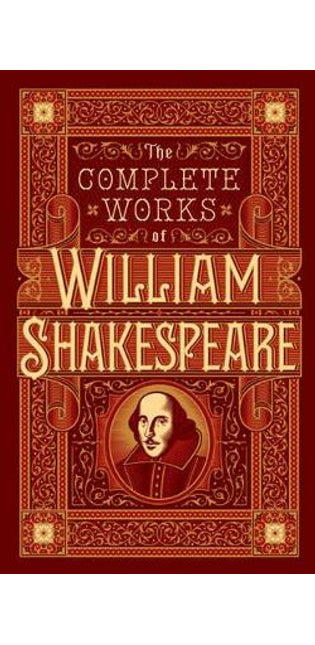
Complete Works of William Shakespeare (Barnes & Noble Collectible Editions)
Hamlet. Romeo and Juliet. Henry V. Macbeth. A Midsummer Night's Dream. King Lear. Lovers of literature will immediately recognise these as signature works of William Shakespeare, whose plays still rank as the greatest dramas ever produced in the English language four centuries after they were written. The Complete Works of William Shakespeare collects all thirty-seven of the immortal Bard's comedies, tragedies, and historical plays in a beautiful edition. This volume also features Shakespeare's complete poetry, including the sonnets. With this beautiful edition, you can enjoy Shakespeare's enduring literary legacy again and again. The Complete Works of William Shakespeare is one of Barnes & Noble's Leatherbound Editions. Each volume presents classic works by the world's best-loved authors in a beautifully designed edition bound in bonded leather. The attractive covers are embossed with colourful foils and the books have many special details including decorative endpapers, gilded edges, and ribbon markers. Elegant and affordable, these volumes are cornerstones for any home library.
R 905.00
Items we need to order for you
Complete Works of William Shakespeare
The Complete Works of Shakespeare contains the recognized canon of the bard’s plays, and his sonnets and poems. The texts were edited by the late Professor Peter Alexander, making it one of the most authoritative editions, recognized the world over for its clarity and scholarship. Described in the Guardian on its first publication in 1951 as ‘a symbol in the history of our national culture’, the Collins edition of the Complete Works of William Shakespeare, edited by the late Professor Peter Alexander, has long been established as one of the most authoritative editions of Shakespeare’s works, and was chosen by the BBC as the basis for its televised cycle of the plays. The book starts with two specially written articles – a biography of Shakespeare by Germaine Greer and a wide-ranging introduction to Shakespeare theatre by the late Anthony Burgess. Each play is also introduced by academics from Glasgow University, where Professor Alexander undertook his editing. New to this edition is an internet resources section, providing details of the most useful Shakespeare websites. In addition, the invaluable glossary of over 2,500 entries explaining the meaning of obsolete words and phrases (complete with line references) has been expanded and redesigned to make it much easier to use.
R 587.00
R 1,174.00
Oxford School Shakespeare: Twelfth Night
Oxford School Shakespeare is an acclaimed edition especially designed for students, with accessible on-page notes and explanatory illustrations, clear background information, and rigorous but accessible scholarly credentials. Twelfth Night is a popular text for study by secondary students the world over. This edition includes illustrations, preliminary notes, reading lists (including websites) and classroom notes.This title is suitable for all exam boards and for the most recent GCSE and AS/A level specifications.
R 223.00
Shakespeare
These thirty essays reflect contemporary interest in poetic language, the aesthetics of drama, the Elizabethan theater, and Renaissance modes of thought. The selections provide an excellent sampling of both contrasting and complementary viewpoints and have been drawn from the work of such distinguished modern critics as H. Granville-Barker, Northrop Frye, L.L. Barber, Robert Ornstein, Mark Van Doren, and Reuben Brower.
R 3,825.00
Shakespeare and the Critics
If we read Shakespeare assuming that he is a consummate artist producing nothing but flawless masterpieces, then we have to account for anything which is inconsistent with that assumption by saying it is an intended part of the deep design. Mr French asks whether Shakespeare wasn't sometimes frankly opportunist, or couldn't see clearly what he wanted to say, or, having seen it, couldn't bring himself to face its consequences. Hamlet in particular is a failure for reasons which have nothing to do with the hero's famous 'psychology'; Lear is much more disturbing than the redemptivists make it; Othello comes close to being a melodrama; while Antony wavers dangerously in tone and in the seriousness of Shakespeare's involvement. This is not a simple devaluation of the national literary institution. It is a patient attempt at open-mindedness, based on a sense of Shakespeare as profoundly original but also human and therefore fallible.
R 1,755.29
Bowdler Shakespeare
'The Family Shakspeare: in which nothing is added to the original text, but those words and expressions are omitted which cannot with propriety be read in a family.' These words on the title pages of this edition gave rise to the verb 'to bowdlerise' - to remove or modify text considered vulgar or objectionable. Although the first edition was in fact created by Henrietta Maria Bowdler (1750–1830) and published in 1807, the many subsequent editions were published under the name of her brother Thomas (1754–1825), who devoted his time to prison reform and chess, as well as the sanitising of Shakespeare. The Bowdlers' work became enormously popular as the scandal-ridden Regency gave way to Victorian respectability. This volume, from the 1853 edition, contains The Tempest, Two Gentlemen of Verona, The Merry Wives of Windsor, Twelfth Night, Measure for Measure, Much Ado about Nothing and A Midsummer Night's Dream.
R 2,480.52
R 1,401.91
William Shakespeare: The Complete Works
A compact edition of the complete works of William Shakespeare. It combines impeccable scholarship with beautifully written editorial material and a user-friendly layout of the text. Also included is a foreword, list of contents, general introduction, essay on language, contemporary allusions to Shakespeare, glossary, consolidated bibliography and index of first lines of Sonnets.
R 1,049.00
Shakespeare
Shakespeare by George Saintsbury was published as part of the Cambridge Miscellany series in 1934. The book contains two chapters on Shakespeare which had previously appeared in the fifth volume of the Cambridge History of English Literature. The chapters were printed together in the 'Miscellany' edition in the year following the author's death with the addition of a few footnotes and an appreciation by Helen Waddell.
R 1,413.19
Shakespeare
'Like so much of Renaissance Art, Shakespeare's work bears an open secret. The esoteric spiritual content is undisguised, though it may be unexpected and not always immediately recognized. And, like all the great artistic achievements...this work remains incomplete until we recognize and respond to its open invitation that we become active participants.' - from the IntroductionThe perennial universal appeal of Shakespeare's work is well established. His core themes explore the challenges of the human condition whilst celebrating the potential of human beings to achieve and develop in earthly life. But what is it that enables Shakespeare's characters to live and breathe beyond the confines of their written roles, some 400 years after the plays were first performed? In these collected lectures, edited with an extensive introduction by Andrew Wolpert, Rudolf Steiner throws new light on the Bard's work, describing the on-going life that flows from it, and the profound spiritual origins of Shakespeare's inspirations. He shows how Shakespeare can enliven us in our longing for contemporary ideals and truths; indeed, in our goal of becoming fully human.Our engagement with the plays, not just as actors and directors, but also as students and members of an audience, can thus become a co-creative participation in the redemptive potential of Shakespeare's enduring legacy. Steiner speaks about Shakespeare in connection with the evolution of the arts of poetry and drama, and the transitions between cultural epochs. He reminds us of the sources and characteristics of classical Greek drama, recalling Aristotle's definition of drama as catharsis, and pointing to Shakespeare's connection to these cultural and historical wellsprings.
R 362.00
Shakespeare
In this stunning reinterpretation of Shakespeare s works, Jonathan Hart explores key topics such as love, lust, time, culture, and history to unlock the Bard s brilliant fictional worlds. From an in-depth look at the private and public myths of love in the narrative poems, through an examination of time in the sonnets, to a discussion of gender in the major history plays, this book offers close readings and new perspectives. Delving into the text and context of a wide range of poems and plays, Hart brings his wealth of experience to bear on Shakespeare s representation of history.
R 1,553.72
Oxford Shakespeare: Pericles
Pericles was one of the most popular plays in the Jacobean theatre, and it has regained much of that popularity in the modern theatre. In a wide-ranging introduction, Roger Warren draws on his experience of the play in rehearsal and performance to explore the reasons for this enduring popularity. Unfortunately Pericles survives only in a corrupt text, the Quarto of 1609: many passages are nonsensical, others appear to be missing altogether. Earliereditions have merely published a cleaned-up version of the Quarto, leaving crucial differences unaddressed; but this edition offers a conjectural reconstruction of what the original play might have been like. It is based on that published in the Oxford Complete Works of 1986, modified in the light of its use inseveral productions since then. It draws upon George Wilkin's narrative The Painful Adventures of Pericles (1608) to emend some of the Quarto's errors and to supply some of the missing material. It does so in the belief that the play is a collaboration between Shakespeare and Wilkins himself. The case for this is fully argued in the Introduction, which also explains the complex textual situation for the general reader. The entire Quarto text is reprinted in an appendix, together withthe passages from Wilkin's narrative that have particularly contributed to the reconstruction, so that readers can see for themselves how the reconstruction has been made. It is hoped that this treatment of the play provides a much more comprehensive edition than has so far been available, making it moreuseful for actors, students, and the general reader.
R 7,734.00
R 1,847.00
New Oxford Shakespeare: Complete Set
The New Oxford Shakespeare consists of four interconnected publications: the Modern Critical Edition (with modern spelling), the Critical Reference Edition (with original spelling), a companion volume on Authorship, and an online version integrating all of this material on OUP's high-powered scholarly editions platform. Together, they provide the perfect resource for the future of Shakespeare studies. This set comprises all of the printvolumes that make up The New Oxford Shakespeare. The Modern Critical Edition gives today's students and playgoers the very best resources they need to understand and enjoy all Shakespeare's works. The authoritative text is accompanied by extensive explanatory and performance notes, and innovative introductory materials which lead the reader into exploring questions about interpretation, textual variants, literary criticism, and performance, for themselves. This volume presents the plays and poetry in the order in which Shakespearewrote them, so that readers can follow the development of his imagination, his engagement with a rapidly evolving culture and theatre, and his relationship to his literary contemporaries.The Critical Reference Edition collects the same versions of the same works found in the Modern Critical Edition, keyed to the same line-numbering. But the Critical Reference Edition emphasizes book history and the documentary origins of each text. It preserves the spelling, punctuation, capitalization, abbreviations, typographical contrasts, ambiguities, and inconsistencies of the early documents. Introductions focus on early modern manuscript and print culture,setting each text within the material circumstances of its production, transmission, and early reception. The works are arranged in the chronological order of the surviving texts: the first volume covers documents manufactured in Shakespeare's lifetime, and the second covers documents made between 1622 and 1728. The Authorship Companion accompanies the Modern Critical Edition and the Critical Reference Edition, and concentrates on the issues of canon and chronology—currently the most active and controversial debates in the field of Shakespeare editing. It presents in full the evidence behind the choices made in The Complete Works about which works Shakespeare wrote, in whole or part. A major new contribution to attribution studies, the Authorship Companionilluminates the work and methodology underpinning the groundbreaking New Oxford Shakespeare, and casts new light on the professional working practice, and creative endeavours, of Shakespeare and his contemporaries.
R 21,461.00
Shakespeare's Workmanship
Sir Arthur Quiller-Couch (1863–1944), who often published under the pen-name of 'Q', was one of the giants of early twentieth-century literature and literary criticism. A novelist and poet who was also a Professor of English, he helped to form the literary tastes of generations of literary students and scholars who came after him. The freshness, enthusiasm and intellectual insight of his work is still evident in his writings nearly a century on. Cambridge University Press is delighted to reissue some of his key texts in this new edition. Shakespeare's Workmanship, first published in 1918, offers detailed readings of Macbeth, A Midsummer Night's Dream, The Merchant of Venice, As You Like It, Hamlet, Pericles and King Henry VIII, Cymbeline, The Winter's Tale and The Tempest, with an account of the story of Falstaff, and a general description of the features of Shakespeare's later plays.
R 2,090.47
Shakespeare's Tragic Cosmos
This study focuses on Romeo and Juliet, Julius Caesar, the four main tragedies and Antony and Cleopatra. Tom McAlindon argues that there were two models of nature in Renaissance culture, one hierarchical, in which everything has an appointed place, and the other contrarious, showing nature as a tense system of interacting opposites, liable to sudden collapse and transformation. This latter model informs Shakespeare's tragedy.
R 2,234.87
Oxford Shakespeare: Anthony and Cleopatra
Written near the end of Shakespeare's most phenomenally creative period, Antony and Cleopatra is perhaps the most ambitious of all Shakespeare's designs, in its unmatched geographical and historial sweep, its bold mingling of genres, and its extraordinary variety of style, mood, and effect. Yet the degree and nature of its success remain surprisingly contentious, and performances of the play have seldom matched the extravagant expectations of itsadmirers.The wideranging introduction to this new edition considers the paradoxes of the play's reception from a number of angles. A full discussion of Shakespeare's sources (the most important of which is excerpted in a generous appendix) considers ways in which these may have influenced the play's problematic design. A comprehensive stage history illustrates how the theatrical fortunes of Antony and Cleopatra continue to be affected by the inappropriate spectacular traditions ofnineteenth-century staging, and by an enduring gender-inflected orientalism that has particularly distorted responses to the character of Cleopatra. A substantial critical section examines how the technique of the play - its deliberate frustrations of expectation, its carefully constructed tensions between rhetoric andaction, and its daring exploitation of bathos and anti-climax - may have contributed to the sense of disappointment which colours so many accounts of performance. The editor argues that such effects are structural to the paradoxical vision of this tragedy and to its disturbed preoccupation with the unstable boundaries of gender and identity.The text has been freshly edited in accordance with the principles of the series, and the extensive commentary is attentive to the theatrical dimensions of the play as well as to the rich complexity of its poetic language.
R 8,894.00
Shakespeare on Page and Stage
This volume presents a winning selection of the very best essays from the long and distinguished career of Stanley Wells, one of the most well-known and respected Shakespeare scholars in the world. Wells's accomplishments include editing the entire canon of Shakespeare plays for the ground-breaking Oxford Shakespeare, and over his lifetime he has made significant contributions to debates over literary criticism of the works, genre study, textual theory, Shakespeare'safterlife in the theatre, and contemporary performance. The volume is introduced by Peter Holland, and its thirty chapters are divided into themed sections: 'Shakespearian Influences', 'Essays on Particular Works', 'Shakespeare in the Theatre', and 'Shakespeare's Text'. An afterword by Margreta deGrazia concludes the volume.
R 1,054.00
Shakespeare's Tragedies
Shakespeare's Tragedies: Violation and Identity traces the linked themes of violation and identity through seven Shakespearean tragedies, beginning with the rape of Lavinia in Titus Andronicus. The implications of this event - its physical and moral shock, the way it puts Lavinia's identity, and the whole notion of identity, into crisis - reverberate through Shakespeare's later tragedies. Through close, theatrically informed readings of Titus Andronicus, Romeo and Juliet, Hamlet, Troilus and Cressida, Othello, King Lear and Macbeth the book traces the way acts of violence provoke questions about the identities of the victims, the perpetrators, and the acts themselves. It shows that violation can be involved in the most innocent-looking acts, that words can be weapons, that interpretation itself can be a form of damage. Written in a clear, accessible style, this study provokes questions about the human implications of Shakespearean tragedy.
R 4,374.74
Shakespeare at Work
It has been established by textual specialists, and is now becoming widely accepted, that Shakespeare revised many of his plays, including some of the most celebrated. But how were the great tragedies altered and with what effect? John Jones looks at the implications of Shakespeare's revisions for the reader and spectator alike and shows the playwright getting to grips with the problems of characterization and scene formation in such plays as Hamlet, Othello, King Lear, and Troilus and Cressida. This is vivid, enthralling stuff. Jones carries his argument down, as he puts it, to the very tip of Shakespeare's quill pen. In characteristically lucid and accessible prose, he assesses recent textual scholarship onShakespeare's revisions and illuminates the artistic impact of the revised texts and their importance for our understanding of each play's moral and metaphysical foundations. Shakespeare at Work brings together English literature's greatest writer and one of its most distinguished critics. The result is a book that will prove a revelation - essential and also fascinating reading for scholars, students, and Shakespeare enthusiasts alike.
R 4,254.00
Shakespeare Unlearned
Shakespeare Unlearned dances along the borderline of sense and nonsense in early modern texts, revealing overlooked opportunities for understanding and shared community in words and ideas that might in the past have been considered too silly to matter much for serious scholarship. Each chapter pursues a self-knowing, gently ironic study of the lexicon and scripting of words and acts related to what has been called 'stupidity' in work by Shakespeare and other authors. Each centers significant, often comic situations that emerge -- on stage, in print, and in the critical and editorial tradition pertaining to the period -- when rigorous scholars and teachers meet language, characters, or plotlines that exceed, and at times entirely undermine, the goals and premises of scholarly rigor. Each suggests that a framing of putative 'stupidity' pursued through lexicography, editorial glossing, literary criticism, and pedagogical practice can help us put Shakespeare and semantically obscure historical literature more generally to new communal ends. Words such as 'baffle' in Twelfth Night or 'twangling' and 'jingling' in The Tempest, and characters such as Sir Andrew Aguecheek and Holofernes the pedant, might in the past have been considered unworthy of critical attention -- too light or obvious to matter much for our understanding of Shakespeare and his contemporaries. Adam Zucker's meditation on the limits of learnedness and the opportunities presented by a philology of stupidity argues otherwise.
R 3,674.00
Oxford Shakespeare: Henry IV, Part One
As Henry's throne is threatened by rebel forces, England is divided. The characters reflect these oppositions, with Hal and Hotspur vying for position, and Falstaff leading Hal away from his father and towards excess. During Shakespeare's lifetime Henry IV, Part I was his most reprinted play, and it remains enormously popular with theatregoers and readers. Falstaff still towers among Shakespeare's comic inventions as he did in the late 1590s. David Bevington'sintroduction discusses the play in both performance and criticism from Shakespeare's time to our own, illustrating the variety of interpretations of which the text is capable. He analyses the play's richly textured language in a detailed commentary on individual words and phrases and clearly explains itshistorical background.
R 8,314.00
Shakespeare for Everyone
Shakespeare for Everyone offers an accessible and engaging introduction to the worlds of Shakespeare’s plays and sonnets.By focusing on emotions, it enables readers to build the skills and confidence to understand, appreciate, and enjoy Shakespeare’s plays by getting up close and personal with the characters in them, with their emotional journeys, and with the dramatic genres—of comedy, tragedy, tragicomedy, and history—in which they are cast. It provides insights into the forces that shaped Shakespeare’s work, and includes in-depth chapters on emotions in four representative plays: love in A Midsummer Night’s Dream, hate in Othello, jealousy in The Winter’s Tale, and the manipulation of emotions in Henry V. The book also considers how emotions were conceptualised in Shakespeare’s time and are understood today by modern psychological science. Additionally, the book enables readers to get to know Shakespeare himself, and gain insights into the processes of his art.Featuring end-of-chapter further reading sections and an invaluable glossary of key terms through which to unlock the meaning of any Shakespeare play, this practical and informative guide proves that Shakespeare is for everyone. Written in a conversational tone, this short yet compelling book is not just a series of insights into what Shakespeare’s plays mean, but a way of exploring what it is to be human.
R 9,304.96
Oxford Handbook of Shakespearean Tragedy
The Oxford Handbook of Shakespearean Tragedy presents fifty-four essays by a range of scholars from all parts of the world. Together these essays offer readers a fresh and comprehensive understanding of Shakespeare tragedies as both works of literature and as performance texts written by a playwright who was himself an experienced actor. The opening section explores ways in which later generations of critics have shaped our idea of 'Shakespearean' tragedy,and addresses questions of genre by examining the playwright's inheritance from the classical and medieval past. The second section is devoted to current textual issues, while the third offers new critical readings of each of the tragedies. This is set beside a group of essays that deal with performancehistory, with screen productions, and with versions devised for the operatic stage, as well as with twentieth and twenty-first century re-workings of Shakespearean tragedy. The book's final section expands readers' awareness of Shakespeare's global reach, tracing histories of criticism and performance across Europe, the Americas, Australasia, the Middle East, Africa, India, and East Asia.
R 2,369.81
Everybody's Shakespeare
Everybody’s Shakespeare brings the insights and wisdom of one of the finest Shakespearean scholars of our century to the task of surveying why the Bard continues to flourish in modern times. Mack treats individually seven plays—Hamlet, King Lear, Macbeth, Othello, Romeo and Juliet, Julius Cesar, and Antony and Cleopatra—and demonstrates in each case how the play has retained its vitality, complexity, and appeal.
R 1,099.00
Rescripting Shakespeare
Building on almost 300 productions from the last 25 years, this 2002 book focuses on the playtexts used when directors stage Shakespeare's plays: the words spoken, the scenes omitted or transposed, and the many other adjustments that must be made. Directors rescript to streamline the playscript and save running time, to eliminate obscurity, conserve on personnel, and occasionally cancel out passages that might not fit their 'concept'. They rewright when they make more extensive changes, moving closer to the role of playwrights, as when the three parts of Henry VI are compressed into two plays. Alan Dessen analyzes what such choices might exclude or preclude, and explains the exigencies faced by actors and directors in placing before today's audiences words targeted at players, playgoers, and playhouses that no longer exist. The results are of interest and importance as much to theatrical professionals as to theatre historians and students.
R 2,083.41
William Shakespeare
This is a concise, accessible introduction to Shakespeare's life and work which focuses on what we know, assessing the differing theories and avoiding speculation. William Shakespeare's work and life have proved endlessly fascinating to generations of readers. However, it can be difficult to find a way through the mass of differing interpretations of his work and speculation about his life. This book offers a reassessment of Shakespeare and his creative output from his earliest work through his 'mature' drama and the late plays, taking into account our current knowledge of Shakespeare's biography and consensus on key textual, critical and theatrical issues. William Baker offers a comprehensive but accessible introduction to Shakespeare's work and places it in the contexts of what is known of his life and activities. Avoiding speculation of a biographical, critical or textual nature, he focuses instead on an account of what is known of Shakespeare and his achievement at the end of the first decade of the twenty-first century. This is a concise, accessible introductions to major writers focusing equally on their life and works.Written in a lively style to appeal to both students and readers, books in the series are ideal guides to authors and their writing.
R 1,058.00
Shakespeare
Bill Bryson’s biography of William Shakespeare unravels the superstitions, academic discoveries and myths surrounding the life of our greatest poet and playwright. Ever since he took the theatre of Elizabethan London by storm over 400 years ago, Shakespeare has remained centre stage. His fame stems not only from his plays – performed everywhere from school halls to the world's most illustrious theatres – but also from his enigmatic persona. His face is familiar to all, yet in reality very little is known about the man behind the masterpieces. Shakespeare’s life, despite the scrutiny of generations of biographers and scholars, is still a thicket of myths and traditions, some preposterous, some conflicting, arranged around the few scant facts known about the Bard – from his birth in Stratford to the bequest of his second best bed to his wife when he died. Taking us on a journey through the streets of Elizabethan and Jacobean England, Bryson examines centuries of stories, half-truths and downright lies surrounding our greatest dramatist. With a steady hand and his trademark wit, he introduces a host of engaging characters, as he celebrates the magic of Shakespeare's language and delights in details of the bard's life, folios, poetry and plays.
R 309.00
Cambridge Companion to Shakespeare's Poetry
This Companion provides a full introduction to the poetry of William Shakespeare through discussion of his freestanding narrative poems, the Sonnets, and his plays. Fourteen leading international scholars provide accessible and authoritative chapters on all relevant topics: from Shakespeare's seminal role in the development of English poetry, the wide-ranging practice of his poetic form, and his enigmatic place in print and manuscript culture, to his immersion in English Renaissance politics, religion, classicism, and gender dynamics. With individual chapters on Venus and Adonis, The Rape of Lucrece, The Passionate Pilgrim, 'The Phoenix and the Turtle', the Sonnets, and A Lover's Complaint, the Companion also includes chapters on the presence of poetry in the dramatic works, on the relation between poetry and performance, and on the reception and influence of the poems. The volume includes a chronology of Shakespeare's life, a note on reference works, and a reading list for each chapter.
R 4,698.13
Notebook on William Shakespeare
First published in 1948, this book may be described as Dame Edith Sitwell's personal notebook. It consists of essays on the subject of the general aspect of the plays-those great hymns to the principle and the glory of life, in which there are the same differences in nature, in matter, in light, in darkness, in movement, that we find in the universe, and in which the characters are so vast they seem each an element (Water, Hamlet; Air, Romeo and Juliet; Fire, King Lear) and which yet bear the stamp of our common humanity, made greater and more universal. There are long essays on King Lear, Macbeth, Othello and Hamlet. Dame Edith believes, with all humility, that she has discovered new sources of the inspiration of King Lear, throwing a new light on the whole play, and giving new meanings to the mad scenes, of an unsurpassable grandeur, depth, and terror. There are shorter essays also on other of the tragedies. The keynotes of many of the plays are examined (not all the plays are discussed), a phrase is studied and will be found to hold the whole meaning of the play.There are essays on many of the comedies, and long passages about the Fools and Clowns. Connecting levels are traced between the philosophies of the plays. There are, too, running commentaries on Shakespeare as that ' common-kissing Titan ', and, since the book is a personal notebook, the author makes copious quotations from the writings of Shakespearean scholars who have thrown light on the various aspects of which she treats, and from works on other subjects which also serve to illumine his mighty and many-sided genius.
R 588.00
Shakespeare
A practical and stimulating guide to all aspects of Shakespeare studies. The volume comprises over 40 specially commissioned essays by a team of Shakespeare scholars. Each essay is written in an accessible and engaging style, and is followed by annotated suggestions for further reading. The volume is divided into four key parts, which as a whole offer a balance of factual and critical content. In the first part, chapters provide information about and discuss Shakespeare, the theatres of his time, the society in which he lived, the language of his period, the conventions of playwriting and his contemporary impact. The second part offers critical overviews of Shakespeare's achievement in the principal genres, and each overview is followed by a practical reading exploring Shakespeare's use of the traditions, scope and boundaries of that genre in one of his key works.
R 2,531.00
Shakespeare
Harold Bloom, the doyen of American literary critics and author of The Western Canon, has spent a professional lifetime reading, writing about and teaching Shakespeare. In this magisterial interpretation, Bloom explains Shakespeare’s genius in a radical and provocative re-reading of the plays. How to understand Shakespeare, whose ability so far exceeds his predecessors and successors, whose genius has defied generations of critics’ explanations, whose work is of greater influence in the modern age even than the Bible? This book is a visionary summation of Harold Bloom’s reading of Shakespeare and in it he expounds a brilliant and far-reaching critical theory: that Shakespeare was, through his dramatic characters, the inventor of human personality as we have come to understand it. In short, Shakespeare invented our understanding of ourselves. He knows us better than we do: ‘The plays remain the outward limit of human achievement: aesthetically, cognitively, in certain ways morally, even spiritually. They abide beyond the end of the mind’s reach; we cannot catch up to them. Shakespeare will go on explaining us in part because he invented us… ’ In a chronological survey of each of the plays, Bloom explores the supra-human personalities of Shakespeare’s great protagonists: Hamlet, Lear, Falstaff, Rosalind, Juliet. They represent the apogee of Shakespeare’s art, that art which is Britain’s most powerful and dominant cultural contribution to the world, here vividly recovered by an inspired and wise scholar at the height of his powers.
R 618.00
Cambridge Shakespeare
The Cambridge Shakespeare was published in nine volumes between 1863 and 1866. Its careful editorial principles, attractive page design and elegant typography have withstood the test of time. This text was based on a thorough collation of the four Folios and of all the Quarto editions of the separate plays, the base text being the 1623 Folio. The critical apparatus appears at the foot of the page, but for passages where the Quarto differs significantly the entire Quarto text appears in small type after the received text. Notes at the end of each play explain variants, emendations, and passages of unusual difficulty or interest. Grammar and metre were generally left unchanged by the editors, but punctuation was normalised and nineteenth-century orthography was adopted instead of the variable Elizabethan spelling. In a bold move for a Victorian edition, the editors restored various 'profane' expressions where metre or sense demanded it.
R 2,973.32
R 1,247.53
R 1,661.86
R 1,172.09
Shakespeare: Hamlet
In this useful guide, Paul Cantor provides a clearly structured introduction to Shakespeare's most famous tragedy. Cantor examines Hamlet's status as tragic hero and the central enigma of the delayed revenge in the light of the play's Renaissance context. He offers students a lucid discussion of the dramatic and poetic techniques used in the play. In the final chapter he deals with the uniquely varied reception of Hamlet on the stage and in literature generally from the seventeenth century to the present day.
R 3,852.32
R 892.44
R 1,921.00
R 845.00
R 1,414.55
R 1,755.86


-
, by sungano kanjere South Africa school team narrowly beaten by Australia in thrilling Kids Literacy Quiz Final
Rugby is not the only sport where South Africa and Australia have clashed recently. On 13 August, the two proud nations faced each other down in...
