



Search results for "Think"
Items in stock - 4 working days delivery time

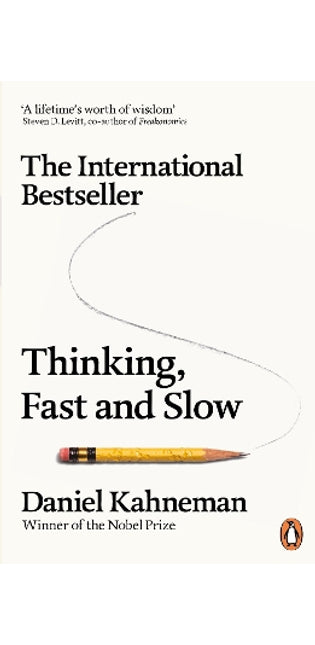
Thinking, Fast and Slow
The phenomenal international bestseller - 2 million copies sold - that will change the way you make decisions 'A lifetime's worth of wisdom' Steven D. Levitt, co-author of Freakonomics 'There have been many good books on human rationality and irrationality, but only one masterpiece. That masterpiece is Thinking, Fast and Slow' Financial Times Why is there more chance we'll believe something if it's in a bold type face? Why are judges more likely to deny parole before lunch? Why do we assume a good-looking person will be more competent? The answer lies in the two ways we make choices: fast, intuitive thinking, and slow, rational thinking. This book reveals how our minds are tripped up by error and prejudice (even when we think we are being logical), and gives you practical techniques for slower, smarter thinking. It will enable to you make better decisions at work, at home, and in everything you do.
R 405.00
Think Again
THE MILLION-COPY BESTSELLER If you can change your mind you can do anything. Why do we refresh our wardrobes every year, renovate our kitchens every decade, but never update our beliefs and our views? Why do we laugh at people using computers that are ten years old, but yet still cling to opinions we formed ten years ago? There's a new skill for the modern world that matters more than raw intelligence - the ability to change your mind. To have the edge we all need to develop the flexibility to unlearn old beliefs and adapt when the evidence and the world changes before us. Told through fascinating stories, informed by cutting-edge research and illustrated with amazing insights from Adam Grant's conversations with people such as Elon Musk, Hilary Clinton's campaign team, top CEOs and leading scientists, this is the ultimate guide to keeping your thinking fresh, learning when to question your ideas and update your own opinions, and how to inspire those around you to do the same.
R 355.00

Items we need to order for you
Think
This is a text about the big questions in life: knowledge, consciousness, fate, God, truth, goodness, justice. It is for anyone who believes there are big questions out there, but does not know how to approach them. "Think" sets out to explain what they are and why they are important. Simon Blackburn begins by putting forward a case for the study of philosophy and goes on to give the reader a sense of how the great historical figures such as Descartes, Hume, Kant, and Wittgenstein have approached its central themes. Each chapter explains a major issue, and gives the reader a self-contained guide through the problems that philosophers have studied. The large scope of topics covered range from scepticism, the self, mind, and body, and freedom to ethics and the arguments surrounding the existence of God. This book is intended for all those who want to learn how the basic techniques of thinking shape our existence.
R 402.00
R 691.00
R 717.00
Think
A defining feature of being human is our ability to think. We refer to ourselves, after all, as homo sapiens. But in a world where experiencing and achieving as much as possible is the number one preoccupation, there is little room for reflection. Technology is also making everything easier, eroding the need for us to think at all. Of course deep, critical thinking can be difficult, sometimes painful, and it demands time. But it is fundamental to our well-being. In this new book, bestselling philosopher and psychologist Svend Brinkmann argues for a return to the thoughtful life, where we learn to think well, to think deeply, to lose ourselves in reverie and tune in to our inner voice. By spending time in our thoughts and letting them wander freely, we will discover that thinking is one of the most enriching things we can do in life – and one of the most human too.
R 1,953.00
R 272.00
R 579.00
Think
What am I? What is consciousness? What is the difference between past and future? Does the world presuppose a creator? Do we always act out of self-interest? This is a book about the big questions in life: knowledge, consciousness, fate, God, truth, goodness, justice. It is for anyone who believes there are big questions out there, but does not know how to approach them. Written by the author of the bestselling Oxford Dictionary of Philosophy, Think sets out to explain what they are and why they are important. Simon Blackburn begins by putting forward a convincing case for the study of philosophy and goes on to give the reader a sense of how the great historical figures such as Plato, Hume, Kant, and Descartes have approached its central themes. Each chapter explains a major issue, and gives the reader a self-contained guide through the problems that philosophers have studied. The large range of topics covered range from scepticism, the self, mind and body, and freedom to ethics and the argumentssurrounding the existence of God. Written in a lively and approachable manner, this book is ideal for all those who want to learn how the basic techniques of thinking shape our existence.
R 775.00
Think
Think is an evolving philosophy questioning what did, is, could, should and shouldn't. The who to find, is you and what to do now.
R 865.00
R 682.00
R 746.00
R 397.00
Thinking
The first international handbook to bring the areas of reasoning,judgment and decision making together, now in paperback format. The book brings three of the important topics of thinkingtogether - reasoning, judgment and decision making â?? anddiscusses key issues in each area. The studies described range fromthose that are purely laboratory based to those that involveexperts making real world judgments, in areas such as medical andlegal decision making and political and economic forecasting. * International collection of original chapters by leadingresearchers in the field * Several chapters contain important new theoreticalperspectives * Paperback version is more affordable for individualresearchers
R 9,944.00
R 879.00
R 241.00
R 1,093.00
R 752.00
Thinking
Sir Frederic Bartlett developed an experimental study of the variety of processes known as thinking. He defines thought as a natural development from earlier established forms of bodily skilled behavior. He has designed some novel experiments (predominantly objective), illustrates some of these experiments, and includes a discussion of their results.
R 2,943.00
R 237.00
Think
Think more critically, learn to question everything, and don't let your ownbrain trip you up.This fresh and exciting approach to science, skepticism, and critical thinking will enlighten and inspire readers of all ages. With a mix of wit and wisdom, it challenges everyone to think like a scientist, embrace the skeptical life, and improve their critical thinking skills.Thinkshows you how to better navigate through the maze of biases and traps that are standard features of every human brain. These innate pitfalls threaten to trick us into seeing, hearing, thinking, remembering, and believing things that are not real or true. Guy Harrison's straightforward text will help you trim away the nonsense, deflect bad ideas, and keep both feet firmly planted in reality.With an upbeat and friendly tone, Harrison shows how it's in everyone's best interest to question everything. He brands skepticism as a constructive and optimistic attitude--a way of life that anyone can embrace. An antidote to nonsense and delusion, this accessible guide to critical thinking is the perfect book for anyone seeking a jolt of inspiration.
R 522.05
Thinking
First published in 1977, this is a volume about the scientific study of thinking: its possibility, its part state and its future prospects. The editors have brought together a set of readings which draw on work in cognitive psychology, artificial intelligence, psycholinguistics and philosophy. It is not, however, a mechanical or merely routine collection. At the time of publication there had been rapid and important advances in several different disciplines concerned with human thinking; many of these advances seem to be fundamental and convergent, to point towards a genuine cognitive science. The editors have tried to capture this sense of readiness, excitement and impetus in their selection of readings and their presentation of them. There are substantial introductions to each of the seven parts of the book as a whole to connect and explain the material, with the student and general reader particularly in mind.
R 2,858.38
Thinking
First published in 1987. Toward the end of August 1984, when most people were enjoying the last beaches and breezes of summer holidays, over 700 people gathered from all parts of the world at the Harvard Graduate School of Education, Cambridge, MA, to hear about, talk about, and think about thinking. The present volume offers a selection of papers from the many more presented at the 1984 International Conference on Thinking, continuing the tradition established by its predecessor volume.
R 9,422.16
Thinking
Unlock your mind From the bestselling authors of Thinking, Fast and Slow; The Black Swan; and Stumbling on Happiness comes a cutting-edge exploration of the mysteries of rational thought, decision-making, intuition, morality, willpower, problem-solving, prediction, forecasting, unconscious behavior, and beyond. Edited by John Brockman, publisher of Edge.org ("The world's smartest website"-The Guardian), Thinking presents original ideas by today's leading psychologists, neuroscientists, and philosophers who are radically expanding our understanding of human thought. Daniel Kahneman on the power (and pitfalls) of human intuition and "unconscious" thinking * Daniel Gilbert on desire, prediction, and why getting what we want doesn't always make us happy * Nassim Nicholas Taleb on the limitations of statistics in guiding decision-making * Vilayanur Ramachandran on the scientific underpinnings of human nature * Simon Baron-Cohen on the startling effects of testosterone on the brain * Daniel C.Dennett on decoding the architecture of the "normal" human mind * Sarah-Jayne Blakemore on mental disorders and the crucial developmental phase of adolescence * Jonathan Haidt, Sam Harris, and Roy Baumeister on the science of morality, ethics, and the emerging synthesis of evolutionary and biological thinking * Gerd Gigerenzer on rationality and what informs our choices
R 456.00
R 643.85
Thinking
First Published in 1958, Thinking Introduces a number of simple experiments which can all be repeated by anybody who is interested. They show that the thinker is all the time trying to fill up gaps in information that is available to him in such a manner that there is a good prospect that all other thinkers, given the same incomplete information, will agree with him. How, and what are the conditions, under which he does this, are considered and illustrated a) for formal thinking; b) for the thinking of the experimental scientist; c) for everyday thinking, and d) for the thinking of the artist.A great many of the processes used in thinking have been developed at a level of bodily skill, and long before thinking proper becomes possible at all. At the same time, it becomes clear, as the investigation proceeds, that thinking processes have important characteristics and rules peculiar to themselves. These also vary according to the fields of information in which the thinker operates. There is no doubt that Sir Frederick’s experimental study is a work of first importance and will be useful for scholars and researchers of psychology.
R 6,656.66
Thinking
The “THINKING: Bioengineering of Science and Art” is to discuss about philosophical aspects of thinking at the context of Science and Art. External representations provide evidence that the fundamental process of thinking exists in both animal subjects and humans. However, the diversity and complexity of thinking in humans is astonishing because humans have been permitted to integrate scientific accounts into their accounts and create excellent illustrations for the effects of this integration. The book necessarily begins with the origins of human thinking and human thinking into self and others, body, and life. Multiple factors tend to modify the pattern of thinking. They all will come into play by this book that brings thinking into different disciplines: humanities, natural sciences, social sciences, formal sciences, and applied sciences. The thinking demands full processing of information, and therefore, the book considers the economy of thinking as well. The book thoroughly intends to explore thinking beyond the boundaries. Specifically, several chapters are devoted to discipline this exploration either by artistic thinking alone or by art and mathematics-aided engineering of complexities. In this manner, the book models variations on thinking at the individual and systems levels and accumulates a list of solutions, each good for specific scenarios and maximal outcomes.
R 6,475.25
Thinking
Healthcare faces immense challenges. Ensuring both clinicians and the public remain healthy to negotiate a world of increasing complexity, misinformation and uncertainty is urgent. Does scientific knowledge help them do this?In Thinking, healthcare professionals and researchers Brown, Harvey Bluemel, and Coccia explore how philosophy can help us think differently about health. Drawing from history, culture, literature, and lived experience, they trace the deep connections between ideas, healing, and human flourishing. Each chapter offers accessible explanations of key philosophical ideas, with examples and exercises to help readers bring those ideas into their own lives.This book invites readers to slow down and give thinking the attention it deserves. Thinking is a guide, but also an invitation to ask better questions; make space for reflection; and to rediscover the value of thought in an age that prizes speed and certainty over depth and understanding.
R 4,254.00
Human Thinking
Human Thinking: The Basics provides an essential introduction into how we develop thoughts, the types of reasoning we engage in, and how our thinking can be tailored by subconscious processing.Beginning with the fundamentals, the book examines the mental processes that shape our thoughts, the trajectory of how thought evolved within the animal kingdom and the stages of development of thinking throughout childhood. Robertson insightfully explains the effectiveness of political slogans and advertisements in engaging shallow information processing and the effortful, analytical processing required in critical thinking. Delving into fascinating topics such as magical thinking in the form of religion and superstition, fake news, and motivated ignorance, the book explains the discrepancy between reality and our internal mental representations, the influence of semantics on deductive reasoning and the error-prone, yet adaptive nature of biases.Containing student-friendly features including end of chapter summaries, demonstrative puzzles, simple figures, and further reading lists, this book will be essential reading for all students of thinking and reasoning.
R 6,118.00
R 519.00
Thinking
Philosophers speak—or, rather, they respond to various forms of speaking that are handed to them. This book by one of our most distinguished philosophers focuses on the communicative aspect of philosophical thought. Peperzak’s central focus is “addressing”: what distinguishes speaking or writing from rumination is their being directed by someone to someone. To be involved in philosophy is to be part of a tradition through which thinkers propose their findings to others, who respond by offering their own appropriations to their interlocutors.After a critical sketch of the conception of modern philosophy, Peperzak presents a succinct analysis of speaking, insisting on the radical distinction between speaking about and speaking to. He enlarges this analysis to history and tries to answer the question whether philosophy also implies a certain form of listening and responding to words of God.Since philosophical speech about persons can neither honor nor reveal their full truth, speaking and thinking about God is even more problematic. Meditation about the archaic Word cannot reach the Speaker unless it turns into prayer, or—as Descartes wrote—into a contemplation that makes the thinker “consider, admire, and adore the beauty of God’s immense light, as much as the eyesight of my blinded mind can tolerate.”“Thinking is a work of genuine and original scholarship which responds to the tradition of philosophical thinking with a critique of its language, style, focus, and scope.”—Catriona Hanley, Loyola College, Maryland
R 3,635.00
Thinking
Thinking: A Guide to Systems Engineering Problem-Solving focuses upon articulating ways of thinking in today’s world of systems and systems engineering. It also explores how the old masters made the advances they made, hundreds of years ago. Taken together, these considerations represent new ways of problem solving and new pathways to answers for modern times. Special areas of interest include types of intelligence, attributes of superior thinkers, systems architecting, corporate standouts, barriers to thinking, and innovative companies and universities.This book provides an overview of more than a dozen ways of thinking, to include: Inductive Thinking, Deductive Thinking, Reductionist Thinking, Out-of-the-Box Thinking, Systems Thinking, Design Thinking, Disruptive Thinking, Lateral Thinking, Critical Thinking, Fast and Slow Thinking, and Breakthrough Thinking. With these thinking skills, the reader is better able to tackle and solve new and varied types of problems.Features Proposes new approaches to problem solving for the systems engineer Compares as well as contrasts various types of Systems Thinking Articulates thinking attributes of the great masters as well as selected modern systems engineers Offers chapter by chapter thinking exercises for consideration and testing Suggests a "top dozen" for today’s systems engineers
R 7,552.52
R 232.00
R 969.00
Psychoanalytic Thinking
A video of Don Carveth discussing the book and its subject matter can be accessed using the following web URL: https://www.youtube.com/watch?v=yW7tGq0uEtUSince the classical Freudian and ego psychology paradigms lost their position of dominance in the late 1950s, psychoanalysis became a multi-paradigm science with those working in the different frameworks increasingly engaging only with those in the same or related intellectual "silos." Beginning with Freud’s theory of human nature and civilization, Psychoanalytic Thinking: A Dialectical Critique of Contemporary Theory and Practice proceeds to review and critically evaluate a series of major post-Freudian contributions to psychoanalytic thought.In response to the defects, blind spots and biases in Freud’s work, Melanie Klein, Wilfred Bion, Jacques Lacan, Erich Fromm, Donald Winnicott, Heinz Kohut, Heinrich Racker, Ernest Becker amongst others offered useful correctives and innovations that are, nevertheless, themselves in need of remediation for their own forms of one-sidedness. Through Carveth’s comparative exploration, readers will acquire a sense of what is enduringly valuable in these diverse psychoanalytic contributions, as well as exposure to the dialectically deconstructive method of critique that Carveth sees as central to psychoanalytic thinking at its best. Carveth violates the taboo against speaking of the Imaginary, Symbolic and the Real unless one is a Lacanian, or the paranoid-schizoid and depressive positions unless one is a Kleinian, or id, ego, superego, ego-ideal and conscience unless one is a Freudian ego psychologist, and so on.Out of dialogue and mutual critique, psychoanalysis can over time separate the wheat from the chaff, collect the wheat, and approach an ever-evolving synthesis. Psychoanalytic Thinking: A Dialectical Critique of Contemporary Theory and Practice will be of great interest to psychoanalysts and psychoanalytic psychotherapists and, more broadly, to readers in philosophy, social science and critical social theory.
R 9,318.50
R 205.00
Think Level 4 Teacher's Book with Digital Pack American English
Think Second edition is the English course that develops your students as learners and challenges them to consider global issues such as climate change and important scientific discoveries. With inspirational topics and texts from around the world, pages dedicated to life competencies and focused Cambridge English exam practice, this course encourages students to think big – in English. The Student's Book pages are fully integrated into the Teacher's Book with teacher's notes, answers, mixed-ability support and references to online resources. The digital pack includes Presentation Plus, teacher's resources and class management tools, all in one place on Cambridge One.
R 3,626.00
R 341.00
R 587.00
Thinking
The “THINKING: Bioengineering of Science and Art” is to discuss about philosophical aspects of thinking at the context of Science and Art. External representations provide evidence that the fundamental process of thinking exists in both animal subjects and humans. However, the diversity and complexity of thinking in humans is astonishing because humans have been permitted to integrate scientific accounts into their accounts and create excellent illustrations for the effects of this integration. The book necessarily begins with the origins of human thinking and human thinking into self and others, body, and life. Multiple factors tend to modify the pattern of thinking. They all will come into play by this book that brings thinking into different disciplines: humanities, natural sciences, social sciences, formal sciences, and applied sciences. The thinking demands full processing of information, and therefore, the book considers the economy of thinking as well. The book thoroughly intends to explore thinking beyond the boundaries. Specifically, several chapters are devoted to discipline this exploration either by artistic thinking alone or by art and mathematics-aided engineering of complexities. In this manner, the book models variations on thinking at the individual and systems levels and accumulates a list of solutions, each good for specific scenarios and maximal outcomes.
R 7,407.63
R 502.00
Thinking
First Published in 1958, Thinking Introduces a number of simple experiments which can all be repeated by anybody who is interested. They show that the thinker is all the time trying to fill up gaps in information that is available to him in such a manner that there is a good prospect that all other thinkers, given the same incomplete information, will agree with him. How, and what are the conditions, under which he does this, are considered and illustrated a) for formal thinking; b) for the thinking of the experimental scientist; c) for everyday thinking, and d) for the thinking of the artist.A great many of the processes used in thinking have been developed at a level of bodily skill, and long before thinking proper becomes possible at all. At the same time, it becomes clear, as the investigation proceeds, that thinking processes have important characteristics and rules peculiar to themselves. These also vary according to the fields of information in which the thinker operates. There is no doubt that Sir Frederick’s experimental study is a work of first importance and will be useful for scholars and researchers of psychology.
R 1,876.64
R 415.00





-
, by sungano kanjere In Conversation with Dustin Thao
Dustin Thao did not expect to blow up on TikTok. As a breakout title from the FYP, You've Reached Sam has gained a cult following...
-
, by Justine Stevens In conversation with Kumi Naidoo
It is not leaders that make history, it is ordinary people – Kumi Naidoo Kumi Naidoo has led a life of service strengthening democracy, breaking...

