



Search results for "Thinking"
Items in stock - 4 working days delivery time

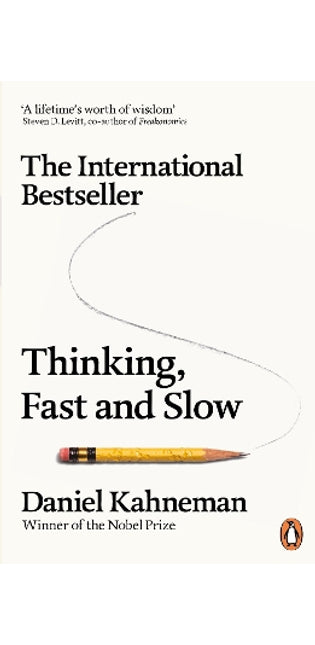
Thinking, Fast and Slow
The phenomenal international bestseller - 2 million copies sold - that will change the way you make decisions 'A lifetime's worth of wisdom' Steven D. Levitt, co-author of Freakonomics 'There have been many good books on human rationality and irrationality, but only one masterpiece. That masterpiece is Thinking, Fast and Slow' Financial Times Why is there more chance we'll believe something if it's in a bold type face? Why are judges more likely to deny parole before lunch? Why do we assume a good-looking person will be more competent? The answer lies in the two ways we make choices: fast, intuitive thinking, and slow, rational thinking. This book reveals how our minds are tripped up by error and prejudice (even when we think we are being logical), and gives you practical techniques for slower, smarter thinking. It will enable to you make better decisions at work, at home, and in everything you do.
R 405.00
Items we need to order for you
Thinking
The first international handbook to bring the areas of reasoning,judgment and decision making together, now in paperback format. The book brings three of the important topics of thinkingtogether - reasoning, judgment and decision making â?? anddiscusses key issues in each area. The studies described range fromthose that are purely laboratory based to those that involveexperts making real world judgments, in areas such as medical andlegal decision making and political and economic forecasting. * International collection of original chapters by leadingresearchers in the field * Several chapters contain important new theoreticalperspectives * Paperback version is more affordable for individualresearchers
R 9,944.00
R 237.00
Thinking
Healthcare faces immense challenges. Ensuring both clinicians and the public remain healthy to negotiate a world of increasing complexity, misinformation and uncertainty is urgent. Does scientific knowledge help them do this?In Thinking, healthcare professionals and researchers Brown, Harvey Bluemel, and Coccia explore how philosophy can help us think differently about health. Drawing from history, culture, literature, and lived experience, they trace the deep connections between ideas, healing, and human flourishing. Each chapter offers accessible explanations of key philosophical ideas, with examples and exercises to help readers bring those ideas into their own lives.This book invites readers to slow down and give thinking the attention it deserves. Thinking is a guide, but also an invitation to ask better questions; make space for reflection; and to rediscover the value of thought in an age that prizes speed and certainty over depth and understanding.
R 4,254.00
Thinking
First published in 1977, this is a volume about the scientific study of thinking: its possibility, its part state and its future prospects. The editors have brought together a set of readings which draw on work in cognitive psychology, artificial intelligence, psycholinguistics and philosophy. It is not, however, a mechanical or merely routine collection. At the time of publication there had been rapid and important advances in several different disciplines concerned with human thinking; many of these advances seem to be fundamental and convergent, to point towards a genuine cognitive science. The editors have tried to capture this sense of readiness, excitement and impetus in their selection of readings and their presentation of them. There are substantial introductions to each of the seven parts of the book as a whole to connect and explain the material, with the student and general reader particularly in mind.
R 2,858.38
Thinking
Unlock your mind From the bestselling authors of Thinking, Fast and Slow; The Black Swan; and Stumbling on Happiness comes a cutting-edge exploration of the mysteries of rational thought, decision-making, intuition, morality, willpower, problem-solving, prediction, forecasting, unconscious behavior, and beyond. Edited by John Brockman, publisher of Edge.org ("The world's smartest website"-The Guardian), Thinking presents original ideas by today's leading psychologists, neuroscientists, and philosophers who are radically expanding our understanding of human thought. Daniel Kahneman on the power (and pitfalls) of human intuition and "unconscious" thinking * Daniel Gilbert on desire, prediction, and why getting what we want doesn't always make us happy * Nassim Nicholas Taleb on the limitations of statistics in guiding decision-making * Vilayanur Ramachandran on the scientific underpinnings of human nature * Simon Baron-Cohen on the startling effects of testosterone on the brain * Daniel C.Dennett on decoding the architecture of the "normal" human mind * Sarah-Jayne Blakemore on mental disorders and the crucial developmental phase of adolescence * Jonathan Haidt, Sam Harris, and Roy Baumeister on the science of morality, ethics, and the emerging synthesis of evolutionary and biological thinking * Gerd Gigerenzer on rationality and what informs our choices
R 456.00
R 570.00
Thinking
Philosophers speak—or, rather, they respond to various forms of speaking that are handed to them. This book by one of our most distinguished philosophers focuses on the communicative aspect of philosophical thought. Peperzak’s central focus is “addressing”: what distinguishes speaking or writing from rumination is their being directed by someone to someone. To be involved in philosophy is to be part of a tradition through which thinkers propose their findings to others, who respond by offering their own appropriations to their interlocutors.After a critical sketch of the conception of modern philosophy, Peperzak presents a succinct analysis of speaking, insisting on the radical distinction between speaking about and speaking to. He enlarges this analysis to history and tries to answer the question whether philosophy also implies a certain form of listening and responding to words of God.Since philosophical speech about persons can neither honor nor reveal their full truth, speaking and thinking about God is even more problematic. Meditation about the archaic Word cannot reach the Speaker unless it turns into prayer, or—as Descartes wrote—into a contemplation that makes the thinker “consider, admire, and adore the beauty of God’s immense light, as much as the eyesight of my blinded mind can tolerate.”“Thinking is a work of genuine and original scholarship which responds to the tradition of philosophical thinking with a critique of its language, style, focus, and scope.”—Catriona Hanley, Loyola College, Maryland
R 3,635.00
Thinking
Sir Frederic Bartlett developed an experimental study of the variety of processes known as thinking. He defines thought as a natural development from earlier established forms of bodily skilled behavior. He has designed some novel experiments (predominantly objective), illustrates some of these experiments, and includes a discussion of their results.
R 2,943.00
Thinking
The “THINKING: Bioengineering of Science and Art” is to discuss about philosophical aspects of thinking at the context of Science and Art. External representations provide evidence that the fundamental process of thinking exists in both animal subjects and humans. However, the diversity and complexity of thinking in humans is astonishing because humans have been permitted to integrate scientific accounts into their accounts and create excellent illustrations for the effects of this integration. The book necessarily begins with the origins of human thinking and human thinking into self and others, body, and life. Multiple factors tend to modify the pattern of thinking. They all will come into play by this book that brings thinking into different disciplines: humanities, natural sciences, social sciences, formal sciences, and applied sciences. The thinking demands full processing of information, and therefore, the book considers the economy of thinking as well. The book thoroughly intends to explore thinking beyond the boundaries. Specifically, several chapters are devoted to discipline this exploration either by artistic thinking alone or by art and mathematics-aided engineering of complexities. In this manner, the book models variations on thinking at the individual and systems levels and accumulates a list of solutions, each good for specific scenarios and maximal outcomes.
R 6,475.25
Think
A defining feature of being human is our ability to think. We refer to ourselves, after all, as homo sapiens. But in a world where experiencing and achieving as much as possible is the number one preoccupation, there is little room for reflection. Technology is also making everything easier, eroding the need for us to think at all. Of course deep, critical thinking can be difficult, sometimes painful, and it demands time. But it is fundamental to our well-being. In this new book, bestselling philosopher and psychologist Svend Brinkmann argues for a return to the thoughtful life, where we learn to think well, to think deeply, to lose ourselves in reverie and tune in to our inner voice. By spending time in our thoughts and letting them wander freely, we will discover that thinking is one of the most enriching things we can do in life – and one of the most human too.
R 1,953.00
Thinking
First published in 1987. Toward the end of August 1984, when most people were enjoying the last beaches and breezes of summer holidays, over 700 people gathered from all parts of the world at the Harvard Graduate School of Education, Cambridge, MA, to hear about, talk about, and think about thinking. The present volume offers a selection of papers from the many more presented at the 1984 International Conference on Thinking, continuing the tradition established by its predecessor volume.
R 9,422.16
Thinking
Philosophers speak—or, rather, they respond to various forms of speaking that are handed to them. This book by one of our most distinguished philosophers focuses on the communicative aspect of philosophical thought. Peperzak’s central focus is “addressing”: what distinguishes speaking or writing from rumination is their being directed by someone to someone. To be involved in philosophy is to be part of a tradition through which thinkers propose their findings to others, who respond by offering their own appropriations to their interlocutors.After a critical sketch of the conception of modern philosophy, Peperzak presents a succinct analysis of speaking, insisting on the radical distinction between speaking about and speaking to. He enlarges this analysis to history and tries to answer the question whether philosophy also implies a certain form of listening and responding to words of God.Since philosophical speech about persons can neither honor nor reveal their full truth, speaking and thinking about God is even more problematic. Meditation about the archaic Word cannot reach the Speaker unless it turns into prayer, or—as Descartes wrote—into a contemplation that makes the thinker “consider, admire, and adore the beauty of God’s immense light, as much as the eyesight of my blinded mind can tolerate.”“Thinking is a work of genuine and original scholarship which responds to the tradition of philosophical thinking with a critique of its language, style, focus, and scope.”—Catriona Hanley, Loyola College, Maryland
R 1,663.00
R 443.25
R 691.00
Thinking
Healthcare faces immense challenges. Ensuring both clinicians and the public remain healthy to negotiate a world of increasing complexity, misinformation and uncertainty is urgent. Does scientific knowledge help them do this?In Thinking, healthcare professionals and researchers Brown, Harvey Bluemel, and Coccia explore how philosophy can help us think differently about health. Drawing from history, culture, literature, and lived experience, they trace the deep connections between ideas, healing, and human flourishing. Each chapter offers accessible explanations of key philosophical ideas, with examples and exercises to help readers bring those ideas into their own lives.This book invites readers to slow down and give thinking the attention it deserves. Thinking is a guide, but also an invitation to ask better questions; make space for reflection; and to rediscover the value of thought in an age that prizes speed and certainty over depth and understanding.
R 980.00
Thinking
The “THINKING: Bioengineering of Science and Art” is to discuss about philosophical aspects of thinking at the context of Science and Art. External representations provide evidence that the fundamental process of thinking exists in both animal subjects and humans. However, the diversity and complexity of thinking in humans is astonishing because humans have been permitted to integrate scientific accounts into their accounts and create excellent illustrations for the effects of this integration. The book necessarily begins with the origins of human thinking and human thinking into self and others, body, and life. Multiple factors tend to modify the pattern of thinking. They all will come into play by this book that brings thinking into different disciplines: humanities, natural sciences, social sciences, formal sciences, and applied sciences. The thinking demands full processing of information, and therefore, the book considers the economy of thinking as well. The book thoroughly intends to explore thinking beyond the boundaries. Specifically, several chapters are devoted to discipline this exploration either by artistic thinking alone or by art and mathematics-aided engineering of complexities. In this manner, the book models variations on thinking at the individual and systems levels and accumulates a list of solutions, each good for specific scenarios and maximal outcomes.
R 7,407.63
R 643.85
Thinking
First Published in 1958, Thinking Introduces a number of simple experiments which can all be repeated by anybody who is interested. They show that the thinker is all the time trying to fill up gaps in information that is available to him in such a manner that there is a good prospect that all other thinkers, given the same incomplete information, will agree with him. How, and what are the conditions, under which he does this, are considered and illustrated a) for formal thinking; b) for the thinking of the experimental scientist; c) for everyday thinking, and d) for the thinking of the artist.A great many of the processes used in thinking have been developed at a level of bodily skill, and long before thinking proper becomes possible at all. At the same time, it becomes clear, as the investigation proceeds, that thinking processes have important characteristics and rules peculiar to themselves. These also vary according to the fields of information in which the thinker operates. There is no doubt that Sir Frederick’s experimental study is a work of first importance and will be useful for scholars and researchers of psychology.
R 6,656.66
R 672.00
R 165.00
Thinking
First Published in 1958, Thinking Introduces a number of simple experiments which can all be repeated by anybody who is interested. They show that the thinker is all the time trying to fill up gaps in information that is available to him in such a manner that there is a good prospect that all other thinkers, given the same incomplete information, will agree with him. How, and what are the conditions, under which he does this, are considered and illustrated a) for formal thinking; b) for the thinking of the experimental scientist; c) for everyday thinking, and d) for the thinking of the artist.A great many of the processes used in thinking have been developed at a level of bodily skill, and long before thinking proper becomes possible at all. At the same time, it becomes clear, as the investigation proceeds, that thinking processes have important characteristics and rules peculiar to themselves. These also vary according to the fields of information in which the thinker operates. There is no doubt that Sir Frederick’s experimental study is a work of first importance and will be useful for scholars and researchers of psychology.
R 1,876.64
Thinking
The first international handbook to bring the areas of reasoning,judgment and decision making together, now in paperback format. The book brings three of the important topics of thinkingtogether - reasoning, judgment and decision making â?? anddiscusses key issues in each area. The studies described range fromthose that are purely laboratory based to those that involveexperts making real world judgments, in areas such as medical andlegal decision making and political and economic forecasting. * International collection of original chapters by leadingresearchers in the field * Several chapters contain important new theoreticalperspectives * Paperback version is more affordable for individualresearchers
R 2,706.00
R 617.18
R 741.57
Thinking
Thinking: A Guide to Systems Engineering Problem-Solving focuses upon articulating ways of thinking in today’s world of systems and systems engineering. It also explores how the old masters made the advances they made, hundreds of years ago. Taken together, these considerations represent new ways of problem solving and new pathways to answers for modern times. Special areas of interest include types of intelligence, attributes of superior thinkers, systems architecting, corporate standouts, barriers to thinking, and innovative companies and universities.This book provides an overview of more than a dozen ways of thinking, to include: Inductive Thinking, Deductive Thinking, Reductionist Thinking, Out-of-the-Box Thinking, Systems Thinking, Design Thinking, Disruptive Thinking, Lateral Thinking, Critical Thinking, Fast and Slow Thinking, and Breakthrough Thinking. With these thinking skills, the reader is better able to tackle and solve new and varied types of problems.Features Proposes new approaches to problem solving for the systems engineer Compares as well as contrasts various types of Systems Thinking Articulates thinking attributes of the great masters as well as selected modern systems engineers Offers chapter by chapter thinking exercises for consideration and testing Suggests a "top dozen" for today’s systems engineers
R 7,552.52
Human Thinking
Human Thinking: The Basics provides an essential introduction into how we develop thoughts, the types of reasoning we engage in, and how our thinking can be tailored by subconscious processing.Beginning with the fundamentals, the book examines the mental processes that shape our thoughts, the trajectory of how thought evolved within the animal kingdom and the stages of development of thinking throughout childhood. Robertson insightfully explains the effectiveness of political slogans and advertisements in engaging shallow information processing and the effortful, analytical processing required in critical thinking. Delving into fascinating topics such as magical thinking in the form of religion and superstition, fake news, and motivated ignorance, the book explains the discrepancy between reality and our internal mental representations, the influence of semantics on deductive reasoning and the error-prone, yet adaptive nature of biases.Containing student-friendly features including end of chapter summaries, demonstrative puzzles, simple figures, and further reading lists, this book will be essential reading for all students of thinking and reasoning.
R 6,118.00
I've Been Thinking
Daniel C. Dennett, preeminent philosopher and cognitive scientist, has spent his career considering the thorniest, most fundamental mysteries of the mind. Do we have free will? What is consciousness and how did it come about? What distinguishes human minds from the minds of animals? Dennett’s answers have profoundly shaped our age of philosophical thought. In I’ve Been Thinking, he reflects on his amazing career and lifelong scientific fascinations. Dennett’s relentless curiosity has taken him from a childhood in Beirut and the classrooms of Harvard, Oxford, and Tufts, to “Cognitive Cruises” on sailboats and the fields and orchards of Maine, and to laboratories and think tanks around the world. Along the way, I’ve Been Thinking provides a master class in the dominant themes of twentieth-century philosophy and cognitive science—including language, evolution, logic, religion, and AI—and reveals both the mistakes and breakthroughs that shaped Dennett’s theories. Key to this journey are Dennett’s interlocutors—Douglas Hofstadter, Marvin Minsky, Willard Van Orman Quine, Gilbert Ryle, Richard Rorty, Thomas Nagel, John Searle, Gerald Edelman, Stephen Jay Gould, Jerry Fodor, Rodney Brooks, and more—whose ideas, even when he disagreed with them, helped to form his convictions about the mind and consciousness. Studded with photographs and told with characteristic warmth, I’ve Been Thinking also instills the value of life beyond the university, one enriched by sculpture, music, farming, and deep connection to family. Dennett compels us to consider: What do I really think? And what if I’m wrong? This memoir by one of the greatest minds of our time will speak to anyone who seeks to balance a life of the mind with adventure and creativity.
R 502.00
R 554.00
R 333.00
What is Thinking?
The philosophical essays of this collection argue, each time from a singular perspective, that the task of thinking is to release the element of the unconditional from various closures, and thus to make it manifest as the true and the essential task of our individual and social existence. Naming this unconditional element as the "messianic", the book displays the profound ethico-political significance of messianic thought for our contemporary world.This book is co-published with Aakar Books, New Delhi. Taylor & Francis does not sell or distribute the print versions of this book in India, Pakistan, Nepal, Bhutan, Bangladesh and Sri Lanka.
R 9,294.25
R 703.00
When Thinking Is a Problem
When Thinking is a Problem examines the activity of thinking and how it is a primary factor in suffering at the individual as well as at the collective level, while at the same time, a necessary function that is often taken for granted and misused. When Thinking is a Problem is unique in helping the reader to see the activity of thinking from a variety of different perspectives provided by writers representing diverse backgrounds. It contains essays, contemplations, and dialogues by eighteen teachers, all of them leaders in their fields. In these chapters, the mechanics and dynamics of thinking are discussed by well-known teachers from the Buddhist and Advaita traditions, as well as from noted neuroscientists, psychologists, philosophers, academics, and prominent writers. In its focus on thinking as it relates to suffering, whether by its presence or absence, the writers discuss the need to honor both thinking as well as the dimension or reality beyond conscious thought.
R 1,393.00
R 744.00
Sonic Thinking
Sonic Thinking attempts to extend the burgeoning field of media philosophy, which so far is defined by a strong focus on cinema, to the field of sound. The contributors urge readers to re-adjust their ideas of Sound Studies by attempting to think not only about sound [by external criteria, such as (cultural) meaning], but to think with and through sound. Series editor Bernd Herzogenrath's collection serves two interconnected purposes: in developing an alternative philosophy of music that takes music serious as a ‘form of thinking’; and in bringing this approach into a fertile symbiosis with the concepts and practices of ‘artistic research’: art, philosophy, and science as heterogeneous, yet coequal forms of thinking and researching. Including contributions by both established figures and younger scholars working on cutting edge material, and weaving artistic responses and interventions in between the more theoretical texts, Herzogenrath's collection provides a lively introduction to a fresh debate.
R 1,441.00
Think
Think is an evolving philosophy questioning what did, is, could, should and shouldn't. The who to find, is you and what to do now.
R 865.00
Thinking in Perspective
Originally published in 1978, the main task of this book was to consider the psychology of thinking in relation to the various perspectives from which thought processes were studied at the time. It provided an up-to-date and critical evaluation of current experimental studies of thinking organized within a framework which reflects the separate theoretical orientations and methodologies through which these investigations are carried out. This approach will help the reader to become aware of the complex relationship between the theoretical orientations, the problems selected for investigation and the methods used for studying them. An important underlying theme of the book concerns the relationship between the activities of the thinker and the demands of his environment.As far as is known, this was the only textbook on thinking to deal with the subject matter specifically in terms of theoretical approaches and methods of investigation at the time.
R 1,612.00
R 775.00
Sonic Thinking
Sonic Thinking attempts to extend the burgeoning field of media philosophy, which so far is defined by a strong focus on cinema, to the field of sound. The contributors urge readers to re-adjust their ideas of Sound Studies by attempting to think not only about sound [by external criteria, such as (cultural) meaning], but to think with and through sound. Series editor Bernd Herzogenrath's collection serves two interconnected purposes: in developing an alternative philosophy of music that takes music serious as a ‘form of thinking’; and in bringing this approach into a fertile symbiosis with the concepts and practices of ‘artistic research’: art, philosophy, and science as heterogeneous, yet coequal forms of thinking and researching. Including contributions by both established figures and younger scholars working on cutting edge material, and weaving artistic responses and interventions in between the more theoretical texts, Herzogenrath's collection provides a lively introduction to a fresh debate.
R 5,591.00
R 1,366.00
R 457.00
R 306.00


-
, by sungano kanjere In Conversation with Dustin Thao
Dustin Thao did not expect to blow up on TikTok. As a breakout title from the FYP, You've Reached Sam has gained a cult following...
-
, by sungano kanjere Celebrate Literacy Month and Heritage Month with top reads from Exclusive Books Recommends!
Get the top reads and recommendations for the month from Exclusive Books Recommends.

