Search results for "Timothy Masters"
Items we need to order for you

R 305.00
R 610.00
R 610.00
Assessing and Improving Prediction and Classification
Assess the quality of your prediction and classification models in ways that accurately reflect their real-world performance, and then improve this performance using state-of-the-art algorithms such as committee-based decision making, resampling the dataset, and boosting. This book presents many important techniques for building powerful, robust models and quantifying their expected behavior when put to work in your application.Considerable attention is given to information theory, especially as it relates to discovering and exploiting relationships between variables employed by your models. This presentation of an often confusing subject avoids advanced mathematics, focusing instead on concepts easily understood by those with modest background in mathematics.All algorithms include an intuitive explanation of operation, essential equations, references to more rigorous theory, and commented C++ source code. Many of these techniques are recent developments, still not in widespread use. Others are standard algorithms given a fresh look. In every case, the emphasis is on practical applicability, with all code written in such a way that it can easily be included in any program.What You'll LearnCompute entropy to detect problematic predictorsImprove numeric predictions using constrained and unconstrained combinations, variance-weighted interpolation, and kernel-regression smoothingCarry out classification decisions using Borda counts, MinMax and MaxMin rules, union and intersection rules, logistic regression, selection by local accuracy, maximization of the fuzzy integral, and pairwise couplingHarness information-theoretic techniques to rapidly screen large numbers of candidate predictors, identifying those that are especially promisingUse Monte-Carlo permutation methods to assess the role of good luck in performance resultsCompute confidence and tolerance intervals for predictions, as well as confidence levels for classification decisionsWho This Book is ForAnyone who creates prediction or classification models will find a wealth of useful algorithms in this book. Although all code examples are written in C++, the algorithms are described in sufficient detail that they can easily be programmed in any language.
R 2,314.76
R 1,210.63
Testing and Tuning Market Trading Systems
Build, test, and tune financial, insurance or other market trading systems using C++ algorithms and statistics. You’ve had an idea and have done some preliminary experiments, and it looks promising. Where do you go from here? Well, this book discusses and dissects this case study approach. Seemingly good backtest performance isn't enough to justify trading real money. You need to perform rigorous statistical tests of the system's validity. Then, if basic tests confirm the quality of your idea, you need to tune your system, not just for best performance, but also for robust behavior in the face of inevitable market changes. Next, you need to quantify its expected future behavior, assessing how bad its real-life performance might actually be, and whether you can live with that. Finally, you need to find its theoretical performance limits so you know if its actual trades conform to this theoretical expectation, enabling you to dump the system if it does not live up to expectations.This book does not contain any sure-fire, guaranteed-riches trading systems. Those are a dime a dozen... But if you have a trading system, this book will provide you with a set of tools that will help you evaluate the potential value of your system, tweak it to improve its profitability, and monitor its on-going performance to detect deterioration before it fails catastrophically. Any serious market trader would do well to employ the methods described in this book.What You Will LearnSee how the 'spaghetti-on-the-wall' approach to trading system development can be done legitimatelyDetect overfitting early in developmentEstimate the probability that your system's backtest results could have been due to just good luckRegularize a predictive model so it automatically selects an optimal subset of indicator candidatesRapidly find the global optimum for any type of parameterized trading systemAssess the ruggedness of your trading system against market changesEnhance the stationarity and information content of your proprietary indicatorsNest one layer of walkforward analysis inside another layer to account for selection bias in complex trading systemsCompute a lower bound on your system's mean future performanceBound expected periodic returns to detect on-going system deterioration before it becomes severeEstimate the probability of catastrophic drawdown Who This Book Is ForExperienced C++ programmers, developers, and software engineers. Prior experience with rigorous statistical procedures to evaluate and maximize the quality of systems is recommended as well.
R 1,449.43
R 1,073.00
Deep Belief Nets in C++ and CUDA C: Volume 3
Discover the essential building blocks of a common and powerful form of deep belief network: convolutional nets. This book shows you how the structure of these elegant models is much closer to that of human brains than traditional neural networks; they have a ‘thought process’ that is capable of learning abstract concepts built from simpler primitives. These models are especially useful for image processing applications. At each step Deep Belief Nets in C++ and CUDA C: Volume 3 presents intuitive motivation, a summary of the most important equations relevant to the topic, and concludes with highly commented code for threaded computation on modern CPUs as well as massive parallel processing on computers with CUDA-capable video display cards. Source code for all routines presented in the book, and the executable CONVNET program which implements these algorithms, are available for free download.What You Will LearnDiscover convolutional nets and how to use themBuild deep feedforward nets using locally connected layers, pooling layers, and softmax outputsMaster the various programming algorithms requiredCarry out multi-threaded gradient computations and memory allocations for this threadingWork with CUDA code implementations of all core computations, including layer activations and gradient calculationsMake use of the CONVNET program and manual to explore convolutional nets and case studiesWho This Book Is ForThose who have at least a basic knowledge of neural networks and some prior programming experience, although some C++ and CUDA C is recommended.
R 1,545.41
Data Mining Algorithms in C++
Discover hidden relationships among the variables in your data, and learn how to exploit these relationships. This book presents a collection of data-mining algorithms that are effective in a wide variety of prediction and classification applications. All algorithms include an intuitive explanation of operation, essential equations, references to more rigorous theory, and commented C++ source code.Many of these techniques are recent developments, still not in widespread use. Others are standard algorithms given a fresh look. In every case, the focus is on practical applicability, with all code written in such a way that it can easily be included into any program. The Windows-based DATAMINE program lets you experiment with the techniques before incorporating them into your own work.What You'll LearnUse Monte-Carlo permutation tests to provide statistically sound assessments of relationships present in your dataDiscover how combinatorially symmetric cross validation reveals whether your model has true power or has just learned noise by overfitting the dataWork with feature weighting as regularized energy-based learning to rank variables according to their predictive power when there is too little data for traditional methodsSee how the eigenstructure of a dataset enables clustering of variables into groups that exist only within meaningful subspaces of the dataPlot regions of the variable space where there is disagreement between marginal and actual densities, or where contribution to mutual information is highWho This Book Is ForAnyone interested in discovering and exploiting relationships among variables. Although all code examples are written in C++, the algorithms are described in sufficient detail that they can easily be programmed in any language.
R 1,980.80
Modern Data Mining Algorithms in C++ and CUDA C
Discover a variety of data-mining algorithms that are useful for selecting small sets of important features from among unwieldy masses of candidates, or extracting useful features from measured variables. As a serious data miner you will often be faced with thousands of candidate features for your prediction or classification application, with most of the features being of little or no value. You’ll know that many of these features may be useful only in combination with certain other features while being practically worthless alone or in combination with most others. Some features may have enormous predictive power, but only within a small, specialized area of the feature space. The problems that plague modern data miners are endless. This book helps you solve this problem by presenting modern feature selection techniques and the code to implement them. Some of these techniques are:Forward selection component analysisLocal feature selectionLinking features and a target with a hidden Markov modelImprovements on traditional stepwise selectionNominal-to-ordinal conversion All algorithms are intuitively justified and supported by the relevant equations and explanatory material. The author also presents and explains complete, highly commented source code. The example code is in C++ and CUDA C but Python or other code can be substituted; the algorithm is important, not the code that's used to write it. What You Will LearnCombine principal component analysis with forward and backward stepwise selection to identify a compact subset of a large collection of variables that captures the maximum possible variation within the entire set.Identify features that may have predictive power over only a small subset of the feature domain. Such features can be profitably used by modern predictive models but may be missed by other feature selection methods.Find an underlying hidden Markov model that controls the distributions of feature variables and the target simultaneously. The memory inherent in this method is especially valuable in high-noise applications such as prediction of financial markets.Improve traditional stepwise selection in three ways: examine a collection of 'best-so-far' feature sets; test candidate features for inclusion with cross validation to automatically and effectively limit model complexity; and at each step estimate the probability that our results so far could be just the product of random good luck. We also estimate the probability that the improvement obtained by adding a new variable could have been just good luck. Take a potentially valuable nominal variable (a category or class membership) that is unsuitable for input to a prediction model, and assign to each category a sensible numeric value that can be used as a model input. Who This Book Is For Intermediate to advanced data science programmers and analysts.
R 1,693.78
Deep Belief Nets in C++ and CUDA C: Volume 1
Discover the essential building blocks of the most common forms of deep belief networks. At each step this book provides intuitive motivation, a summary of the most important equations relevant to the topic, and concludes with highly commented code for threaded computation on modern CPUs as well as massive parallel processing on computers with CUDA-capable video display cards. The first of three in a series on C++ and CUDA C deep learning and belief nets, Deep Belief Nets in C++ and CUDA C: Volume 1 shows you how the structure of these elegant models is much closer to that of human brains than traditional neural networks; they have a thought process that is capable of learning abstract concepts built from simpler primitives. As such, you’ll see that a typical deep belief net can learn to recognize complex patterns by optimizing millions of parameters, yet this model can still be resistant to overfitting. All the routines and algorithms presented in the book are available in the code download, which also contains some libraries of related routines. What You Will LearnEmploy deep learning using C++ and CUDA CWork with supervised feedforward networks Implement restricted Boltzmann machines Use generative samplingsDiscover why these are importantWho This Book Is ForThose who have at least a basic knowledge of neural networks and some prior programming experience, although some C++ and CUDA C is recommended.
R 866.00
R 1,244.44
R 942.28
4-Hour Chef
WHAT IF YOU COULD BECOME WORLD-CLASS IN ANYTHING IN 6 MONTHS OR LESS? The 4-Hour Chef isn't just a cookbook. It's a choose-your-own-adventure guide to the world of rapid learning. #1 New York Times bestselling author (and lifelong non-cook) Tim Ferriss takes you from Manhattan to Okinawa, and from Silicon Valley to Calcutta, unearthing the secrets of the world's fastest learners and greatest chefs. Ferriss uses cooking to explain "meta-learning," a step-by-step process that can be used to master anything, whether searing steak or shooting 3-pointers in basketball. That is the real "recipe" of The 4-Hour Chef. You'll train inside the kitchen for everything outside the kitchen. Featuring tips and tricks from chess prodigies, world-renowned chefs, pro athletes, master sommeliers, super models, and everyone in between, this "cookbook for people who don't buy cookbooks" is a guide to mastering cooking and life. The 4-Hour Chef is a five-stop journey through the art and science of learning: 1. META-LEARNING. Before you learn to cook, you must learn to learn. META charts the path to doubling your learning potential. 2. THE DOMESTIC. DOM is where you learn the building blocks of cooking. These are the ABCs (techniques) that can take you from Dr, Seuss to Shakespeare. 3. THE WILD. Becoming a master student requires self-sufficiency in all things. WILD teaches you to hunt, forage, and survive. 4. THE SCIENTIST. SCI is the mad scientist and modernist painter wrapped into one. This is where you rediscover whimsy and wonder. 5. THE PROFESSIONAL. Swaraj, a term usually associated with Mahatma Gandhi, can be translated as "self-rule." In PRO, we'll look at how the best in the world become the best in the world, and how you can chart your own path far beyond this book.
R 1,026.00
New Masters of Capital
In The New Masters of Capital, Timothy J. Sinclair examines a key aspect of the global economy—the rating agencies. In the global economy, trust is formalized in the daily operations of such firms as Moody's and Standard & Poor's, which continuously monitor the financial health of bond-issuers ranging from private corporations to local and national governments. Their judgments affect unimaginably large sums, approximately $30 trillion in outstanding debt issues, according to a recent Moody's estimate. The difference between an AA and a BB rating may cost millions of dollars in interest payments or determine if a corporation or government can even issue bonds.Without bond rating agencies, there would be no standard means to compare risks in the global economy, and international investment would be problematic. Most observers assume that the agencies are neutral and scientific, and that they interpret their role in narrowly economic terms. But these agencies, by their nature, wield extraordinary power and exert massive influence over public policy. Sinclair offers a highly accessible account of these institutions, their origins, and the rating processes they use to judge creditworthiness. Illustrated with a wide range of cases, this book offers a fresh assessment of the role of an often-overlooked institution in the dynamics of modern global capitalism.
R 1,823.00
New Masters of Capital
In The New Masters of Capital, Timothy J. Sinclair examines a key aspect of the global economy—the rating agencies. In the global economy, trust is formalized in the daily operations of such firms as Moody's and Standard & Poor's, which continuously monitor the financial health of bond-issuers ranging from private corporations to local and national governments. Their judgments affect unimaginably large sums, approximately $30 trillion in outstanding debt issues, according to a recent Moody's estimate. The difference between an AA and a BB rating may cost millions of dollars in interest payments or determine if a corporation or government can even issue bonds.Without bond rating agencies, there would be no standard means to compare risks in the global economy, and international investment would be problematic. Most observers assume that the agencies are neutral and scientific, and that they interpret their role in narrowly economic terms. But these agencies, by their nature, wield extraordinary power and exert massive influence over public policy. Sinclair offers a highly accessible account of these institutions, their origins, and the rating processes they use to judge creditworthiness. Illustrated with a wide range of cases, this book offers a fresh assessment of the role of an often-overlooked institution in the dynamics of modern global capitalism.
R 999.00
R 1,366.00
Entering the Chain of Union
Entering the Chain of Union explores different esoteric, spiritual, and initiatic traditions from around the world and illustrates how they share similar doctrines and rituals. This book is a first hand account by a western initiate as he examines traditions as diverse as Gnosticism, Hermeticism, Sufi, Druze, Taoist and Tibetan alchemical doctrines, Egyptian mysteries, Mayan traditions, and an exploration of many sacred monuments from around the world. It is also a first hand account of his meeting with spiritual leaders of different traditions, including Harun Yahya. This book will be particularly interesting to anyone with a background in Templarism, Freemasonry, Rosicrucianism, or Martinism. Timothy Hogan is the Grand Master of the Knights Templar (Ordre Souverain du Temple Initiatique lineage), and he currently runs CIRCES International. He speaks regularly around the world on the western mystery tradition. This book follows some of his travels as he attempts to do The Great Work.
R 1,557.00
Whore
This book about Whores is brought to you by just maybe the craziest man on the planet. He is known as the "Fetish King"and the "Master of Horror" he is Timothy Mark. With 8 books to his credit and 3 full length feature films this man is definitely carving his way in the history books as one of the great authors of all time. This book is a must have for people wanting to learn about the Whore.
R 284.00
Beating the Kings Indian and Grunfeld
In this book, Timothy Taylor gets to grips with the King's Indian and Grunfeld, providing White with a number of easy-to-learn and effective weapons which are specially designed to cause Black maximum discomfort. Taylor examines the typical tactical and positional ideas for both players, highlighting the tricks and pitfalls one must look out for. A study of this book will allow the reader to battle against the King's Indian and the Grunfeld with renewed confidence. *Written by a renowned openings expert *Weapons against two of Black's most popular defences *Ideal for club and tournament players International Master Timothy Taylor is an experienced tournament player who has enjoyed several notable successes, including winning the US Open. He is also a skilled chess writer, one of his previous books, How to Defeat the Smith-Morra Gambit, becoming a US Chess Federation bestseller. This is his second book for Everyman Chess; his first was Bird's Opening. Outside of chess, he is the author of two published novels, Elaine the Fair and Amanda, while he directed the film Wicked Pursuits.
R 686.46
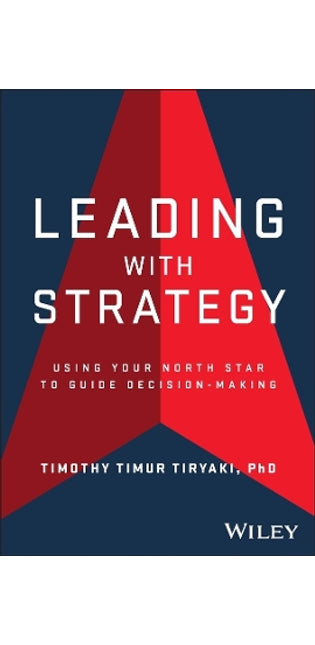
Leading with Strategy
A powerful collection of over 50 adaptable strategy frameworks to solve today's most complex business challenges In Leading With Strategy: Using Your North Star to Guide Decision-Making, veteran executive coach and strategy consultant for Fortune 500 firms Timothy Tiryaki delivers a transformative guide that clarifies the complex tradeoffs in today's AI-enabled business environment. Dr. Tiryaki explores the contemporary maze of undiscussed leadership dilemmas that have been surfaced by the latest generative AI technologies and provides unique perspectives on strategic thinking and leadership. At the core of Leading With Strategy are 50 practical visual frameworks. They're dynamic tools designed as adaptable tools for creatively tackling diverse challenges and obstacles. These frameworks go beyond staid, one-size-fits-all approaches to common business problems and help you master essential strategic thinking and execution skills. Inside the book: Dozens of illustrated frameworks and models designed as “thinking hats” to help you reflect on and solve complex problemsOriginal insights that encourage you to build your awareness and ask the right questions in the right situationsExpert techniques to scope a situation, gather relevant evidence, collaborate with others, co-create alignment, and make informed decisions Perfect for managers, executives, entrepreneurs, founders, and other business leaders, Leading With Strategy is a must-have collection of problem-solving tools you can adapt to virtually any obstacle, challenge, or problem you encounter in the workplace.
R 639.00
Entering the Chain of Union
Entering the Chain of Union explores different esoteric, spiritual, and initiatic traditions from around the world and illustrates how they share similar doctrines and rituals. This book is a first hand account by a western initiate as he examines traditions as diverse as Gnosticism, Hermeticism, Sufi, Druze, Taoist and Tibetan alchemical doctrines, Egyptian mysteries, Mayan traditions, and an exploration of many sacred monuments from around the world. It is also a first hand account of his meeting with spiritual leaders of different traditions, including Harun Yahya. This book will be particularly interesting to anyone with a background in Templarism, Freemasonry, Rosicrucianism, or Martinism. Timothy Hogan is the Grand Master of the Knights Templar (Ordre Souverain du Temple Initiatique lineage), and he currently runs CIRCES International. He speaks regularly around the world on the western mystery tradition. This book follows some of his travels as he attempts to do The Great Work.
R 1,248.03
Master Medicine: Microbiology and Infection
Approx. 328 pagesConcise synoptic (not telegraphic text).Appropriate self-assessment material.Only covers core, so student knows the whole book is essential.Includes key objectives.Contains simple and memorable diagrams for reproduction in exams.Ideal for learning as well as examination review, specifically trying to stimulate the student into assessing his/her own knowledge.The books in the series both complement other available major texts, but also contain enough material to stand in the own right.Provides examination practice.Part of co-ordinated series.Contents refined to reflect 'core knowledge'Major revision of self-assessment material to match change in exam styles (more Extended Matching Questions and OSC-style questions)
R 1,205.00
R 1,275.00
Bird's Opening
Bird's Opening is an underrated and dynamic choice for White that immediately directs the game into relatively unexplored territory, setting Black players early problems and forcing them to think for themselves rather than having the luxury of relying on the theory of more mainstream openings. It's also a very flexible option that can lead to both sharp gambit play, such as the notorious From's Gambit, as well as quieter positional lines. In this book International Master Timothy Taylor unearths the secrets of Bird's Opening and its many deviations. Using illustrative games, he examines tactical and positional ideas for both colours and recommends the best paths in both the "main lines" and the lesser-trodden paths. A study of this book will give readers the required knowledge and confidence to play the Bird's Opening with either color.
R 712.63
R 761.00
R 671.00
R 852.00
R 1,024.00
Deep Belief Nets in C++ and CUDA C: Volume 2
Discover the essential building blocks of a common and powerful form of deep belief net: the autoencoder. You’ll take this topic beyond current usage by extending it to the complex domain for signal and image processing applications. Deep Belief Nets in C++ and CUDA C: Volume 2 also covers several algorithms for preprocessing time series and image data. These algorithms focus on the creation of complex-domain predictors that are suitable for input to a complex-domain autoencoder. Finally, you’ll learn a method for embedding class information in the input layer of a restricted Boltzmann machine. This facilitates generative display of samples from individual classes rather than the entire data distribution. The ability to see the features that the model has learned for each class separately can be invaluable. At each step this book provides you with intuitive motivation, a summary of the most important equations relevant to the topic, and highly commented code for threaded computation on modern CPUs as well as massive parallel processing on computers with CUDA-capable video display cards. What You'll LearnCode for deep learning, neural networks, and AI using C++ and CUDA CCarry out signal preprocessing using simple transformations, Fourier transforms, Morlet wavelets, and moreUse the Fourier Transform for image preprocessingImplement autoencoding via activation in the complex domainWork with algorithms for CUDA gradient computationUse the DEEP operating manualWho This Book Is ForThose who have at least a basic knowledge of neural networks and some prior programming experience, although some C++ and CUDA C is recommended.
R 1,298.29
How to Develop and Implement a Security Master Plan
Engage Stakeholders with a Long-Term SolutionThe goal: Convince executive management to "buy in" to your security program, support it, and provide the largest possible amount of funding.The solution: Develop a meticulously detailed long-term plan that sells decision-makers on the dire need for your program, and then maps out its direction and required budget. Assess and Outline Security Risks to Map Out Mitigation Strategies This practical guide details how to construct a customized, comprehensive five-year corporate security plan that synchronizes with the strategies of any business or institution. The author explains how to develop a plan and implementation strategy that aligns with an organization’s particular philosophies, strategies, goals, programs, and processes. Readers learn how to outline risks and then formulate appropriate mitigation strategies. This guide provides tested, real-world solutions on how to: Conduct an effective, efficient assessment of the site and security personnel, meticulously addressing the particular needs of many different environments Make decisions about security philosophies, strategies, contract relationships, technology, and equipment replacement Interview executive and security management to determine their concerns, educate them, and ensure that they buy in to your plan Use all gathered data to construct and finalize the Security Master Plan and then implement it into the management of the businessApply Insights from an Expert with Global Experience at the Highest LevelAuthor Tim Giles worked at IBM for 31 years serving as Director of Security for the company’s operations in the United States and Canada, as well as Latin America and Asia-Pacific. His immeasurable experience and insight provide readers with an extraordinarily comprehensive understanding that they can use to design and execute a highly effective, tailored security program.
R 7,592.91
R 911.00
Biblical Interpretation of William of Alton
Studies of medieval Biblical interpretation usually focus on the printed literature, neglecting the vast majority of relevant works. Timothy Bellamah offers a groundbreaking examination of the exegesis of William of Alton, a thirteenth-century Dominican regent master at Paris whose commentaries have never previously appeared in print. As a near contemporary of Hugh of St. Cher, Bonaventure, Albert the Great, and Thomas Aquinas, William was an important representative of university exegesis at a time of rapidly changing methods and remarkable intellectual development. His commentaries are valuable resources for understanding Biblical study of the thirteenth century, in the schoolroom and in the pulpit. Yet study of William's work has been impeded by the dubious authenticity of numerous commentaries questionably attributed tohim over the centuries. Bellamah addresses these complex problems by unearthing evidence of authorship in each commentary's style and methodology. This inquiry employs the traits of William's commentaries as criteria for constituting a list of works that can be reliably attributed to him, which, in turn, provides a crucial basis for studying his exegesis. William was a man of his time, but even more than his contemporaries he was deeply interested in history and the literal sense, which he understood to be theintention of Scripture's authors, divine and human. He took a keen interest in Biblical history and put to use a wide array of procedures for textual, linguistic, and rhetorical analysis. At the same time, he remained aware of the spiritual senses and the diverse elements of the exegetical and theologicaltradition in which he stood.
R 4,016.99
R 388.52
R 546.00
Teaching Essential Mathematics, Grades K-8
"The activities can be used to help students understand the reason for the algorithms. Students should not just learn ′how,′ but also ′why.′"—Carrie Chiappetta, Math TeacherMagnet Middle School, Stamford, CT"This is a much needed resource book for both inservice and preservice teachers."—Helen Melvin, Second-Grade TeacherDr. Levesque School Elementary School, Fort Kent, MECreative, ready-to-use classroom activities for teaching essential math concepts!Not all educators feel comfortable teaching math, yet it is critical for all students to gain a solid foundation of mathematical understanding in grades K–8. Written by a national consultant in mathematics instruction and assessment, this resource helps educators gain the confidence they need to teach math in creative and engaging ways.Teaching Essential Mathematics, Grades K–8 provides teachers with an overview of the key mathematics concepts students need to acquire and includes hands-on activities and clear examples to help students learn these concepts in depth. The classroom-ready activities and calculator exercises are organized according to the NCTM content standards, and each activity is directly aligned with specific benchmarks. The material also features:Suggestions for incorporating cooperative learning into mathematics instructionA comprehensive glossary of mathematical terms to broaden educators′ subject knowledgeReproducible blackline masters that can be used with students immediatelyBoth new and veteran teachers can leverage this book′s many rich examples and student-centered learning tasks to re-energize their instruction and renew students′ enthusiasm.
R 1,074.52
Take the Plunge
Timothy Radcliffe holds a unique position in the modern Catholic Church. As Master of the Dominican Order in Rome for nine years, he held one of the most senior and influential appointments the Catholic Church has on offer. But he is a member of an Order of Preachers and is thus truly apostolic. The order's motto consists of one word, Veritas (Truth), and it is the vigorous pursuit of intellectual and emotional truth which is the hallmark of his writing. This new book will not disappoint his admirers. Here, Fr Radcliffe argues that Christianity will only thrive today, overcoming the challenges of secularism and religious fundamentalism, if we rediscover the beauty of baptism. It touches the deepest dramas of human life: birth, growing up, falling in love, daring to give oneself to others, searching for meaning, coping with suffering and failure, and eventually death.
R 387.00
Recognition and the Self in Hegel's Phenomenology of Spirit
Hegel's Phenomenology of Spirit is famed for its account of the problem of recognition. Yet while readers agree about the importance of its influential accounts of the struggle to the death and the master/slave relation in developing that problem, there is no consensus regarding what sorts of relations among subjects would count as successful forms of recognition. Timothy Brownlee articulates the essential connections between Hegel's concepts of recognition and the self, and presents a novel interpretation of the Phenomenology that traces the emergence of actual relations of reciprocal recognition through the work as a whole. He focuses on the distinctive social constitution conception of the self that Hegel develops in his account of 'spirit,' and demonstrates that the primary significance of recognition lies in its contribution to self-knowledge. His book will be valuable for scholars and students interested in Hegel, German Idealism, and philosophical conceptions of recognition.
R 4,052.22
Rousseau
Timothy O'Hagan investigates Jean-Jacques Rousseau's writings concerning the formation of humanity, of the individual and of the citizen in his three master works: the "Discourse on the Origin of Inequality among Men", "Emile" and the "Social Contract". O'Hagan gives Rousseau's arguments a close and sympathetic reading and explores his reflections on the sexes, language and religion. O'Hagan writes as a philosopher, not a historian - yet he does not lose sight of the cultural context of Rousseau's work.
R 2,846.09