



Search results for "William Javier Nelson"
Items in stock - 4 working days delivery time

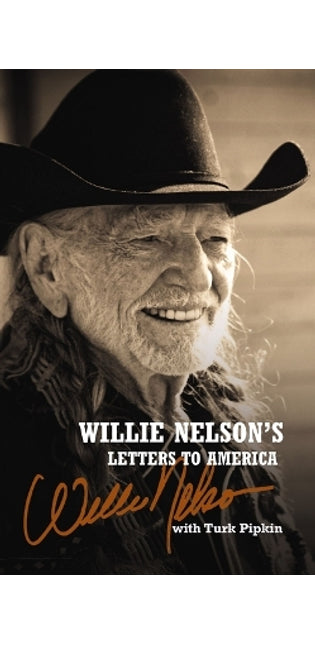
Willie Nelson's Letters to America
An intimate collection of fond memories, personal letters, good songs, and bad jokes from a true American legend."This is your old friend, Willie, sending a note to see how you're doing and to say I'm doing fine."In this series of short letters straight from the heart, Willie sends his thanks and his thoughts to everyone from his family, his fellow musicians, his heroes, and his guitar "Trigger."These letters, written in the straight-shooting, heart-rending, and profound style of his songs are a lyrical homage to all Americans—past, present, and future. From his opening letter "Dear America" to his epilogue, Willie digs deep into his heart and soul—and his music—to lift us up in difficult times, and to remind us of the endless promise and continuous obligations to ourselves, to one another, and to our nation.These pages are also filled with the moving lyrics to some of his most famous and insightful songs, including "Let Me Be a Man," "Family Bible," "Summer of Roses," "Me and Paul," "A Horse called Music," "Healing Hands of Time," and "Yesterday's Wine."Willie Nelson's Letters to America is perfect for:Musicians and fans of country, bluegrass, and folk music.Fans of Willie’s bestselling memoir, It’s A Long Story.Anyone looking for some simple and timeless wisdom and tasteful humor.All Americans: who need to be reminded that "when the going gets tough, the tough needs a little inspiration to get going."
R 415.00
Items we need to order for you
R 737.00
Willie Nelson - An Epic Life
Willie Nelson has spent the last 30 years on that higher plane of celebrity where he signifies many things to many people--American folk hero, national treasure, Outlaw, tax dodger, country traditionalist, actor and friend of the farmer amongst many others. Acclaimed biographer and journalist Joe Nick Patoski offers a frank and thorough portrait, adding some surprising insight on this beloved performer. From his humble beginnings in Waco, TX, cared for by his grandparents, to learning to play guitar at 6 and wrote his first song at 7 to his remarkable rise to legendary status as a genre-bending music maker and a bona fide Hollywood darling, Patoski draws from his own association with Nelson, a relationship that began in the 1970s when Patoski began writing about the man and his music. Why does Nelson keep going down the road, steady as a mountain stream, creating an illusion for the millions that sit in awe of him as he sings the same repertoire night after night? With relish, Willie delves into these questions and more as Patoski reveals the true motivations for the Texanmost Texan.
R 667.00
R 941.37
R 1,216.51
R 846.99
R 452.00
R 1,131.96
R 695.09
R 451.00
R 517.00
R 692.87
R 672.00
Time of Enlightenment
A new idea of the future emerged in eighteenth-century France. With the development of modern biological, economic, and social engineering, the future transformed from being predetermined and beyond significant human intervention into something that could be dramatically affected through actions in the present.The Time of Enlightenment argues that specific mechanisms for constructing the future first arose through the development of practices and instruments aimed at countering degeneration. In their attempts to regenerate a healthy natural state, Enlightenment philosophes created the means to exceed previously recognized limits and build a future that was not merely a recuperation of the past, but fundamentally different from it. A theoretically inflected work combining intellectual history and the history of science, this book will appeal to anyone interested in European history and the history of science, as well as the history of France, the Enlightenment, and the French Revolution.
R 3,009.00
Muddy Ground
In early North America, carrying watercraft—usually canoes—and supplies across paths connecting one body of water to another was essential in the establishment of both Indigenous and European mobility in the continent's interior. The Chicago portage, a network of overland canoe routes that connected the Great Lakes and Mississippi watersheds, grew into a crossroads of interaction as Indigenous and European people vied for its control during early contact and colonization. John William Nelson charts the many peoples that traversed and sought power along Chicago's portage paths from the seventeenth to the mid-nineteenth centuries, including Indigenous Illinois traders, French explorers, Jesuit missionaries, Meskwaki warriors, British officers, Anishinaabe headmen, and American settlers. Nelson compellingly demonstrates that even deep within the interior, power relations fluctuated based on the control of waterways and local environmental knowledge. Pushing beyond political and cultural explanations for Indigenous-European relations in the borderlands of North America, Nelson places environmental and geographic realities at the center of the history of Indigenous Chicago, offering a new explanation for how the United States gained control of the North American interior through a two-pronged subjugation of both the landscapes and peoples of the continent.
R 3,044.00
Willie
Willie Nelson is more than just a singer whose albums have captures this country's imagination for more than thirty years: he is the nearest thing we have to the poet laureate of America's heart and the heartland. Told with frankness, warmth and earthy humor, here is Willie's story: his depression ere childhood; his stormy marriages; his will experiences with drugs, booze and women; his long rise to stardom; his musical and personal experiences with Waylon Jennings, Julio Iglesias, Kris Kristopherson, Johnny Cash, Ray Charles, Loretta Lynn, George Jones, Frank Sinatra and Linda Ronstadt.
R 487.00
R 576.00
R 897.00
Muddy Ground
In early North America, carrying watercraft—usually canoes—and supplies across paths connecting one body of water to another was essential in the establishment of both Indigenous and European mobility in the continent's interior. The Chicago portage, a network of overland canoe routes that connected the Great Lakes and Mississippi watersheds, grew into a crossroads of interaction as Indigenous and European people vied for its control during early contact and colonization. John William Nelson charts the many peoples that traversed and sought power along Chicago's portage paths from the seventeenth to the mid-nineteenth centuries, including Indigenous Illinois traders, French explorers, Jesuit missionaries, Meskwaki warriors, British officers, Anishinaabe headmen, and American settlers. Nelson compellingly demonstrates that even deep within the interior, power relations fluctuated based on the control of waterways and local environmental knowledge. Pushing beyond political and cultural explanations for Indigenous-European relations in the borderlands of North America, Nelson places environmental and geographic realities at the center of the history of Indigenous Chicago, offering a new explanation for how the United States gained control of the North American interior through a two-pronged subjugation of both the landscapes and peoples of the continent.
R 1,216.38
Appointment at Ie Shima
On the 25 of July, 1944, Ernie Pyle suffered an injury to his mind of a type the very existence of which would not be recognized by medical science for decades yet to come. Still that injury surely drove him, on April 18, 1945, to an appointment on a little island in the Pacific with the obscure name, Ie Shima.
R 454.00
R 452.00
R 1,133.72
R 1,089.00
R 1,129.75
R 1,130.64
R 295.48
Common Law in Colonial America
The eminent legal historian William E. Nelson's magisterial four-volume The Common Law in Colonial America traces how the many legal orders of Britain's thirteen North American colonies gradually evolved into one American system. Initially established on divergent political, economic, and religious grounds, the various colonial systems slowly converged until it became possible by the 1770s to imagine that all thirteen participated in a common American legalorder, which diverged in its details but differed far more substantially from English common law. This fourth and final volume begins where volume three ended. It focuses on the laws of the thirteen colonies in the mid-eighteenth century and on constitutional events leading up to the American Revolution. Nelson first examines procedural and substantive law and looks at important shifts in the law to show how the mid-eighteenth- century colonial legal system in large part functioned effectively in the interests both of Great Britain and of its thirteen colonies. Nelson then turns to constitutional events leading to the Revolution. Here he shows how lawyers deployed ideological arguments not for their own sake, but in order to protect colonial institutional structures and the socio-economic interests of their clients. As lawyers deployed the arguments, they developed them into a constitutional theory that gave primacy to common-law constitutional rights and local self-government. In the process, the lawyers became leaders of the revolutionary movementand a dominant political force in the new United States.
R 3,597.74
R 554.49
White Hat
Best known for his role in the arrest and killing of Crazy Horse and for the book he wrote, The Indian Sign Language, Captain William Philo Clark (1845-1884) was one of the Old Army's renaissance men, by turns administrator, fighter, diplomat, explorer, and ethnologist. As such, Clark found himself at center stage during some of the most momentous events of the post-Civil War West: from Brigadier General George Crook's infamous 'Starvation March' to the Battle of Slim Buttes and the Dull Knife Fight, then to the attack against the Bannocks at Index Peak and Sitting Bull's final fight against the U.S. Army. Captain Clark's life story, here chronicled in full for the first time, is at once an introduction to a remarkable figure in the annals of nineteenth-century U.S. history, and a window on the exploits of the U.S. Army on the contested western frontier. White Hat follows Clark from his upbringing in New York State to his life as a West Point cadet, through his varied army posts on the northern plains, and finally to his stint in Lieutenant General Philip Sheridan's headquarters first in Chicago and later in Washington, D.C. Along the way, Mark J. Nelson sets the record straight on Clark's controversial relationship with Crazy Horse during the Lakota leader's time at Camp Robinson, Nebraska. His book also draws a detailed picture of Clark's service at Fort Keogh, Montana Territory, including what is arguably his greatest success - the securing of Northern Cheyenne leader Little Wolf's peaceful surrender. In telling Clark's story, White Hat illuminates the history of the nineteenth-century American military and the Great Plains, including the Grand Duke Alexis's buffalo hunt, the Great Sioux War, and the careers of Crook and Sheridan. Nelson's examination of Clark's early years in the army offers a rare look at the experiences of a staff officer stationed on the frontier and expands our view of the army, as well as the United States' westward march.
R 724.00
R 1,192.00
R 306.00
R 561.76
William Nelson Lovatt in Late Qing China
William Nelson Lovatt in Late Qing China: War, Maritime Customs, and Treaty Ports,1860-1904 looks at the late Qing dynasty through the eyes of a British-American who spent most of his adult life in China in the late nineteenth century, fighting in four wars, serving in its maritime customs service, and living in eleven different treaty ports. It is based on the newly-discovered journals, correspondence, and photographs of William Nelson Lovatt (1838-1904), who first arrived in China in 1860 as a sergeant in the British army to fight in the Second Opium War, and who then proceeded to fight against the Taiping in Shanghai, against the Nian in Tianjin, and finally against the Japanese in Taiwan, providing an inside look at those four conflicts. Joining the Chinese Imperial Maritime Customs Service in 1863 under Inspector-General Sir Robert Hart, Lovatt provides a rare insider look at the operation of Hart and the Maritime Customs Service for during the four decades he served. Because he was based in treaty ports, he also provides a new look at those enclaves, their institutions, and their inhabitants – Chinese, missionaries, and fellow customs officials. Fluent in Chinese, his frequent travels outside the treaty ports gave him rare access to Chinese society available to few others. This volume opens up a new window on China during the final decades of the Qing dynasty.
R 4,330.00
![William Nelson [microform]](http://exclusivebooks.co.za/cdn/shop/products/9781014434609_a52c904a-c34b-430f-a08a-d6bee744141c.jpg?height=645&pad_color=fff&v=1707370477&width=315)


