


Approx. 20 - 30 Business Days

R 667.00
R 2,197.00
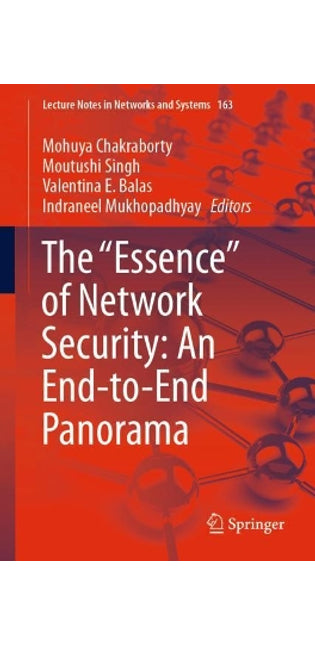
"Essence" of Network Security: An End-to-End Panorama
This edited book provides an optimal portrayal of the principles and applications related to network security. The book is thematically divided into five segments: Part A describes the introductory issues related to network security with some concepts of cutting-edge technologies; Part B builds from there and exposes the readers to the digital, cloud and IoT forensics; Part C presents readers with blockchain and cryptography techniques; Part D deals with the role of AI and machine learning in the context of network security. And lastly, Part E is written on different security networking methodologies.This is a great book on network security, which has lucid and well-planned chapters. All the latest security technologies are thoroughly explained with upcoming research issues. Details on Internet architecture, security needs, encryption, cryptography along with the usages of machine learning and artificial intelligence for network security are presented in a single cover. The broad-ranging text/reference comprehensively surveys network security concepts, methods, and practices and covers network security policies and goals in an integrated manner. It is an essential security resource for practitioners in networks and professionals who develop and maintain secure computer networks.
R 4,725.00
R 545.00
R 303.00
R 249.00
R 212.00
R 871.00
R 451.00
R 576.00
R 562.00
R 636.00
R 455.00
R 361.00
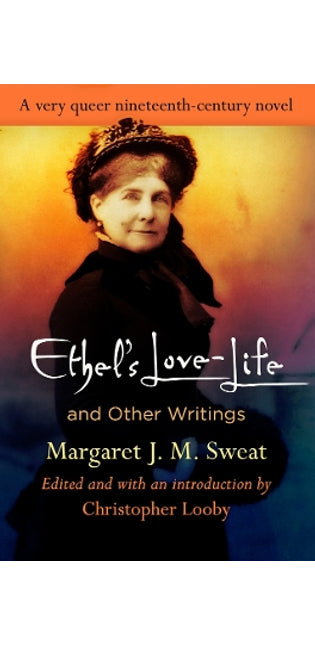
"Ethel's Love-Life" and Other Writings
In a series of lengthy letters, the unsettled and unruly Ethel Sutherland writes to an initially unnamed and ungendered correspondent, and patiently discloses the troubled history of her past romantic attachments to both men and women. Not until the third letter does she reveal that her correspondent is Ernest, the man to whom she is engaged to be married. Wanting to make him understand how all of her past loves are included and sublimated in her love for him, she especially wants to explain how "women often love each other with as much fervor and excitement as they do men"; and although this love is curiously "freed from all the grosser elements of passion, as it exists between sexes," nevertheless it "retains its energy, its abandonment, its flush, its eagerness, its palpitation, and its rapture."Margaret Jane Mussey Sweat (1823-1908), a native of Portland, Maine, and wife of a United States congressman, published Ethel's Love-Life in 1859. The book is sometimes credited as an early—even the first—"lesbian" American novel, but such a label, Christopher Looby observes in his Introduction, somewhat misrepresents what is distinctive and surprising about the book. Ethel's Love-Life confounds our received binary distinctions between the spiritual and the carnal and, indeed, between the sexual and the nonsexual—the boundaries between such categories being not nearly as well-policed at the time as they later became. It is here reprinted, along with Sweat's Verses (1890) and five of her published essays, on Charlotte Brontë, George Sand, the contemporary novel, and the friendships of women.
R 877.00
R 958.00
R 423.00
R 347.00
R 697.00
R 1,033.00
R 613.00
R 445.00
R 364.00
R 453.00
R 566.00
R 163.00
"Every Valley Shall Be Exalted"
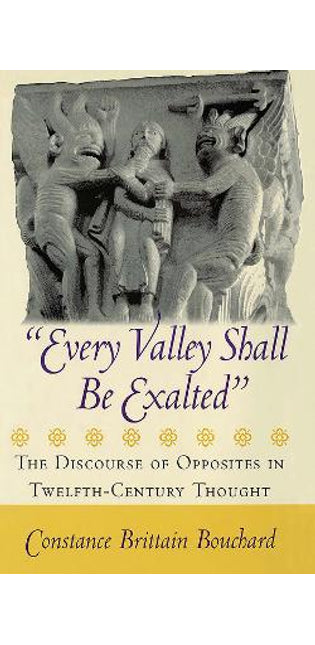
In high medieval France, men and women saw the world around them as the product of tensions between opposites. Imbued with a Christian culture in which a penniless preacher was also the King of Kings and the last were expected to be first, twelfth-century thinkers brought order to their lives through the creation of opposing categories. In a highly original work, Constance Brittain Bouchard examines this poorly understood component of twelfth-century thought, one responsible, in her view, for the fundamental strangeness of that culture to modern thinking.Scholars have long recognized that dialectical reasoning was the basic approach to philosophical, legal, and theological matters in the high Middle Ages. Bouchard argues that this way of thinking and categorizing—which she terms a "discourse of opposites"—permeated all aspects of medieval thought. She rejects suggestions that it was the result of imprecision, and provides evidence that people of that era sought not to reconcile opposing categories but rather to maintain them. Bouchard scrutinizes the medieval use of opposites in five broad areas: scholasticism, romance, legal disputes, conversion, and the construction of gender. Drawing on research in a series of previously unedited charters and the earliest glossa manuscripts, she demonstrates that this method of constructing reality was a constitutive element of the thought of the period.
R 1,780.00
"Every Valley Shall Be Exalted"
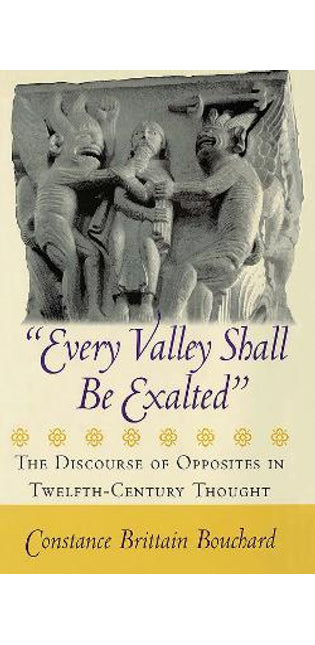
In high medieval France, men and women saw the world around them as the product of tensions between opposites. Imbued with a Christian culture in which a penniless preacher was also the King of Kings and the last were expected to be first, twelfth-century thinkers brought order to their lives through the creation of opposing categories. In a highly original work, Constance Brittain Bouchard examines this poorly understood component of twelfth-century thought, one responsible, in her view, for the fundamental strangeness of that culture to modern thinking.Scholars have long recognized that dialectical reasoning was the basic approach to philosophical, legal, and theological matters in the high Middle Ages. Bouchard argues that this way of thinking and categorizing—which she terms a "discourse of opposites"—permeated all aspects of medieval thought. She rejects suggestions that it was the result of imprecision, and provides evidence that people of that era sought not to reconcile opposing categories but rather to maintain them. Bouchard scrutinizes the medieval use of opposites in five broad areas: scholasticism, romance, legal disputes, conversion, and the construction of gender. Drawing on research in a series of previously unedited charters and the earliest glossa manuscripts, she demonstrates that this method of constructing reality was a constitutive element of the thought of the period.
R 992.00
R 394.00