Search results for "python arithmetic"
Items we need to order for you

Arithmetic Differential Operators over the p-adic Integers
The study of arithmetic differential operators is a novel and promising area of mathematics. This complete introduction to the subject starts with the basics: a discussion of p-adic numbers and some of the classical differential analysis on the field of p-adic numbers leading to the definition of arithmetic differential operators on this field. Buium's theory of arithmetic jet spaces is then developed succinctly in order to define arithmetic operators in general. Features of the book include a comparison of the behaviour of these operators over the p-adic integers and their behaviour over the unramified completion, and a discussion of the relationship between characteristic functions of p-adic discs and arithmetic differential operators that disappears as soon as a single root of unity is adjoined to the p-adic integers. This book is essential reading for researchers and graduate students who want a first introduction to arithmetic differential operators over the p-adic integers.
R 2,630.00
Basic Structures of Function Field Arithmetic
From the reviews:"The book...is a thorough and very readable introduction to the arithmetic of function fields of one variable over a finite field, by an author who has made fundamental contributions to the field. It serves as a definitive reference volume, as well as offering graduate students with a solid understanding of algebraic number theory the opportunity to quickly reach the frontiers of knowledge in an important area of mathematics...The arithmetic of function fields is a universe filled with beautiful surprises, in which familiar objects from classical number theory reappear in new guises, and in which entirely new objects play important roles. Goss'clear exposition and lively style make this book an excellent introduction to this fascinating field." MR 97i:11062
R 3,600.07
Quasi-Projective and Formal-Analytic Arithmetic Surfaces
A milestone in the geometric understanding of algebraization theorems that also provides an introduction to Arakelov geometryMotivated by questions of transcendental number theory, arithmetic, and Diophantine geometry, this book provides a thorough study of a new kind of mathematical object—formal-analytic arithmetic surfaces. These are arithmetic counterparts in Arakelov geometry of germs of complex surfaces along projective complex curves. Formal-analytic arithmetic surfaces involve both an arithmetic and a complex-analytic aspect, and they provide a natural framework for old and new arithmetic algebraization theorems. Formal-analytic arithmetic surfaces admit a rich geometry that parallels the geometry of complex analytic surfaces. The dichotomy between pseudoconvexity and pseudoconcavity plays a central role in this framework.The book develops the general theory of formal-analytic arithmetic surfaces, making notable use of real invariants coming from an infinite-dimensional version of geometry of numbers. Those so-called theta invariants play the role of the dimension of spaces of sections of vector bundles in complex geometry. Relating those invariants to the classical invariants of Arakelov intersection theory involves a new real invariant attached to certain maps between Riemann surfaces, the Archimedean overflow, which is introduced and discussed in detail.The book contains applications to concrete Diophantine problems. It provides a generalization of the arithmetic holonomicity theorem of Calegari-Dimitrov-Tang regarding the dimension of spaces of power series with integral coefficients satisfying some convergence conditions. It also establishes new effective finiteness theorems for fundamental groups of arithmetic surfaces.Along the way, the book discusses many tools, classical and new, in Arakelov geometry and complex analysis, and it can be used as an introduction to some of these topics.
R 5,995.12
Arakelov Geometry and Diophantine Applications
Bridging the gap between novice and expert, the aim of this book is to present in a self-contained way a number of striking examples of current diophantine problems to which Arakelov geometry has been or may be applied. Arakelov geometry can be seen as a link between algebraic geometry and diophantine geometry. Based on lectures from a summer school for graduate students, this volume consists of 12 different chapters, each written by a different author. The first chapters provide some background and introduction to the subject. These are followed by a presentation of different applications to arithmetic geometry. The final part describes the recent application of Arakelov geometry to Shimura varieties and the proof of an averaged version of Colmez's conjecture. This book thus blends initiation to fundamental tools of Arakelov geometry with original material corresponding to current research. This book will be particularly useful for graduate students and researchers interested in the connections between algebraic geometry and number theory. The prerequisites are some knowledge of number theory and algebraic geometry.
R 2,394.25
Arithmetic of Complex Manifolds
It was the aim of the Erlangen meeting in May 1988 to bring together number theoretists and algebraic geometers to discuss problems of common interest, such as moduli problems, complex tori, integral points, rationality questions, automorphic forms. In recent years such problems, which are simultaneously of arithmetic and geometric interest, have become increasingly important. This proceedings volume contains 12 original research papers. Its main topics are theta functions, modular forms, abelian varieties and algebraic three-folds.
R 1,131.98
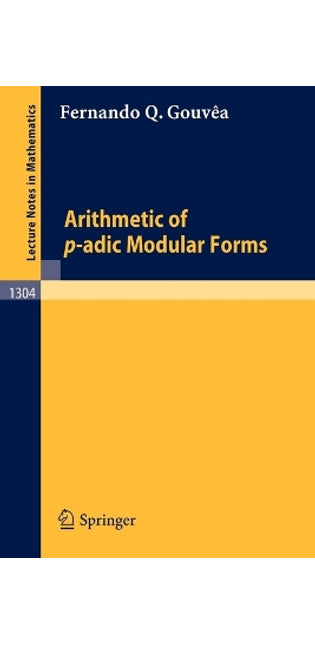
Arithmetic of p-adic Modular Forms
The central topic of this research monograph is the relation between p-adic modular forms and p-adic Galois representations, and in particular the theory of deformations of Galois representations recently introduced by Mazur. The classical theory of modular forms is assumed known to the reader, but the p-adic theory is reviewed in detail, with ample intuitive and heuristic discussion, so that the book will serve as a convenient point of entry to research in that area. The results on the U operator and on Galois representations are new, and will be of interest even to the experts. A list of further problems in the field is included to guide the beginner in his research. The book will thus be of interest to number theorists who wish to learn about p-adic modular forms, leading them rapidly to interesting research, and also to the specialists in the subject.
R 855.40
Arithmetic Theory of Elliptic Curves
This volume contains the expanded versions of the lectures given by the authors at the C.I.M.E. instructional conference held in Cetraro, Italy, from July 12 to 19, 1997. The papers collected here are broad surveys of the current research in the arithmetic of elliptic curves, and also contain several new results which cannot be found elsewhere in the literature. Owing to clarity and elegance of exposition, and to the background material explicitly included in the text or quoted in the references, the volume is well suited to research students as well as to senior mathematicians.
R 2,015.00
Rational Points and Arithmetic of Fundamental Groups
The section conjecture in anabelian geometry, announced by Grothendieck in 1983, is concerned with a description of the set of rational points of a hyperbolic algebraic curve over a number field in terms of the arithmetic of its fundamental group. While the conjecture is still open today in 2012, its study has revealed interesting arithmetic for curves and opened connections, for example, to the question whether the Brauer-Manin obstruction is the only one against rational points on curves. This monograph begins by laying the foundations for the space of sections of the fundamental group extension of an algebraic variety. Then, arithmetic assumptions on the base field are imposed and the local-to-global approach is studied in detail. The monograph concludes by discussing analogues of the section conjecture created by varying the base field or the type of variety, or by using a characteristic quotient or its birational analogue in lieu of the fundamental group extension.
R 2,551.13
Advanced Topics in the Arithmetic of Elliptic Curves
In the introduction to the first volume of The Arithmetic of Elliptic Curves (Springer-Verlag, 1986), I observed that "the theory of elliptic curves is rich, varied, and amazingly vast," and as a consequence, "many important topics had to be omitted." I included a brief introduction to ten additional topics as an appendix to the first volume, with the tacit understanding that eventually there might be a second volume containing the details. You are now holding that second volume. it turned out that even those ten topics would not fit Unfortunately, into a single book, so I was forced to make some choices. The following material is covered in this book: I. Elliptic and modular functions for the full modular group. II. Elliptic curves with complex multiplication. III. Elliptic surfaces and specialization theorems. IV. Neron models, Kodaira-Neron classification of special fibers, Tate's algorithm, and Ogg's conductor-discriminant formula. V. Tate's theory of q-curves over p-adic fields. VI. Neron's theory of canonical local height functions.
R 2,000.57
Cohomology of Arithmetic Groups and Automorphic Forms
Cohomology of arithmetic groups serves as a tool in studying possible relations between the theory of automorphic forms and the arithmetic of algebraic varieties resp. the geometry of locally symmetric spaces. These proceedings will serve as a guide to this still rapidly developing area of mathematics. Besides two survey articles, the contributions are original research papers.
R 1,700.46
Elliptic Curves and Arithmetic Invariants
This book contains a detailed account of the result of the author's recent Annals paper and JAMS paper on arithmetic invariant, including μ-invariant, L-invariant, and similar topics. This book can be regarded as an introductory text to the author's previous book p-Adic Automorphic Forms on Shimura Varieties. Written as a down-to-earth introduction to Shimura varieties, this text includes many examples and applications of the theory that provide motivation for the reader. Since it is limited to modular curves and the corresponding Shimura varieties, this book is not only a great resource for experts in the field, but it is also accessible to advanced graduate students studying number theory. Key topics include non-triviality of arithmetic invariants and special values of L-functions; elliptic curves over complex and p-adic fields; Hecke algebras; scheme theory; elliptic and modular curves over rings; and Shimura curves.
R 3,872.54
Theta Invariants of Euclidean Lattices and Infinite-Dimensional Hermitian Vector Bundles over Arithmetic Curves
This book presents the most up-to-date and sophisticated account of the theory of Euclidean lattices and sequences of Euclidean lattices, in the framework of Arakelov geometry, where Euclidean lattices are considered as vector bundles over arithmetic curves. It contains a complete description of the theta invariants which give rise to a closer parallel with the geometric case. The author then unfolds his theory of infinite Hermitian vector bundles over arithmetic curves and their theta invariants, which provides a conceptual framework to deal with the sequences of lattices occurring in many diophantine constructions.The book contains many interesting original insights and ties to other theories. It is written with extreme care, with a clear and pleasant style, and never sacrifices accessibility to sophistication.
R 4,922.28