Search results for "Offensive Security Using Python"
Items in stock - 4 working days delivery time

Python Without Fear
Praise for this book, Python Without Fear “This is really a great book. I wish I’d had it when I was learning Python.” –John M. Wargo, author of Apache Cordova 4 Programming Praise for the previous book in the series, C++ Without Fear “I’m in love with your C++ Without Fear book. It keeps me awake for hours during the night. Thanks to you, I got most of the idea in just a few hours.” –Laura Viral, graduate physics student at CERN and Istanbul, Turkey “It’s hard to tell where I began and ended with your book. I felt like I woke up and literally knew how to write C++ code. I can’t overstate the confidence you gave me.” – Danny Grady, senior programmer/analyst at a Fortune 500 Company Whether you’re new to programming or moving from another language, Python Without Fear will quickly make you productive! Brian Overland’s unique approach to Python includes: Taking you by the hand while teaching topics from the very basics to intermediate and advanced features of PythonTeaching by examples that are explained line by lineHeavy emphasis on examples that are fun and useful, including games, graphics, database applications, file storage, puzzles, and more!How to think “Pythonically” and avoid common “gotchas” Register your product at informit.com/register for convenient access to downloads, updates, and/or corrections as they become available.
R 1,377.00

Items we need to order for you
R 993.00
R 549.83
Hacking Exposed Malware & Rootkits: Security Secrets and Solutions, Second Edition
Publisher's Note: Products purchased from Third Party sellers are not guaranteed by the publisher for quality, authenticity, or access to any online entitlements included with the product.Arm yourself for the escalating war against malware and rootkitsThwart debilitating cyber-attacks and dramatically improve your organization’s security posture using the proven defense strategies in this thoroughly updated guide. Hacking Exposed™ Malware and Rootkits: Security Secrets & Solutions, Second Edition fully explains the hacker’s latest methods alongside ready-to-deploy countermeasures. Discover how to block pop-up and phishing exploits, terminate embedded code, and identify and eliminate rootkits. You will get up-to-date coverage of intrusion detection, firewall, honeynet, antivirus, and anti-rootkit technology.• Learn how malware infects, survives, and propagates across an enterprise• See how hackers develop malicious code and target vulnerable systems• Detect, neutralize, and remove user-mode and kernel-mode rootkits • Use hypervisors and honeypots to uncover and kill virtual rootkits• Defend against keylogging, redirect, click fraud, and identity theft• Block spear phishing, client-side, and embedded-code exploits• Effectively deploy the latest antivirus, pop-up blocker, and firewall software• Identify and stop malicious processes using IPS solutions
R 2,352.04
R 1,140.00
High Performance Python
Your Python code may run correctly, but what if you need it to run faster? This practical book shows you how to locate performance bottlenecks and significantly speed up your code in high-data-volume programs. By explaining the fundamental theory behind design choices, this expanded edition of High Performance Python helps experienced Python programmers gain a deeper understanding of Python's implementation.How do you take advantage of multicore architectures or compilation? Or build a system that scales up beyond RAM limits or with a GPU? Authors Micha Gorelick and Ian Ozsvald reveal concrete solutions to many issues and include war stories from companies that use high-performance Python for GenAI data extraction, productionized machine learning, and more.Get a better grasp of NumPy, Cython, and profilersLearn how Python abstracts the underlying computer architectureUse profiling to find bottlenecks in CPU time and memory usageWrite efficient programs by choosing appropriate data structuresSpeed up matrix and vector computationsProcess DataFrames quickly with Pandas, Dask, and PolarsSpeed up your neural networks and GPU computationsUse tools to compile Python down to machine codeManage multiple I/O and computational operations concurrentlyConvert multiprocessing code to run on local or remote clusters
R 1,505.00
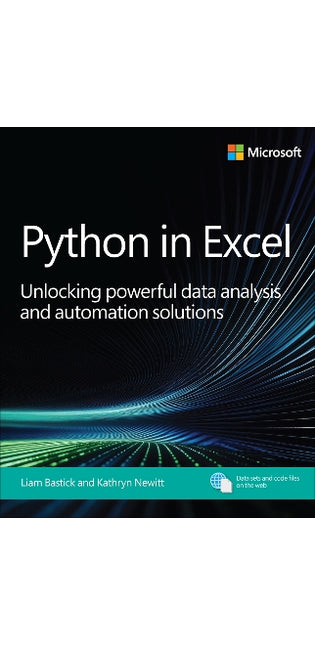
Python in Excel
Seasoned Experts Liam Bastick and Kathryn Newitt unveil a groundbreaking guide to mastering data analysis and automation with Python in Excel Python in Excel: Unlocking powerful data analysis and automation solutions is a hands-on, practical guide that leverages the authors’ decades of expertise to teach readers how to harness the newly integrated Python capabilities within Microsoft Excel, mapping familiar Excel concepts to Python foundations. Covering essential topics such as Python syntax, data structures, data analysis with pandas, visualization, and the use of AI tools like Copilot, the book empowers professionals to elevate their data analysis and automation skills. Readers will gain the ability to perform advanced forecasting, build predictive models, and streamline workflows, making them more efficient and competitive in today’s data-driven workplace. By reading this book, you will: Understand the fundamentals of Python programming directly within ExcelMap your existing Excel skills to Python concepts for easier learningAutomate repetitive tasks and workflows Analyze and visualize data with powerfulPython libraries like pandas Build advanced forecasting and predictive models without leaving ExcelExplore and manipulate data efficiently using Python’s concise syntaxIntegrate AI tools such as Copilot to assist with coding and analysisConnect Excel with external data sources using Python and Power QueryDevelop custom solutions for business modeling and data scienceCreate a roadmap for further study and mastery of Python in Excel
R 2,083.00
R 916.00
Programming Computer Vision with Python
If you want a basic understanding of computer vision's underlying theory and algorithms, this hands-on introduction is the ideal place to start. As a student, researcher, hacker, or enthusiast, you'll learn as you follow examples written in Python - the easy-to-learn language that has modules for handling images and mathematical computing and data mining on a par with commercial alternatives. Programming Computer Vision with Python teaches computer vision in broad terms that won't bog you down in theory. Instead, you'll find this book to be inspiring and motivating. You'll get all the code you need, with clear explanations on how to reproduce the book's examples and build upon them directly.
R 1,368.00
R 2,138.96
R 1,374.00
AI Security Engineering
Design, Build, and Secure Dependable AI Systems Across the Enterprise Lifecycle AI is rapidly becoming part of core enterprise systems but most security programs were not designed for systems that are probabilistic, adaptive, and increasingly autonomous. AI Security Engineering provides a foundational, engineering-first playbook for designing, operating, and scaling secure AI systems across the enterprise lifecycle. Written by Ashish Rajan, a CISO advising Fortune 500 organizations on AI security, this book focuses on security for AI systems not AI used as a security tool. It examines how AI changes traditional security assumptions and how organizations must adapt their architectures, pipelines, governance models, and operating practices to manage AI risk effectively in production environments. Rather than focusing on tools or point solutions, AI Security Engineering applies security engineering principles to modern AI systems. It covers AI threat models, secure AI pipelines, runtime detection and incident response, governance and compliance at scale, and the emerging challenges of agentic and multi-model systems. Readers are guided through how to evolve existing security programs to support AI-enabled applications without slowing delivery or becoming the “department of no”. This book shows how to: Design and operate secure AI systems across their full lifecycle from architecture and delivery to operations and scaleDefend production AI applications against adversarial, emergent, and agent-driven threatsEmbed governance and risk controls into AI pipelines using engineering-first approachesOperate AI security in dynamic environments, including third-party and agentic systemsBalance regulatory compliance, system performance, and engineering velocity CISOs seeking strategic clarity for AI security investments, security architects designing resilient systems, and engineers responsible for operating AI in production will find this book a durable reference for building dependable AI systems at enterprise scale.
R 1,527.00
Practical Post-Quantum Signatures
The current digital signature methods like RSA, DSA, and ECDSA are relatively simple to understand, and their signing and verification processes operate in comparable time frames. However, in the quantum computing era, cryptographic methods must be designed to withstand both classical and quantum attacks. This requires an in-depth understanding of advanced mathematical concepts like algebraic geometry, lattice theory, Gaussian sampling, and efficient polynomial computation techniques such as FFT and NTT, which are essential for lattice-based cryptosystems.The FALCON algorithm, chosen as a finalist in the NIST Post-Quantum Cryptography (PQC) standardization project, is a lattice-based, hash-and-sign digital signature scheme known for its efficiency and compactness compared to other quantum-resistant signatures like Dilithium and SPHINCS+. Following FALCON’s development, the SOLMAE algorithm was introduced in 2021, offering a simplified signing process within the same GPV framework and also implemented in Python for easier accessibility.This monograph provides a practical and educational introduction to post-quantum digital signatures, focusing on the FALCON and SOLMAE algorithms. The material aims to bridge the gap between theory and practice, offering hands-on knowledge of post-quantum cryptographic techniques. With a focus on clear, practical examples using Python, this book is a valuable resource for anyone looking to understand or implement quantum-secure digital signatures.
R 2,487.29
R 912.00
Mastering Cybersecurity
Mastering Cybersecurity: A Practical Guide to Cyber Tools and Techniques (Volume 2) offers a hands-on, real-world approach to developing modern cybersecurity skills. This volume builds on foundational concepts to provide readers with practical techniques and toolsets that are essential in today’s evolving threat landscape. Each chapter dives into a critical area of cybersecurity, emphasizing applied learning through real-world scenarios, case studies, and step-by-step exercises.This book begins with an in-depth focus on network security, guiding readers through capturing and analyzing traffic using command-line tools and understanding how attackers exploit unencrypted protocols. It then progresses to more complex attack vectors such as man-in-the-middle attacks, DNS spoofing, and email threats, reinforcing defensive strategies using tools like Wireshark and Tcpdump. The exploration of open-source intelligence (OSINT) offers a comprehensive look at harvesting digital footprints from publicly accessible data, applying techniques and tools such as Shodan, Google Dorking, and reverse image searches for real investigations. As the world becomes increasingly interconnected, this book dedicates several chapters to the Internet of Things (IoT), uncovering its vulnerabilities and showcasing threat surface attack assessments through real device testing and threat mapping frameworks. Readers learn to analyze device security and apply countermeasures such as secure boot, blockchain integration, and anomaly detection.The volume also delves into the dark web, shedding light on anonymous networks like TOR and I2P and equipping readers with methods to investigate hidden services safely. It explains how to extract intelligence using automation, analyze illicit activity, and integrate findings into broader cybersecurity frameworks. Culminating with advanced cyber threat intelligence (CTI), this book examines intelligence cycles, tools, and platforms, enabling readers to move from theory to practice. From indicator of compromise analysis and threat actor profiling to automation and incident response, readers gain the skills to leverage CTI for strategic defense.Designed for cybersecurity students, professionals, and enthusiasts, this book offers a balanced blend of technical depth, ethical awareness, and actionable guidance. By the end, readers will not only understand key cybersecurity domains but also be prepared to apply their knowledge in practical, high-stakes environments, making them valuable assets in the fight against cyber threats.
R 2,723.51
Intelligent Security Systems
INTELLIGENT SECURITY SYSTEMS Dramatically improve your cybersecurity using AI and machine learning In Intelligent Security Systems, distinguished professor and computer scientist Dr. Leon Reznik delivers an expert synthesis of artificial intelligence, machine learning and data science techniques, applied to computer security to assist readers in hardening their computer systems against threats. Emphasizing practical and actionable strategies that can be immediately implemented by industry professionals and computer device’s owners, the author explains how to install and harden firewalls, intrusion detection systems, attack recognition tools, and malware protection systems. He also explains how to recognize and counter common hacking activities. This book bridges the gap between cybersecurity education and new data science programs, discussing how cutting-edge artificial intelligence and machine learning techniques can work for and against cybersecurity efforts. Intelligent Security Systems includes supplementary resources on an author-hosted website, such as classroom presentation slides, sample review, test and exam questions, and practice exercises to make the material contained practical and useful. The book also offers: A thorough introduction to computer security, artificial intelligence, and machine learning, including basic definitions and concepts like threats, vulnerabilities, risks, attacks, protection, and tools An exploration of firewall design and implementation, including firewall types and models, typical designs and configurations, and their limitations and problems Discussions of intrusion detection systems (IDS), including architecture topologies, components, and operational ranges, classification approaches, and machine learning techniques in IDS design A treatment of malware and vulnerabilities detection and protection, including malware classes, history, and development trends Perfect for undergraduate and graduate students in computer security, computer science and engineering, Intelligent Security Systems will also earn a place in the libraries of students and educators in information technology and data science, as well as professionals working in those fields.
R 3,483.00
R 916.00
Python for DevOps
Much has changed in technology over the past decade. Data is hot, the cloud is ubiquitous, and many organizations need some form of automation. Throughout these transformations, Python has become one of the most popular languages in the world. This practical resource shows you how to use Python for everyday Linux systems administration tasks with today’s most useful DevOps tools, including Docker, Kubernetes, and Terraform.Learning how to interact and automate with Linux is essential for millions of professionals. Python makes it much easier. With this book, you’ll learn how to develop software and solve problems using containers, as well as how to monitor, instrument, load-test, and operationalize your software. Looking for effective ways to "get stuff done" in Python? This is your guide.Python foundations, including a brief introduction to the languageHow to automate text, write command-line tools, and automate the filesystemLinux utilities, package management, build systems, monitoring and instrumentation, and automated testingCloud computing, infrastructure as code, Kubernetes, and serverlessMachine learning operations and data engineering from a DevOps perspectiveBuilding, deploying, and operationalizing a machine learning project
R 1,368.00
Foundations of Cybersecurity, 2nd Edition
Cybersecurity is critical to protecting data, systems, and people. Whether you're new to the field, an IT professional strengthening your skills, or a manager shaping security policy, Foundations of Cybersecurity provides the knowledge and practice you need. Building on the first edition (Foundations of Information Security), this updated guide covers the essentials: authentication, authorization, and auditing; cryptography; security architecture; threat assessment; network and OS hardening; application and IoT security; incident response; compliance; and the human factors attackers exploit. You'll learn how to: Apply the core principles of security across systems and networks, Defend against emerging threats like AI-driven attacks and IoT vulnerabilities, Manage incident response and governance, risk, and compliance (GRC), Strengthen defenses against social engineering and insider threats, Explore career paths and skills for a future in cybersecurity. What's New in This Edition: Includes a new chapter on AI security, expanded coverage of security operations and governance, and practical 'Down the Rabbit Hole' labs in every chapter to help you practice real-world skills. Whether you're new to the field, strengthening your skills, or guiding a team, this book will help you build a solid foundation for protecting systems, data, and people.
R 1,669.00
Critical Issues in Homeland Security
Critical Issues in Homeland Security: A Casebook encourages analytical and careful examination of practical homeland security problems through the presentation of contemporary cases involving major state or national events. Case studies demonstrate the complexity of challenges within the domain of homeland security policy and administration. Editors James D. Ramsay and Linda Kiltz carefully curated fourteen cases, all from top scholars and practitioners, to cover a broad range of legal, policy, and operational challenges within the field of homeland security. Timely and interesting cases on such issues as arctic security, the use of drones in targeted killings, cyber security, and the emergency management lessons of the 2010 Haiti earthquake give students a deeper understanding of the relationship between the theories and the practices of homeland security. Discussion questions at the end of each case and an online instructor's manual make Critical Issues in Homeland Security an even more effective learning tool for any homeland security program.
R 1,708.33
R 1,099.00
R 1,022.00
Elements of Computer Security
As our society grows ever more reliant on computers, so it also becomes more vulnerable to computer crime. Cyber attacks have been plaguing computer users since the 1980s, and computer security experts are predicting that smart telephones and other mobile devices will also become the targets of cyber security threats in the future.Developed from the author's successful Springer guide to Foundations of Computer Security, this accessible textbook/reference is fully updated and enhanced with resources for students and tutors.Topics and features: examines the physical security of computer hardware, networks, and digital data; introduces the different forms of rogue software (or malware), discusses methods for preventing and defending against malware, and describes a selection of viruses, worms and Trojans in detail; investigates the important threats to network security, and explores the subjects of authentication, spyware, and identity theft; discusses issues of privacy and trust in the online world, including children's privacy and safety; includes appendices which discuss the definition, meaning, and history of the term hacker, introduce the language of "l33t Speak", and provide a detailed virus timeline; provides numerous exercises and examples throughout the text, in addition to a Glossary of terms used in the book; supplies additional resources at the associated website, http://www.DavidSalomon.name/, including an introduction to cryptography, and answers to the exercises.Clearly and engagingly written, this concise textbook is an ideal resource for undergraduate classes on computer security. The book is mostly non-mathematical, and is suitable for anyone familiar with the basic concepts of computers and computations.
R 1,166.67
R 1,044.62
Computer Security Fundamentals
ONE-VOLUME INTRODUCTION TO COMPUTER SECURITY Clearly explains core concepts, terminology, challenges, technologies, and skills Covers today's latest attacks and countermeasures The perfect beginner's guide for anyone interested in a computer security career Dr. Chuck Easttom brings together complete coverage of all basic concepts, terminology, and issues, along with all the skills you need to get started. Drawing on 30 years of experience as a security instructor, consultant, and researcher, Easttom helps you take a proactive, realistic approach to assessing threats and implementing countermeasures. Writing clearly and simply, he addresses crucial issues that many introductory security books ignore, while addressing the realities of a world where billions of new devices are Internet-connected. This guide covers web attacks, hacking, spyware, network defense, security appliances, VPNs, password use, and much more. Its many tips and examples refl ect new industry trends and the state-of-the-art in both attacks and defense. Exercises, projects, and review questions in every chapter help you deepen your understanding and apply all you’ve learned. LEARN HOW TO Identify and prioritize potential threats to your networkUse basic networking knowledge to improve securityGet inside the minds of hackers, so you can deter their attacksImplement a proven layered approach to network securityResist modern social engineering attacksDefend against today’s most common Denial of Service (DoS) attacksHalt viruses, spyware, worms, Trojans, and other malwarePrevent problems arising from malfeasance or ignoranceChoose the best encryption methods for your organizationCompare security technologies, including the latest security appliancesImplement security policies that will work in your environmentScan your network for vulnerabilitiesEvaluate potential security consultantsMaster basic computer forensics and know what to do if you’re attackedLearn how cyberterrorism and information warfare are evolving
R 2,798.00
R 763.00
R 306.00
Machine Learning with Spark and Python
Machine Learning with Spark and Python Essential Techniques for Predictive Analytics, Second Edition simplifies ML for practical uses by focusing on two key algorithms. This new second edition improves with the addition of Spark—a ML framework from the Apache foundation. By implementing Spark, machine learning students can easily process much large data sets and call the spark algorithms using ordinary Python code. Machine Learning with Spark and Python focuses on two algorithm families (linear methods and ensemble methods) that effectively predict outcomes. This type of problem covers many use cases such as what ad to place on a web page, predicting prices in securities markets, or detecting credit card fraud. The focus on two families gives enough room for full descriptions of the mechanisms at work in the algorithms. Then the code examples serve to illustrate the workings of the machinery with specific hackable code.
R 1,140.00
Hacker's Guide to Scaling Python
Python is an excellent programming language that allows to write applications quickly. But how do you make those applications scale for thousands of users and requests? It takes years of practice, research, trial and errors to build experience and knowledge along the way. Simple questions such as ""How do I make my code faster?,"" ""How do I make sure there is no bottleneck?"" or ""How do I run this application on several computers?"" cost hours to find satisfying answers. Without enough background on the topic, you'll never be sure that any solution you'll come up with will be correct. In The Hacker's Guide to Scaling Python, you will learn how to solve these issues. This book provides guidelines, tips and best practice on how to build high performing Python applications. Adding a few interview of experts on the subject, you will learn how you can distribute your Python application so it can process thousands of requests.
R 1,596.00
Coding Club Python: Building Big Apps Level 3
A unique series that provides a framework for teaching coding skills. Build more sophisticated apps with level 3 of Coding Club! Following on from Python: Next Steps, this lively book explains how to break down projects into manageable chunks, guiding and supporting you with building larger, more exciting projects. Activities include building a version of Pong and, using the classes created for Pong, building a Breakout game and an Invaders game, developing and learning the necessary skills to build larger apps on the way. The code is suitable for Mac, Windows and Linux users and therefore compatible with the Raspberry Pi.
R 880.00
Hacking Exposed Windows: Microsoft Windows Security Secrets and Solutions, Third Edition
Publisher's Note: Products purchased from Third Party sellers are not guaranteed by the publisher for quality, authenticity, or access to any online entitlements included with the product.The latest Windows security attack and defense strategies"Securing Windows begins with reading this book." --James Costello (CISSP) IT Security Specialist, Honeywell Meet the challenges of Windows security with the exclusive Hacking Exposed "attack-countermeasure" approach. Learn how real-world malicious hackers conduct reconnaissance of targets and then exploit common misconfigurations and software flaws on both clients and servers. See leading-edge exploitation techniques demonstrated, and learn how the latest countermeasures in Windows XP, Vista, and Server 2003/2008 can mitigate these attacks. Get practical advice based on the authors' and contributors' many years as security professionals hired to break into the world's largest IT infrastructures. Dramatically improve the security of Microsoft technology deployments of all sizes when you learn to: Establish business relevance and context for security by highlighting real-world risksTake a tour of the Windows security architecture from the hacker's perspective, exposing old and new vulnerabilities that can easily be avoidedUnderstand how hackers use reconnaissance techniques such as footprinting, scanning, banner grabbing, DNS queries, and Google searches to locate vulnerable Windows systems Learn how information is extracted anonymously from Windows using simple NetBIOS, SMB, MSRPC, SNMP, and Active Directory enumeration techniquesPrevent the latest remote network exploits such as password grinding via WMI and Terminal Server, passive Kerberos logon sniffing, rogue server/man-in-the-middle attacks, and cracking vulnerable servicesSee up close how professional hackers reverse engineer and develop new Windows exploitsIdentify and eliminate rootkits, malware, and stealth softwareFortify SQL Server against external and insider attacksHarden your clients and users against the latest e-mail phishing, spyware, adware, and Internet Explorer threats Deploy and configure the latest Windows security countermeasures, including BitLocker, Integrity Levels, User Account Control, the updated Windows Firewall, Group Policy, Vista Service Refactoring/Hardening, SafeSEH, GS, DEP, Patchguard, and Address Space Layout Randomization
R 1,876.00
R 306.00
Python Polars: The Definitive Guide
Want to speed up your data analysis and work with larger-than-memory datasets? Python Polars offers a blazingly fast, multithreaded, and elegant API for data loading, manipulation, and processing. With this hands-on guide, you'll walk through every aspect of Polars and learn how to tackle practical use cases using real-world datasets. Jeroen Janssens and Thijs Nieuwdorp from Xomnia in Amsterdam show you how this superfast DataFrame library is perfect for efficient data wrangling, ETL pipelines, and so much more. This book helps you quickly learn the syntax and understand Polars' underlying concepts. You don't need to have experience with pandas or Spark, but if you do, this book will help you make a smooth transition. With this definitive guide at your side, you'll be able to: Process larger-than-memory datasets at record speed Apply the eager, lazy, and streaming APIs of Polars and decide when to use them Transition smoothly from pandas or Spark to Polars Integrate Polars into your existing code base Work with Arrow and Parquet to efficiently read and write data Translate complex ETL tasks into efficient and elegant queries
R 1,824.00
R 580.00
R 702.00
Network Security Essentials: Applications and Standards, Global Edition
For courses in Corporate, Computer and Network Security . Network Securities Essentials: Applications and Standards introduces students to the critical importance of internet security in our age of universal electronic connectivity. Amidst viruses, hackers, and electronic fraud, organisations and individuals are constantly at risk of having their private information compromised. This creates a heightened need to protect data and resources from disclosure, guarantee their authenticity, and safeguard systems from network-based attacks. The 6th Edition covers the expanding developments in the cryptography and network security disciplines, giving students a practical survey of applications and standards. The text places emphasis on applications widely used for Internet and corporate networks, as well as extensively deployed internet standards.
R 1,951.00
R 611.00
Python Microservices Development
Use Python microservices to craft applications that are built as small standard units using proven best practices and avoiding common errorsKey FeaturesBecome well versed with the fundamentals of building, designing, testing, and deploying Python microservicesIdentify where a monolithic application can be split, how to secure it, and how to scale it once ready for deploymentUse the latest framework based on asynchronous programming to write effective microservices with PythonBook DescriptionThe small scope and self-contained nature of microservices make them faster, cleaner, and more scalable than code-heavy monolithic applications. However, building microservices architecture that is efficient as well as lightweight into your applications can be challenging due to the complexity of all the interacting pieces. Python Microservices Development, Second Edition will teach you how to overcome these issues and craft applications that are built as small standard units using proven best practices and avoiding common pitfalls. Through hands-on examples, this book will help you to build efficient microservices using Quart, SQLAlchemy, and other modern Python tools In this updated edition, you will learn how to secure connections between services and how to script Nginx using Lua to build web application firewall features such as rate limiting. Python Microservices Development, Second Edition describes how to use containers and AWS to deploy your services. By the end of the book, you’ll have created a complete Python application based on microservices.What you will learnExplore what microservices are and how to design themConfigure and package your code according to modern best practicesIdentify a component of a larger service that can be turned into a microserviceHandle more incoming requests, more effectivelyProtect your application with a proxy or firewallUse Kubernetes and containers to deploy a microserviceMake changes to an API provided by a microservice safely and keep things workingIdentify the factors to look for to get started with an unfamiliar cloud providerWho this book is forThis book is for developers who want to learn how to build, test, scale, and manage Python microservices. Readers will require basic knowledge of the Python programming language, the command line, and HTTP-based application principles. No prior experience of writing microservices in Python is assumed.
R 1,661.00
Adversarial Symbiosis in Cybersecurity
Apply evolutionary biology to AI-driven cybersecurity attack and defense Offensive AI now discovers vulnerabilities, generates adversarial examples that defeat defensive models, and adapts in real time. Adversarial Symbiosis in Cybersecurity: Co-evolving AI for Attack, Defense and Governance reconceptualizes this landscape as a living ecosystem where defensive AI, offensive AI, and human operators continuously co-evolve through adaptive learning loops, with each side’s adaptations shaping the other’s trajectory. Drawing on predator-prey dynamics and biological co-evolution, the book delivers quantitative models, simulation methods, and practical design principles for building AI systems that adapt dynamically rather than merely detect threats. Later chapters address offensive AI capabilities including automated exploit discovery and adversarial example generation, while governance models balance innovation with ethics, safety, and regulatory compliance. The book also covers: Human-centered approaches integrating cognitive science, decision support design, and trust calibration into AI-augmented security operations workflowsReal-world case studies demonstrating co-evolutionary patterns in advanced persistent threat campaigns, phishing ecosystems, and IoT botnetsPractical architectures for designing adaptive defense systems that respond to evolving offensive techniques through continuous learning loopsMulti-agent reinforcement learning and meta-learning frameworks applied to emergent behaviors within adversarial cybersecurity environmentsGovernance and policy frameworks addressing ethical deployment of offensive AI capabilities alongside regulatory compliance requirements Written for security operations center analysts and managers, threat intelligence specialists, and incident response teams, this book also serves security architects, engineers, and CISOs seeking a rigorous co-evolutionary framework for understanding and operationalizing AI-driven cybersecurity strategy.
R 4,396.00
R 579.00
Python for Signal Processing
This book covers the fundamental concepts in signal processing illustrated with Python code and made available via IPython Notebooks, which are live, interactive, browser-based documents that allow one to change parameters, redraw plots, and tinker with the ideas presented in the text. Everything in the text is computable in this format and thereby invites readers to “experiment and learn” as they read. The book focuses on the core, fundamental principles of signal processing. The code corresponding to this book uses the core functionality of the scientific Python toolchain that should remain unchanged into the foreseeable future. For those looking to migrate their signal processing codes to Python, this book illustrates the key signal and plotting modules that can ease this transition. For those already comfortable with the scientific Python toolchain, this book illustrates the fundamental concepts in signal processing and provides a gateway to further signal processing concepts.
R 3,205.21