Search results for "Christopher Howe"
Items in stock - 4 working days delivery time

These Strange New Minds
‘Engaging, insightful, panoramic’ Mustafa Suleyman, CEO of Microsoft AI & Cofounder of DeepMind'An eye-opening exploration of a revolution unfolding before our eyes' New York Journal of BooksStunning advances in digital technology have introduced a new wave of human-like AI systems. Chatbots like ChatGPT, Claude, and Gemini are already reshaping economies, challenge democracies, and reshaping society in unpredictable ways. And soon, these AI systems could make autonomous decisions on their users' behalf, transforming everything we do. Understanding how they work is crucial.Can AI systems think, know, and understand?Could they manipulate or deceive you, and if so, what might they make you do?Whose interests do they represent?When will they be able to move beyond words and take action in the real world?Neuroscientist and AI researcher Christopher Summerfield explores these questions, charting AI's evolution from early ideas in the seventeenth century to today's deep neural networks. His book is the most accessible, up-to-date, and authoritative exploration of this radical technology. With an understanding of AI's inner workings, we can address the existential question of our age: can we look forward to a technological utopia, or are we writing ourselves out of history?‘As a leading authority...Summerfield is perfectly situated to explore the meaning and implications of these machines that are so uncannily like – and unlike – ourselves’ Brian Christian, co-author of Algorithms to Live by'You might choose to be alarmed, excited, or indifferent to LLMs, but you should read Chris’s book before you decide’ Mike Woolridge, author of The Road to Conscious Machines
R 330.00

Items we need to order for you
R 367.00
Employment and Economic Growth in Urban China 1949–1957
A study of China's urban employment problems set in the context of growth and fluctuations in the urban economy between 1949 and 1957. Its main objectives are to analyse the size and determinants or urban employment change, and to trace the evolution both of Chinese thinking about employment and the institutions of labour control that reflected this thinking in day-to-day administration. Important source materials used in this book, many of which had not previously been used by western scholars, include the journal of the Ministry of Labour and local newspapers and journals. These materials are used to show the ways in which the urban employment problem varied according to the geographical location and level of administration from which it was viewed. Dr Howe examines the changing urban economic environment and the dimensions of urban employment and its evolution and relates them to the broader understanding of economic change in China.
R 1,746.32
R 245.00
Shanghai
Shanghai is Asia's largest city and for over a hundred years has played a critical role both in China's internal political arid economic affairs, and in the history of international relations in the Far East. Before 1949, Shanghai was the principal point of western and, later, Japanese penetrations of China. Under foreign control the city saw the beginnings of modern economic growth, of new forms of westernized education and culture, and of fierce social and political conflicts. This book is a comprehensive study of the way in which old Shanghai was transformed and developed by the Communist Party between 1949 and the later 1970s. It throws light on the paradox that a city that for years was the object of hostility and distrust has become in the Post-Mao era the spearhead of China's new programme for economic and technological modernization. The book is divided into sections dealing with political, economic and cultural change, and with the special characteristics of Shanghai's rural suburbia.
R 2,472.29
China and Japan
This book is a remarkable attempt to understand and summarize the current and historical Sino-Japanese relationship: two countries bound by ties of history, culture, geography, and economic complementarity. Through this investigation, the contributors are also able to broaden our understanding of contemporary changes in international relations, and to consider the implications of changes in the Sino-Japanese relationship for the wider world. All contributors arewell-known experts in their fields. This volume deals with the history of contact, the economic imperatives driving the links, the diplomatic and political manoeuvrings in which both countries indulge, and the antipathies that mean the Sino-Japanese `special relationship' is far from trouble-free. This book should become an invaluable reference work for academics and students.
R 2,978.00
Wage Patterns and Wage Policy in Modern China 1919–1972
This book provides an analysis of changes in the level and structure of wages in China from the 1920s to 1972. In the first part of the study Dr Howe uses this analysis as a starting point to evaluate the degree to which wage policy objectives have been achieved, particularly since 1949. The author explains both fluctuations in policy and discrepancies between plans and reality and examines the mechanisms of wage determination. In so doing, he makes it clear that even in a highly planned society there are some limits to what is possible in the regulation of wages and incomes. He goes on to argue that the wage system can only be understood within a common analysis of the whole framework of incentives and controls affecting the workforce. This approach sheds new light, not only on the development of the wage system but on economic aspects of the Cultural Revolution and its aftermath.
R 1,745.28
R 305.00
R 397.00
R 458.00
R 329.00
R 336.00
R 305.00
Sleepwalkers
The pacy, sensitive and formidably argued history of the causes of the First World War, from acclaimed historian and author Christopher ClarkFINANCIAL TIMES BOOKS OF THE YEAR 2014SUNDAY TIMES and INDEPENDENT BOOKS OF THE YEAR 2012Winner of the Los Angeles Times History Book Prize 2014The moments that it took Gavrilo Princip to step forward to the stalled car and shoot dead Franz Ferdinand and his wife were perhaps the most fateful of the modern era. An act of terrorism of staggering efficiency, it fulfilled its every aim: it would liberate Bosnia from Habsburg rule and it created a powerful new Serbia, but it also brought down four great empires, killed millions of men and destroyed a civilization. What made a seemingly prosperous and complacent Europe so vulnerable to the impact of this assassination? In The Sleepwalkers Christopher Clark retells the story of the outbreak of the First World War and its causes. Above all, it shows how the failure to understand the seriousness of the chaotic, near genocidal fighting in the Balkans would drag Europe into catastrophe.Reviews:'Formidable ... one of the most impressive and stimulating studies of the period ever published' Max Hastings, Sunday Times'Easily the best book ever written on the subject ... A work of rare beauty that combines meticulous research with sensitive analysis and elegant prose. The enormous weight of its quality inspires amazement and awe ... Academics should take note: Good history can still be a good story' Washington Post'A lovingly researched work of the highest scholarship. It is hard to believe we will ever see a better narrative of what was perhaps the biggest collective blunder in the history of international relations' Niall Ferguson'[Reading The Sleepwalkers], it is as if a light had been turned on a half-darkened stage of shadowy characters cursing among themselves without reason ... [Clark] demolishes the standard view ... The brilliance of Clark's far-reaching history is that we are able to discern how the past was genuinely prologue ... In conception, steely scholarship and piercing insights, his book is a masterpiece' Harold Evans, New York Times Book Review'Impeccably researched, provocatively argued and elegantly written ... a model of scholarship' Sunday Times Books of the Year'Superb ... effectively consigns the old historical consensus to the bin ... It's not often that one has the privilege of reading a book that reforges our understanding of one of the seminal events of world history' Mail Online'A monumental new volume ... Revelatory, even revolutionary ... Clark has done a masterful job explaining the inexplicable' Boston Globe'Superb ... One of the great mysteries of history is how Europe's great powers could have stumbled into World War I ... This is the single best book I have read on this important topic' Fareed Zakaria'A meticulously researched, superbly organized, and handsomely written account Military HistoryClark is a masterly historian ... His acc
R 597.00
Principal Characters
As the grandson of actress Ivy Close and son of director Ronald Neame (Straight from the Horse's Mouth; Scarecrow, 2003), Christopher Neame's roots in the film business were already firmly established by the time he joined the family profession. In his first memoir, Rungs on a Ladder, Neame gave readers an insider's look into a number of productions of the 1960s and 70s produced by Hammer Studios. Christopher followed this with A Take on British TV Drama, in which he recounted the challenges and rewards of working on some of the most distinguished works of British television, including The Flame Trees of Thika, Monsignor Quixote, and Danger: U.X.B. In Principal Characters, Neame fills in the gaps of his illustrious career by providing brief intimate portraits of the many important film figures he has worked with. In this charming collection of anecdotes, he asks and answers questions about the stars, who reveal both their carefree and vulnerable moments alike: Was Richard Harris really such a hell-raiser as a young man? What was Peter Sellers like to work with? How did Robert Mitchum find himself in trouble? How many faces did Alec Guinness have? What was behind Peter O'Toole and a bomb threat in Paris? Looking behind the camera lens, Neame captures director Karel Reisz (This Sporting Life) wearing a producer's hat, marvels at cinematographer Geoffrey Unsworth 'painting' Cabaret with light, discloses Kenneth Tynan's unusual predilection, and weighs in on the culinary skills of Ismail Merchant (A Room with a View). Throughout these accounts, Christopher looks both acutely and often amusingly at many who are household names, and when he feels it is appropriate to do so, he doesn't pull punches. This work is a fitting conclusion to an autobiographical "trilogy," and will be of interest to all those curious about the film industry and especially the stars and directors Christopher Neame has worked with over the years.
R 2,746.00
Christopher Marlowe
Christopher Marlowe: Poet & Spy is the most thorough and detailed life of Marlowe since John Bakeless's in 1942. It has new material on Marlowe in relation to Canterbury, also on his home life, schooling, and six and a half years at Corpus Christi College, Cambridge, and includes fresh data on his reading, teachers, and early achievements, including a new letter with a new date for the famous 'putative portrait' of Marlowe at Cambridge. The biography uses for the first time the Latin writings of his friend Thomas Watson to illuminate Marlowe's life in London and his career as a spy (that is, as a courier and agent for the Elizabethan Privy Council). There are new accounts of him on the continent, particularly at Flushing or Vlissingen, where he was arrested. The book also more fully explains Marlowe's relations with his chief patron, Thomas Walsingham, than ever before. This is also the first biography to explore in detail Marlowe's relations with fellow playwrights such as Kyd and Shakespeare, and to show how Marlowe's relations with Shakespeare evolved from 1590 to 1593. With closer views of him in relation to the Elizabethan stage than have appeared in any biography, the book examines in detail his aims, mind, and techniques as exhibited in all of his plays, from Dido, the Tamburlaine dramas, and Doctor Faustus through to TheJew of Malta and Edward II. It offers new treatments of his evolving versions of 'The Passionate Shepherd', and displays circumstances, influences, and the bearings of Shakespeare's 'Venus and Adonis' in relation to Marlowe's 'Hero and Leander'.Throughout, there is a strong emphasis on Marlowe's friendships and so-called 'homosexuality'. Fresh information is brought to bear on his seductive use of blasphemy, his street fights, his methods of preparing himself for writing, and his atheism and religious interests. The book also explores his attraction to scientists and mathematicians such as Thomas Harriot and others in the Ralegh-Northumberland set of thinkers and experimenters. Finally, there is new data on spies and business agentssuch as Robert Poley, Nicholas Skeres, and Ingram Frizer, and a more exact account of the circumstances that led up to Marlowe's murder.
R 1,740.00
Gene Cloning and Manipulation
Updated to reflect advances in the field, this introduction provides a broad, but concise, coverage of recombinant DNA techniques. Written for advanced undergraduates, graduates and scientists who want to use this technology, emphasis is placed on the concepts underlying particular types of cloning vectors to aid understanding and to enable readers to devise suitable strategies for novel experimental situations. An introduction to the basic biochemical principles is presented first. Then PCR and cloning using E. coli hosts and plasmid, phage and hybrid vectors are described, followed by the generation and screening of libraries and how to modify, inactivate or express cloned sequences. Finally genetic manipulation in a range of other organisms is discussed, including other bacteria, fungi, algae and plants, insects and mammals. A series of 'real-life' biological problems are also presented to enable readers to assess their understanding of the material and to prepare for exams.
R 2,318.00
China's Economic Reform
This book presents a collection and analysis of original policy documents, newly translated into English, from a key period of Chinese development, providing both a current and a retrospective analysis of China's economic reform efforts. Topics dealt with include the evolution of Chinese economic strategy; economic planning and the spread of market mechanisms; technology transfer in industry; evolution of an agricultural system; the development of population policy; and foreign economic relations. The collection will be of great interest not only to scholars and students of Chinese studies, but also to professionals and social scientists concerned with China but unable to read source documents in Chinese.
R 2,820.09
R 243.00
Contemporary American Playwrights
Christopher Bigsby explores the works and influences of ten contemporary American playwrights: John Guare (House of Blue Leaves), Tina Howe (Museum and Approaching Zanzibar), Pulitzer Prize and Tony award winner Tony Kushner (Angels in America), Emily Mann (Anulla: An Autobiography and Having Our Say), Richard Nelson (An American Comedy), Marsha Norman (The Secret Garden), David Rabe (In the Boom Boom Room), Pulitzer Prize winner Paula Vogel (Desdemona: A Play about a Handkerchief), Wendy Wasserstein (The Sisters Rosenzweig), and Pulitzer Prize winner Lanford Wilson (Talley's Folly). Bigsby examines, in some detail, the developing careers of some of America's most fascinating and original dramatic talent. In addition to well-known works, Bigsby discusses some of the latest plays to reach the stage. This lively and accessible book, by one of the leading writers on American theatre, will be of interest to students, scholars and general theatre-goers alike.
R 5,186.24
Way the Money Goes
The Way the Money Goes traces out what happened to the UK's fiscal constitution - the framework for planning and controlling public spending - under three different governments (Conservative, Labour, Conservative/Liberal Democrat) from the early 1990s to the mid-2010s. The book tells the story of what happened under each government and combines narrative with vignettes that range from the funding of a new Treasury building to efforts to 'crowdsource' ideas for spending cuts. It also includes chapters devoted to different domains of spending control, namely capital spending, spending by subnational governments, running cost expenditure, fiscal forecasting, and the development of new accounting metrics. This book is based on over 120 in-depth interviews of civil servants and ministers who were involved in public spending over the period, as well as documents from the same timeframe. It explores how and why, despite much talk of change and reform in everything from parliamentary procedure to bureaucratic processes, many of the underlying features of the UK's fiscal constitution persisted, including arrangements for formula-funding of the different countries within the union designed as a temporary stopgap in the transition to devolution. To put UK developments into perspective, the book includes a discussion of how the UK system was rated in reports from international bodies over the period, which suggests that in such exercises the more 'political' parts of the fiscal constitution were rated differently from the more 'technocratic' parts. Given several volcanic-type political eruptions in the UK over recent years, the book concludes by exploring some different possible scenarios for the future of its fiscal constitution in the light of those and other possible eruptions to come.
R 4,834.00
Christopher Marlowe
Christopher Marlowe: Poet & Spy is the most thorough and detailed life of Marlowe since John Bakeless's in 1942. It has new material on Marlowe in relation to Canterbury, also on his home life, schooling, and six and a half years at Corpus Christi College, Cambridge, and includes fresh data on his reading, teachers, and early achievements, including a new letter with a new date for the famous 'putative portrait' of Marlowe at Cambridge.The biography uses for the first time the Latin writings of his friend Thomas Watson to illuminate Marlowe's life in London and his career as a spy (that is, as a courier and agent for the Elizabethan Privy Council). There are new accounts of him on the continent, particularly at Flushing or Vlissingen, where he was arrested. The book also more fully explains Marlowe's relations with his chief patron, Thomas Walsingham, than ever before.This is also the first biography to explore in detail Marlowe's relations with fellow playwrights such as Kyd and Shakespeare, and to show how Marlowe's relations with Shakespeare evolved from 1590 to 1593. With closer views of him in relation to the Elizabethan stage than have appeared in any biography, the book examines in detail his aims, mind, and techniques as exhibited in all of his plays, from Dido, the Tamburlaine dramas, and Doctor Faustus through to TheJew of Malta and Edward II. It offers new treatments of his evolving versions of 'The Passionate Shepherd', and displays circumstances, influences, and the bearings of Shakespeare's 'Venus and Adonis' in relation to Marlowe's 'Hero and Leander'Throughout, there is a strong emphasis on Marlowe's friendships and so-called 'homosexuality'. Fresh information is brought to bear on his seductive use of blasphemy, his street fights, his methods of preparing himself for writing, and his atheism and religious interests. The book also explores his attraction to scientists and mathematicians such as Thomas Harriot and others in the Ralegh-Northumberland set of thinkers and experimenters. Finally, there is new data on spies and business agentssuch as Robert Poley, Nicholas Skeres, and Ingram Frizer, and a more exact account of the circumstances that led up to Marlowe's murder.
R 3,403.00
Mobile Lifeworlds
Mobile Lifeworlds illustrates how the imaginaries and ideals of Western travellers, especially those of untouched nature and spiritual enlightenment, are consistent with media representations of the Himalayan region, romanticism and modernity at large. Blending tourism and pilgrimage, travel across Nepal, Tibet, Bhutan, and Northern India is often inspired and oriented by a search for authenticity, adventure and Otherness. Such valued ideals are shown, however, to be contested by the very forces and configurations that enable global mobility. The role ubiquitous media and mobile technologies now play in framing travel experiences are explored, revealing a situation in which actors are neither here nor there, but increasingly are ‘inter-placed’ across planetary landscapes. Beyond institutionalised religious contexts and the visiting of sacred sites, the author shows how a secular religiosity manifests in practical, bodily encounters with foreign environments. This book is unique in that it draws on a dynamic and innovative set of disciplinary and theoretical perspectives, especially phenomenology, the mobilities paradigm and philosophical anthropology. The volume breaks fresh ground in pilgrimage, tourism and travel studies by unfolding the complex relationships between the virtual, imaginary and corporeal dynamics of contemporary mobile lifeworlds.
R 2,626.48
Dimensions of Expertise
This title opens up the debate into the nature of skill, skilfulness and expertise in vocational and professional education. A detailed philosophical debate on the nature of expertise is long overdue and "Dimensions of Expertise" opens up that debate. Christopher Winch firstly explores an account of know-how, derived primarily from the pioneering work of Gilbert Ryle, and moves on to relate this epistemological debate to discussions concerning the nature of expertise in vocational and professional education, including attempts to provide a theory of expertise.
R 7,650.00
From Iran to Hollywood and Some Places In-Between
The New Iranian Cinema has had a fascinating success story in world cinema and critics have hailed Iranian films as alternatives to the homogenising global influence of mainstream Hollywood cinema. Drawing on seminal ideas of 'art cinema', Christopher Gow examines how the success of this cinema and the films of Abbas Kiarostami, its foremost proponent, can be accounted for by the extent to which they fit into a pre-established notion of art cinema. Gow also expands understanding of post-revolutionary Iranian cinema by examining the links between the New Iranian Cinema and emigre Iranian filmmaking, from the uncompromising German films of Sohrab Shahid Saless, to Vadim Perlman's exploration of the Iranian experience of exile in the Oscar-nominated 'House of Sand and Fog'. He reveals how this large and dispersed emigre Iranian cinema challenges our understanding of New Iranian Cinema itself and of national cinema in general.
R 1,088.00
Blame Game
The blame game, with its finger-pointing and mutual buck-passing, is a familiar feature of politics and organizational life, and blame avoidance pervades government and public organizations at every level. Political and bureaucratic blame games and blame avoidance are more often condemned than analyzed. In The Blame Game, Christopher Hood takes a different approach by showing how blame avoidance shapes the workings of government and public services. Arguing that the blaming phenomenon is not all bad, Hood demonstrates that it can actually help to pin down responsibility, and he examines different kinds of blame avoidance, both positive and negative. Hood traces how the main forms of blame avoidance manifest themselves in presentational and "spin" activity, the architecture of organizations, and the shaping of standard operating routines. He analyzes the scope and limits of blame avoidance, and he considers how it plays out in old and new areas, such as those offered by the digital age of websites and e-mail. Hood assesses the effects of this behavior, from high-level problems of democratic accountability trails going cold to the frustrations of dealing with organizations whose procedures seem to ensure that no one is responsible for anything. Delving into the inner workings of complex institutions, The Blame Game proves how a better understanding of blame avoidance can improve the quality of modern governance, management, and organizational design.
R 1,178.79
R 1,041.00
Art of the State
Why does public management - the art of the state - so often go wrong, producing failure and fiasco instead of public service? What are the different ways in which control or regulation can be applied to government? Why do we find contradictory recipes for the improvement of public services? Are the forces of modernity set to produce world-wide convergence in ways of organizing government? This important new study aims to explore such questions, central to currentdebates over public management. Combining contemporary and historical experience, it employs grid/group cultural theory as an organizing frame and method of exploration. Using examples from different places and eras, the study seeks to identify the recurring variety of ideas about how to organizepublic services. And contrary to widespread claims that modernization will bring a new global uniformity, it argues that variety is unlikely to disappear from doctrine and practice in public management.
R 7,154.00
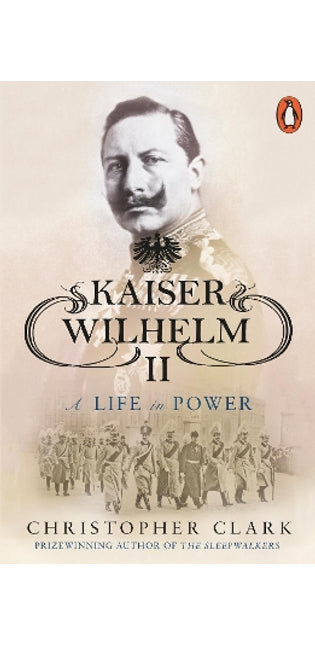
Kaiser Wilhelm II
Christopher Clark's Kaiser Wilhelm II: A Life in Power is a short, fascinating and accessible biography of one of the 20th century's most important figures.King of Prussia, German Emperor, war leader and defeated exile, Kaiser Wilhelm II was one of the most important - and most controversial - figures in the history of twentieth-century Europe. But how much power did he really have?Christopher Clark, winner of the Wolfson prize for his history of Prussia, Iron Kingdom, follows Kaiser Wilhelm's political career from his youth at the Hohenzollern court through the turbulent decades of the Wilhelmine era into global war and the collapse of Germany in 1918, to his last days. He asks: what was his true role in the events that led to the outbreak of the First World War? What was the nature and extent of his control? What were his political goals and his success in achieving them? How did he project authority and exercise influence? And how did his people really view him?Through original research, Clark presents a fresh new interpretation of this contentious figure, focusing on how his thirty-year reign from 1888 to 1918 affected Germany, and the rest of Europe, for years to come. 'Clark's fresh and enlightening history brings the Kaiser's life into critical and illuminating review' German History Christopher Clark is a lecturer in Modern European History at St Catharine's College, University of Cambridge. His book Iron Kingdom: The Rise and Downfall of Prussia 1600 to 1947 was the winner of the Wolfson Prize for History.
R 471.00
Cambridge Introduction to Christopher Marlowe
Providing a comprehensive survey of Christopher Marlowe's literary career, this Introduction presents an approachable account of the life, works and influence of the groundbreaking Elizabethan dramatist and poet. It includes in-depth discussions of all of Marlowe's plays, stressing what was new and revolutionary about them as well as how they made use of existing dramatic models. Marlowe's poems and translations, sometimes marginalised in discussions of his work, are analysed to emphasise their literary importance and political resonances. The book presents a balanced discussion of Marlowe's turbulent life and considers his afterlives: the influence of his work on other writers and examples of how his plays have been performed. In addition to introducing the reader to the historical and religious contexts within which Marlowe wrote, the Introduction stresses the qualities that continue to make his work fascinating: intellectual range, radical irony and an awareness of the dangerously compelling power of theatre.
R 1,095.48
Art of the State
Why does public management–the art of the state–so often go wrong, producing failure and fiasco instead of public service? What are the different ways in which control or regulation can be applied to government? Why do we find contradictory recipes for the improvement of public services? Are the forces of modernity set to produce worldwide convergence in ways of organizing government? This important new study aims to explore such questions, central tocurrent debates over public management. Combining contemporary and historical experience, it employs grid/group cultural theory as an organizing frame and method of exploration. Using examples from different places and eras, the study seeks to identify the recurring variety of ideas about how to organize publicservices. And contrary to widespread claims that modernization will bring a new global uniformity, it argues that variety is unlikely to disappear from doctrine and practice in public management.
R 3,133.00
Pragmatic Maxim
Christopher Hookway presents a series of essays on the philosophy of Charles Sanders Peirce (1839-1913), the 'founder of pragmatism' and one of the most important and original American philosophers. Peirce made significant contributions to the development of formal logic and to the study of the normative standards we should follow in carrying out inquiries and enhancing our knowledge in science and mathematics. In The Pragmatic Maxim, Hookway exploresPeirce's writings on truth, science, and the nature of meaning, which have become steadily more influential over recent decades. He demonstrates how Peirce's ideas can contribute to and inform philosophical understanding in debates that continue today.The first seven chapters explore the framework of Peirce's thought, especially his fallibilism and his rejection of scepticism, and his contributions to the pragmatist understanding of truth and reality. Like Frege and Husserl, among others, Peirce rejected psychologism and used phenomenological foundations to defend the system of categories. The final three chapters are concerned with 'the pragmatic maxim', a rule for clarifying the contents of concepts and ideas. Hookway explores thedifferent strategies Peirce employed to demonstrate the correctness of the maxim, and thus of pragmatism. As well as studying and evaluating Peirce's views, The Pragmatic Maxim discusses the relations between the views of Peirce and other pragmatist philosophers such as William James, C. I. Lewis, andRichard Rorty.
R 4,641.00
Cabinet Decisions on Foreign Policy
Although Parliament is the principal source of authority in the British political system, it is the Cabinet which stands at the pinnacle of government. Yet what actually happens at Cabinet meetings? How are decisions made, particularly in the arena of foreign policy? Such questions have hitherto been largely overlooked by both historians and political scientists. In this book, Dr Christopher Hill presents a detailed case-study of the British government and foreign policy, during the dramatic period from the Munich Conference of 1938 to the German invasion of the Soviet Union three years later. Using extensive archival material, he examines how far the strong personalities of Neville Chamberlain and Winston Churchill respectively were really able to dominate their Cabinets in an area of policy where Prime Ministers have traditionally been supposed to exercise considerable freedom. This analysis concentrates on six decisions that were of key importance in committing Britain to the war which began in September 1939 but which changed so sharply in character in June 1940 with the fall of France. An original study of foreign policymaking at the highest level, this book will be widely read by international relations specialists while historians will welcome the close-textured account of key episodes of this period. It will also reinvigorate debates among political scientists on the nature of Cabinet government.
R 2,603.04
Truth, Rationality, and Pragmatism
Christopher Hookway presents a series of studies of themes from the work of American philosopher Charles S. Peirce (1839-1913), often described as the founder of pragmatism. These themes concern how we are able to investigate the world rationally; and, as Hookway shows, the ideas introduced by Peirce can still make fruitful contributions to research in philosophy, logic and semiotics After an extended examination of Peirce's account of truth, and of its relations to his ideas about logic, reference, and representation, Hookway discusses his claims that rationality requires a system of "scientific metaphysics". The second half of the book studies the role of common sense, sentiments, and emotions in rationality. It concludes with discussions of Peirce's approach to religious belief and the role of pragmatism in his thought.
R 3,094.00
Word Monkey
This is the memoir Christopher Fowler always wanted to write about 'writing'.It's the story of how a young bookworm growing up in a house where there was nothing to read but knitting pamphlets and motorcycle manuals became a writer - a 'word monkey' - and pursued a sort of career in popular fiction. It's a book full of brilliant insights and sharp observations about the highs and lows and pitfalls and pleasures of his profession and about his favourite (and not-so-favourite) novelists. For would-be writers, Word Monkey is a treasure trove of sage advice on what to watch out for, to approach with caution or, indeed, to avoid at all costs.But woven into this hugely entertaining, inspiring and politely opinionated account of a writer's life is an altogether darker thread. Because in Spring 2020, as the world went into lockdown, Chris was diagnosed with terminal cancer and his world was turned upside down. And yet Word Monkey is anything but a misery memoir. In prose as light as air, he recounts with candour, grace and typically self-deprecating humour what he came to realise would be the final chapter in his story. The result is a deeply moving, often very funny and surprisingly uplifting account of someone suddenly having to confront and come to terms with their own mortality.
R 597.00
Authority Participation and Cultural Change in China
This 1973 volume is a fascinating collection of original studies on the immediate consequences and the likely long-term effects of the Chinese Cultural Revolution, the enormous social and political upheaval initiated by Mao Tse-Tung in 1966. The authors discuss a series of connected problems, all intimately related to the central theme of leadership and participation in the Chinese pattern of economic development and social change. The collection is edited by Stuart Schram, who also provides a long introduction; he puts the Cultural Revolution in the broad historical perspective of the Chinese revolution as it has taken shape since the end of the nineteenth century.
R 1,988.43
Christopher Nolan
Christopher Nolan is the writer and director of Hollywood blockbusters like The Dark Knight and The Dark Knight Rises, and also of arthouse films like Memento and Inception. Underlying his staggering commercial success however, is a darker sensibility that questions the veracity of human knowledge, the allure of appearance over reality and the latent disorder in contemporary society. This appreciation of the sinister owes a huge debt to philosophy and especially modern thinkers like Friedrich Nietzsche, Sigmund Freud and Jacques Derrida. Taking a thematic approach to Nolan’s oeuvre, Robbie Goh examines how the director’s postmodern inclinations manifest themselves in non-linearity, causal agnosticism, the threat of social anarchy and the frequent use of the mise en abyme, while running counter to these are narratives of heroism, moral responsibility and the dignity of human choice. For Goh, Nolan is a ‘reluctant postmodernist’. His films reflect the cynicism of the modern world, but with their representation of heroic moral triumphs, they also resist it.
R 2,943.00
In Search of Lost Roses
Once upon a time-before the 1860s-people loved old roses like "Pearl of Gold," "Marchionesse of Lorne," or "Autumn Damask." Then along came the hybrid tea roses, which were easier to arrange, more dramatic, and longer-blooming, and the old roses were all but forgotten. Now the lovely, subtle-hued, richly perfumed old roses are making a comeback, thanks to the efforts of a stubborn band of eccentric characters who rescued them from back alleys, ramshackle cottages, and overgrown graveyards across the country. Thomas Christopher tells us the fascinating stories of the old roses-how they were created and made their way to America-and the unforgettable people who "rustle" them from abandoned lots and secret gardens today, revelling in the mystery of an "unknown yellow."
R 813.00
Mobile Lifeworlds
Mobile Lifeworlds illustrates how the imaginaries and ideals of Western travellers, especially those of untouched nature and spiritual enlightenment, are consistent with media representations of the Himalayan region, romanticism and modernity at large. Blending tourism and pilgrimage, travel across Nepal, Tibet, Bhutan, and Northern India is often inspired and oriented by a search for authenticity, adventure and Otherness. Such valued ideals are shown, however, to be contested by the very forces and configurations that enable global mobility. The role ubiquitous media and mobile technologies now play in framing travel experiences are explored, revealing a situation in which actors are neither here nor there, but increasingly are ‘inter-placed’ across planetary landscapes. Beyond institutionalised religious contexts and the visiting of sacred sites, the author shows how a secular religiosity manifests in practical, bodily encounters with foreign environments. This book is unique in that it draws on a dynamic and innovative set of disciplinary and theoretical perspectives, especially phenomenology, the mobilities paradigm and philosophical anthropology. The volume breaks fresh ground in pilgrimage, tourism and travel studies by unfolding the complex relationships between the virtual, imaginary and corporeal dynamics of contemporary mobile lifeworlds.
R 9,303.07
Life and Death at Cape Disappointment
The ocean is one of the few untamed places on earth, unpredictable and unsympathetic to the lives lost there. For this reason people remain fascinated by its tides, currents, and mysteries. Life and Death at Cape Disappointment is the author’s first-hand account of life as a surfman at one of the Coast Guard’s most dangerous stations, Cape Disappointment is one of the most notorious Coast Guard units on the Pacific Coast, its area of responsibility referred to as the “Graveyard of the Pacific.” The book focuses on five of the most significant search and rescue cases during the author’s tour and how such work affected him and his colleagues mentally and physically. It’s armchair entertainment for those enthralled by the ocean. During the author’s tenure at Station Cape Disappointment, he amassed over 2,200 hours of underway time, routinely operating on the hazardous Columbia River bar, where he earned a reputation as one of the most skilled boat handlers in the Coast Guard. He has worked on and supervised over 430 search and rescue cases. One of his rescues earned him the Association for Rescue at Sea’s gold lifesaving medal.
R 455.00
Voicing America
How is a nation brought into being? In a detailed examination of crucial texts of 18th-century American literature, Christopher Looby argues that the United States was self-consciously enacted through the spoken word. Historical material informs and animates theoretical texts by Derrida, Lacan, and others as Looby unravels the texts of Benjamin Franklin, Charles Brockden Brown, and Hugh Henry Brackenridge and connects them to nation-building, political discourse, and self-creation. Correcting the strong emphasis on the importance of print culture in 18th-century America, "Voicing America" uncovers the complex process of early American writers articulating their new nation, and reveals a body of literature and a political discourse thoroughly concerned with the power of vocal language.
R 883.00
How To Squander Your Potential - The Smart Es & Kniteforce Story
The story of the rise and fall of the early nineties band Smart E's as told by one of the founding members.
R 785.27
A Natural History of Empty Lots
"Brown lives far from any conventional battlefield, but he is surrounded by the wreckage of a different war, and he, too, finds hope in cultivating the ruins of nature...A Natural History of Empty Lots is less a departure from the nature writing tradition than a welcome addition to its edgelands." -New York Review of Books"The nature writing we need now." -Michelle Nijhuis, author of Beloved Beasts"Incredible" -Kelly Link, Pulitzer Prize finalist"An instant classic" -Jeff VanderMeer, New York Times bestselling authorDuring the real estate crash of the late 2000s, Christopher Brown purchased an empty lot in an industrial section of Austin, Texas. The property-abandoned and full of litter and debris-was an unlikely site for a home. Brown had become fascinated with these empty lots around Austin, so-called "ruined" spaces once used for agriculture and industry awaiting their redevelopment. He discovered them to be teeming with natural activity, and embarked on a twenty-year project to live in and document such spaces. There, in our most damaged landscapes, he witnessed the remarkable resilience of wild nature, and how we can heal ourselves by healing the Earth. Beautifully written and philosophically hard-hitting, A Natural History of Empty Lots offers a new lens on human disruption and nature, offering a sense of hope among the edgelands.
R 456.00
And the Band Played On: The enthralling account of what happened after the Titanic sank
On 14th April 1912 the Titanic struck an iceberg on her maiden voyage and sank. Fifteen hundred passengers and crew lost their lives. As the order to abandon ship was given, the orchestra took their instruments on deck and continued to play. They were still playing when the ship went down.The violinist, 21 year-old Jock Hume, knew that his fiancée, Mary, was expecting their first child, the author's mother.One hundred years later, Christopher Ward reveals a dramatic story of love, loss and betrayal, and the catastrophic impact of Jock's death on two very different Scottish families. He paints a vivid portrait of an age in which class determined the way you lived - and died. An outstanding piece of historical detective work, AND THE BAND PLAYED ON is also a moving account of how the author's quest to learn more about his grandfather revealed the shocking truth about a family he thought he knew, a truth that had been hidden for nearly a hundred years.
R 408.00
Who Cares
The first comprehensive map of the social safety net, public and private, in the United States. Societies are often judged by how they treat their most vulnerable members: the poor and near poor. In the United States, this responsibility belongs not only to governments, but also to charities, businesses, individuals, and family members. Their combined efforts generate a social safety net. In Who Cares, Christopher Howard offers the first comprehensive map of the US social safety net. He chronicles how different parts of American society talk about poverty-related needs. And heshows what Americans do to provide basic levels of income, food, housing, medical care, and daily care. Although the US social safety net is extensive, major gaps remain, particularly impacting Blacks, Hispanics, and individuals who are not employed full-time. Drawing heavily upon evidence from the years rightbefore the Covid-19 pandemic, Howard demonstrates that these problems persist even when the economy seems healthy. Who Cares concludes with an initial assessment of how the social safety net performed during the pandemic.
R 1,431.00