Search results for "Python in Depth"
Items we need to order for you

R 690.14
R 615.18
R 387.00
R 611.00
R 611.00
R 624.00
R 1,096.00
R 580.00
Supercharged Python
If you’re ready to write better Python code and use more advanced features, Advanced Python Programming was written for you. Brian Overland and John Bennett distill advanced topics down to their essentials, illustrating them with simple examples and practical exercises. Building on Overland’s widely-praised approach in Python Without Fear, the authors start with short, simple examples designed for easy entry, and quickly ramp you up to creating useful utilities and games, and using Python to solve interesting puzzles. Everything you’ll need to know is patiently explained and clearly illustrated, and the authors illuminate the design decisions and tricks behind each language feature they cover. You’ll gain the in-depth understanding to successfully apply all these advanced features and techniques: Coding for runtime efficiencyLambda functions (and when to use them)Managing versioning Localization and UnicodeRegular expressionsBinary operators Radix conversions Data formatting, in depthCreating, building, and importing packagesUsing the Django web-development packageGraphics programmingMagic methods and advanced object orientationReading and writing binary files, and more
R 1,026.00
R 641.00
R 763.00
Deep Dive Python
Take your programming skills to the next level by expanding real-world Python applications in open-source code. This book is an essential guide for experienced developers looking to enhance their Python proficiency. Using code examples from popular open-source projects you'll master Python concepts and see how they are applied in production-level code. By understanding code from established projects, you'll develop a deeper appreciation for Python's capabilities and learn best practices that have been battle-tested in the real world. You'll gain the confidence to tackle complex projects, optimize your code, and implement advanced Python features effectively. You'll also examine typing, generators, iterators, the itertools module, multithreading, multiprocessing, and asyncio. This will equip you to build production-ready Python programs and libraries. Whether you're building large-scale applications, contributing to open-source projects, or solving intricate programming challenges, Deep Dive Python will provide you with the knowledge and practical experience to excel in your Python development journey. What You Will Learn Master Python's core data structures and how to use them effectively. Implement decorators, descriptors, metaclasses, and abstract base classes in your code Enhance your code with functional programming techniques using the functools module Improve iteration with generators, iterators, and the itertools module Select the best Python concurrent programming models to use for optimal performance Apply best practices for code organization, packaging, and creating maintainable Python projects Who This Book Is For Experienced Python developers who want to expand their programming skils
R 1,368.00
Learning Python
Get a comprehensive, in-depth introduction to the core Python language with this hands-on book. Based on author Mark Lutz's popular training course, this updated sixth edition will help you quickly write efficient, high-quality code with Python. It's an ideal way to begin, whether you're new to programming or a professional developer versed in other languages.Complete with quizzes, exercises, and helpful illustrations, this easy-to-follow self-paced tutorial gets you started with Python 3.12 and all other releases in use today. With a pragmatic focus on what you need to know, it also introduces some advanced language features that have become increasingly common in Python code.This book helps you:Explore Python's built-in object types such as strings, lists, dictionaries, and filesCreate and process objects with Python statements, and learn Python's syntax modelUse functions and functional programming to avoid redundancy and maximize reuseOrganize code into larger components with modules and packagesCode robust programs with Python's exception handling and development toolsApply object-oriented programming and classes to make code customizableSurvey advanced Python tools including decorators, descriptors, and metaclassesWrite idiomatic Python code that runs portably across a wide variety of platforms
R 1,824.00
R 641.00
Quick Python Book, Fourth Edition
A fast-paced introduction to Python for intermediate developers–now with coverage of generative AI!For over 25 years, The Quick Python Book has been one of the best Python books money can buy. It concisely covers programming basics, while introducing Python's comprehensive standard library and unique features in depth and detail. In this fourth edition, you'll find new coverage of AI coding tools like Copilot and Google's Colaboratory (Colab), and develop a mindset that can make the most of AI. The Quick Python Book, Fourth Edition includes: Python syntax, data structures, and best practicesPython as an object oriented languageCommon Python librariesBasic data handling with PythonUsing AI code generation tools with Python Whether you're new to Python or looking to advance your basic skills, The Quick Python Book, Fourth Edition will get you writing effective Python code fast. Python authority and former Chair of the Python Software Foundation Board or Directors Naomi Ceder has returned to author this extensively revised fourth edition. With the personal touch of a skilled teacher, Naomi beautifully balances details of the language with the insights and advice you need to handle any task. About the technology: System automation. High-performance web apps. Cloud and back-end services. Cutting edge AI. No matter what you're building, it pays to know how to read and write Python! The Quick Python Book has helped over 100,000 developers get up to speed with the Python programming language. This revised Fourth Edition, fully updated for Python 3.13, explores the latest features and libraries and shows you how to code smarter with AI tools like ChatGPT.
R 1,921.00
Python Object-Oriented Programming
A comprehensive guide to exploring modern Python through data structures, design patterns, and effective object-oriented techniquesKey FeaturesBuild an intuitive understanding of object-oriented design, from introductory to mature programsLearn the ins and outs of Python syntax, libraries, and best practicesExamine a machine-learning case study at the end of each chapterBook DescriptionObject-oriented programming (OOP) is a popular design paradigm in which data and behaviors are encapsulated in such a way that they can be manipulated together. Python Object-Oriented Programming, Fourth Edition dives deep into the various aspects of OOP, Python as an OOP language, common and advanced design patterns, and hands-on data manipulation and testing of more complex OOP systems. These concepts are consolidated by open-ended exercises, as well as a real-world case study at the end of every chapter, newly written for this edition. All example code is now compatible with Python 3.9+ syntax and has been updated with type hints for ease of learning. Steven and Dusty provide a comprehensive, illustrative tour of important OOP concepts, such as inheritance, composition, and polymorphism, and explain how they work together with Python’s classes and data structures to facilitate good design. In addition, the book also features an in-depth look at Python’s exception handling and how functional programming intersects with OOP. Two very powerful automated testing systems, unittest and pytest, are introduced. The final chapter provides a detailed discussion of Python's concurrent programming ecosystem. By the end of the book, you will have a thorough understanding of how to think about and apply object-oriented principles using Python syntax and be able to confidently create robust and reliable programs.What you will learnImplement objects in Python by creating classes and defining methodsExtend class functionality using inheritanceUse exceptions to handle unusual situations cleanlyUnderstand when to use object-oriented features, and more importantly, when not to use themDiscover several widely used design patterns and how they are implemented in PythonUncover the simplicity of unit and integration testing and understand why they are so importantLearn to statically type check your dynamic codeUnderstand concurrency with asyncio and how it speeds up programsWho this book is forIf you are new to object-oriented programming techniques, or if you have basic Python skills and wish to learn how and when to correctly apply OOP principles in Python, this is the book for you. Moreover, if you are an object-oriented programmer coming from other languages or seeking a leg up in the new world of Python, you will find this book a useful introduction to Python. Minimal previous experience with Python is necessary.
R 2,605.00
Classic Computer Science Problems in Python
Classic Computer Science Problems in Python presents dozens of coding challenges, ranging from simple tasks like finding items in a list with a binary sort algorithm to clustering data using k-means. Classic Computer Science Problems in Python deepens your Python language skills by challenging you with time-tested scenarios, exercises, and algorithms. As you work through examples in search, clustering, graphs, and more, you'll remember important things you've forgotten and discover classic solutions to your "new" problems Key Features · Breadth-first and depth-first search algorithms · Constraints satisfaction problems · Common techniques for graphs · Adversarial Search · Neural networks and genetic algorithms · Written for data engineers and scientists with experience using Python. For readers comfortable with the basics of Python About the technology Python is used everywhere for web applications, data munging, and powerful machine learning applications. Even problems that seem new or unique stand on the shoulders of classic algorithms, coding techniques, and engineering principles. Master these core skills, and you’ll be ready to use Python for AI, data-centric programming, deep learning, and the other challenges you’ll face as you grow your skill as a programmer. David Kopec teaches at Champlain College in Burlington, VT and is the author of Manning’s Classic Computer Science Problemsin Swift.
R 925.00
Python for Engineers and Scientists
This book equips technical professionals with a complete, structured path to mastering Python for real-world engineering and scientific applications. As Python becomes central to research labs, automation, simulation, and data-driven engineering, the learning curve remains steep. This book bridges that gap with a practical roadmap from fundamentals to professional-grade scientific computing.The book begins by building a strong programming foundation—covering Python’s architecture, essential syntax, data structures, modules, functions, control flow, and object-oriented design. Readers learn not only how to write Python, but why the language behaves the way it does, ensuring deep understanding and strong problem-solving skills. From there, the focus shifts to practical engineering tools. Dedicated chapters train readers in file handling, math modules, and key scientific libraries including NumPy, SciPy, Pandas, and Matplotlib, enabling efficient computation, signal processing, data analysis, and high-quality visualization. Advanced chapters then showcase Python’s versatility through GUI development with Kivy, database work with SQLAlchemy, and hands-on control system modeling and analysis. Each topic is rooted in industry and academic scenarios, making the content directly applicable to automation, simulation, data workflows, and engineering computation.Whether you're a student building foundational skills or a professional modernizing engineering workflows, this guide provides the programming depth, scientific tools, and applied knowledge needed to use Python confidently for prototyping, simulation, analysis, and automation. It is the one-stop resource for mastering Python in technical disciplines.What you will learn:Learn core Python programming concepts, including variables, loops, functions, and object-oriented principles in a scientific and engineering context.Build strong skills in key scientific Python libraries such as NumPy, Pandas, Matplotlib, and SciPy for computation, analysis, and visualization.Apply Python to real-world engineering scenarios, including dynamic control systems and automation workflows.Develop interactive engineering applications by creating graphical user interfaces (GUIs) with Kivy. Who this book is for:This book is intended for practicing engineers and scientists across various disciplines of engineering who need to use Python for complex problem-solving, simulation, and data analysis in their work.
R 1,368.00
Python Basics
This book is designed for use as a primary introduction to Python and can be used as an introductory text or as a resource for professionals in industry. The book has been divided into four sections. The first section deals with the language fundamentals, primarily the procedural part of the language, the second introduces the object-oriented paradigms, the third section deals with data structures, and the last is devoted to advanced topics like handling multi-dimensional arrays using NumPy and visualization using Matplotlib. Regular expressions and multi-threading have been introduced in the appendices.Features:Includes sections dedicated to data structures Offers in-depth treatment of topics such as classes, inheritance, BST, andNumPyIntroduces topics like Matplotlib and PILContains exercises for practice and a review of essential programming concepts
R 1,139.00
Deep Reinforcement Learning with Python
An example-rich guide for beginners to start their reinforcement and deep reinforcement learning journey with state-of-the-art distinct algorithmsKey FeaturesCovers a vast spectrum of basic-to-advanced RL algorithms with mathematical explanations of each algorithmLearn how to implement algorithms with code by following examples with line-by-line explanationsExplore the latest RL methodologies such as DDPG, PPO, and the use of expert demonstrationsBook DescriptionWith significant enhancements in the quality and quantity of algorithms in recent years, this second edition of Hands-On Reinforcement Learning with Python has been revamped into an example-rich guide to learning state-of-the-art reinforcement learning (RL) and deep RL algorithms with TensorFlow 2 and the OpenAI Gym toolkit. In addition to exploring RL basics and foundational concepts such as Bellman equation, Markov decision processes, and dynamic programming algorithms, this second edition dives deep into the full spectrum of value-based, policy-based, and actor-critic RL methods. It explores state-of-the-art algorithms such as DQN, TRPO, PPO and ACKTR, DDPG, TD3, and SAC in depth, demystifying the underlying math and demonstrating implementations through simple code examples. The book has several new chapters dedicated to new RL techniques, including distributional RL, imitation learning, inverse RL, and meta RL. You will learn to leverage stable baselines, an improvement of OpenAI’s baseline library, to effortlessly implement popular RL algorithms. The book concludes with an overview of promising approaches such as meta-learning and imagination augmented agents in research. By the end, you will become skilled in effectively employing RL and deep RL in your real-world projects.What you will learnUnderstand core RL concepts including the methodologies, math, and codeTrain an agent to solve Blackjack, FrozenLake, and many other problems using OpenAI GymTrain an agent to play Ms Pac-Man using a Deep Q NetworkLearn policy-based, value-based, and actor-critic methodsMaster the math behind DDPG, TD3, TRPO, PPO, and many othersExplore new avenues such as the distributional RL, meta RL, and inverse RLUse Stable Baselines to train an agent to walk and play Atari gamesWho this book is forIf you’re a machine learning developer with little or no experience with neural networks interested in artificial intelligence and want to learn about reinforcement learning from scratch, this book is for you.Basic familiarity with linear algebra, calculus, and the Python programming language is required. Some experience with TensorFlow would be a plus.
R 1,661.00
R 970.00
Python for the Busy Java Developer
Are you a seasoned Java developer who wishes to learn Python? Perhaps you’ve just joined a project where a chunk of system integration code is written in Python. Or maybe you need to implement a report generation module in the next sprint and your colleague mentioned that Python would be the perfect tool for the job. In any case, if you are in a situation where you have to pick up the Python programming language overnight, this book is just for you! Hit the ground running and gain a fast-paced overview of what the Python language is all about, the syntax that it uses and the ecosystem of libraries and tools that surround the language. This concise book doesn’t spend time on details from an introductory programming course or document every single Python feature. Instead, Python for the Busy Java Developer is designed for experienced Java developers to obtain sufficient familiarity with the language and dive into coding, quickly. What You'll LearnDiscover the fundamentals of the core Python language and how they compare to JavaUnderstand Python syntax and the differences between Python 2.x and 3.xExplore the Python ecosystem, its standard libraries, and how to implement themWho This Book Is ForWorking programmers who are comfortable with Java or another object-oriented programming language such as C#
R 836.98
Python 3: Pocket Primer
As part of the best selling Pocket Primer series, this book is an effort to give programmers sufficient knowledge of Python 3 to be able to work on their own projects. In addition to covering all of the basic concepts, the book features a chapter on PyGame, which allows a programmer to handle graphics, mouse and keyboard interaction, and play sounds and videos. The demonstration example for that chapter is a Lunar Lander game. Another feature is the chapter on communication, which makes use of one of Python's best features: a collection of modules for sending and receiving Email, communicating between computers, and working with Twitter and Web pages. Companion files that accompany this book contain all of the code examples as complete working programs. This means that there is no need to key them in, so they can be executed and perhaps modified or expanded. Features:Features a chapter on PyGame, which allows a programmer to handle graphics, mouse / keyboard interaction, and play sounds and videosExplores communication in depth, making use of one of Python's best features: a collection of modules for sending and receiving Email, communicating between computers, and working with Twitter and Web pages.Companion files contain all of the code examples as complete working programsOn the Companion Files:(also available from the publisher for downloading by emailing info@merclearning.com)Source code samplesAll images from the text (including 4-color)
R 752.00
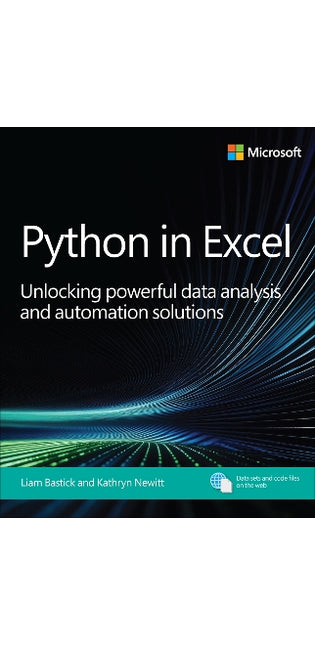
Python in Excel
Seasoned Experts Liam Bastick and Kathryn Newitt unveil a groundbreaking guide to mastering data analysis and automation with Python in Excel Python in Excel: Unlocking powerful data analysis and automation solutions is a hands-on, practical guide that leverages the authors’ decades of expertise to teach readers how to harness the newly integrated Python capabilities within Microsoft Excel, mapping familiar Excel concepts to Python foundations. Covering essential topics such as Python syntax, data structures, data analysis with pandas, visualization, and the use of AI tools like Copilot, the book empowers professionals to elevate their data analysis and automation skills. Readers will gain the ability to perform advanced forecasting, build predictive models, and streamline workflows, making them more efficient and competitive in today’s data-driven workplace. By reading this book, you will: Understand the fundamentals of Python programming directly within ExcelMap your existing Excel skills to Python concepts for easier learningAutomate repetitive tasks and workflows Analyze and visualize data with powerfulPython libraries like pandas Build advanced forecasting and predictive models without leaving ExcelExplore and manipulate data efficiently using Python’s concise syntaxIntegrate AI tools such as Copilot to assist with coding and analysisConnect Excel with external data sources using Python and Power QueryDevelop custom solutions for business modeling and data scienceCreate a roadmap for further study and mastery of Python in Excel
R 2,083.00
Programming Python
Once you've come to grips with the core Python language, learning how to build Python applications presents a far more interesting challenge. Tap this book's wealth of practical advice, snippets of code, and patterns of program design to take your Python skills to the next level. You'll start with in-depth discussions of core concepts and then progress toward complete programs in different application domains, including: * GUI programming * Internet scripting * Parallel processing * Database management * Networked applications * System administration * Text processing Most programming experts consider this classic book, now updated for Python 3.x, to be the industry standard for learning Python application programming. With clear and concise explanations of Python syntax and programming techniques, and numerous examples that illustrate both correct usage and common idioms, Programming Python shows you the right way to code with Python.
R 1,710.00
Concise Introduction to Programming in Python
A Concise Introduction to Programming in Python, Second Edition provides a hands-on and accessible introduction to writing software in Python, with no prior programming experience required.The Second Edition was thoroughly reorganized and rewritten based on classroom experience to incorporate: A spiral approach, starting with turtle graphics, and then revisiting concepts in greater depth using numeric, textual, and image data Clear, concise explanations written for beginning students, emphasizing core principles A variety of accessible examples, focusing on key concepts Diagrams to help visualize new concepts New sections on recursion and exception handling, as well as an earlier introduction of lists, based on instructor feedbackThe text offers sections designed for approximately one class period each, and proceeds gradually from procedural to object-oriented design. Examples, exercises, and projects are included from diverse application domains, including finance, biology, image processing, and textual analysis. It also includes a brief "How-To" sections that introduce optional topics students may be interested in exploring.The text is written to be read, making it a good fit in flipped classrooms. Designed for either classroom use or self-study, all example programs and solutions to odd-numbered exercises (except for projects) are available at: http://www.central.edu/go/conciseintro/.
R 2,987.09
R 641.00
Python for Secret Agents - Volume II
Gather, analyze, and decode data to reveal hidden facts using Python, the perfect tool for all aspiring secret agentsAbout This Book• Discover the essential features of Python programming: statements, variables, expressions, and many of the built-in data types• Use Python's standard library to do more sophisticated data gathering and analysis• Written by a Python programming expert, with over 35 years' experience as a consultant, teacher, author and software developerWho This Book Is ForThis book is for Secret Agents who have some exposure to Python. Our focus is on the Field Agents who are ready to do more sophisticated and complex programming in Python. We'll stick to simple statistics for the most part. A steady hand with a soldering iron is not required, but a skilled field agent should be able to assemble a working Arduino circuit to gather their own sensor data.What You Will Learn• Upgrade Python to the latest version and discover its latest and greatest tools• Use Python libraries to extract data from log files that are designed more for people to read than for automated analysis• Summarize log files and extract meaningful information• Gather data from social networking sites and leverage your experience of analyzing log files to summarize the data you find• Extract text and images from social networking sites• Parse the complex and confusing data structures in a PDF file to extract meaningful text that we can analyze• Connect small, intelligent devices to our computer to use them as remote sensors• Use Python to analyze measurements from sensors to calibrate them and use sensors efficientlyIn DetailPython is easy to learn and extensible programming language that allows any manner of secret agent to work with a variety of data. Agents from beginners to seasoned veterans will benefit from Python's simplicity and sophistication. The standard library provides numerous packages that move beyond simple beginner missions. The Python ecosystem of related packages and libraries supports deep information processing.This book will guide you through the process of upgrading your Python-based toolset for intelligence gathering, analysis, and communication. You'll explore the ways Python is used to analyze web logs to discover the trails of activities that can be found in web and database servers. We'll also look at how we can use Python to discover details of the social network by looking at the data available from social networking websites.Finally, you'll see how to extract history from PDF files, which opens up new sources of data, and you'll learn about the ways you can gather data using an Arduino-based sensor device.Style and approachEach chapter will include a background briefing that covers an essential Python technology. After some in-depth exploration of the features, the chapter will conclude with a mission that is a concrete application of the Python tools and techniques covered.
R 912.00
Python in a Nutshell
Python was recently ranked as today's most popular programming language on the TIOBE index, thanks to its broad applicability to design and prototyping to testing, deployment, and maintenance. With this updated fourth edition, you'll learn how to get the most out of Python, whether you're a professional programmer or someone who needs this language to solve problems in a particular field.Carefully curated by recognized experts in Python, this new edition focuses on version 3.10, bringing this seminal work on the Python language fully up to date on five version releases, including preview coverage of upcoming 3.11 features.This handy guide will help you:Learn how Python represents data and program as objectsUnderstand the value and uses of type annotationsExamine which language features appeared in which recent versionsDiscover how to use modern Python idiomaticallyLearn ways to structure Python projects appropriatelyUnderstand how to debug Python code
R 2,052.00
R 970.00
Learning Concurrency in Python
Practically and deeply understand concurrency in Python to write efficient programsAbout This Book• Build highly efficient, robust, and concurrent applications• Work through practical examples that will help you address the challenges of writing concurrent code• Improve the overall speed of execution in multiprocessor and multicore systems and keep them highly availableWho This Book Is ForThis book is for Python developers who would like to get started with concurrent programming. Readers are expected to have a working knowledge of the Python language, as this book will build on these fundamentals concepts.What You Will Learn• Explore the concept of threading and multiprocessing in Python• Understand concurrency with threads• Manage exceptions in child threads• Handle the hardest part in a concurrent system — shared resources• Build concurrent systems with Communicating Sequential Processes (CSP)• Maintain all concurrent systems and master them• Apply reactive programming to build concurrent systems• Use GPU to solve specific problemsIn DetailPython is a very high level, general purpose language that is utilized heavily in fields such as data science and research, as well as being one of the top choices for general purpose programming for programmers around the world. It features a wide number of powerful, high and low-level libraries and frameworks that complement its delightful syntax and enable Python programmers to create.This book introduces some of the most popular libraries and frameworks and goes in-depth into how you can leverage these libraries for your own high-concurrent, highly-performant Python programs. We'll cover the fundamental concepts of concurrency needed to be able to write your own concurrent and parallel software systems in Python.The book will guide you down the path to mastering Python concurrency, giving you all the necessary hardware and theoretical knowledge. We'll cover concepts such as debugging and exception handling as well as some of the most popular libraries and frameworks that allow you to create event-driven and reactive systems.By the end of the book, you'll have learned the techniques to write incredibly efficient concurrent systems that follow best practices.Style and approachThis easy-to-follow guide teaches you new practices and techniques to optimize your code, and then moves toward more advanced ways to effectively write efficient Python code. Small and simple practical examples will help you test the concepts yourself, and you will be able to easily adapt them for any application.
R 1,661.00
Concise Introduction to Programming in Python
A Concise Introduction to Programming in Python, Second Edition provides a hands-on and accessible introduction to writing software in Python, with no prior programming experience required.The Second Edition was thoroughly reorganized and rewritten based on classroom experience to incorporate: A spiral approach, starting with turtle graphics, and then revisiting concepts in greater depth using numeric, textual, and image data Clear, concise explanations written for beginning students, emphasizing core principles A variety of accessible examples, focusing on key concepts Diagrams to help visualize new concepts New sections on recursion and exception handling, as well as an earlier introduction of lists, based on instructor feedbackThe text offers sections designed for approximately one class period each, and proceeds gradually from procedural to object-oriented design. Examples, exercises, and projects are included from diverse application domains, including finance, biology, image processing, and textual analysis. It also includes a brief "How-To" sections that introduce optional topics students may be interested in exploring.The text is written to be read, making it a good fit in flipped classrooms. Designed for either classroom use or self-study, all example programs and solutions to odd-numbered exercises (except for projects) are available at: http://www.central.edu/go/conciseintro/.
R 9,158.00
R 439.00
R 550.00
Python 3 Object-Oriented Programming
Uncover modern Python with this guide to Python data structures, design patterns, and effective object-oriented techniquesKey FeaturesIn-depth analysis of many common object-oriented design patterns that are more suitable to Python's unique styleLearn the latest Python syntax and librariesExplore abstract design patterns and implement them in Python 3.8Book DescriptionObject-oriented programming (OOP) is a popular design paradigm in which data and behaviors are encapsulated in such a way that they can be manipulated together. This third edition of Python 3 Object-Oriented Programming fully explains classes, data encapsulation, and exceptions with an emphasis on when you can use each principle to develop well-designed software. Starting with a detailed analysis of object-oriented programming, you will use the Python programming language to clearly grasp key concepts from the object-oriented paradigm. You will learn how to create maintainable applications by studying higher level design patterns. The book will show you the complexities of string and file manipulation, and how Python distinguishes between binary and textual data. Not one, but two very powerful automated testing systems, unittest and pytest, will be introduced in this book. You'll get a comprehensive introduction to Python's concurrent programming ecosystem. By the end of the book, you will have thoroughly learned object-oriented principles using Python syntax and be able to create robust and reliable programs confidently.What you will learnImplement objects in Python by creating classes and defining methodsGrasp common concurrency techniques and pitfalls in Python 3Extend class functionality using inheritanceUnderstand when to use object-oriented features, and more importantly when not to use themDiscover what design patterns are and why they are different in PythonUncover the simplicity of unit testing and why it's so important in PythonExplore concurrent object-oriented programmingWho this book is forIf you're new to object-oriented programming techniques, or if you have basic Python skills and wish to learn in depth how and when to correctly apply OOP in Python, this is the book for you. If you are an object-oriented programmer for other languages or seeking a leg up in the new world of Python 3.8, you too will find this book a useful introduction to Python. Previous experience with Python 3 is not necessary.
R 2,735.00
R 611.00
R 916.00
R 641.00
Python 3 Using DeepSeek
This book is your definitive guide to mastering DeepSeek, a leading open-source Large Language Model (LLM), and leveraging its power through practical Python programming. It is structured to build your expertise from foundational Python data structures and object-oriented programming to advanced model deployment.The initial chapters establish a strong technical base in Python's core features, including comprehensions, iterators, and the OOP paradigm. The focus then shifts entirely to DeepSeek, detailing its innovative Mixture-of-Experts (MoE) architecture, its superior performance on code-centric benchmarks like HumanEval, and its efficiency advantages. You will gain crucial insight into model management, specifically through the concept of quantization and local deployment with tools like Ollama, which is essential for maximizing performance while minimizing resource usage. The final chapter provides numerous, practical Python mini-projects, allowing you to immediately apply DeepSeek's capabilities to a range of real-world tasks from basic web scraping and data visualization to advanced object-oriented programming and linear regression.Python 3 Using DeepSeek is essential reading for Python developers (intermediate to advanced), machine learning practitioners, and data scientists. It is your guide to integrating high-performing, open-source LLMs into your workflows, particularly for code generation, algorithmic reasoning, and highly efficient local model deployment.
R 2,674.00
Deep Learning with Python
Master the practical aspects of implementing deep learning solutions with PyTorch, using a hands-on approach to understanding both theory and practice. This updated edition will prepare you for applying deep learning to real world problems with a sound theoretical foundation and practical know-how with PyTorch, a platform developed by Facebook’s Artificial Intelligence Research Group.You'll start with a perspective on how and why deep learning with PyTorch has emerged as an path-breaking framework with a set of tools and techniques to solve real-world problems. Next, the book will ground you with the mathematical fundamentals of linear algebra, vector calculus, probability and optimization. Having established this foundation, you'll move on to key components and functionality of PyTorch including layers, loss functions and optimization algorithms. You'll also gain an understanding of Graphical Processing Unit (GPU) based computation, which is essential for training deep learning models. All the key architectures in deep learning are covered, including feedforward networks, convolution neural networks, recurrent neural networks, long short-term memory networks, autoencoders and generative adversarial networks. Backed by a number of tricks of the trade for training and optimizing deep learning models, this edition of Deep Learning with Python explains the best practices in taking these models to production with PyTorch.What You'll LearnReview machine learning fundamentals such as overfitting, underfitting, and regularization.Understand deep learning fundamentals such as feed-forward networks, convolution neural networks, recurrent neural networks, automatic differentiation, and stochastic gradient descent.Apply in-depth linear algebra with PyTorchExplore PyTorch fundamentals and its building blocksWork with tuning and optimizing models Who This Book Is ForBeginners with a working knowledge of Python who want to understand Deep Learning in a practical, hands-on manner.
R 866.00
R 1,023.22
R 916.00
R 611.00