Search results for "learn ai-assisted python programming, second edition"
Items we need to order for you

R 641.00
C++: A Beginner's Guide, Second Edition
Publisher's Note: Products purchased from Third Party sellers are not guaranteed by the publisher for quality, authenticity, or access to any online entitlements included with the product.Essential skills made easy! Written by Herb Schildt, the world’s leading programming author, this step-by-step book is ideal for first-time programmers or those new to C++. The modular approach of this series, including sample projects and progress checks, makes it easy to learn to use C++ at your own pace.
R 1,380.21
R 2,846.24
R 641.00
R 1,094.00
R 367.00
R 546.53
Mathematics and Programming for Machine Learning with R
Based on the author’s experience in teaching data science for more than 10 years, Mathematics and Programming for Machine Learning with R: From the Ground Up reveals how machine learning algorithms do their magic and explains how these algorithms can be implemented in code. It is designed to provide readers with an understanding of the reasoning behind machine learning algorithms as well as how to program them. Written for novice programmers, the book progresses step-by-step, providing the coding skills needed to implement machine learning algorithms in R. The book begins with simple implementations and fundamental concepts of logic, sets, and probability before moving to the coverage of powerful deep learning algorithms. The first eight chapters deal with probability-based machine learning algorithms, and the last eight chapters deal with machine learning based on artificial neural networks. The first half of the book does not require mathematical sophistication, although familiarity with probability and statistics would be helpful. The second half assumes the reader is familiar with at least one semester of calculus. The text guides novice R programmers through algorithms and their application and along the way; the reader gains programming confidence in tackling advanced R programming challenges. Highlights of the book include: More than 400 exercises A strong emphasis on improving programming skills and guiding beginners to the implementation of full-fledged algorithms Coverage of fundamental computer and mathematical concepts including logic, sets, and probability In-depth explanations of machine learning algorithms
R 3,172.22
Understanding Flight, Second Edition
Publisher's Note: Products purchased from Third Party sellers are not guaranteed by the publisher for quality, authenticity, or access to any online entitlements included with the product.Discover how planes get--and stay--airborneNow you can truly master an understanding of the phenomenon of flight. This practical guide is the most intuitive introduction to basic flight mechanics available. Understanding Flight, Second Edition, explains the principles of aeronautics in terms, descriptions, and illustrations that make sense--without complicated mathematics. Updated to include helicopter flight fundamentals and aircraft structures, this aviation classic is required reading for new pilots, students, engineers, and anyone fascinated with flight. Understanding Flight, Second Edition, covers: Physics of flightWing design and configurationStability and controlPropulsionHigh-speed flightPerformance and safetyAerodynamic testingHelicopters and autogyrosAircraft structures and materials
R 1,277.00
R 580.00
R 1,177.00
Computer-Assisted Foreign Language Teaching and Learning
Educational technologies continue to advance the ways in which we teach and learn. As these technologies continue to improve our communication with one another, computer-assisted foreign language learning has provided a more efficient way of communication between different languages.Computer-Assisted Foreign Language Teaching and Learning: Technological Advances highlights new research and an original framework that brings together foreign language teaching, experiments and testing practices that utilise the most recent and widely used e-learning resources. This comprehensive collection of research will offer linguistic scholars, language teachers and students as well as policymakers a better understanding of the importance and influence of e-learning in second language acquisition.
R 6,803.87
R 1,221.00
Introduction to Reliable and Secure Distributed Programming
In modern computing a program is usually distributed among several processes. The fundamental challenge when developing reliable and secure distributed programs is to support the cooperation of processes required to execute a common task, even when some of these processes fail. Failures may range from crashes to adversarial attacks by malicious processes.Cachin, Guerraoui, and Rodrigues present an introductory description of fundamental distributed programming abstractions together with algorithms to implement them in distributed systems, where processes are subject to crashes and malicious attacks. The authors follow an incremental approach by first introducing basic abstractions in simple distributed environments, before moving to more sophisticated abstractions and more challenging environments. Each core chapter is devoted to one topic, covering reliable broadcast, shared memory, consensus, and extensions of consensus. For every topic, many exercises and their solutions enhance the understanding This book represents the second edition of "Introduction to Reliable Distributed Programming". Its scope has been extended to include security against malicious actions by non-cooperating processes. This important domain has become widely known under the name "Byzantine fault-tolerance".
R 3,866.79
Integration of AI and OR Techniques in Constraint Programming
This book constitutes the proceedings of the International Conference on the Integration of Artificial Intelligence (AI) and Operations Research (OR) Techniques in Constraint Programming, CPAIOR 2014, held in Cork, Ireland, in May 2014. The 33 papers presented in this volume were carefully reviewed and selected from 70 submissions. The papers focus on constraint programming and global constraints; scheduling modelling; encodings and SAT logistics; MIP; CSP and complexity; parallelism and search; and data mining and machine learning.
R 2,205.20
R 2,243.00
R 641.00
RTI Approach to Evaluating Learning Disabilities, Second Edition
From leading authorities, this indispensable work is now in a revised and expanded second edition, presenting state-of-the-art tools and procedures for practitioners. The book shows how to use response to intervention (RTI) to evaluate K-12 students for specific learning disabilities (SLD). The second edition gives increased attention to optimizing the instructional environment in the context of a multi-tiered system of supports (MTSS). Procedures are described for screening at-risk students; using RTI to intensify instruction in reading, writing, and math; identifying SLD; determining eligibility for special education; and planning individualized education programs. Case examples and pointers for practice are woven throughout. In a convenient large-size format, the book includes reproducible tools that can be downloaded and printed for repeated use. New to This Edition *Incorporates contemporary perspectives on SLD, upgraded procedures for implementing an MTSS, new approaches to measuring RTI, and enhancements in using classroom observations. *Chapter on best practices in academic screening, including important dos and don'ts. *Separate chapters on using RTI for reading, written expression, and mathematics. *Chapter on RTI and special education law, focusing on what practitioners need to know. This book is in The Guilford Practical Intervention in the Schools Series, edited by Sandra M. Chafouleas.
R 1,576.00
Semantic Relations Between Nominals, Second Edition
Opportunity and Curiosity find similar rocks on Mars. One can generally understand this statement if one knows that Opportunity and Curiosity are instances of the class of Mars rovers, and recognizes that, as signalled by the word on, rocks are located on Mars. Two mental operations contribute to understanding: recognize how entities/concepts mentioned in a text interact and recall already known facts (which often themselves consist of relations between entities/concepts). Concept interactions one identifies in the text can be added to the repository of known facts, and aid the processing of future texts. The amassed knowledge can assist many advanced language-processing tasks, including summarization, question answering and machine translation.Semantic relations are the connections we perceive between things which interact. The book explores two, now intertwined, threads in semantic relations: how they are expressed in texts and what role they play in knowledge repositories. A historical perspective takes us back more than 2000 years to their beginnings, and then to developments much closer to our time: various attempts at producing lists of semantic relations, necessary and sufficient to express the interaction between entities/concepts. A look at relations outside context, then in general texts, and then in texts in specialized domains, has gradually brought new insights, and led to essential adjustments in how the relations are seen. At the same time, datasets which encompass these phenomena have become available. They started small, then grew somewhat, then became truly large. The large resources are inevitably noisy because they are constructed automatically. The available corpora—to be analyzed, or used to gather relational evidence—have also grown, and some systems now operate at the Web scale. The learning of semantic relations has proceeded in parallel, in adherence to supervised, unsupervised or distantly supervised paradigms. Detailed analyses of annotated datasets in supervised learning have granted insights useful in developing unsupervised and distantly supervised methods. These in turn have contributed to the understanding of what relations are and how to find them, and that has led to methods scalable to Web-sized textual data. The size and redundancy of information in very large corpora, which at first seemed problematic, have been harnessed to improve the process of relation extraction/learning. The newest technology, deep learning, supplies innovative and surprising solutions to a variety of problems in relation learning. This book aims to paint a big picture and to offer interesting details.
R 3,065.49
Principles of Concurrent and Distributed Programming
The latest edition of a classic text on concurrency and distributed programming – from a winner of the ACM/SIGCSE Award for Outstanding Contribution to Computer Science Education.
R 2,188.00
R 793.00
Statistical Computing with R, Second Edition
Praise for the First Edition:". . . the book serves as an excellent tutorial on the R language, providing examples that illustrate programming concepts in the context of practical computational problems. The book will be of great interest for all specialists working on computational statistics and Monte Carlo methods for modeling and simulation." – Tzvetan Semerdjiev, Zentralblatt MathComputational statistics and statistical computing are two areas within statistics that may be broadly described as computational, graphical, and numerical approaches to solving statistical problems. Like its bestselling predecessor, Statistical Computing with R, Second Edition covers the traditional core material of these areas with an emphasis on using the R language via an examples-based approach. The new edition is up-to-date with the many advances that have been made in recent years. Features Provides an overview of computational statistics and an introduction to the R computing environment. Focuses on implementation rather than theory. Explores key topics in statistical computing including Monte Carlo methods in inference, bootstrap and jackknife, permutation tests, Markov chain Monte Carlo (MCMC) methods, and density estimation. Includes new sections, exercises and applications as well as new chapters on resampling methods and programming topics. Includes coverage of recent advances including R Studio, the tidyverse, knitr and ggplot2 Accompanied by online supplements available on GitHub including R code for all the exercises as well as tutorials and extended examples on selected topics.Suitable for an introductory course in computational statistics or for self-study, Statistical Computing with R, Second Edition provides a balanced, accessible introduction to computational statistics and statistical computing.About the AuthorMaria Rizzo is Professor in the Department of Mathematics and Statistics at Bowling Green State University in Bowling Green, Ohio, where she teaches statistics, actuarial science, computational statistics, statistical programming and data science. Prior to joining the faculty at BGSU in 2006, she was Assistant Professor in the Department of Mathematics at Ohio University in Athens, Ohio. Her main research area is energy statistics and distance correlation. She is the software developer and maintainer of the energy package for R. She also enjoys writing books including a forthcoming joint research monograph on energy statistics.
R 4,433.00
R 763.00
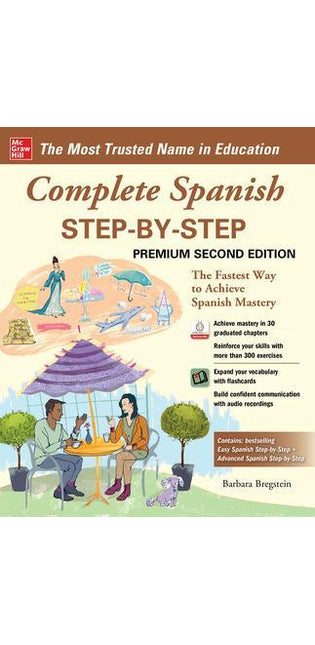
Complete Spanish Step-by-Step, Premium Second Edition
Publisher's Note: Products purchased from Third Party sellers are not guaranteed by the publisher for quality, authenticity, or access to any online entitlements included with the product.Go from beginner’s Spanish to mastery with this single, comprehensive guide!Experts agree: the quickest route to learning a language—from beginner to advanced—is through a solid grounding in grammar and well-crafted exercises that reinforce lessons in vocabulary, essential structures. This premium resource combines two bestsellers, Easy Spanish Step-by-Step and Advanced Spanish Step-by-Step into one easy-to-use guide. Following a series of logically interconnected “steps,” you’ll progress from the basics and essential structures to more advanced concepts that govern how Spanish is spoken and written—including the use of preterit and imperfect tenses, commands, the present and past subjunctive, idiom, and much, much more.Complete Spanish Step-by-Step brings you: • Two bestselling books in one convenient, easy-to-use guide• Unique “building block” approach to mastering essential grammar, verbs, and vocabulary• Tools to help you begin speaking Spanish almost immediately• Audio recordings of answers to 150 exercises via the exclusive McGraw-Hill Language Lab app • Exercises to help test and measure your progress, and more
R 587.00
R 580.00
Beginning C for Arduino, Second Edition
Beginning C for Arduino, Second Edition is written for those who have no prior experience with microcontrollers or programming but would like to experiment and learn both. Updated with new projects and new boards, this book introduces you to the C programming language, reinforcing each programming structure with a simple demonstration of how you can use C to control the Arduino family of microcontrollers. Author Jack Purdum uses an engaging style to teach good programming techniques using examples that have been honed during his 25 years of university teaching. Beginning C for Arduino, Second Edition will teach you:The C programming language How to use C to control a microcontroller and related hardware How to extend C by creating your own libraries, including an introduction to object-oriented programmingDuring the course of the book, you will learn the basics of programming, such as working with data types, making decisions, and writing control loops. You'll then progress onto some of the trickier aspects of C programming, such as using pointers effectively, working with the C preprocessor, and tackling file I/O. Each chapter ends with a series of exercises and review questions to test your knowledge and reinforce what you have learned.
R 1,734.52
Simulation, Modeling, and Programming for Autonomous Robots
This book constitutes the refereed proceedings of the First International Conference on Simulation, Modeling, and Programming for Autonomous Robots, SIMPAR 2008, held in Venice, Italy, in November 2008. The 29 revised full papers and 21 revised poster papers presented were carefully reviewed and selected from 42 submissions. The papers address all current issues of robotics applications and simulation environments thereof, such as 3D robot simulation, reliability, scalability and validation of robot simulation, simulated sensors and actuators, offline simulation of robot design, online simulation with realtime constraints, simulation with software/hardware-in-the-loop, middleware for robotics, modeling framework for robots and environments, testing and validation of robot control software, standardization for robotic services, communication infrastructures in distributed robotics, interaction between sensor networks and robots, human robot interaction, and multirobot. The papers are organized in topical sections on simulation, programming, and applications.
R 1,567.69
R 618.00
R 445.00
R 2,005.00
R 916.00
R 336.00
Schaum's Outline of Programming with C
Confusing Textbooks? Missed Lectures? Not Enough Time?Fortunately for you, there's Schaum's Outlines. More than 40 million students have trusted Schaum's to help them succeed in the classroom and on exams. Schaum's is the key to faster learning and higher grades in every subject. Each Outline presents all the essential course information in an easy-to-follow, topic-by-topic format. You also get hundreds of examples, solved problems, and practice exercises to test your skills. This Schaum's Outline gives youPractice problems with full explanations that reinforce knowledgeCoverage of the most up-to-date developments in your course fieldIn-depth review of practices and applicationsFully compatible with your classroom text, Schaum's highlights all the important facts you need to know. Use Schaum's to shorten your study time-and get your best test scores!Schaum's Outlines-Problem Solved.
R 1,415.35
Distributed Programming
Distributed Programming: Theory and Practice presents a practical and rigorous method to develop distributed programs that correctly implement their specifications. The method also covers how to write specifications and how to use them. Numerous examples such as bounded buffers, distributed locks, message-passing services, and distributed termination detection illustrate the method. Larger examples include data transfer protocols, distributed shared memory, and TCP network sockets. Distributed Programming: Theory and Practice bridges the gap between books that focus on specific concurrent programming languages and books that focus on distributed algorithms. Programs are written in a "real-life" programming notation, along the lines of Java and Python with explicit instantiation of threads and programs. Students and programmers will see these as programs and not "merely" algorithms in pseudo-code. The programs implement interesting algorithms and solve problems that are large enough to serve as projects in programming classes and software engineering classes. Exercises and examples are included at the end of each chapter with on-line access to the solutions. Distributed Programming: Theory and Practice is designed as an advanced-level text book for students in computer science and electrical engineering. Programmers, software engineers and researchers working in this field will also find this book useful.
R 1,572.21
Learn Java 17 Programming
Explore the essential concepts of programming such as object-oriented, functional, and reactive programming by writing code and building projects using the latest LTS version of JavaKey FeaturesA step-by-step guide for beginners to get started with programming in Java 17Explore core programming topics including GUI programming, concurrency, and error handlingWrite efficient code and build projects while learning the fundamentals of programmingBook DescriptionJava is one of the most preferred languages among developers. It is used in everything right from smartphones and game consoles to even supercomputers, and its new features simply add to the richness of the language.This book on Java programming begins by helping you learn how to install the Java Development Kit. You'll then focus on understanding object-oriented programming (OOP), with exclusive insights into concepts such as abstraction, encapsulation, inheritance, and polymorphism, which will help you when programming for real-world apps. Next, you'll cover fundamental programming structures of Java such as data structures and algorithms that will serve as the building blocks for your apps with the help of sample programs and practice examples. You'll also delve into core programming topics that will assist you with error handling, debugging, and testing your apps. As you progress, you'll move on to advanced topics such as Java libraries, database management, and network programming and also build a sample project to help you understand the applications of these concepts.By the end of this Java book, you'll not only have become well-versed with Java 17 but also gained a perspective into the future of this language and have the skills to code efficiently with best practices.What you will learnUnderstand and apply object-oriented principles in JavaExplore Java design patterns and best practices to solve everyday problemsBuild user-friendly and attractive GUIs with easeUnderstand the usage of microservices with the help of practical examplesDiscover techniques and idioms for writing high-quality Java codeGet to grips with the usage of data structures in JavaWho this book is forThis book is for those who would like to start a new career in the modern Java programming profession, as well as those who do it professionally already and would like to refresh their knowledge of the latest Java and related technologies and ideas.
R 1,531.00
R 533.00