Search results for "Andre Python"
Items we need to order for you

R 932.00
Hands-On Data Structures and Algorithms with Python
Understand how implementing different data structures and algorithms intelligently can make your Python code and applications more maintainable and efficientKey FeaturesExplore functional and reactive implementations of traditional and advanced data structuresApply a diverse range of algorithms in your Python codeImplement the skills you have learned to maximize the performance of your applicationsBook DescriptionChoosing the right data structure is pivotal to optimizing the performance and scalability of applications. This new edition of Hands-On Data Structures and Algorithms with Python will expand your understanding of key structures, including stacks, queues, and lists, and also show you how to apply priority queues and heaps in applications. You'll learn how to analyze and compare Python algorithms, and understand which algorithms should be used for a problem based on running time and computational complexity. You will also become confident organizing your code in a manageable, consistent, and scalable way, which will boost your productivity as a Python developer.By the end of this Python book, you'll be able to manipulate the most important data structures and algorithms to more efficiently store, organize, and access data in your applications.What you will learnUnderstand common data structures and algorithms using examples, diagrams, and exercisesExplore how more complex structures, such as priority queues and heaps, can benefit your codeImplement searching, sorting, and selection algorithms on number and string sequencesBecome confident with key string-matching algorithmsUnderstand algorithmic paradigms and apply dynamic programming techniquesUse asymptotic notation to analyze algorithm performance with regard to time and space complexitiesWrite powerful, robust code using the latest features of PythonWho this book is forThis book is for developers and programmers who are interested in learning about data structures and algorithms in Python to write complex, flexible programs. Basic Python programming knowledge is expected.
R 1,628.00
R 353.00
R 2,603.00
R 1,092.75
R 409.00
R 994.00
R 1,047.53
R 367.00
R 580.00
R 611.00
Introduction to Python for Science and Engineering
Introduction to Python for Science and Engineering offers a quick and incisive introduction to the Python programming language for use in any science or engineering discipline. The approach is pedagogical and “bottom up,” which means starting with examples and extracting more general principles from that experience. No prior programming experience is assumed.Readers will learn the basics of Python syntax, data structures, input and output, conditionals and loops, user-defined functions, plotting, animation, and visualization. They will also learn how to use Python for numerical analysis, including curve fitting, random numbers, linear algebra, solutions to nonlinear equations, numerical integration, solutions to differential equations, and fast Fourier transforms.Readers learn how to interact and program with Python using JupyterLab and Spyder, two simple and widely used integrated development environments.All the major Python libraries for science and engineering are covered, including NumPy, SciPy, Matplotlib, and Pandas. Other packages are also introduced, including Numba, which can render Python numerical calculations as fast as compiled computer languages such as C but without their complex overhead.
R 6,893.02
Elementary Mechanics Using Python
This book – specifically developed as a novel textbook on elementary classical mechanics – shows how analytical and numerical methods can be seamlessly integrated to solve physics problems. This approach allows students to solve more advanced and applied problems at an earlier stage and equips them to deal with real-world examples well beyond the typical special cases treated in standard textbooks.Another advantage of this approach is that students are brought closer to the way physics is actually discovered and applied, as they are introduced right from the start to a more exploratory way of understanding phenomena and of developing their physical concepts.While not a requirement, it is advantageous for the reader to have some prior knowledge of scientific programming with a scripting-type language. This edition of the book uses Python, and a chapter devoted to the basics of scientific programming with Python is included. A parallel edition using Matlab instead of Python is also available.Last but not least, each chapter is accompanied by an extensive set of course-tested exercises and solutions.
R 2,198.00
R 626.00
R 764.00
R 606.00
R 402.00
Python for AI, Machine Learning, and Deep Learning
Learn AI, machine learning, and deep learning with Python from the ground up, then build and tune models with XGBoost, TensorFlow, PyTorch, CNNs, RNNs, transformers, and transfer learning through practical Python projects.Key FeaturesBuild Python, data science, mathematics, and statistics foundations for machine learningTrain, evaluate, and tune regression, classification, ensemble, XGBoost, LightGBM, and CatBoost modelsCreate CNN, RNN, transformer, and transfer learning projects with TensorFlow, Keras, and PyTorchBook DescriptionLearning modern AI often feels fragmented: Python in one resource, mathematics in another, and deep learning or transformers somewhere else. This book brings those foundations into one practical progression, helping you connect the concepts behind machine learning with the code used to build models.You will start with Python programming, NumPy, Pandas, data visualization, exploratory data analysis, linear algebra, calculus, probability, and statistics. From there, you will build supervised learning skills across regression, classification, k-NN, feature engineering, model evaluation, cross-validation, and hyperparameter tuning. You will then work with ensemble methods including random forests, gradient boosting, XGBoost, LightGBM, and CatBoost, while learning to handle imbalanced data and justify modeling decisions.The final part moves into neural networks and deep learning with TensorFlow, Keras, and PyTorch. You will build CNNs for image classification, explore RNNs, LSTMs, GRUs, word embeddings, and sequence-to-sequence models, and understand attention and transformer architectures through BERT and GPT examples. You will finish by applying transfer learning and fine-tuning to computer vision and NLP tasks, supported by projects that turn theory into practical AI and machine learning skills for real-world problem solving.What you will learnUse Python, NumPy, Pandas, Matplotlib, and Seaborn for data analysisApply linear algebra, calculus, probability, and statistics to MLBuild regression, classification, and k-NN modelsEngineer features and evaluate models with cross-validation and hyperparameter tuningTrain ensembles with random forests, XGBoost, LightGBM, and CatBoostBuild neural networks and CNNs with TensorFlow, Keras, and PyTorchDevelop RNNs, LSTMs, GRUs, attention, BERT, and GPT workflows for NLPApply transfer learning and fine-tuning to computer vision and NLPWho this book is forThis book is for aspiring data scientists, machine learning engineers, AI developers, students, and career changers who want one structured path from Python fundamentals to machine learning and deep learning. It suits readers seeking practical skills in data analysis, predictive modeling, computer vision, NLP, transformers, and transfer learning. No prior machine learning or deep learning experience is required. Python is introduced from the fundamentals, although basic programming familiarity and foundational mathematics will help.
R 1,628.00
R 886.00
Python Audio Cookbook
The Python Audio Cookbook offers an introduction to Python for sound and multimedia applications, with chapters that cover writing your first Python programs, controlling Pyo with physical computing, and writing your own GUI, among many others.Guiding the reader through a variety of audio synthesis techniques, the book empowers readers to combine their projects with popular platforms, from the Arduino to Twitter, and state-of-the-art practices such as AI. The Python Audio Cookbook balances accessible explanations for theoretical concepts, including Python syntax, audio processing and machine learning, with practical applications. This book is an essential introductory guide to Python for sound and multimedia practitioners, as well as programmers interested in audio applications.
R 9,432.25
R 611.00
R 915.00
R 305.00
Python Programming on WIN32
Python is growing in popularity; based on download statistics, there are now over 450,000 people using Python, and more than 150,000 people using Python on Windows. Use of the language has been growing at about 40% per year since 1995, and there is every reason to believe that growth will continue. Despite Python's increasing popularity on Windows, Python Programming on Win32 is the first book to demonstrate how to use it as a serious Windows development and administration tool. Unlike scripting on Unix, Windows scripting involves integrating a number of components, such as COM or the various mail and database APIs, with the Win32 programming interface. While experienced Windows C++ programmers can find their way through the various objects, most people need some guidance, and this book is it. It addresses all the basic technologies for common integration tasks on Windows, explaining both the Windows issues and the Python code you need to glue things together.Topics include: * The Python language and the PythonWin extensions * Building a GUI with COM * Adding a Macro language * Distributing the application * Client-side COM for output and data access * Integration with mail and other internet protocols * Managing users and drives This is a vital and unique book. Python Programming on Win32 is an excellent presentation of Windows application development and a solid illustration of how to use Python in the Windows environment.
R 2,076.00
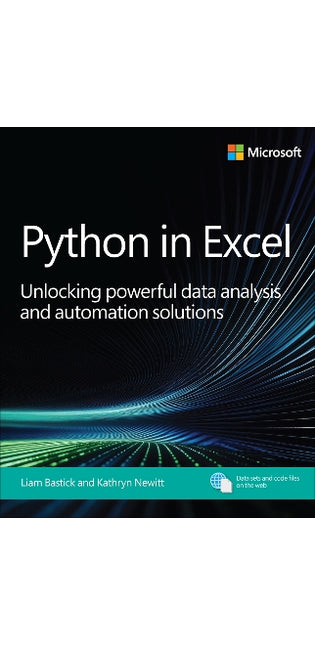
Python in Excel
Seasoned Experts Liam Bastick and Kathryn Newitt unveil a groundbreaking guide to mastering data analysis and automation with Python in Excel Python in Excel: Unlocking powerful data analysis and automation solutions is a hands-on, practical guide that leverages the authors’ decades of expertise to teach readers how to harness the newly integrated Python capabilities within Microsoft Excel, mapping familiar Excel concepts to Python foundations. Covering essential topics such as Python syntax, data structures, data analysis with pandas, visualization, and the use of AI tools like Copilot, the book empowers professionals to elevate their data analysis and automation skills. Readers will gain the ability to perform advanced forecasting, build predictive models, and streamline workflows, making them more efficient and competitive in today’s data-driven workplace. By reading this book, you will: Understand the fundamentals of Python programming directly within ExcelMap your existing Excel skills to Python concepts for easier learningAutomate repetitive tasks and workflows Analyze and visualize data with powerfulPython libraries like pandas Build advanced forecasting and predictive models without leaving ExcelExplore and manipulate data efficiently using Python’s concise syntaxIntegrate AI tools such as Copilot to assist with coding and analysisConnect Excel with external data sources using Python and Power QueryDevelop custom solutions for business modeling and data scienceCreate a roadmap for further study and mastery of Python in Excel
R 2,083.00
R 944.00
Building Android Apps in Python Using Kivy with Android Studio
Start building Python-based Android applications using Kivy with Android Studio. Through in-depth examples, this book teaches you everything you need to create your first Android application in Python and publish on Google Play.Building Android Apps in Python Using Kivy with Android Studio takes you through the basics of Kivy by discussing its application structure, widgets, and event handling. The KV language is then introduced for separating the logic and GUI by adding widgets within a KV file. You will then learn how to utilize Android camera using Kivy, build the HTTP server using Flask, and create and manage multiple screens to help you design your own applications. Through detailed step-by-step instructions, you will create your first multi-level cross-platform game that includes animation and sound effects. Following this, the process of converting the Kivy application into an Android application using Buildozer and Python-4-Android is covered in detail. You will then learn how to edit the generated Android Studio project into Android Studio by adding extensions to the original application. The widgets added in Kivy could be handled within Android Studio. Moreover, Android views could be added to enrich the Kivy application. The resulting Android application created with Kivy can be hosted on Google Play to download and install as a regular Android application.At the end, this book will give you the basic knowledge of Kivy needed to build cross-platform Android applications, produce an Android Studio project, and understand how it all works in detail. What You Will LearnBuild cross-platform applications from scratch using Kivy in detailCreate a cross-platform interactive multi-level game from the ground upExamine the pipeline of building an Android app from the Python Kivy appUnderstand the structure of the Android Studio project produced by KivyRecognize how to extend the application within Android Studio by adding more Android views to the application main activity. Who This Book Is ForPython developers with no previous experience in Kivy who are looking to create their first Android application completely in Python.
R 1,748.95
R 1,047.00
R 641.00
R 275.00
Python Programming and Numerical Methods
Python Programming and Numerical Methods: A Guide for Engineers and Scientists introduces programming tools and numerical methods to engineering and science students, with the goal of helping the students to develop good computational problem-solving techniques through the use of numerical methods and the Python programming language. Part One introduces fundamental programming concepts, using simple examples to put new concepts quickly into practice. Part Two covers the fundamentals of algorithms and numerical analysis at a level that allows students to quickly apply results in practical settings.
R 2,353.00
R 1,596.00
R 702.00
R 439.00
Python for Secret Agents - Volume II
Gather, analyze, and decode data to reveal hidden facts using Python, the perfect tool for all aspiring secret agentsAbout This Book• Discover the essential features of Python programming: statements, variables, expressions, and many of the built-in data types• Use Python's standard library to do more sophisticated data gathering and analysis• Written by a Python programming expert, with over 35 years' experience as a consultant, teacher, author and software developerWho This Book Is ForThis book is for Secret Agents who have some exposure to Python. Our focus is on the Field Agents who are ready to do more sophisticated and complex programming in Python. We'll stick to simple statistics for the most part. A steady hand with a soldering iron is not required, but a skilled field agent should be able to assemble a working Arduino circuit to gather their own sensor data.What You Will Learn• Upgrade Python to the latest version and discover its latest and greatest tools• Use Python libraries to extract data from log files that are designed more for people to read than for automated analysis• Summarize log files and extract meaningful information• Gather data from social networking sites and leverage your experience of analyzing log files to summarize the data you find• Extract text and images from social networking sites• Parse the complex and confusing data structures in a PDF file to extract meaningful text that we can analyze• Connect small, intelligent devices to our computer to use them as remote sensors• Use Python to analyze measurements from sensors to calibrate them and use sensors efficientlyIn DetailPython is easy to learn and extensible programming language that allows any manner of secret agent to work with a variety of data. Agents from beginners to seasoned veterans will benefit from Python's simplicity and sophistication. The standard library provides numerous packages that move beyond simple beginner missions. The Python ecosystem of related packages and libraries supports deep information processing.This book will guide you through the process of upgrading your Python-based toolset for intelligence gathering, analysis, and communication. You'll explore the ways Python is used to analyze web logs to discover the trails of activities that can be found in web and database servers. We'll also look at how we can use Python to discover details of the social network by looking at the data available from social networking websites.Finally, you'll see how to extract history from PDF files, which opens up new sources of data, and you'll learn about the ways you can gather data using an Arduino-based sensor device.Style and approachEach chapter will include a background briefing that covers an essential Python technology. After some in-depth exploration of the features, the chapter will conclude with a mission that is a concrete application of the Python tools and techniques covered.
R 912.00
R 2,127.20
Deep Dive Python
Take your programming skills to the next level by expanding real-world Python applications in open-source code. This book is an essential guide for experienced developers looking to enhance their Python proficiency. Using code examples from popular open-source projects you'll master Python concepts and see how they are applied in production-level code. By understanding code from established projects, you'll develop a deeper appreciation for Python's capabilities and learn best practices that have been battle-tested in the real world. You'll gain the confidence to tackle complex projects, optimize your code, and implement advanced Python features effectively. You'll also examine typing, generators, iterators, the itertools module, multithreading, multiprocessing, and asyncio. This will equip you to build production-ready Python programs and libraries. Whether you're building large-scale applications, contributing to open-source projects, or solving intricate programming challenges, Deep Dive Python will provide you with the knowledge and practical experience to excel in your Python development journey. What You Will Learn Master Python's core data structures and how to use them effectively. Implement decorators, descriptors, metaclasses, and abstract base classes in your code Enhance your code with functional programming techniques using the functools module Improve iteration with generators, iterators, and the itertools module Select the best Python concurrent programming models to use for optimal performance Apply best practices for code organization, packaging, and creating maintainable Python projects Who This Book Is For Experienced Python developers who want to expand their programming skils
R 1,368.00
R 2,603.00
Artificial Intelligence with Python
Entering the field of artificial intelligence and data science can seem daunting to beginners with little to no prior background, especially those with no programming experience. The concepts used in self-driving cars and virtual assistants like Amazon’s Alexa may seem very complex and difficult to grasp. The aim of Artificial Intelligence in Python is to make AI accessible and easy to understand for people with little to no programming experience though practical exercises. Newcomers will gain the necessary knowledge on how to create such systems, which are capable of executing tasks that require some form of human-like intelligence.This book introduces readers to various topics and examples of programming in Python, as well as key concepts in artificial intelligence. Python programming skills will be imparted as we go along. Concepts and code snippets will be covered in a step-by-step manner, to guide and instill confidence in beginners. Complex subjects in deep learning and machine learning will be broken down into easy-to-digest content and examples. Artificial intelligence implementations will also be shared, allowing beginners to generate their own artificial intelligence algorithms for reinforcement learning, style transfer, chatbots, speech, and natural language processing.
R 2,015.00
R 763.00
R 1,124.48
R 456.82