Search results for "Health Analytics with Python"
Items we need to order for you

Data Modelling and Analytics for the Internet of Medical Things
The emergence of the Internet of Medical Things (IoMT) is transforming the management of diseases, improving diseases diagnosis and treatment methods, and reducing healthcare costs and errors. This book covers all the essential aspects of IoMT in one place, providing readers with a comprehensive grasp of IoMT and related technologies.Data Modelling and Analytics for the Internet of Medical Things integrates the architectural, conceptual, and technological aspects of IoMT, discussing in detail the IoMT, connected smart medical devices, and their applications to improve health outcomes. It explores various methodologies and solutions for medical data analytics in healthcare systems using machine learning and deep learning approaches, as well as exploring how technologies such as blockchain and cloud computing can further enhance data analytics in the e-health domain. Prevalent IoMT case studies and applications are also discussed.The book suits scientists, design engineers, system integrators, and researchers in the field of IoMT. It will also be of interest to postgraduate students in computer science focusing on healthcare applications and as supplementary reading for IoMT courses.
R 9,324.22
Derivatives Analytics with Python
Supercharge options analytics and hedging using the power of Python Derivatives Analytics with Python shows you how to implement market-consistent valuation and hedging approaches using advanced financial models, efficient numerical techniques, and the powerful capabilities of the Python programming language. This unique guide offers detailed explanations of all theory, methods, and processes, giving you the background and tools necessary to value stock index options from a sound foundation. You'll find and use self-contained Python scripts and modules and learn how to apply Python to advanced data and derivatives analytics as you benefit from the 5,000+ lines of code that are provided to help you reproduce the results and graphics presented. Coverage includes market data analysis, risk-neutral valuation, Monte Carlo simulation, model calibration, valuation, and dynamic hedging, with models that exhibit stochastic volatility, jump components, stochastic short rates, and more. The companion website features all code and IPython Notebooks for immediate execution and automation. Python is gaining ground in the derivatives analytics space, allowing institutions to quickly and efficiently deliver portfolio, trading, and risk management results. This book is the finance professional's guide to exploiting Python's capabilities for efficient and performing derivatives analytics. Reproduce major stylized facts of equity and options markets yourselfApply Fourier transform techniques and advanced Monte Carlo pricingCalibrate advanced option pricing models to market dataIntegrate advanced models and numeric methods to dynamically hedge options Recent developments in the Python ecosystem enable analysts to implement analytics tasks as performing as with C or C++, but using only about one-tenth of the code or even less. Derivatives Analytics with Python — Data Analysis, Models, Simulation, Calibration and Hedging shows you what you need to know to supercharge your derivatives and risk analytics efforts.
R 3,419.00
Foundations of Programming, Statistics, and Machine Learning for Business Analytics
Business Analysts and Data Scientists are in huge demand, as global companies seek to digitally transform themselves and leverage their data resources to realize competitive advantage.This book covers all the fundamentals, from statistics to programming to business applications, to equip you with the solid foundational knowledge needed to progress in business analytics. Assuming no prior knowledge of programming or statistics, this book takes a simple step-by-step approach which makes potentially intimidating topics easy to understand, by keeping Maths to a minimum and including examples of business analytics in practice.Key features:· Introduces programming fundamentals using R and Python· Covers data structures, data management and manipulation and data visualization· Includes interactive coding notebooks so that you can build up your programming skills progressivelySuitable as an essential text for undergraduate and postgraduate students studying Business Analytics or as pre-reading for students studying Data Science.Ram Gopal is Pro-Dean and Professor of Information Systems at the University of Warwick.Daniel Philps is an Artificial Intelligence Researcher and Head of Rothko Investment Strategies.Tillman Weyde is Senior Lecturer at City, University of London.
R 6,385.00
Data-Driven Analytics for Healthcare
The new book highlights the application of artificial intelligence, machine learning, and deep learning techniques to diagnose medical problems. General predictive analysis methods are explained in disease detection applications along with machine learning techniques for the implementation of predictive analysis methods. The book covers object detection approaches for diseases such as pneumonia, application of monitoring and tracking the coronavirus disease, various endodontic applications for handling diagnostic abnormalities using deep learning methods, applications of healthcare for human activity recognition, and more.
R 8,589.39
Practical Data Science with Python
Learn to effectively manage data and execute data science projects from start to finish using PythonKey FeaturesUnderstand and utilize data science tools in Python, such as specialized machine learning algorithms and statistical modelingBuild a strong data science foundation with the best data science tools available in PythonAdd value to yourself, your organization, and society by extracting actionable insights from raw dataBook DescriptionPractical Data Science with Python teaches you core data science concepts, with real-world and realistic examples, and strengthens your grip on the basic as well as advanced principles of data preparation and storage, statistics, probability theory, machine learning, and Python programming, helping you build a solid foundation to gain proficiency in data science.The book starts with an overview of basic Python skills and then introduces foundational data science techniques, followed by a thorough explanation of the Python code needed to execute the techniques. You'll understand the code by working through the examples. The code has been broken down into small chunks (a few lines or a function at a time) to enable thorough discussion.As you progress, you will learn how to perform data analysis while exploring the functionalities of key data science Python packages, including pandas, SciPy, and scikit-learn. Finally, the book covers ethics and privacy concerns in data science and suggests resources for improving data science skills, as well as ways to stay up to date on new data science developments.By the end of the book, you should be able to comfortably use Python for basic data science projects and should have the skills to execute the data science process on any data source.What you will learnUse Python data science packages effectivelyClean and prepare data for data science work, including feature engineering and feature selectionData modeling, including classic statistical models (such as t-tests), and essential machine learning algorithms, such as random forests and boosted modelsEvaluate model performanceCompare and understand different machine learning methodsInteract with Excel spreadsheets through PythonCreate automated data science reports through PythonGet to grips with text analytics techniquesWho this book is forThe book is intended for beginners, including students starting or about to start a data science, analytics, or related program (e.g. Bachelor’s, Master’s, bootcamp, online courses), recent college graduates who want to learn new skills to set them apart in the job market, professionals who want to learn hands-on data science techniques in Python, and those who want to shift their career to data science.The book requires basic familiarity with Python. A "getting started with Python" section has been included to get complete novices up to speed.
R 1,889.00
Smart Healthcare Analytics: State of the Art
This edited book helps researchers and practitioners to understand e-health, m-healthcare architecture through IoT and the state of the art in IoT counter measures. This book provides a comprehensive discussion on a functional framework for IoT-based healthcare systems, intelligent medicine box, RFID technology, HMI, cognitive interpretation, BCI, remote health monitoring systems, wearable sensors, WBAN, healthcare analytics, machine learning (ML) techniques for IoT-enabled healthcare services, security and privacy issues in IoT-based healthcare monitoring systems. The book discusses integration of IoT with big data and cloud computing for solving several real-time problems by the use of smart healthcare applications. In these applications, the cloud computing provides a common workplace for IoT and big data, big data provides data analytics technology and IoT provides the source of data. It serves as a reference resource for researchers and practitioners in academia and industry.
R 8,200.95
Dimensions of Intelligent Analytics for Smart Digital Health Solutions
This title demystifies artificial intelligence (AI) and analytics, upskilling individuals (healthcare professionals, hospital managers, consultants, researchers, students, and the population at large) around analytics and AI as it applies to healthcare.This book shows how the tools, techniques, technologies, and tactics around analytics and AI can be best leveraged and utilised to realise a healthcare value proposition of better quality, better access and high value for everyone every day, everywhere. The book presents a triumvirate approach including technical, business and medical aspects of data and analytics and by so doing takes a responsible approach to this key area.This work serves to introduce the critical issues in AI and analytics for healthcare to students, practitioners, and researchers.
R 9,343.62
Survival Analysis with Python
Survival analysis uses statistics to calculate time to failure. Survival Analysis with Python takes a fresh look at this complex subject by explaining how to use the Python programming language to perform this type of analysis. As the subject itself is very mathematical and full of expressions and formulations, the book provides detailed explanations and examines practical implications. The book begins with an overview of the concepts underpinning statistical survival analysis. It then delves into Parametric models with coverage of Concept of maximum likelihood estimate (MLE) of a probability distribution parameter MLE of the survival function Common probability distributions and their analysis Analysis of exponential distribution as a survival function Analysis of Weibull distribution as a survival function Derivation of Gumbel distribution as a survival function from Weibull Non-parametric models including Kaplan–Meier (KM) estimator, a derivation of expression using MLE Fitting KM estimator with an example dataset, Python code and plotting curves Greenwood’s formula and its derivation Models with covariates explaining The concept of time shift and the accelerated failure time (AFT) model Weibull-AFT model and derivation of parameters by MLE Proportional Hazard (PH) model Cox-PH model and Breslow’s method Significance of covariates Selection of covariates The Python lifelines library is used for coding examples. By mapping theory to practical examples featuring datasets, this book is a hands-on tutorial as well as a handy reference.
R 1,179.09
R 5,412.00
R 1,282.00
Smart Healthcare Analytics: State of the Art
This edited book helps researchers and practitioners to understand e-health, m-healthcare architecture through IoT and the state of the art in IoT counter measures. This book provides a comprehensive discussion on a functional framework for IoT-based healthcare systems, intelligent medicine box, RFID technology, HMI, cognitive interpretation, BCI, remote health monitoring systems, wearable sensors, WBAN, healthcare analytics, machine learning (ML) techniques for IoT-enabled healthcare services, security and privacy issues in IoT-based healthcare monitoring systems. The book discusses integration of IoT with big data and cloud computing for solving several real-time problems by the use of smart healthcare applications. In these applications, the cloud computing provides a common workplace for IoT and big data, big data provides data analytics technology and IoT provides the source of data. It serves as a reference resource for researchers and practitioners in academia and industry.
R 8,472.20
R 1,995.00
Healthcare Informatics and Analytics
Healthcare practices have been enhanced through the use of information technologies and analytical methods. A cross between computer science, healthcare, and information science is needed for the optimization of data resources and information systems within the healthcare industry.Healthcare Informatics and Analytics: Emerging Issues and Trends introduces the latest research concerning the innovative implementation of information technology and data analysis in the healthcare field.Highlighting current concerns and recent advances in patient care and healthcare delivery, this book is a comprehensive reference source for academics, researchers, medical students, and healthcare practitioners interested in the application of information science within the health sector.
R 9,115.99
R 580.00
R 1,099.00
Healthcare Analytics
The first COVID-19 case in the US was reported on January 20, 2020. As the first cases were being reported in the US, Washington State became a reliable source not just for hospital bed demand based on incidence and community spread but also for modeling the impact of skilled nursing facilities and assisted living facilities on hospital bed demand. Various hospital bed demand modeling efforts began in earnest across the United States in university settings, private consulting and health systems. Nationally, the University of Washington Institute of Health Metrics and Evaluation seemed to gain a footing and was adopted as a source for many states for its ability to predict the epidemiological curve by state, including the peak.This book therefore addresses a compelling need for documenting what has been learned by the academic and professional healthcare communities in healthcare analytics and disaster preparedness to this point in the pandemic. What is clear, at least from the US perspective, is that the healthcare system was unprepared and uncoordinated from an analytics perspective. Learning from this experience will only better prepare all healthcare systems and leaders for future crisis.Both prospectively, from a modeling perspective and retrospectively from a root cause analysis perspective, analytics provide clarity and help explain causation and data relationships. A more structured approach to teaching healthcare analytics to students, using the pandemic and the rich dataset that has been developed, provides a ready-made case study from which to learn and inform disaster planning and preparedness. The pandemic has strained the healthcare and public health systems. Researchers and practitioners must learn from this crisis to better prepare our processes for future pandemics, at minimum. Finally, government officials and policy makers can use this data to decide how best to assist the healthcare and public health systems in crisis.
R 2,722.69
Business Analytics
This book focuses on three core knowledge requirements for effective and thorough data analysis for solving business problems. These are a foundational understanding of:1. statistical, econometric, and machine learning techniques;2. data handling capabilities;3. at least one programming language.Practical in orientation, the volume offers illustrative case studies throughout and examples using Python in the context of Jupyter notebooks. Covered topics include demand measurement and forecasting, predictive modeling, pricing analytics, customer satisfaction assessment, market and advertising research, and new product development and research. This volume will be useful to business data analysts, data scientists, and market research professionals, as well as aspiring practitioners in business data analytics. It can also be used in colleges and universities offering courses and certifications in business data analytics, data science, and market research.
R 4,234.14
Data Science for Marketing Analytics
Explore new and more sophisticated tools that reduce your marketing analytics efforts and give you precise resultsKey FeaturesStudy new techniques for marketing analyticsExplore uses of machine learning to power your marketing analysesWork through each stage of data analytics with the help of multiple examples and exercisesBook DescriptionData Science for Marketing Analytics covers every stage of data analytics, from working with a raw dataset to segmenting a population and modeling different parts of the population based on the segments.The book starts by teaching you how to use Python libraries, such as pandas and Matplotlib, to read data from Python, manipulate it, and create plots, using both categorical and continuous variables. Then, you'll learn how to segment a population into groups and use different clustering techniques to evaluate customer segmentation. As you make your way through the chapters, you'll explore ways to evaluate and select the best segmentation approach, and go on to create a linear regression model on customer value data to predict lifetime value. In the concluding chapters, you'll gain an understanding of regression techniques and tools for evaluating regression models, and explore ways to predict customer choice using classification algorithms. Finally, you'll apply these techniques to create a churn model for modeling customer product choices.By the end of this book, you will be able to build your own marketing reporting and interactive dashboard solutions.What you will learnAnalyze and visualize data in Python using pandas and MatplotlibStudy clustering techniques, such as hierarchical and k-means clusteringCreate customer segments based on manipulated data Predict customer lifetime value using linear regressionUse classification algorithms to understand customer choiceOptimize classification algorithms to extract maximal informationWho this book is forData Science for Marketing Analytics is designed for developers and marketing analysts looking to use new, more sophisticated tools in their marketing analytics efforts. It'll help if you have prior experience of coding in Python and knowledge of high school level mathematics. Some experience with databases, Excel, statistics, or Tableau is useful but not necessary.
R 1,498.00
Hands-on Signal Analysis with Python
This book provides the tools for analyzing data in Python: different types of filters are introduced and explained, such as FIR-, IIR- and morphological filters, as well as their application to one- and two-dimensional data. The required mathematics are kept to a minimum, and numerous examples and working Python programs are included for a quick start. The goal of the book is to enable also novice users to choose appropriate methods and to complete real-world tasks such as differentiation, integration, and smoothing of time series, or simple edge detection in images. An introductory section provides help and tips for getting Python installed and configured on your computer. More advanced chapters provide a practical introduction to the Fourier transform and its applications such as sound processing, as well as to the solution of equations of motion with the Laplace transform. A brief excursion into machine learning shows the powerful tools that are available with Python. This book also provides tips for an efficient programming work flow: from the use of a debugger for finding mistakes, code-versioning with git to avoid the loss of working programs, to the construction of graphical user interfaces (GUIs) for the visualization of data. Working, well-documented Python solutions are included for all exercises, and IPython/Jupyter notebooks provide additional help to get people started and outlooks for the interested reader.
R 2,462.02
Building Statistical Models in Python
Make data-driven, informed decisions and enhance your statistical expertise in Python by turning raw data into meaningful insightsPurchase of the print or Kindle book includes a free PDF eBookKey FeaturesGain expertise in identifying and modeling patterns that generate successExplore the concepts with Python using important libraries such as stats modelsLearn how to build models on real-world data sets and find solutions to practical challengesBook DescriptionThe ability to proficiently perform statistical modeling is a fundamental skill for data scientists and essential for businesses reliant on data insights. Building Statistical Models with Python is a comprehensive guide that will empower you to leverage mathematical and statistical principles in data assessment, understanding, and inference generation.This book not only equips you with skills to navigate the complexities of statistical modeling, but also provides practical guidance for immediate implementation through illustrative examples. Through emphasis on application and code examples, you’ll understand the concepts while gaining hands-on experience. With the help of Python and its essential libraries, you’ll explore key statistical models, including hypothesis testing, regression, time series analysis, classification, and more.By the end of this book, you’ll gain fluency in statistical modeling while harnessing the full potential of Python's rich ecosystem for data analysis.What you will learnExplore the use of statistics to make decisions under uncertaintyAnswer questions about data using hypothesis testsUnderstand the difference between regression and classification modelsBuild models with stats models in PythonAnalyze time series data and provide forecastsDiscover Survival Analysis and the problems it can solveWho this book is forIf you are looking to get started with building statistical models for your data sets, this book is for you! Building Statistical Models in Python bridges the gap between statistical theory and practical application of Python. Since you’ll take a comprehensive journey through theory and application, no previous knowledge of statistics is required, but some experience with Python will be useful.
R 1,693.00
R 455.00
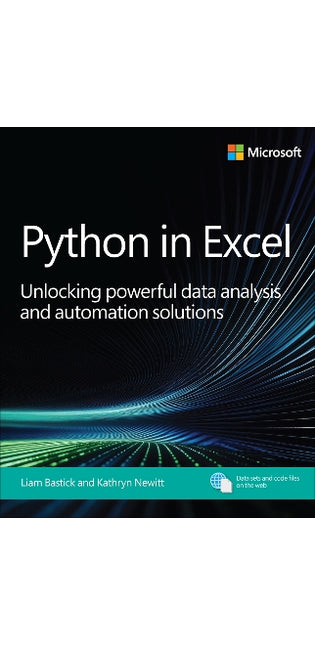
Python in Excel
Seasoned Experts Liam Bastick and Kathryn Newitt unveil a groundbreaking guide to mastering data analysis and automation with Python in Excel Python in Excel: Unlocking powerful data analysis and automation solutions is a hands-on, practical guide that leverages the authors’ decades of expertise to teach readers how to harness the newly integrated Python capabilities within Microsoft Excel, mapping familiar Excel concepts to Python foundations. Covering essential topics such as Python syntax, data structures, data analysis with pandas, visualization, and the use of AI tools like Copilot, the book empowers professionals to elevate their data analysis and automation skills. Readers will gain the ability to perform advanced forecasting, build predictive models, and streamline workflows, making them more efficient and competitive in today’s data-driven workplace. By reading this book, you will: Understand the fundamentals of Python programming directly within ExcelMap your existing Excel skills to Python concepts for easier learningAutomate repetitive tasks and workflows Analyze and visualize data with powerfulPython libraries like pandas Build advanced forecasting and predictive models without leaving ExcelExplore and manipulate data efficiently using Python’s concise syntaxIntegrate AI tools such as Copilot to assist with coding and analysisConnect Excel with external data sources using Python and Power QueryDevelop custom solutions for business modeling and data scienceCreate a roadmap for further study and mastery of Python in Excel
R 2,083.00
Big Data Analytics in Bioinformatics and Healthcare
As technology evolves and electronic data becomes more complex, digital medical record management and analysis becomes a challenge. In order to discover patterns and make relevant predictions based on large data sets, researchers and medical professionals must find new methods to analyze and extract relevant health information.Big Data Analytics in Bioinformatics and Healthcare merges the fields of biology, technology, and medicine in order to present a comprehensive study on the emerging information processing applications necessary in the field of electronic medical record management. Complete with interdisciplinary research resources, this publication is an essential reference source for researchers, practitioners, and students interested in the fields of biological computation, database management, and health information technology, with a special focus on the methodologies and tools to manage massive and complex electronic information.
R 9,907.12
R 611.00
R 885.00
Python for Geospatial Data Analysis
In spatial data science, things in closer proximity to one another likely have more in common than things that are farther apart. With this practical book, geospatial professionals, data scientists, business analysts, geographers, geologists, and others familiar with data analysis and visualization will learn the fundamentals of spatial data analysis to gain a deeper understanding of their data questions.Author Bonny P. McClain demonstrates why detecting and quantifying patterns in geospatial data is vital. Both proprietary and open source platforms allow you to process and visualize spatial information. This book is for people familiar with data analysis or visualization who are eager to explore geospatial integration with Python.This book helps you:Understand the importance of applying spatial relationships in data scienceSelect and apply data layering of both raster and vector graphicsApply location data to leverage spatial analyticsDesign informative and accurate mapsAutomate geographic data with Python scriptsExplore Python packages for additional functionalityWork with atypical data types such as polygons, shape files, and projectionsUnderstand the graphical syntax of spatial data science to stimulate curiosity
R 1,824.00
Python Data Mining Quick Start Guide
Explore the different data mining techniques using the libraries and packages offered by PythonKey FeaturesGrasp the basics of data loading, cleaning, analysis, and visualizationUse the popular Python libraries such as NumPy, pandas, matplotlib, and scikit-learn for data miningYour one-stop guide to build efficient data mining pipelines without going into too much theoryBook DescriptionData mining is a necessary and predictable response to the dawn of the information age. It is typically defined as the pattern and/ or trend discovery phase in the data mining pipeline, and Python is a popular tool for performing these tasks as it offers a wide variety of tools for data mining.This book will serve as a quick introduction to the concept of data mining and putting it to practical use with the help of popular Python packages and libraries. You will get a hands-on demonstration of working with different real-world datasets and extracting useful insights from them using popular Python libraries such as NumPy, pandas, scikit-learn, and matplotlib. You will then learn the different stages of data mining such as data loading, cleaning, analysis, and visualization. You will also get a full conceptual description of popular data transformation, clustering, and classification techniques.By the end of this book, you will be able to build an efficient data mining pipeline using Python without any hassle.What you will learnExplore the methods for summarizing datasets and visualizing/plotting dataCollect and format data for analytical workAssign data points into groups and visualize clustering patternsLearn how to predict continuous and categorical outputs for dataClean, filter noise from, and reduce the dimensions of dataSerialize a data processing model using scikit-learn’s pipeline featureDeploy the data processing model using Python’s pickle moduleWho this book is forPython developers interested in getting started with data mining will love this book. Budding data scientists and data analysts looking to quickly get to grips with practical data mining with Python will also find this book to be useful. Knowledge of Python programming is all you need to get started.
R 1,140.00
Python for Excel Users
Excel is a mainstay of the modern workplace, but it isn't up to every task. Python for Excel Users offers a better way, showing how relatively simple programming can greatly boost productivity by streamlining workflows and adding new tools to the reader's toolbox - no programming experience required. Uses include: Generating beautiful data visualizations, Creating interactive reports and dashboards, Tracking collaborative projects. This book leverages what readers already know about Excel to introduce useful coding applications. Practical examples illustrate how programming skills can be immediately applied to the reader's day-to-day work.
R 1,391.00
Patient-Centric Analytics in Health Care
In Patient-Centric Analytics in Health Care: Driving Value in Clinical Settings and Psychological Practice, James J. Gillespie and Gregory J. Privitera introduce a framework that explores the utility of analytics for managing care that is based on six key inputs of the health care system: patients, policy makers, providers, pharmacies, pharmaceuticals, and payers. Understanding the roles of these 6 P’s and the utility of analytics to promote data-driven decision models can lead to new innovations. These improvements can enhance quality, increase access, and reduce costs, and thereby drive value for the most important stakeholders in health care: the patients. As the accessibility and volume of data continues to increase, there is a growing desire to utilize data to guide and optimize decision-making in health care environments. There is a wealth of data in health care organizations and much of it is not fully utilized. In today’s climate, these organizations are under increased regulatory and financial pressures to deliver measurable value, particularly as it relates to the quality of patient care in clinical and diagnostic settings. This book includes short contributions from practitioners, including Laurie Branch, Puneet Chahal, Patrick C. Cunningham, Star* Cunningham, Matthew Dreckmeier, Joseph P. Gaspero, Sherri Matis-Mitchell, Gail Mayeaux, Edwin K. Morris, Plamen Petrov, Steven Press, Andrew J. Privitera, Derek Walton, and Daniel Yunker.
R 4,213.00
Soccer Analytics with Machine Learning
Struggling to grasp machine learning concepts or unsure how to apply them in the real world? This book aims to change that by using the world's most popular game—soccer—to illuminate key concepts in predictive modeling and data science. Whether you're a complete beginner or you're interested in entering the burgeoning field of sports analytics, you'll develop a solid foundation in machine learning through engaging examples that bridge academic principles with practical applications.Written by experts in both machine learning and sports analytics, this practical Python-focused guide introduces fundamental data science techniques using real soccer data. Ideal for students, analysts, and soccer fans alike, it offers instructions on models and techniques such as logistic regression, random forests, deep learning, simulations, and feature engineering. But instead of memorizing algorithms, you'll learn by building predictive models to analyze match outcomes, test betting strategies, run simulated game scenarios, and more.Understand machine learning concepts by working with real sports dataDevelop, refine, and evaluate machine learning models, using Python for data analysisCarry out detailed analyses and research on soccer game predictions and betting strategies to surface valuable insightsApply the skills you learn to predictive modeling scenarios in other industries
R 1,368.00
R 611.00
R 764.00
R 611.00
Data Analytics in Biomedical Engineering and Healthcare
Data Analytics in Biomedical Engineering and Healthcare explores key applications using data analytics, machine learning, and deep learning in health sciences and biomedical data. The book is useful for those working with big data analytics in biomedical research, medical industries, and medical research scientists. The book covers health analytics, data science, and machine and deep learning applications for biomedical data, covering areas such as predictive health analysis, electronic health records, medical image analysis, computational drug discovery, and genome structure prediction using predictive modeling. Case studies demonstrate big data applications in healthcare using the MapReduce and Hadoop frameworks.
R 4,414.00
Predictive Analytics for the Modern Enterprise
The surging predictive analytics market is expected to grow from $10.5 billion today to $28 billion by 2026. With the rise in automation across industries, the increase in data-driven decision-making, and the proliferation of IoT devices, predictive analytics has become an operational necessity in today's forward-thinking companies. If you're a data professional, you need to be aligned with your company's business activities more than ever before. This practical book provides the background, tools, and best practices necessary to help you design, implement, and operationalize predictive analytics in the cloud. Author Nooruddin Abbas Ali, principal solutions architect at MongoDB, brings you up to speed through industry use cases and end-to-end hands-on examples. This book helps business technology leaders: Implement and operationalize predictive analytics in your organization Explore ways that predictive analytics can provide direct input back to your business Understand mathematical tools commonly used in predictive analytics Learn the development frameworks used in predictive analytics applications Appreciate the role of predictive analytics in the machine learning process Examine industry implementations of predictive analytics Build, train, and retrain predictive models using Python and TensorFlow
R 1,505.00
Healthcare Data Analytics
At the intersection of computer science and healthcare, data analytics has emerged as a promising tool for solving problems across many healthcare-related disciplines. Supplying a comprehensive overview of recent healthcare analytics research, Healthcare Data Analytics provides a clear understanding of the analytical techniques currently available to solve healthcare problems.The book details novel techniques for acquiring, handling, retrieving, and making best use of healthcare data. It analyzes recent developments in healthcare computing and discusses emerging technologies that can help improve the health and well-being of patients.Written by prominent researchers and experts working in the healthcare domain, the book sheds light on many of the computational challenges in the field of medical informatics. Each chapter in the book is structured as a "survey-style" article discussing the prominent research issues and the advances made on that research topic. The book is divided into three major categories: Healthcare Data Sources and Basic Analytics - details the various healthcare data sources and analytical techniques used in the processing and analysis of such data Advanced Data Analytics for Healthcare - covers advanced analytical methods, including clinical prediction models, temporal pattern mining methods, and visual analytics Applications and Practical Systems for Healthcare - covers the applications of data analytics to pervasive healthcare, fraud detection, and drug discovery along with systems for medical imaging and decision supportComputer scientists are usually not trained in domain-specific medical concepts, whereas medical practitioners and researchers have limited exposure to the data analytics area. The contents of this book will help to bring together these diverse communities by carefully and comprehensively discussing the most relevant contributions from each domain.
R 5,996.32
R 457.00
Advancing Big Data Analytics for Healthcare Service Delivery
In recent years, there has been steady increase in the interest shown in both big data analytics and the use of information technology (IT) solutions to improve healthcare services. Despite the growing interest, there are limited materials, to addressing the needs and challenges posed by the activities and processes including the use of big data. From IT solutions’ perspectives, this book aims to advance the deployment and use of big data analytics to increase patients’ big data usefulness and improve healthcare service delivery.The book provides significant insights and useful guide on how to access and manage big data, in improving healthcare service delivery. The book contributes a fresh perspective, which primarily comes from the complementary use of analytics approach with actor-network theory (ANT), and other techniques, in advancing healthcare service delivery. Accessing and managing healthcare big data have always been a challenging exercise. Due to the sensitivity of the health sector, the focus on patients’ big data is from either technical or social perspective. Thus, the book employs sociotechnical theories, ANT and structuration theory (ST) as lenses to examine and explain the factors that enable and constrain the use of patients’ big data for health services. By doing so, the book brings a different dimension and advance health service delivery.Providing a timely and important contribution to this critical area, this book is a valuable, international resource for academics, postgraduate students and researchers in the areas of IT, big data analytics, data management and health informatics.
R 7,567.05
R 531.00
Hands-On Business Intelligence with Qlik Sense
Create dynamic dashboards to bring interactive data visualization to your enterprise using Qlik SenseKey FeaturesImplement various Qlik Sense features to create interactive dashboardsAnalyze data easily and make business decisions faster using Qlik SensePerform self-service data analytics and geospatial analytics using an example-based approachBook DescriptionQlik Sense allows you to explore simple-to-complex data to reveal hidden insights and data relationships to make business-driven decisions.Hands-On Business Intelligence with Qlik Sense begins by helping you get to grips with underlying Qlik concepts and gives you an overview of all Qlik Sense’s features. You will learn advanced modeling techniques and learn how to analyze the data loaded using a variety of visualization objects. You’ll also be trained on how to share apps through Qlik Sense Enterprise and Qlik Sense Cloud and how to perform aggregation with AGGR. As you progress through the chapters, you’ll explore the stories feature to create data-driven presentations and update an existing story. This book will guide you through the GeoAnalytics feature with the geo-mapping object and GeoAnalytics connector. Furthermore, you’ll learn about the self-service analytics features and perform data forecasting using advanced analytics. Lastly, you’ll deploy Qlik Sense apps for mobile and tablet. By the end of this book, you will be well-equipped to run successful business intelligence applications using Qlik Sense's functionality, data modeling techniques, and visualization best practices.What you will learnDiscover how to load, reshape, and model data for analysisApply data visualization practices to create stunning dashboardsMake use of Python and R for advanced analyticsPerform geo-analysis to create visualizations using native objectsLearn how to work with AGGR and data storiesWho this book is forIf you’re a data analyst, BI developer, or interested in business intelligence and want to gain practical experience of working on Qlik Sense, this book is for you. You’ll also find it useful if you want to explore Qlik Sense’s next-generation applications for self-service business intelligence. No prior experience of working with Qlik Sense is required.
R 1,498.00
Mastering Python Scripting for System Administrators
Leverage the features and libraries of Python to administrate your environment efficiently.Key FeaturesLearn how to solve problems of system administrators and automate routine activitiesLearn to handle regular expressions, network administration Building GUI, web-scraping and database administration including data analyticsBook DescriptionPython has evolved over time and extended its features in relation to every possible IT operation. Python is simple to learn, yet has powerful libraries that can be used to build powerful Python scripts for solving real-world problems and automating administrators' routine activities. The objective of this book is to walk through a series of projects that will teach readers Python scripting with each project.This book will initially cover Python installation and quickly revise basic to advanced programming fundamentals. The book will then focus on the development process as a whole, from setup to planning to building different tools. It will include IT administrators' routine activities (text processing, regular expressions, file archiving, and encryption), network administration (socket programming, email handling, the remote controlling of devices using telnet/ssh, and protocols such as SNMP/DHCP), building graphical user interface, working with websites (Apache log file processing, SOAP and REST APIs communication, and web scraping), and database administration (MySQL and similar database data administration, data analytics, and reporting).By the end of this book, you will be able to use the latest features of Python and be able to build powerful tools that will solve challenging, real-world tasksWhat you will learnUnderstand how to install Python and debug Python scriptsUnderstand and write scripts for automating testing and routine administrative activitiesUnderstand how to write scripts for text processing, encryption, decryption, and archivingHandle files, such as pdf, excel, csv, and txt files, and generate reportsWrite scripts for remote network administration, including handling emailsBuild interactive tools using a graphical user interfaceHandle Apache log files, SOAP and REST APIs communicationAutomate database administration and perform statistical analysisWho this book is forThis book would be ideal for users with some basic understanding of Python programming and who are interested in scaling their programming skills to command line scripting and system administration. Prior knowledge of Python would be necessary.
R 1,661.00
Learn Data Analysis with Python
Get started using Python in data analysis with this compact practical guide. This book includes three exercises and a case study on getting data in and out of Python code in the right format. Learn Data Analysis with Python also helps you discover meaning in the data using analysis and shows you how to visualize it. Each lesson is, as much as possible, self-contained to allow you to dip in and out of the examples as your needs dictate. If you are already using Python for data analysis, you will find a number of things that you wish you knew how to do in Python. You can then take these techniques and apply them directly to your own projects.If you aren’t using Python for data analysis, this book takes you through the basics at the beginning to give you a solid foundation in the topic. As you work your way through the book you will have a better of idea of how to use Python for data analysis when you are finished.What You Will LearnGet data into and out of Python codePrepare the data and its formatFind the meaning of the dataVisualize the data using iPythonWho This Book Is For Those who want to learn data analysis using Python. Some experience with Python is recommended but not required, as is some prior experience with data analysis or data science.
R 1,067.67
Transforming Healthcare with Big Data
Healthcare organizations are utilizing big data for improved data analytics and performance measurements. This book provides a comprehensive framework integrating 41 components, emphasizing data completeness for better healthcare outcomes. It provides guidelines for selecting appropriate technology and implementing solutions.Transforming Healthcare with Big Data: A Practical Guide for Big Data in Healthcare Systems presents a six-layer framework for healthcare systems, integrating organization, people, process, data, technology, and outcomes. It discusses big data analytics, predictive risk assessments, and the benefits of combining it with artificial intelligence, machine learning, and deep learning technologies. It also guides planning big data analytics solutions, tracking KPIs, and optimizing healthcare operations for cost reduction without compromising care quality.Healthcare executives, administrators, IT professionals, data scientists, analysts, clinical and operations managers, consultants, researchers, academics, policymakers, and graduate students in health informatics and industrial engineering can all benefit from this book by gaining a comprehensive and practical framework for effectively implementing big data analytics in healthcare. This will enable improved patient outcomes, cost efficiency, and operational excellence.
R 3,600.58
Business Analytics for Professionals
This book explains concepts and techniques for business analytics and demonstrate them on real life applications for managers and practitioners. It illustrates how machine learning and optimization techniques can be used to implement intelligent business automation systems. The book examines business problems concerning supply chain, marketing & CRM, financial, manufacturing and human resources functions and supplies solutions in Python.
R 3,663.00