Search results for "code"
Items we need to order for you

R 1,588.08
R 457.00
R 489.00
Great Code
Considered by many to be Northrop Frye's magnum opus, The Great Code (1982) reflects a lifetime of thinking about the patterns and meanings of the Bible. In this new edition of The Great Code, Alvin A. Lee presents a corrected and fully annotated version of Frye's text, as well as a comprehensive introduction to help contextualize this important work and guide readers through its allusive passages. Lee's introduction provides a synoptic account of the role of the Bible in Frye's intellectual and spiritual odyssey, as well as a description of how The Great Code as a book came into existence, and an introductory critique of the shape and meaning of the book's argument. The Great Code is culturally allusive to a high degree. It takes much of its inspiration from the Bible itself, including a profusion of biblical passages, but also from the author's extensive reading of a host of other texts from ancient times until the late twentieth century. Lee's extensive annotation illustrates, beyond question, that Frye's knowledge of the Bible and how it has worked in Western culture was at once profound and visionary.This new edition not only re-presents Frye's text in a clear, correct, and fully annotated form, it goes a long way in helping us understand the widespread scholarly and popular reception that met this extraordinary and in some ways revolutionary book and how it can still be richly rewarding for readers.
R 5,994.00
R 397.00
R 367.00
R 1,627.73
Codes, Graphs, and Systems
Foreword by James L. Massey. Codes, Graphs, and Systems is an excellent reference for both academic researchers and professional engineers working in the fields of communications and signal processing. A collection of contributions from world-renowned experts in coding theory, information theory, and signal processing, the book provides a broad perspective on contemporary research in these areas. Survey articles are also included. Specific topics covered include convolutional codes and turbo codes; detection and equalization; modems; physics and information theory; lattices and geometry; and behaviors and codes on graphs.Codes, Graphs, and Systems is a tribute to the leadership and profound influence of G. David Forney, Jr. The 35 contributors to the volume have assembled their work in his honor.
R 4,656.91
R 502.00
Codes and Algebraic Curves
The geometry of curves has fascinated mathematicians for 2500 years, and the theory has become highly abstract. Recently links have been made with the subject of error correction, leading to the creation of geometric Goppa codes, a new and important area of coding theory. This book is an updated and extended version of the last part of the successful book Error-Correcting Codes and Finite Fields. It provides an elementary introduction to Goppa codes, andincludes many examples, calculations, and applications. The book is in two parts with an emphasis on motivation, and applications of the theory take precedence over proofs of theorems. The formal theory is, however, provided in the second part of the book, and several of the concepts and proofs have beensimplified without sacrificing rigour.
R 7,347.00
R 1,140.00
R 855.00
R 900.00
R 457.00
Codes Guidebook for Interiors
THE INTERIOR CODES AND STANDARDS REFERENCE OF CHOICE FOR DESIGNERS AND ARCHITECTS—UPDATED FOR THE 2018 AND 2021 CODES If you are involved with the design or management of buildings and spaces, it is important to remain up-to-date on the ever-evolving codes and standards that keep communities safe. With over 80,000 copies sold, The Codes Guidebook for Interiors continues to provide comprehensive explanations of the major codes and standards applicable to commercial and residential interior projects. The easily navigable format gives clear perspective to how these often confusing concepts and requirements are integrated into real world practice, helping designers incorporate the relevant standards into their projects. Updated with the most recent changes and insights to the codes and standards of the ICC, NFPA, ANSI, ADA, and other standards, the Eighth Edition provides unparalleled and integrated guidance on building safety, accessibility, sustainability, energy efficiency, and more. Updates to the Eighth Edition include: Explanations of code requirements, highlighting the latest changes in the 2018 and 2021 ICC codes, including the International Building Code and the NFPA’s Life Safety CodeClarifications to how and when the ADA, ABA and the ICC/ANSI accessibility requirements will apply to a projectIntroduction to the codes and standards that address sustainability in typical projectsIn-depth examinations of fire and smoke resistant assemblies, fire protection systems, and plumbing and mechanical requirementsA companion website with printable study flashcards, instructor’s manual, and PowerPoint slides for use in academic settingsDigital and printable code checklists that can guide code research for professional projects and use in a design studio Current, practical, and relevant to nearly any interior or architectural project, The Codes Guidebook for Interiors provides invaluable insight and reference for both student and professional interior designers and architects.
R 3,357.00
Turbo-like Codes
This book introduces turbo error correcting concept in a simple language, including a general theory and the algorithms for decoding turbo-like code. It presents a unified framework for the design and analysis of turbo codes and LDPC codes and their decoding algorithms.A major focus is on high speed turbo decoding, which targets applications with data rates of several hundred million bits per second (Mbps).
R 4,081.65
R 457.00
R 457.00
R 352.00
R 457.00
Error-Correcting Codes
Error-Correcting Codes, by Professor Peterson, was originally published in 1961. Now, with E. J. Weldon, Jr., as his coauthor, Professor Peterson has extensively rewritten his material. The book contains essentially all of the material of the first edition; however, the authors state that because there has been so much new work published in error-correcting codes, the preparation of this second edition proved to be a much greater task than writing the original book. The major additions are the chapters on majority-logic codes, synchronization, and convolutional codes. Much new material has also been added to the chapters on important linear block codes and cyclic codes. The authors cite some highly regarded books on recent work done in Eastern Europe and an extensive bibliography on coding theory in the Soviet Union [sic]. In its much-expanded form, Error-Correcting Codes may be considered another valuable contribution to computer coding.
R 1,286.90
R 519.00
Turbo-like Codes
This book introduces turbo error correcting concept in a simple language, including a general theory and the algorithms for decoding turbo-like code. It presents a unified framework for the design and analysis of turbo codes and LDPC codes and their decoding algorithms.A major focus is on high speed turbo decoding, which targets applications with data rates of several hundred million bits per second (Mbps).
R 3,006.16
R 428.00
R 748.02
R 457.00
Contending with Codes in a World of Difference
Whenever and wherever people communicate, they contend with powerful and sometimes hidden systems of symbols, meanings, premises, and rules pertaining to communicative conduct, i.e, speech codes. Adding to thirty years of cultural communication research, this ground-breaking volume presents readers with a new set of original, fieldwork-based case studies that examine speech codes in on- and offline settings around the world. Most importantly, Contending with Codes in a World of Difference culminates with a newly updated, expanded, and re-energized version of speech codes theory, well-suited to the contemporary study of communication and culture.Co-edited by Dr. Gerry Philipsen, the originator of speech codes theory, and Dr. Tabitha Hart, a fellow speech codes scholar, this edited collection is filled with examples, stories, and transcripts illustrating how to locate speech codes in a cultural arena; how to discern what speech codes reveal about local culture; what happens when multiple speech codes are in play; and how people resist, challenge, negotiate, or reconcile contending speech codes.Offering theoretical and methodological guidance for researchers and practical insight for students, practitioners, and laypeople, this book is essential for anyone interested in learning more about the art of contending with speech codes in a world of difference.
R 3,531.00
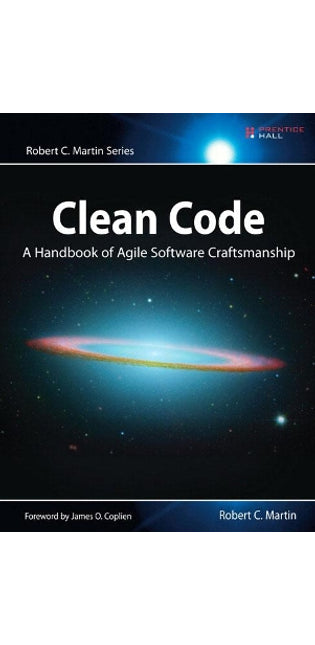
Clean Code
Even bad code can function. But if code isn’t clean, it can bring a development organization to its knees. Every year, countless hours and significant resources are lost because of poorly written code. But it doesn’t have to be that way. Noted software expert Robert C. Martin presents a revolutionary paradigm with Clean Code: A Handbook of Agile Software Craftsmanship. Martin has teamed up with his colleagues from Object Mentor to distill their best agile practice of cleaning code “on the fly” into a book that will instill within you the values of a software craftsman and make you a better programmer—but only if you work at it. What kind of work will you be doing? You’ll be reading code—lots of code. And you will be challenged to think about what’s right about that code, and what’s wrong with it. More importantly, you will be challenged to reassess your professional values and your commitment to your craft. Clean Code is divided into three parts. The first describes the principles, patterns, and practices of writing clean code. The second part consists of several case studies of increasing complexity. Each case study is an exercise in cleaning up code—of transforming a code base that has some problems into one that is sound and efficient. The third part is the payoff: a single chapter containing a list of heuristics and “smells” gathered while creating the case studies. The result is a knowledge base that describes the way we think when we write, read, and clean code. Readers will come away from this book understanding How to tell the difference between good and bad codeHow to write good code and how to transform bad code into good codeHow to create good names, good functions, good objects, and good classesHow to format code for maximum readabilityHow to implement complete error handling without obscuring code logicHow to unit test and practice test-driven developmentThis book is a must for any developer, software engineer, project manager, team lead, or systems analyst with an interest in producing better code.
R 1,832.00
R 185.00
Ready, Set, Code!
Are you ready to learn about real technology and make it yourself?Ready, Set, Code! explains how cutting-edge digital technology works and its surprising uses now and in the future. Filled with interesting examples, each chapter explores a different topic, such as artificial intelligence, sensors and data, and applies it with a fun, hands-on coding project. You will learn how to create your own chatbot, translate messages into different languages, construct a burglar alarm, make digital art and music, and launch a citizen science project. Plus, you'll learn how to protect yourself online and much more.Suitable for beginners, this book provides illustrated step-by-step instructions to teach kids to code with the highly acclaimed Scratch programming language, popular micro:bit mini computers and simple app building tools.
R 733.00
Five Lines of Code
Improving existing code—refactoring—is one of the most common tasks you’ll face as a programmer. Five Lines of Code teaches you clear and actionable refactoring rules that you can apply without relying on intuitive judgements such as “code smells.” It’s written for working developers, guiding you step by step through applying refactoring patterns to the codebase of a 2D puzzle game. Following the author’s expert perspective—that refactoring and code smells can be learned by following a concrete set of principles—you’ll learn when to refactor your code, what patterns to apply to what problem, and the code characteristics that indicate it’s time for a rework. Thanks to this hands-on guide, you’ll find yourself programming faster while still delivering high-quality code that your teammates will love to work with. about the technologyRefactoring is a fact of life. All code is imperfect, and refactoring is a systematic process you can use to improve the quality of your codebase. Whatever your architecture, choice of OO language, or skill as a programmer, the continuous design improvements of refactoring make your code simpler, more readable, and less prone to bugs. You’ll be amazed at the productivity boost of adding refactoring to your code hygiene routine—it’s quicker to hammer out bad code and then improve it than spending hours writing good code in the first place! about the book Five Lines of Code teaches working developers the shortcuts to quality code. You’ll follow author Christian Clausen’s unique approach to teaching refactoring that’s focused on concrete rules, and getting any method down to five lines or less to implement! There’s no jargon or tricky automated-testing skills required, just easy guidelines and patterns illustrated by detailed code samples. Chapter by chapter you’ll put techniques into action by refactoring a complete 2D puzzle game. Before you know it, you’ll be making serious and tangible improvements to your codebase. what's inside The symptoms of bad codeThe extracting method, introducing strategy pattern, and many other refactoring patternsModifying code safely, even when you don’t understand itWriting stable code that enables change-by-additionProper compiler practicesWriting code that needs no commentsReal-world practices for great refactoring about the readerFor developers who know an object-oriented programming language. about the author Christian Clausen works as a Technical Agile Coach teaching teams how to properly refactor their code. Previously he worked as a software engineer on the Coccinelle semantic patching project, an automated refactoring tool. He has an MSc in computer science, and five years’ experience teaching software quality at a university level.
R 1,921.00
R 305.00
R 519.00
R 457.00
Jesus Code
In 1998, John Randolph Price experienced a mystical revelation from which came specific steps to higher consciousness - a ladder to climb to a new dimension where the illusions of sickness, scarcity and discord are shattered and a world of wholeness, abundance and right relations is revealed. He was also given a glimpse of the future as we move into the third millennium, and how lasting peace will finally come to Earth. This is the story of that revelation.
R 391.00
Code Design for Dependable Systems
Theoretical and practical tools to master matrix code design strategy and technique Error correcting and detecting codes are essential to improving system reliability and have popularly been applied to computer systems and communication systems. Coding theory has been studied mainly using the code generator polynomials; hence, the codes are sometimes called polynomial codes. On the other hand, the codes designed by parity check matrices are referred to in this book as matrix codes. This timely book focuses on the design theory for matrix codes and their practical applications for the improvement of system reliability. As the author effectively demonstrates, matrix codes are far more flexible than polynomial codes, as they are capable of expressing various types of code functions. In contrast to other coding theory publications, this one does not burden its readers with unnecessary polynomial algebra, but rather focuses on the essentials needed to understand and take full advantage of matrix code constructions and designs. Readers are presented with a full array of theoretical and practical tools to master the fine points of matrix code design strategy and technique: * Code designs are presented in relation to practical applications, such as high-speed semiconductor memories, mass memories of disks and tapes, logic circuits and systems, data entry systems, and distributed storage systems * New classes of matrix codes, such as error locating codes, spotty byte error control codes, and unequal error control codes, are introduced along with their applications * A new parallel decoding algorithm of the burst error control codes is demonstrated In addition to the treatment of matrix codes, the author provides readers with a general overview of the latest developments and advances in the field of code design. Examples, figures, and exercises are fully provided in each chapter to illustrate concepts and engage the reader in designing actual code and solving real problems. The matrix codes presented with practical parameter settings will be very useful for practicing engineers and researchers. References lead to additional material so readers can explore advanced topics in depth. Engineers, researchers, and designers involved in dependable system design and code design research will find the unique focus and perspective of this practical guide and reference helpful in finding solutions to many key industry problems. It also can serve as a coursebook for graduate and advanced undergraduate students.
R 8,400.00
R 457.00
Codes, Graphs, and Systems
Foreword by James L. Massey. Codes, Graphs, and Systems is an excellent reference for both academic researchers and professional engineers working in the fields of communications and signal processing. A collection of contributions from world-renowned experts in coding theory, information theory, and signal processing, the book provides a broad perspective on contemporary research in these areas. Survey articles are also included. Specific topics covered include convolutional codes and turbo codes; detection and equalization; modems; physics and information theory; lattices and geometry; and behaviors and codes on graphs.Codes, Graphs, and Systems is a tribute to the leadership and profound influence of G. David Forney, Jr. The 35 contributors to the volume have assembled their work in his honor.
R 4,682.51
R 275.00
R 458.00
Code Book
The Science of Secrecy from Ancient Egypt to Quantum Cryptography From the best-selling author of Fermat’s Last Theorem, The Code Book is a history of man’s urge to uncover the secrets of codes, from Egyptian puzzles to modern day computer encryptions. As in Fermat’s Last Theorem, Simon Singh brings life to an anstonishing story of puzzles, codes, languages and riddles that reveals man’s continual pursuit to disguise and uncover, and to work out the secret languages of others. Codes have influenced events throughout history, both in the stories of those who make them and those who break them. The betrayal of Mary Queen of Scots and the cracking of the enigma code that helped the Allies in World War II are major episodes in a continuing history of cryptography. In addition to stories of intrigue and warfare, Simon Singh also investigates other codes, the unravelling of genes and the rediscovery of ancient languages and most tantalisingly, the Beale ciphers, an unbroken code that could hold the key to a $20 million treasure.
R 340.00
R 607.75
Turbo Codes
This book grew out of our research, industry consulting and con tinuing education courses. Turbo coding initially seemed to belong to a restricted research area, while now has become a part of the mainstream telecommu nication theory and practice. The turbo decoding principles have found widespread applications not only in error control, but in de tection, interference suppression and equalization. Intended for use by advanced students and professional engi neers, involved in coding and telecommunication research, the book includes both basic and advanced material. The chapters are se quenced so that the knowledge is acquired in a logical and progres sive way. The algorithm descriptions and analysis are supported by examples throughout the book. Performance evaluations of the presented algorithms are carried out both analytically and by sim ulations. Basic material included in the book has been taught to students and practicing professionals over the last four years in the form of senior undergraduate or graduate courses, lecture series and short continuing education courses.
R 4,661.51
Bible Code
0n September 1, 1994, I flew to Israel and met in Jerusalem with a close friend of Prime Minister Yitzhak Rabin, the poet Chaim Guri. I gave him a letter which he immediately gave to the Prime Minister. "An Israeli mathematician has discovered a hidden code in the Bible that appears to reveal the details of events that took place thousands of years after the Bible was written," my letter to Rabin stated. "The reason I'm telling you about this is that the only time your full name Yitzhak Rabin is encoded in the Bible, the words 'assassin that will assassinate' cross your name." On November 4, 1995, came the awful confirmation, a shot in the back from a man who believed he was on a mission from God, the murder that was encoded in the Bible three thousand years ago.
R 456.00
R 457.00
R 457.00
Codes, Cryptology and Information Security
This book constitutes the proceedings of the Second International Conference on Codes, Cryptology and Information Security, C2SI 2017, held in Rabat, Morocco, in April 2017. The 19 regular papers presented together with 5 invited talks were carefully reviewed and selected from 72 submissions. The first aim of this conference is to pay homage to Claude Carlet for his valuable contribution in teaching and disseminating knowledge in coding theory and cryptography worldwide, especially in Africa. The second aim of the conference is to provide an international forum for researchers from academia and practitioners from industry from all over the world for discussion of all forms of cryptology, coding theory and information security.
R 2,189.60