Search results for "offensive security using python"
Items we need to order for you

R 641.00
Artificial Intelligence Programming with Python
A hands-on roadmap to using Python for artificial intelligence programming In Practical Artificial Intelligence Programming with Python: From Zero to Hero, veteran educator and photophysicist Dr. Perry Xiao delivers a thorough introduction to one of the most exciting areas of computer science in modern history. The book demystifies artificial intelligence and teaches readers its fundamentals from scratch in simple and plain language and with illustrative code examples. Divided into three parts, the author explains artificial intelligence generally, machine learning, and deep learning. It tackles a wide variety of useful topics, from classification and regression in machine learning to generative adversarial networks. He also includes: Fulsome introductions to MATLAB, Python, AI, machine learning, and deep learningExpansive discussions on supervised and unsupervised machine learning, as well as semi-supervised learningPractical AI and Python “cheat sheet” quick referencesThis hands-on AI programming guide is perfect for anyone with a basic knowledge of programming—including familiarity with variables, arrays, loops, if-else statements, and file input and output—who seeks to understand foundational concepts in AI and AI development.
R 958.00
Python for Experimental Psychologists
Python for Experimental Psychologists equips researchers who have no prior programming experience with the essential knowledge to independently script experiments and analyses in the programming language Python. The book offers an excellent introduction, whether you are an undergraduate, a PhD candidate, or an established researcher.This updated edition is on Python 3 (the most current version). It starts by teaching the fundamentals of programming in Python, and then offers several chapters on scripting experiments (displaying stimuli, obtaining and logging user input, precision timing, etc.) using the popular PsychoPy package. The remainder of the book is dedicated to data analysis, and includes chapters on reading/writing to text files, time series, eye tracking, data visualisation, and statistics.Access to a companion website enriches the learning experience with colour figures, example stimuli, datasets, scripts, and a portable Windows installation of Python. The book assumes no prior knowledge, and its informal and accessible tone helps readers with backgrounds in experimental psychology and cognitive neuroscience to quickly understand Python. It serves as a useful resource not only for researchers in these fields, but also for lecturers instructing on methodology and data analysis.Python for Experimental Psychologists demystifies programming complexities, and empowers researchers to proficiently conduct experiments and to analyse their results.
R 9,375.40
R 320.00
R 457.00
R 611.00
R 466.00
R 1,053.52
Learning Advanced Python by Studying Open Source Projects
This book is one of its own kind. It is not an encyclopedia or a hands-on tutorial that traps readers in the tutorial-hell. It is a distillation of just one common Python user’s learning experience. The experience is packaged with exceptional teaching techniques, careful dependence unraveling and most importantly, passion.Learning Advanced Python by Studying Open Source Projects helps readers overcome the difficulty in their day-to-day tasks and seek insights from solutions in famous open source projects. Different from a technical manual, this book mixes the technical knowledge, real-world applications and more theoretical content, providing readers with a practical and engaging approach to learning Python.Throughout the book, readers will learn how to write Python code that is efficient, readable, and maintainable, covering key topics such as data structures, algorithms, object-oriented programming, and more. The author's passion for Python shines through in the book, making it an enjoyable and inspiring read for both beginners and experienced programmers.
R 2,697.30
Network Security with OpenSSL
Most applications these days are at least somewhat network aware, but how do you protect those applications against common network security threats? Many developers are turning to OpenSSL, an open source version of SSL/TLS, which is the most widely used protocol for secure network communications. The OpenSSL library is seeing widespread adoption for web sites that require cryptographic functions to protect a broad range of sensitive information, such as credit card numbers and other financial transactions. The library is the only free, full-featured SSL implementation for C and C++, and it can be used programmatically or from the command line to secure most TCP-based network protocols. Network Security with OpenSSL enables developers to use this protocol much more effectively. Traditionally, getting something simple done in OpenSSL could easily take weeks. This concise book gives you the guidance you need to avoid pitfalls, while allowing you to take advantage of the library?s advanced features. And, instead of bogging you down in the technical details of how SSL works under the hood, this book provides only the information that is necessary to use OpenSSL safely and effectively.In step-by-step fashion, the book details the challenges in securing network communications, and shows you how to use OpenSSL tools to best meet those challenges. As a system or network administrator, you will benefit from the thorough treatment of the OpenSSL command-line interface, as well as from step-by-step directions for obtaining certificates and setting up your own certification authority. As a developer, you will further benefit from the in-depth discussions and examples of how to use OpenSSL in your own programs. Although OpenSSL is written in C, information on how to use OpenSSL with Perl, Python and PHP is also included. OpenSSL may well answer your need to protect sensitive data. If that?s the case, Network Security with OpenSSL is the only guide available on the subject.
R 911.00
Hacking Exposed Windows: Microsoft Windows Security Secrets and Solutions, Third Edition
Publisher's Note: Products purchased from Third Party sellers are not guaranteed by the publisher for quality, authenticity, or access to any online entitlements included with the product.The latest Windows security attack and defense strategies"Securing Windows begins with reading this book." --James Costello (CISSP) IT Security Specialist, Honeywell Meet the challenges of Windows security with the exclusive Hacking Exposed "attack-countermeasure" approach. Learn how real-world malicious hackers conduct reconnaissance of targets and then exploit common misconfigurations and software flaws on both clients and servers. See leading-edge exploitation techniques demonstrated, and learn how the latest countermeasures in Windows XP, Vista, and Server 2003/2008 can mitigate these attacks. Get practical advice based on the authors' and contributors' many years as security professionals hired to break into the world's largest IT infrastructures. Dramatically improve the security of Microsoft technology deployments of all sizes when you learn to: Establish business relevance and context for security by highlighting real-world risksTake a tour of the Windows security architecture from the hacker's perspective, exposing old and new vulnerabilities that can easily be avoidedUnderstand how hackers use reconnaissance techniques such as footprinting, scanning, banner grabbing, DNS queries, and Google searches to locate vulnerable Windows systems Learn how information is extracted anonymously from Windows using simple NetBIOS, SMB, MSRPC, SNMP, and Active Directory enumeration techniquesPrevent the latest remote network exploits such as password grinding via WMI and Terminal Server, passive Kerberos logon sniffing, rogue server/man-in-the-middle attacks, and cracking vulnerable servicesSee up close how professional hackers reverse engineer and develop new Windows exploitsIdentify and eliminate rootkits, malware, and stealth softwareFortify SQL Server against external and insider attacksHarden your clients and users against the latest e-mail phishing, spyware, adware, and Internet Explorer threats Deploy and configure the latest Windows security countermeasures, including BitLocker, Integrity Levels, User Account Control, the updated Windows Firewall, Group Policy, Vista Service Refactoring/Hardening, SafeSEH, GS, DEP, Patchguard, and Address Space Layout Randomization
R 1,876.00
Python-Based Laboratory
The Python-Based Laboratory: A Hands-On Guide for Scientists and Engineers provides a learn-by-doing approach to acquiring the Python programming skills needed to implement computer-controlled experimental work. The book leads its readers to mastery of the popular, open-source Python computer language in its role as a powerful laboratory tool by carrying out interesting and relevant projects that explore the acquisition, production, analysis, and presentation of digitized waveforms. Readers, who are assumed to have no prior computer programming or Python background, begin writing meaningful programs in the first few pages.The Python-Based Laboratory can be used as a textbook for science and engineering instructional laboratory students who are being taught up-to-date Python-based experimental skills. The book also works well as a self-study guide for professional laboratory researchers, industrial engineers, hobbyists, and electronics enthusiasts seeking to automate tasks using Python. Topics covered include the control of data acquisition devices (including multifunction data acquisition hardware and IEEE-interfaced stand-alone instruments), data file storage and presentation, digitized data concepts (such as resolution, sampling frequency, and aliasing), and data analysis techniques (curve fitting and fast Fourier transform). As readers work their way through the book, they build several computer-based instruments, including a DC voltmeter, digital oscilloscope, DC voltage source, waveform generator, blinking LED array, digital thermometer, and spectrum analyzer. Each chapter concludes with a Do-It-Yourself project and a Use It! example as well as a healthy selection of homework-style problems, allowing readers to test their understanding and further develop their Python-based experimentation skills.
R 6,961.00
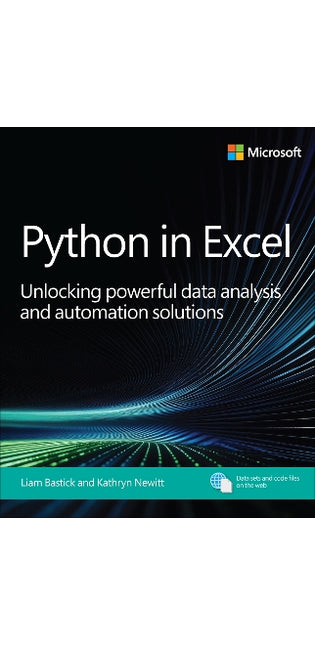
Python in Excel
Seasoned Experts Liam Bastick and Kathryn Newitt unveil a groundbreaking guide to mastering data analysis and automation with Python in Excel Python in Excel: Unlocking powerful data analysis and automation solutions is a hands-on, practical guide that leverages the authors’ decades of expertise to teach readers how to harness the newly integrated Python capabilities within Microsoft Excel, mapping familiar Excel concepts to Python foundations. Covering essential topics such as Python syntax, data structures, data analysis with pandas, visualization, and the use of AI tools like Copilot, the book empowers professionals to elevate their data analysis and automation skills. Readers will gain the ability to perform advanced forecasting, build predictive models, and streamline workflows, making them more efficient and competitive in today’s data-driven workplace. By reading this book, you will: Understand the fundamentals of Python programming directly within ExcelMap your existing Excel skills to Python concepts for easier learningAutomate repetitive tasks and workflows Analyze and visualize data with powerfulPython libraries like pandas Build advanced forecasting and predictive models without leaving ExcelExplore and manipulate data efficiently using Python’s concise syntaxIntegrate AI tools such as Copilot to assist with coding and analysisConnect Excel with external data sources using Python and Power QueryDevelop custom solutions for business modeling and data scienceCreate a roadmap for further study and mastery of Python in Excel
R 2,083.00
Programming with Python for Social Scientists
As data become ′big′, fast and complex, the software and computing tools needed to manage and analyse them are rapidly developing. Social scientists need new tools to meet these challenges, tackle big datasets, while also developing a more nuanced understanding of - and control over - how these computing tools and algorithms are implemented. Programming with Python for Social Scientists offers a vital foundation to one of the most popular programming tools in computer science, specifically for social science researchers, assuming no prior coding knowledge. It guides you through the full research process, from question to publication, including:the fundamentals of why and how to do your own programming in social scientific research,questions of ethics and research design,a clear, easy to follow ′how-to′ guide to using Python, with a wide array of applications such as data visualisation, social media data research, social network analysis, and more.Accompanied by numerous code examples, screenshots, sample data sources, this is the textbook for social scientists looking for a complete introduction to programming with Python and incorporating it into their research design and analysis.
R 3,287.32
Data Structures for Engineers and Scientists Using Python
The text covers the fundamentals of Python programming and the implementation of data structures using Python programming with the help of worked-out examples. It provides a learning tool for engineers as well as for researchers and scientists of advanced level. The text further discusses important concepts such as polynomial manipulation, sparse matrices, implementation of stack using the queue model and topological sorting.This book:Discusses the implementation of various data structures such as an array, stack, queue, tree and graph along with sorting and searching algorithms. Includes programming tips to highlight important concepts and help readers avoid common programming errors. Presents each concept of data structure with a different approach and implements the same using Python programming. Offers rich chapter-end pedagogy including objective-type questions (with answers), review questions and programming exercises to facilitate review. Covers fundamentals of Python up to object-oriented concepts including regular expression. It is primarily written for senior undergraduate, graduate students and academic researchers in the fields of electrical engineering, electronics and communication engineering, computer engineering and information technology.
R 3,297.00
Learn Python 3 the Hard Way
You Will Learn Python 3! Zed Shaw has perfected the world’s best system for learning Python 3. Follow it and you will succeed—just like the millions of beginners Zed has taught to date! You bring the discipline, commitment, and persistence; the author supplies everything else. In Learn Python 3 the Hard Way, you’ll learn Python by working through 52 brilliantly crafted exercises. Read them. Type their code precisely. (No copying and pasting!) Fix your mistakes. Watch the programs run. As you do, you’ll learn how a computer works; what good programs look like; and how to read, write, and think about code. Zed then teaches you even more in 5+ hours of video where he shows you how to break, fix, and debug your code—live, as he’s doing the exercises. Install a complete Python environmentOrganize and write codeFix and break codeBasic mathematicsVariablesStrings and textInteract with usersWork with filesLooping and logicData structures using lists and dictionariesProgram designObject-oriented programmingInheritance and compositionModules, classes, and objectsPython packagingAutomated testingBasic game developmentBasic web development It’ll be hard at first. But soon, you’ll just get it—and that will feel great! This course will reward you for every minute you put into it. Soon, you’ll know one of the world’s most powerful, popular programming languages. You’ll be a Python programmer. This Book Is Perfect For Total beginners with zero programming experienceJunior developers who know one or two languagesReturning professionals who haven’t written code in yearsSeasoned professionals looking for a fast, simple, crash course in Python 3
R 912.00
Programming with Python for Social Scientists
As data become ′big′, fast and complex, the software and computing tools needed to manage and analyse them are rapidly developing. Social scientists need new tools to meet these challenges, tackle big datasets, while also developing a more nuanced understanding of - and control over - how these computing tools and algorithms are implemented. Programming with Python for Social Scientists offers a vital foundation to one of the most popular programming tools in computer science, specifically for social science researchers, assuming no prior coding knowledge. It guides you through the full research process, from question to publication, including:the fundamentals of why and how to do your own programming in social scientific research,questions of ethics and research design,a clear, easy to follow ′how-to′ guide to using Python, with a wide array of applications such as data visualisation, social media data research, social network analysis, and more.Accompanied by numerous code examples, screenshots, sample data sources, this is the textbook for social scientists looking for a complete introduction to programming with Python and incorporating it into their research design and analysis.
R 5,706.92
Predictive Data Security using AI
This contributed volume consists of 11 chapters that specifically cover the security aspects of the latest technologies such as Blockchain, IoT, and DevOps, and how to effectively deal with them using Intelligent techniques. Moreover, machine learning (ML) and deep learning (DL) algorithms are also not secured and often manipulated by attackers for data stealing. This book also discusses the types of attacks and offers novel solutions to counter the attacks on ML and DL algorithms. This book describes the concepts and issues with figures and the supporting arguments with facts and charts. In addition to that, the book provides the comparison of different security solutions in terms of experimental results with tables and charts. Besides, the book also provides the future directions for each chapter and novel alternative approaches, wherever applicable. Often the existing literature provides domain-specific knowledge such as the description of security aspects. However, the readers find it difficult to understand how to tackle the application-specific security issues. This book takes one step forward and offers the security issues, current trends, and technologies supported by alternate solutions. Moreover, the book provides thorough guidance on the applicability of ML and DL algorithms to deal with application-specific security issues followed by novel approaches to counter threats to ML and DL algorithms. The book includes contributions from academicians, researchers, security experts, security architectures, and practitioners and provides an in-depth understanding of the mentioned issues.
R 6,594.00
R 165.00
R 916.00
R 611.00
R 428.00
R 641.00
Hacking Exposed Malware & Rootkits: Security Secrets and Solutions, Second Edition
Publisher's Note: Products purchased from Third Party sellers are not guaranteed by the publisher for quality, authenticity, or access to any online entitlements included with the product.Arm yourself for the escalating war against malware and rootkitsThwart debilitating cyber-attacks and dramatically improve your organization’s security posture using the proven defense strategies in this thoroughly updated guide. Hacking Exposed™ Malware and Rootkits: Security Secrets & Solutions, Second Edition fully explains the hacker’s latest methods alongside ready-to-deploy countermeasures. Discover how to block pop-up and phishing exploits, terminate embedded code, and identify and eliminate rootkits. You will get up-to-date coverage of intrusion detection, firewall, honeynet, antivirus, and anti-rootkit technology.• Learn how malware infects, survives, and propagates across an enterprise• See how hackers develop malicious code and target vulnerable systems• Detect, neutralize, and remove user-mode and kernel-mode rootkits • Use hypervisors and honeypots to uncover and kill virtual rootkits• Defend against keylogging, redirect, click fraud, and identity theft• Block spear phishing, client-side, and embedded-code exploits• Effectively deploy the latest antivirus, pop-up blocker, and firewall software• Identify and stop malicious processes using IPS solutions
R 2,352.04
Python for Experimental Psychologists
Python for Experimental Psychologists equips researchers who have no prior programming experience with the essential knowledge to independently script experiments and analyses in the programming language Python. The book offers an excellent introduction, whether you are an undergraduate, a PhD candidate, or an established researcher.This updated edition is on Python 3 (the most current version). It starts by teaching the fundamentals of programming in Python, and then offers several chapters on scripting experiments (displaying stimuli, obtaining and logging user input, precision timing, etc.) using the popular PsychoPy package. The remainder of the book is dedicated to data analysis, and includes chapters on reading/writing to text files, time series, eye tracking, data visualisation, and statistics.Access to a companion website enriches the learning experience with colour figures, example stimuli, datasets, scripts, and a portable Windows installation of Python. The book assumes no prior knowledge, and its informal and accessible tone helps readers with backgrounds in experimental psychology and cognitive neuroscience to quickly understand Python. It serves as a useful resource not only for researchers in these fields, but also for lecturers instructing on methodology and data analysis.Python for Experimental Psychologists demystifies programming complexities, and empowers researchers to proficiently conduct experiments and to analyse their results.
R 2,052.00
R 2,138.96
R 1,099.00
R 641.00
R 1,498.00
R 478.00
R 1,140.00
Machine Learning Security Principles
Thwart hackers by preventing, detecting, and misdirecting access before they can plant malware, obtain credentials, engage in fraud, modify data, poison models, corrupt users, eavesdrop, and otherwise ruin your dayKey FeaturesDiscover how hackers rely on misdirection and deep fakes to fool even the best security systemsRetain the usefulness of your data by detecting unwanted and invalid modificationsDevelop application code to meet the security requirements related to machine learningBook DescriptionBusinesses are leveraging the power of AI to make undertakings that used to be complicated and pricy much easier, faster, and cheaper. The first part of this book will explore these processes in more depth, which will help you in understanding the role security plays in machine learning.As you progress to the second part, you'll learn more about the environments where ML is commonly used and dive into the security threats that plague them using code, graphics, and real-world references.The next part of the book will guide you through the process of detecting hacker behaviors in the modern computing environment, where fraud takes many forms in ML, from gaining sales through fake reviews to destroying an adversary's reputation. Once you've understood hacker goals and detection techniques, you'll learn about the ramifications of deep fakes, followed by mitigation strategies.This book also takes you through best practices for embracing ethical data sourcing, which reduces the security risk associated with data. You'll see how the simple act of removing personally identifiable information (PII) from a dataset lowers the risk of social engineering attacks.By the end of this machine learning book, you'll have an increased awareness of the various attacks and the techniques to secure your ML systems effectively.What you will learnExplore methods to detect and prevent illegal access to your systemImplement detection techniques when access does occurEmploy machine learning techniques to determine motivationsMitigate hacker access once security is breachedPerform statistical measurement and behavior analysisRepair damage to your data and applicationsUse ethical data collection methods to reduce security risksWho this book is forWhether you're a data scientist, researcher, or manager working with machine learning techniques in any aspect, this security book is a must-have. While most resources available on this topic are written in a language more suitable for experts, this guide presents security in an easy-to-understand way, employing a host of diagrams to explain concepts to visual learners. While familiarity with machine learning concepts is assumed, knowledge of Python and programming in general will be useful.
R 1,596.00
R 516.00
AI Cybersecurity Handbook
An up-to-date exploration of how AI is transforming cybersecurity and how to implement AI in your organization’s cyber defenses to meet today’s evolving threat landscape In The AI Cybersecurity Handbook, author Caroline Wong examines AI’s impact on both offensive and defensive cybersecurity strategies. Wong explains how artificial intelligence has transformed the way cyberattacks are carried out and how technology professionals prepare for and defend against them. On the offensive side, the author explores how AI is being used to automate, accelerate, and personalize attacks against targets. She shows you how these technologies make cyberattacks cheaper to carry out, harder to detect, and easier to automate at scale--broadening the impact beyond initial targets to include partners, third parties, and critical connected systems. For defenders, this book demonstrates how to use AI to evolve past traditional, rules-based cybersecurity defense to an adaptive model that evolves in real-time to counteract emergent risks and novel attack vectors. These new systems rely on continuously updated data inputs and form resilient bulwarks against formidable threats. Inside the book: Hands-on strategies for minimizing operational barriers to AI implementation to enable new capabilities for defenders and allow for the use of powerful tools, like smart data enrichment, AI-powered query engines, and self-initiating security actionsUp-to-date discussions of how to use AI to accelerate your cybersecurity responses while improving their accuracy, including anomaly detection, threat identification, and dynamic mitigation processesExpert advice for building resilient AI-enabled cybersecurity without compromising on AI ethics Perfect for cybersecurity professionals, IT managers, developers and business leaders looking for actionable guidance on the integration of AI into their IT security practices, The AI Cybersecurity Handbook offers accessible strategies well-suited to people with varying levels of technical expertise. It’s a must-read book for everyone with a stake in safeguarding digital assets.
R 798.00
R 458.00
R 916.00
R 463.56
R 397.00
R 611.00
R 611.00