Search results for "Python und NLP"
Items we need to order for you

Eye-Tracking with Python and Pylink
Several Python programming books feature tools designed for experimental psychologists. What sets this book apart is its focus on eye-tracking.Eye-tracking is a widely used research technique in psychology and neuroscience labs. Research grade eye-trackers are typically faster, more accurate, and of course, more expensive than the ones seen in consumer goods or usability labs. Not surprisingly, a successful eye-tracking study usually requires sophisticated computer programming. Easy syntax and flexibility make Python a perfect choice for this task, especially for psychology researchers with little or no computer programming experience.This book offers detailed coverage of the Pylink library, a Python interface for the gold standard EyeLink ® eye-trackers, with many step-by-step example scripts. This book is a useful reference for eye-tracking researchers, but you can also use it as a textbook for graduate-level programming courses.
R 3,814.47
Eye-Tracking with Python and Pylink
Several Python programming books feature tools designed for experimental psychologists. What sets this book apart is its focus on eye-tracking.Eye-tracking is a widely used research technique in psychology and neuroscience labs. Research grade eye-trackers are typically faster, more accurate, and of course, more expensive than the ones seen in consumer goods or usability labs. Not surprisingly, a successful eye-tracking study usually requires sophisticated computer programming. Easy syntax and flexibility make Python a perfect choice for this task, especially for psychology researchers with little or no computer programming experience.This book offers detailed coverage of the Pylink library, a Python interface for the gold standard EyeLink ® eye-trackers, with many step-by-step example scripts. This book is a useful reference for eye-tracking researchers, but you can also use it as a textbook for graduate-level programming courses.
R 3,284.34
Text Analysis in Python for Social Scientists
Text is everywhere, and it is a fantastic resource for social scientists. However, because it is so abundant, and because language is so variable, it is often difficult to extract the information we want. There is a whole subfield of AI concerned with text analysis (natural language processing). Many of the basic analysis methods developed are now readily available as Python implementations. This Element will teach you when to use which method, the mathematical background of how it works, and the Python code to implement it.
R 865.00
Python
This title is part of UC Press's Voices Revived program, which commemorates University of California Press’s mission to seek out and cultivate the brightest minds and give them voice, reach, and impact. Drawing on a backlist dating to 1893, Voices Revived makes high-quality, peer-reviewed scholarship accessible once again using print-on-demand technology. This title was originally published in 1959.
R 3,090.00
R 886.00
R 550.78
Handbook of NLP
Since its Californian beginnings a generation ago, Neurolinguistic Programming (NLP) has won world-wide recognition as probably the most powerful set of tools available for improving communication, thinking and problem-solving. Derived from the study of leading practitioners in fields as disparate as psychotherapy and selling, NLP is now used extensively in business, management, human resource development and sport. Dr Alder's Handbook brings together in one volume the ideas and skills involved in applying NLP to achieve superior performance at both the personal and the professional level. Part 1 sets out the underlying principles and introduces key concepts such as outcomes, representational systems, anchoring, modelling and reframing, together with the techniques required for putting them to work. Part 2 shows how to use NLP in training, selling, negotiating, interviewing, coaching and presentation. Throughout the text there are examples and exercises designed to help readers profit from, rather than simply understand, the procedures described. Other valuable features include a glossary of terms and a sources and resources section containing an annotated reading list and details of organizations offering NLP training. Anyone seeking a comprehensive guide to NLP theory and practice need look no further.
R 9,442.64
R 951.14
R 816.82
R 670.86
Artificial Intelligence with Python
Entering the field of artificial intelligence and data science can seem daunting to beginners with little to no prior background, especially those with no programming experience. The concepts used in self-driving cars and virtual assistants like Amazon’s Alexa may seem very complex and difficult to grasp. The aim of Artificial Intelligence in Python is to make AI accessible and easy to understand for people with little to no programming experience though practical exercises. Newcomers will gain the necessary knowledge on how to create such systems, which are capable of executing tasks that require some form of human-like intelligence.This book introduces readers to various topics and examples of programming in Python, as well as key concepts in artificial intelligence. Python programming skills will be imparted as we go along. Concepts and code snippets will be covered in a step-by-step manner, to guide and instill confidence in beginners. Complex subjects in deep learning and machine learning will be broken down into easy-to-digest content and examples. Artificial intelligence implementations will also be shared, allowing beginners to generate their own artificial intelligence algorithms for reinforcement learning, style transfer, chatbots, speech, and natural language processing.
R 2,931.00
R 428.00
Python 3 Using DeepSeek
This book is your definitive guide to mastering DeepSeek, a leading open-source Large Language Model (LLM), and leveraging its power through practical Python programming. It is structured to build your expertise from foundational Python data structures and object-oriented programming to advanced model deployment.The initial chapters establish a strong technical base in Python's core features, including comprehensions, iterators, and the OOP paradigm. The focus then shifts entirely to DeepSeek, detailing its innovative Mixture-of-Experts (MoE) architecture, its superior performance on code-centric benchmarks like HumanEval, and its efficiency advantages. You will gain crucial insight into model management, specifically through the concept of quantization and local deployment with tools like Ollama, which is essential for maximizing performance while minimizing resource usage. The final chapter provides numerous, practical Python mini-projects, allowing you to immediately apply DeepSeek's capabilities to a range of real-world tasks from basic web scraping and data visualization to advanced object-oriented programming and linear regression.Python 3 Using DeepSeek is essential reading for Python developers (intermediate to advanced), machine learning practitioners, and data scientists. It is your guide to integrating high-performing, open-source LLMs into your workflows, particularly for code generation, algorithmic reasoning, and highly efficient local model deployment.
R 2,674.00
R 639.00
R 3,053.00
Building AI Systems with Python
This book is a practical, end-to-end guide for engineers and practitioners who want to move beyond prototypes and confidently deploy machine learning and large language model solutions in real-world environments. This book guides through the entire modern machine learning lifecycle. You'll start with foundations using NumPy, Pandas, and PyArrow for data pipelines, then build solid baselines with scikit-learn. From there, you advance into deep learning with PyTorch, transformers, and LLM adaptation techniques such as LoRA and QLoRA. You'll explore diffusion and multimodal models, and learn to build retrieval-augmented generation systems with FAISS and pgvector. Practical chapters cover agents, tool use, evaluation frameworks, observability, and responsible AI practices including privacy, safety, and governance. Finally, you'll master deployment techniques using FastAPI, Ray Serve, TorchServe, and cutting-edge LLM serving engines like vLLM and TGI. Each concept is paired with clear code examples, testing patterns, and operational checklists. Instead of one-off tricks, you'll adopt repeatable workflows: schema-first tooling, reproducible training pipelines, evaluation with golden datasets, and secure production rollouts with monitoring and compliance checkpoints. In the end, this book helps you build systems that are robust, auditable, and optimized--whether you're deploying your first model or managing complex enterprise workloads. For engineers who want to ship AI confidently and responsibly, this is your practical playbook for the GenAI era. What you will learn: Implement modern AI models including transformers, diffusion, multimodal, recommenders, and RL using practical PyTorch examples. Fine tune and serve LLMs with LoRA/QLoRA, quantization, RAG, tool calling, structured prompts, and robust evaluation techniques. Design agentic AI systems with memory, planning, safe tool execution, multi agent patterns, and autonomy evaluation frameworks. Deploy and run production grade AI with MLOps/LLMOps covering serving, performance tuning, monitoring, cost control, compliance, and edge deployments. Who this book is for: This book is designed for practicing machine learning and AI engineers, software engineers moving into applied AI, data scientists building production systems, MLOps/LLMOps practitioners, and technical builders who want to go beyond demos and deploy real-world GenAI, LLM, and PyTorch-based systems at scale.
R 1,368.00
R 458.00
Explainable AI with Python
This comprehensive book on Explainable Artificial Intelligence has been updated and expanded to reflect the latest advancements in the field of XAI, enriching the existing literature with new research, case studies, and practical techniques. The Second Edition expands on its predecessor by addressing advancements in AI, including large language models and multimodal systems that integrate text, visual, auditory, and sensor data. It emphasizes making complex systems interpretable without sacrificing performance and provides an enhanced focus on additive models for improved interpretability. Balancing technical rigor with accessibility, the book combines theory and practical application to equip readers with the skills needed to apply explainable AI (XAI) methods effectively in real-world contexts. Features: Expansion of the "Intrinsic Explainable Models" chapter to delve deeper into generalized additive models and other intrinsic techniques, enriching the chapter with new examples and use cases for a better understanding of intrinsic XAI models. Further details in "Model-Agnostic Methods for XAI" focused on how explanations differ between the training set and the test set, including a new model to illustrate these differences more clearly and effectively. New section in "Making Science with Machine Learning and XAI" presenting a visual approach to learning the basic functions in XAI, making the concept more accessible to readers through an interactive and engaging interface. Revision in "Adversarial Machine Learning and Explainability" that includes a code review to enhance understanding and effectiveness of the concepts discussed, ensuring that code examples are up-to-date and optimized for current best practices. New chapter on "Generative Models and Large Language Models (LLM)" chapter dedicated to generative models and large language models, exploring their role in XAI and how they can be used to create richer, more interactive explanations. This chapter also covers the explainability of transformer models and privacy through generative models. New "Artificial General Intelligence and XAI" mini-chapter dedicated to exploring the implications of Artificial General Intelligence (AGI) for XAI, discussing how advancements towards AGI systems influence strategies and methodologies for XAI. Enhancements in "Explaining Deep Learning Models" features new methodologies in explaining deep learning models, further enriching the chapter with cutting-edge techniques and insights for deeper understanding.
R 2,198.00
R 621.34
Introducing Python
Stuck in a coding conundrum? Whether you're an advanced beginner, an intermediate developer, or a curious newcomer, the complexities of coding can often feel like a labyrinth with no exit. With Python, however, you can start writing real code quickly-but where should you start?In this updated third edition, Bill Lubanovic acts as your personal guide to Python, offering a clear path through the intricacies and capabilities of this much-beloved coding language, including new chapters on AI models and performance enhancements. Easy to understand and enjoyable to read, this book not only teaches you the core concepts but also dives into practical applications that bridge the gap between learning and doing. By reading it, you will:Understand everything from basic data structures to advanced featuresGain insights into using Python for files, networking, databases, and data scienceLearn testing, debugging, code reuse, and other essential development tipsExplore how Python can be utilized in business, science, and the arts
R 1,140.00
R 353.83
Introduction to Machine Learning with Python
Machine learning has become an integral part of many commercial applications and research projects, but this field is not exclusive to large companies with extensive research teams. If you use Python, even as a beginner, this book will teach you practical ways to build your own machine learning solutions. With all the data available today, machine learning applications are limited only by your imagination. You'll learn the steps necessary to create a successful machine-learning application with Python and the scikit-learn library. Authors Andreas Muller and Sarah Guido focus on the practical aspects of using machine learning algorithms, rather than the math behind them. Familiarity with the NumPy and matplotlib libraries will help you get even more from this book.With this book, you'll learn: Fundamental concepts and applications of machine learning Advantages and shortcomings of widely used machine learning algorithms How to represent data processed by machine learning, including which data aspects to focus on Advanced methods for model evaluation and parameter tuning The concept of pipelines for chaining models and encapsulating your workflow Methods for working with text data, including text-specific processing techniques Suggestions for improving your machine learning and data science skills
R 2,076.00
R 1,652.45
R 305.00
R 700.00
R 1,130.00
R 639.00
R 468.47
Change Your Life with NLP
There is a brighter future ahead of you – and it starts right here, right now. It doesn’t matter how your life has been so far. It doesn’t matter what’s happened in the past. All that matters is now. Change can happen in an instant and making changes, even really big ones, can be much less scary than you might imagine. All you need is to change your thinking - and this book explains how. Change Your Life with NLP uses powerful tools and techniques from the tried and tested field of neuro linguistic programming to reveal how you’ve got to where you are and what might be holding you back or stopping good things happening. You can use NLP to: - determine what you want in life - find the perfect partner or career - boost your confidence - increase your happiness - banish anxiety - drop bad habits - lose weight (and keep it off) - get out of debt - improve your relationships with everybody and much, much more. In fact, once you understand what’s going on in your unconscious mind, and have shifted your thinking, every area of your life will start to benefit! This new edition includes three brand new chapters on using NLP for influence and persuasion, becoming more self-aware and identifying and understanding your priorities.
R 340.00
R 1,373.00
Machine Learning and AI with Simple Python and Matlab Scripts
A practical guide to AI applications for Simple Python and Matlab scripts Machine Learning and AI with Simple Python and Matlab Scripts: Courseware for Non-computing Majors introduces basic concepts and principles of machine learning and artificial intelligence to help readers develop skills applicable to many popular topics in engineering and science. Step-by-step instructions for simple Python and Matlab scripts mimicking real-life applications will enter the readers into the magical world of AI, without requiring them to have advanced math and computational skills. The book is supported by instructor only lecture slides and sample exams with multiple-choice questions. Machine Learning and AI with Simple Python and Matlab Scripts includes information on: Artificial neural networks applied to real-world problems such as algorithmic trading of financial assets, Alzheimer’s disease prognosisConvolution neural networks for speech recognition and optical character recognitionRecurrent neural networks for chatbots and natural language translatorsTypical AI tasks including flight control for autonomous drones, dietary menu planning, and route planningAdvanced AI tasks including particle swarm optimization and differential and grammatical evolution as well as the current state of the art in AI tools Machine Learning and AI with Simple Python and Matlab Scripts is an accessible, thorough, and practical learning resource for undergraduate and graduate students in engineering and science programs along with professionals in related industries seeking to expand their skill sets.
R 3,224.00
R 409.00
R 1,221.00
R 305.00
Python für Dummies Alles-in-einem-Band
Python programmieren lernen lohnt sich. Es ist eine moderne sich ständig weiterentwickelnde Programmiersprache. Dieses Buch hilft Ihnen, wenn Sie Python von der Pike auf lernen wollen, aber auch mehr als nur die Grundlagen verstehen wollen. Johannes Hofmeister erklärt Ihnen Grundlagen wie Syntax, Module und Basic-Funktionen und schreitet dann zu fort zu höheren Konzepten wie Funktionen und Objekte. Er zeigt Ihnen auch, wie Sie diese testen können, um fehlerfrei Software zu schreiben. Danach widmet sich der Autor Internettechnologien wie E-Mail, Apis und Browsing und erklärt Ihnen, wie Sie mit Django eine Webanwendung bauen. Sie erfahren, wie Sie mithilfe von Python komplexe Datensätze analysieren und zuletzt beweist Ihnen der Autor, wie vielseitig nutzbar Python ist.
R 911.00
AI and ML for Coders in Pytorch
Eager to learn AI and machine learning but unsure where to start? Laurence Moroney's hands-on, code-first guide demystifies complex AI concepts without relying on advanced mathematics. Designed for programmers, it focuses on practical applications using PyTorch, helping you build real-world models without feeling overwhelmed.From computer vision and natural language processing (NLP) to generative AI with Hugging Face Transformers, this book equips you with the skills most in demand for AI development today. You'll also learn how to deploy your models across the web and cloud confidently.Gain the confidence to apply AI without needing advanced math or theory expertiseDiscover how to build AI models for computer vision, NLP, and sequence modeling with PyTorchLearn generative AI techniques with Hugging Face Diffusers and Transformers
R 1,824.00
R 214.00
R 1,003.45
Python für Ingenieure für Dummies
Schlichtes Ausführen fertiger Software wird den Bedürfnissen des Ingenieuralltags nicht mehr gerecht. Oft muss Programmcode selbst entwickelt oder angepasst werden. Aber Ingenieure sind keine Softwareentwickler. Mit Python steht ein mächtiger und flexibler Werkzeugkasten zur Verfügung, der es erlaubt, eine große Klasse von Ingenieurproblemen - oft mit wenig Aufwand - zu lösen. Die Kernaufgaben sind dabei meist: Daten akquirieren, Lösungsalgorithmen anwenden, Ergebnisse visualisieren. Das Buch zeigt anhand zahlreicher Beispiele aus unterschiedlichen Anwendungsfeldern der Ingenieurwissenschaften, wie Python zur Lösung dieser Aufgaben eingesetzt werden kann. Gleichzeitig wird das nötige Hintergrundwissen vermittelt, um das Gelernte auf eigene Fragestellungen zu transferieren. Die vermittelten Kenntnisse sind anwendbar auf Übungsaufgaben im Studium genauso wie auf Probleme aus der Praxis.
R 741.00
R 947.00
R 748.00
R 519.00
Supervised Machine Learning with Python
Teach your machine to think for itself!Key FeaturesDelve into supervised learning and grasp how a machine learns from dataImplement popular machine learning algorithms from scratch, developing a deep understanding along the wayExplore some of the most popular scientific and mathematical libraries in the Python languageBook DescriptionSupervised machine learning is used in a wide range of sectors (such as finance, online advertising, and analytics) because it allows you to train your system to make pricing predictions, campaign adjustments, customer recommendations, and much more while the system self-adjusts and makes decisions on its own. As a result, it's crucial to know how a machine “learns” under the hood.This book will guide you through the implementation and nuances of many popular supervised machine learning algorithms while facilitating a deep understanding along the way. You’ll embark on this journey with a quick overview and see how supervised machine learning differs from unsupervised learning. Next, we explore parametric models such as linear and logistic regression, non-parametric methods such as decision trees, and various clustering techniques to facilitate decision-making and predictions. As we proceed, you'll work hands-on with recommender systems, which are widely used by online companies to increase user interaction and enrich shopping potential. Finally, you’ll wrap up with a brief foray into neural networks and transfer learning.By the end of this book, you’ll be equipped with hands-on techniques and will have gained the practical know-how you need to quickly and powerfully apply algorithms to new problems.What you will learnCrack how a machine learns a concept and generalize its understanding to new dataUncover the fundamental differences between parametric and non-parametric modelsImplement and grok several well-known supervised learning algorithms from scratchWork with models in domains such as ecommerce and marketingExpand your expertise and use various algorithms such as regression, decision trees, and clusteringBuild your own models capable of making predictionsDelve into the most popular approaches in deep learning such as transfer learning and neural networksWho this book is forThis book is for aspiring machine learning developers who want to get started with supervised learning. Intermediate knowledge of Python programming—and some fundamental knowledge of supervised learning—are expected.
R 912.00
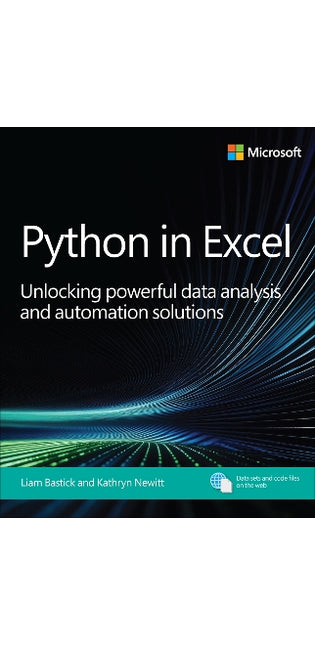
Python in Excel
Seasoned Experts Liam Bastick and Kathryn Newitt unveil a groundbreaking guide to mastering data analysis and automation with Python in Excel Python in Excel: Unlocking powerful data analysis and automation solutions is a hands-on, practical guide that leverages the authors’ decades of expertise to teach readers how to harness the newly integrated Python capabilities within Microsoft Excel, mapping familiar Excel concepts to Python foundations. Covering essential topics such as Python syntax, data structures, data analysis with pandas, visualization, and the use of AI tools like Copilot, the book empowers professionals to elevate their data analysis and automation skills. Readers will gain the ability to perform advanced forecasting, build predictive models, and streamline workflows, making them more efficient and competitive in today’s data-driven workplace. By reading this book, you will: Understand the fundamentals of Python programming directly within ExcelMap your existing Excel skills to Python concepts for easier learningAutomate repetitive tasks and workflows Analyze and visualize data with powerfulPython libraries like pandas Build advanced forecasting and predictive models without leaving ExcelExplore and manipulate data efficiently using Python’s concise syntaxIntegrate AI tools such as Copilot to assist with coding and analysisConnect Excel with external data sources using Python and Power QueryDevelop custom solutions for business modeling and data scienceCreate a roadmap for further study and mastery of Python in Excel
R 2,083.00