Search results for "Alan Butler"
Items in stock - 4 working days delivery time

The idea of the ANC
The African National Congress (ANC) has established itself as Africa’s most famous liberation movement. The year 2012 is an important year in the history of the African National Congress’ organisational, political and ideological development and growth. It marks 100 years of the ANC’s existence; a milestone that has prompted partisans to a century of unparalleled achievement in the struggle against colonialism and racial discrimination and the year of the 53rd National Conference in Mangaung. It is, though, a liberation whose critics have painted a less-flattering portrait of the historical ANC, as a communist puppet, a moribund dinosaur, or an elitist political parasite. For such sceptics, the ANC – now in government for two decades – has betrayed South Africans rather than liberated them. The politics of the ANC, and those of the country it governs, are today tumultuous. South Africans endure deep inequality and unemployment, violent community protests, murders of foreign residents, major policy blunders, an AIDS crisis, and deepening corruption. Inside the ANC there are episodes of open rebellion against the leadership, conflicts over the character of a post-liberation movement, and debilitating battles for succession to the movement’s presidency. The Idea of the ANC explores how ANC intellectuals and leaders interpret the historical project of their movement. It investigates three interlocked ideas: a conception of power, a responsibility for promoting unity, and a commitment to human liberation. It explores how these notions have shaped South African politics in the past, and how they will inform ANC leaders’ responses to the challenges of the future.
R 202.00

Items we need to order for you
R 367.00
R 1,433.00
Sheltered Housing for the Elderly
In the early-1980s, the ten million people of retirement age in the UK figured prominently among the disadvantaged and deprived. They were heavily over-represented in sub-standard housing and among those in most need of support from the personal social services.One form of social provision which gained rapidly in popularity in the 1960s and 1970s was sheltered housing. It was seen to combine housing with care; provided support while fostering independence; and gave scope for flexibility and experimentation in adapting schemes to local circumstances. By the late 1970s hundreds of schemes were administered, and they were occupied by half a million elderly tenants. Sheltered housing was called ‘the greatest breakthrough in the housing scene since the war’. Extravagant expectations were aroused, and sheltered housing was regarded by some as the solution to all manner of complex problems.Taking the country as a whole, however, relatively little was known about the numbers of schemes and where they were located; who owned them and how they were managed; the aims and assumptions of those who provided or advocated sheltered housing; how the schemes functioned and whether they achieved what they were set up to do; the role, experience and attitudes of wardens; what kinds of people lived in sheltered housing, their history, and how they became tenants; their assessment of the scheme; and much else.The Leeds study, on which this book is based, originally published in 1983, was the most comprehensive and detailed to have been conducted into sheltered housing. It evoked widespread interest in Britain and abroad at the time. It sought to answer some of the important questions about the growth and proliferation of sheltered housing, to evaluate sheltered housing from different points of view – including those of tenants, and to consider the scope for future development.While sheltered housing is the focal topic of the book it should be viewed in the broader context of social policy, administration, professional practice and client experience. The book describes in detail an innovatory and evolving form of social provision and, in doing so, illuminates the operation and impact of policy in action at several levels – from the policy-maker to the consumer, from the organisation of policy to its object.There was significant evidence from the study that many tenants were provided with a service which was not the one they sought, or even needed, but they were given what the agency happened to have – or made – available. Among other topics, the book examines sheltered housing as a response to, or reflection of, myths and prejudices about ageing. It discusses whether elderly people should be compelled to move from familiar surroundings late in life – and how they cope when they do move. The usefulness or otherwise of alarm systems is assessed – with conclusions that throw considerable doubt on their value or reliability. The evolution and modifications taking place in
R 6,662.39
R 367.00
R 367.00
Goddess, the Grail and the Lodge
Revealing the origins of the grail in Goddess religion, this title shows its continuance through Christianity down to modern times, with devotees of the Goddess still at work in the world today. It explains why it was adopted and used, how it existed on different levels to different people and shows what Grail Knowledge really was and is.
R 416.00
Sheltered Housing for the Elderly
In the early-1980s, the ten million people of retirement age in the UK figured prominently among the disadvantaged and deprived. They were heavily over-represented in sub-standard housing and among those in most need of support from the personal social services.One form of social provision which gained rapidly in popularity in the 1960s and 1970s was sheltered housing. It was seen to combine housing with care; provided support while fostering independence; and gave scope for flexibility and experimentation in adapting schemes to local circumstances. By the late 1970s hundreds of schemes were administered, and they were occupied by half a million elderly tenants. Sheltered housing was called ‘the greatest breakthrough in the housing scene since the war’. Extravagant expectations were aroused, and sheltered housing was regarded by some as the solution to all manner of complex problems.Taking the country as a whole, however, relatively little was known about the numbers of schemes and where they were located; who owned them and how they were managed; the aims and assumptions of those who provided or advocated sheltered housing; how the schemes functioned and whether they achieved what they were set up to do; the role, experience and attitudes of wardens; what kinds of people lived in sheltered housing, their history, and how they became tenants; their assessment of the scheme; and much else.The Leeds study, on which this book is based, originally published in 1983, was the most comprehensive and detailed to have been conducted into sheltered housing. It evoked widespread interest in Britain and abroad at the time. It sought to answer some of the important questions about the growth and proliferation of sheltered housing, to evaluate sheltered housing from different points of view – including those of tenants, and to consider the scope for future development.While sheltered housing is the focal topic of the book it should be viewed in the broader context of social policy, administration, professional practice and client experience. The book describes in detail an innovatory and evolving form of social provision and, in doing so, illuminates the operation and impact of policy in action at several levels – from the policy-maker to the consumer, from the organisation of policy to its object.There was significant evidence from the study that many tenants were provided with a service which was not the one they sought, or even needed, but they were given what the agency happened to have – or made – available. Among other topics, the book examines sheltered housing as a response to, or reflection of, myths and prejudices about ageing. It discusses whether elderly people should be compelled to move from familiar surroundings late in life – and how they cope when they do move. The usefulness or otherwise of alarm systems is assessed – with conclusions that throw considerable doubt on their value or reliability. The evolution and modifications taking place in
R 2,000.90
R 275.00
Not Just Batman's Butler
In January 1966, Alan Napier became a household name on ABC's hit series Batman (1966-1968) as Alfred Pennyworth, loyal butler to the show's title character. This ""overnight success"" came after 16 years of stage work (and the occasional film) in his native England. He followed his signature role with another 26 years of film and television work (and the occasional play) in the United States.In the early 1970s, Napier wrote an autobiography, detailing his childhood as a ""poor relation"" of Birmingham's famous political family the Chamberlains (Prime Minister Neville Chamberlain was a cousin), and his collaborations over the years with the likes of John Gielgud, Laurence Olivier, George Bernard Shaw, Noel Coward, Fritz Lang, Otto Preminger and Alfred Hitchcock. Almost 30 years after Napier's death, James Bigwood, who first met the actor in 1975 when interviewing him for a ""Films in Review"" profile, discovered the unpublished manuscript. This is Napier's story in his own words, annotated and updated, with dozens of rare photographs.
R 1,176.00
Ageing
Originally published in 1985, Ageing: Recent Advances and Creative Responses contains a selection of the papers contributed to the British Society of Gerontology Annual Conference, held in Leeds in September 1984. The book examines some of the positive and innovative multi-disciplinary work which is going on in the field of human ageing, placing particular emphasis on issues such as: the use of leisure in later life; association and friendship; innovations in the funding of services; the political and social views of older people themselves; the importance of an adequate income and appropriate housing; the psychologist’s role in prevention and early detection of disorders, and work in the community.The book will be of value to all academics, policy makers and practitioners with an interest in human ageing and later life, the health and social difficulties encountered by this age group, and the positive responses that can be made by both the providers of services and the elderly themselves.
R 2,054.10
Four British Fantasists
Four British Fantasists explores the work of four of the most successful and influential fantasy writers of the generation who rose to prominence in the "second Golden Age" of children's literature in Britain: Susan Cooper, Alan Garner, Diana Wynne Jones, and Penelope Lively. Drawing on history, archeology, social geography, anthropology, and postcolonial theory, as well as literary criticism, Butler provides a series of new perspectives through which to view these writers' achievements. He begins by highlighting some points of biographic coincidence (e.g. all four authors were children during WWII, all were born within a year or two of each other, and all attended Oxford University in the early 1950s—when C. S. Lewis and J. R. R. Tolkien were publishing their seminal fantasies) and questions if these factors play any significant role in the development of these fantasy writers. The author then uses this question as the springboard for a case study in the assessment of biographical and literary influence. The book also considers the role played by Britain itself in determining the shape and preoccupations of these writers' fiction. Britain is a land with a long history in which contemporary life is constantly juxtaposed with evidence of the past in the form of ancient buildings, historic sites, and archeological remains. By placing the work of Cooper, Garner, Jones, and Lively in the context of British culture and of their own time, Butler provides a key to their fascination with history, mythology, and magic, and to the ways in which that fascination has found expression in their fiction. Students of children's literature and of fantasy literature as well as readers who are interested in the lives of these four subject authors will find this an insightful read.
R 3,296.00
Complexity Thinking in Physical Education
In the past two decades, complexity thinking has emerged as an important theoretical response to the limitations of orthodox ways of understanding educational phenomena. Complexity provides ways of understanding that embrace uncertainty, non-linearity and the inevitable ‘messiness’ that is inherent in educational settings, paying attention to the ways in which the whole is greater than the sum of its parts. This is the first book to focus on complexity thinking in the context of physical education, enabling fresh ways of thinking about research, teaching, curriculum and learning.Written by a team of leading international physical education scholars, the book highlights how the considerable theoretical promise of complexity can be reflected in the actual policies, pedagogies and practices of physical education (PE). It encourages teachers, educators and researchers to embrace notions of learning that are more organic and emergent, to allow the inherent complexity of pedagogical work in PE to be examined more broadly and inclusively. In doing so, Complexity Thinking in Physical Education makes a major contribution to our understanding of pedagogy, curriculum design and development, human movement and educational practice.
R 9,311.15
Complexity Thinking in Physical Education
In the past two decades, complexity thinking has emerged as an important theoretical response to the limitations of orthodox ways of understanding educational phenomena. Complexity provides ways of understanding that embrace uncertainty, non-linearity and the inevitable ‘messiness’ that is inherent in educational settings, paying attention to the ways in which the whole is greater than the sum of its parts. This is the first book to focus on complexity thinking in the context of physical education, enabling fresh ways of thinking about research, teaching, curriculum and learning.Written by a team of leading international physical education scholars, the book highlights how the considerable theoretical promise of complexity can be reflected in the actual policies, pedagogies and practices of physical education. It encourages teachers, educators and researchers to embrace notions of learning that are more organic and emergent, to allow the inherent complexity of pedagogical work in PE to be examined more broadly and inclusively. In doing so, Complexity Thinking in Physical Education makes a major contribution to our understanding of pedagogy, curriculum design and development, human movement and educational practice.
R 2,555.54
R 274.00
R 611.00
R 469.00
R 626.00
R 1,023.72
R 305.00
R 397.00
R 611.00
R 593.00
R 813.00
R 1,366.63
Suit
19 year old Frank Slater is a debt collector in the Hulme area of Manchester, England. It's 1959 and rock and roll is the thing. Frank has just bought a new suit, paid for by ill-gotten gains. This is the story of the suit's first outing and what happens to it, what is spilt on it, and the awful characters it comes across in Frank's quest to collect GBP200.00 from a small time gangster. No suit should ever be treated this way. Strong language and violence throughout.
R 567.00
Idea of the ANC
The African National Congress (ANC) is Africa’s most famous liberation movement. It has recently celebrated its centenary, a milestone that has prompted partisans to detail a century of unparalleled achievement in the struggle against colonialism and racial discrimination. Critics paint a less flattering portrait of the historical ANC as a communist puppet, a moribund dinosaur, or an elitist political parasite. For such skeptics, the ANC—now in government for two decades—has betrayed South Africans rather than liberating them.South Africans endure deep inequality and unemployment, violent community protests, murders of foreign residents, major policy blunders, an AIDS crisis, and deepening corruption. Inside the ANC there are episodes of open rebellion against the leadership, conflicts over the character of a postliberation movement, and debilitating battles for succession to the movement’s presidency. The ANC is nevertheless likely to remain the party of government for the foreseeable future.This remarkable book explores how ANC intellectuals and leaders interpret the historical project of their movement. It investigates three interlocking ideas: a conception of power, a responsibility for promoting unity, and a commitment to human liberation. Anthony Butler explores how these notions have shaped South African politics in the past and how they will inform ANC leaders’ responses to the challenges of the future.
R 520.00
R 1,401.76
R 536.00
R 1,303.00
R 456.00
R 397.00
R 994.00
Guardians of Life
A collection of short memoirs and essays about the author's summer job as a lifeguard. The stories illustrate how a simple task, like watching a pool, can quickly escalate into all sorts of crazy events ranging from girls to explosions and everything in between.
R 423.00
R 975.88
R 1,316.71
R 501.09
R 458.00
R 1,334.22
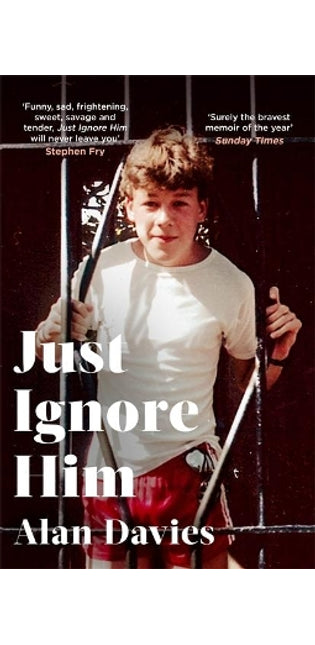
Just Ignore Him
'A simply astonishing achievement. The quality, depth, emotional power and terrifying honesty of Alan Davies's story-telling take the breath away' Stephen Fry'This hugely affecting book is brave, insightful and, at times, funny about things it is hard to be funny about' Jo BrandThe story of a life built on sand. In the rain.In this compelling memoir, comedian and actor Alan Davies recalls his boyhood with vivid insight and devastating humour. Shifting between his 1970s upbringing and his life today, Davies moves poignantly from innocence to experience to the clarity of hindsight, always with a keen sense of the absurd.From sibling dynamics, to his voiceless, misunderstood progression through school, sexuality and humiliating 'accidents', Davies inhabits his younger mind with spectacular accuracy, sharply evoking an era when Green Shield Stamps, Bob-a-Job week and Whizzer & Chips loomed large, a bus fare was 2p - and children had little power in the face of adult motivation. Here, there are often exquisitely tender recollections of the mother he lost at six years old, of a bereaved family struggling to find its way, and the kicks and confusion of adolescence.Through even the joyous and innocent memories, the pain of Davies's lifelong grief and profound betrayal is unfiltered, searing and beautifully articulated. Just Ignore Him is not only an autobiography, it is a testament to a survivor's resilience and courage.
R 408.00