Search results for "Alan Perry"
Items we need to order for you

R 611.00
R 833.30
R 985.00
R 968.76
Stranglers Then & Now
Previously unpublished photos of The Stranglers from 1977 to the present day with Baz Warne and Jim Macaulay. This full colour 128-page A4 book includes photos from several locations including the Locarno Ballroom, Coventry; the notorious Battersea Park concert; Wembley Stadium as support to The Who; Reading Festival; Leamington and Birmingham.
R 773.00
R 1,773.00
R 602.88
R 607.60
R 435.81
R 405.00
R 396.00
R 1,710.00
R 305.00
R 580.00
R 752.00
R 611.00
Land Where Blues Began
Winner of a National Book Critics Circle award, a rollicking and unforgettable memoir by the man who helped bring the music of the blues into the mainstream“Without Lomax it’s possible that there would have been no blues explosion, no R&B movement, no Beatles and no Stones and no Velvet Underground.” —Brian EnoA self-described “song-hunter,” the folklorist Alan Lomax traveled the Mississippi Delta in the 1930s and ’40s, armed with primitive recording equipment and a keen love of the Delta’s music heritage. Crisscrossing the towns and hamlets where the blues began, Lomax gave voice to such greats as Leadbelly, Fred MacDowell, Muddy Waters, and many others, all of whom made their debut recordings with him.The Land Where the Blues Began is both a fascinating recollection of a pivotal time in American music history and an intimate portrait of the struggles blues musicians faced in the Jim Crow South. The blues were an organic expression of Black humanity in a place where slavery had been outlawed but where segregation, violence, and racial inequality were still the law of the land. Lomax’s role as a liaison to white America, relating the emotion and musical virtuosity displayed by those musicians, would change American popular music forever. Through candid conversations with bluesmen and vivid, firsthand accounts of the landscape where their music was born, Lomax’s “discerning reconstructions . . . give life to a domain most of us can never know . . . one that summons us with an oddly familiar sensation of reverence and dread” (The New York Times Book Review).Artistic expression has always been a way for oppressed peoples to speak truth to power, assert their dignity, and simply live in a world rife with injustice. The Land Where the Blues Began is an enthralling chronicle of the journey to bring this irrepressible art out of the Delta where it began and into the ears of every American.
R 1,384.00
Taskers End
If there is a thin divide between brilliance and madness, who is to judge our sanity? Alan Reynolds follows up the five-star rated Flying with Kites with a gripping psychological thriller, Taskers End. The story opens with three criminal psychiatrists reviewing the case-notes and background history of Gerald Perry, a wealthy former forensic science student and diagnosed schizophrenic. We learn about his tragic up-bringing and the incident that lead to him being interned to a mental institution indefinitely. When the decision is eventually made to release him, Gerald assumes a new identity and returns to his family home, Taskers End where he had been brought up by his beloved grand-parents. He soon discovers that in his absence they had died in mysterious circumstances and, using his forensic skills, starts his own investigation with devastating consequences. Then there is the beautiful Maureen...For everyone who becomes involved with Gerald Perry life will never be the same again.
R 753.14
Dark Theatre
The Dark Theatre is an indispensable text for activist communities wondering what theatre might have to do with their futures, students and scholars across Theatre and Performance Studies, Urban Studies, Cultural Studies, Political Economy and Social Ecology.The Dark Theatre returns to the bankrupted warehouse in Hope (Sufferance) Wharf in London’s Docklands where Alan Read worked through the 1980s to identify a four-decade interregnum of ‘cultural cruelty’ wreaked by financialisation, austerity and communicative capitalism. Between the OPEC Oil Embargo and the first screening of The Family in 1974, to the United Nations report on UK poverty and the fire at Grenfell Tower in 2017, this volume becomes a book about loss.In the harsh light of such loss is there an alternative to the market that profits from peddling ‘well-being’ and pushes prescriptions for ‘self-help’, any role for the arts that is not an apologia for injustice? What if culture were not the solution but the problem when it comes to the mitigation of grief? Creativity not the remedy but the symptom of a structural malaise called inequality? Read suggests performance is no longer a political panacea for the precarious subject but a loss adjustor measuring damages suffered, compensations due, wrongs that demand to be put right. These field notes from a fire sale are a call for angry arts of advocacy representing those abandoned as the detritus of cultural authority, second-order victims whose crime is to have appealed for help from those looking on, audiences of sorts.
R 2,412.94
Not Just Batman's Butler
In January 1966, Alan Napier became a household name on ABC's hit series Batman (1966-1968) as Alfred Pennyworth, loyal butler to the show's title character. This ""overnight success"" came after 16 years of stage work (and the occasional film) in his native England. He followed his signature role with another 26 years of film and television work (and the occasional play) in the United States.In the early 1970s, Napier wrote an autobiography, detailing his childhood as a ""poor relation"" of Birmingham's famous political family the Chamberlains (Prime Minister Neville Chamberlain was a cousin), and his collaborations over the years with the likes of John Gielgud, Laurence Olivier, George Bernard Shaw, Noel Coward, Fritz Lang, Otto Preminger and Alfred Hitchcock. Almost 30 years after Napier's death, James Bigwood, who first met the actor in 1975 when interviewing him for a ""Films in Review"" profile, discovered the unpublished manuscript. This is Napier's story in his own words, annotated and updated, with dozens of rare photographs.
R 1,176.00
Codpieces
'To be or not to be?' may be The Question, but it is not the only one. Hamlet, Part II, for example, answers a question about Hamlet that has plagued scholars, readers and play-goers for over four hundred years: What happened next? Prince Lear tackles yet another conundrum: What happened just before the start of King Lear, setting in motion the improbable events of Act I, scene 1? And in Fatal Loins, the question answered by the play is directly posed in the prologue: 'If Juliet and Romeo survive / Will their eternal passion stay alive?'“I am no stranger to Shakespearean parody… but reading Pontac I am (only slightly) mortified to find that he can write cod Shakespeare much better than Peter Cook, Jonathan Miller, Dudley Moore or myself” – Alan Bennett, from the foreword
R 457.00
Powsels and Thrums
‘I salute him with the most heartfelt respect and admiration’ PHILIP PULLMAN ‘Entrancing … a creative manifesto’ TELEGRAPH ‘Mesmerising … vibrating with life and curiosity’ OBSERVER In this lyrical and revelatory memoir, Alan Garner, Booker shortlisted author of Treacle Walker, traces the line of his life: from a working-class childhood in the landscape of Cheshire during World War II, through a grammar school education and on to the University of Oxford, and then home to see if he could become what he most desired: a writer. We see the serendipitous moments that drove his course, from coming-of-age in a period of great cultural change, to crossing paths with a famous mathematician while out long-distance running, to the fateful day he chanced across Blackden, the medieval hall, miraculously located next to the giant telescope at Jodrell Bank, that was to become his lasting home and the setting for Treacle Walker. As Garner tells us, a lifetime of working with a pen produces the powsels and thrums of research, imagination and story. These oddments can be shaped into something more than its parts: a vivid tapestry of a creative life that will inspire any reader, and what a celebration it is. ‘Advice is practical as well as profound … Garner is a magus. Read him’ Guardian ‘Offers a remarkable window into Garner’s mind and heart … Garner’s prose is as clear as glass’ Spectator ‘A creative manifesto … We are all the richer for it’ Byline Times
R 309.00
Craft of Piano Playing
In The Craft of Piano Playing, master pianist Alan Fraser offers readers an original and comprehensive approach to piano technique, offering over 100 illustrations and a series of unique exercises to guide the reader. Drawing on his many years as a performer and teacher, his long-standing collaborations with pedagogue Phil Cohen and virtuoso Kemal Gekich, and his professional training in the Feldenkrais Method, Fraser introduces his truly innovative piano technique by• Teaching how to move your hands with greater sensitivity, power, and accuracy, and honing the skeletal alignments to help you access your innate, structural potency;• Linking your physical technique to musical expression, creating an "absolutely natural way of moving at the piano that is powerful, flexible, and musical" (Piano News, Germany); and• Keeping your hands healthy while avoiding the threats of tendonitis, carpal tunnel syndrome, focal dystonia, and RSI. This revised second edition joins the DVD of the same name, his study guide, and his latest book, Honing the Pianistic Self-Image, in Alan Fraser's growing line of piano pedagogical materials. This edition includes new chapters, such as "Arm Rhythm" and "The Body's Support of Natural Finger Shape," updated material reflecting evolutions in Fraser's technical and pedagogical thinking, a "cleaner and leaner" literary style, and more extensive, better-organized tables of contents, with cross-references to corresponding chapters in the DVD.For more information please visit www.maplegroveproductions.com, www.craftofpiano.com, or www.alanfraser.net
R 2,929.00
Creating Health Behavior Change
I have no doubt that this book will be extremely useful to folk involved in programmes that aim to improve health outcomes of children and adolescents. It′s brevity, among other factors, ensures that most people who buy, borrow or steal the book will actually fulfil an intention of reading it cover-to-cover! --Alan J. Fisher, University of Cape Town Journal of Child and Adolescent Mental Health The purpose of this book is to provide a process for the development of effective community-wide health behavior programs for children and adolescents. Significant behavior change among young people across a variety of behaviors and community-based research studies has been achieved through programs that have been created based on this 10-step process. These steps will be discussed in four primary stages: preparing for program development; determining the program components; creating the health behavior program; and implementing and maintaining a program. The intent, then, of this book is to provide steps for developing programs that will lead to meaningful change in improving the health behaviors of young people in our communities, in the broader context of improving physical, psychological, social, and spiritual well-being.
R 7,054.35
Craft of Piano Playing
In The Craft of Piano Playing, master pianist Alan Fraser offers readers an original and comprehensive approach to piano technique, offering over 100 illustrations and a series of unique exercises to guide the reader. Drawing on his many years as a performer and teacher, his long-standing collaborations with pedagogue Phil Cohen and virtuoso Kemal Gekich, and his professional training in the Feldenkrais Method, Fraser introduces his truly innovative piano technique by• Teaching how to move your hands with greater sensitivity, power, and accuracy, and honing the skeletal alignments to help you access your innate, structural potency;• Linking your physical technique to musical expression, creating an "absolutely natural way of moving at the piano that is powerful, flexible, and musical" (Piano News, Germany); and• Keeping your hands healthy while avoiding the threats of tendonitis, carpal tunnel syndrome, focal dystonia, and RSI. This revised second edition joins the DVD of the same name, his study guide, and his latest book, Honing the Pianistic Self-Image, in Alan Fraser's growing line of piano pedagogical materials. This edition includes new chapters, such as "Arm Rhythm" and "The Body's Support of Natural Finger Shape," updated material reflecting evolutions in Fraser's technical and pedagogical thinking, a "cleaner and leaner" literary style, and more extensive, better-organized tables of contents, with cross-references to corresponding chapters in the DVD.For more information please visit www.maplegroveproductions.com, www.craftofpiano.com, or www.alanfraser.net
R 4,396.00
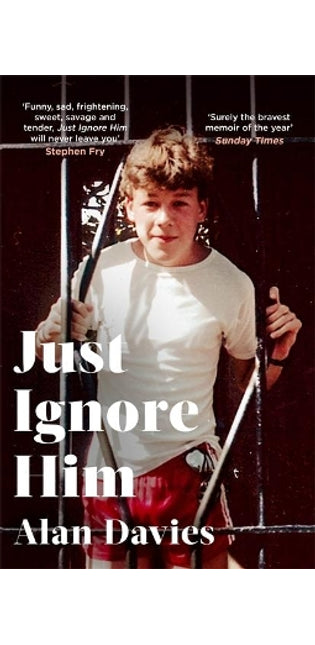
Just Ignore Him
'A simply astonishing achievement. The quality, depth, emotional power and terrifying honesty of Alan Davies's story-telling take the breath away' Stephen Fry'This hugely affecting book is brave, insightful and, at times, funny about things it is hard to be funny about' Jo BrandThe story of a life built on sand. In the rain.In this compelling memoir, comedian and actor Alan Davies recalls his boyhood with vivid insight and devastating humour. Shifting between his 1970s upbringing and his life today, Davies moves poignantly from innocence to experience to the clarity of hindsight, always with a keen sense of the absurd.From sibling dynamics, to his voiceless, misunderstood progression through school, sexuality and humiliating 'accidents', Davies inhabits his younger mind with spectacular accuracy, sharply evoking an era when Green Shield Stamps, Bob-a-Job week and Whizzer & Chips loomed large, a bus fare was 2p - and children had little power in the face of adult motivation. Here, there are often exquisitely tender recollections of the mother he lost at six years old, of a bereaved family struggling to find its way, and the kicks and confusion of adolescence.Through even the joyous and innocent memories, the pain of Davies's lifelong grief and profound betrayal is unfiltered, searing and beautifully articulated. Just Ignore Him is not only an autobiography, it is a testament to a survivor's resilience and courage.
R 402.00
Long and Winding Road
Winner of the Parliamentary Book Award, best memoir by a Parliamentarian, 2016From the condemned slums of Southam Street in West London to the corridors of power in Westminster, Alan Johnson’s multi-award-winning autobiography charts an extraordinary journey, almost unimaginable in today’s Britain. This third volume tells of Alan’s early political skirmishes as a trades union leader, where his negotiating skills and charismatic style soon came to the notice of Tony Blair and other senior members of the Labour Party.As a result, Alan was chosen to stand in the constituency of Hull West and Hessle, and entered Parliament as an MP after the landslide election victory for Labour in May 1997. But this is no self-aggrandizing memoir of Westminster politicking and skulduggery. Supporting the struggle of his constituents, the Hull trawlermen and their families, for justice comes more naturally to Alan than do the byzantine complexities of Parliamentary procedure. But of course he does succeed there, and rises through various ministerial positions to the office of Home Secretary in 2009.In The Long and Winding Road, Alan’s characteristic honesty and authenticity shine through every word. His book takes you into a world which is at once familiar and strange: this is politics as you’ve never seen it before…
R 402.00
R 396.00
R 1,223.29
Where Shall We Run To?
A NEW STATESMAN BOOK OF THE YEAR From one of our greatest living writers, comes a remarkable memoir of a forgotten England. 'The war went. We sang in the playground, "Bikini lagoon, an atom bomb’s boom, and two big explosions." David’s father came back from Burma and didn’t eat rice. Twiggy taught by reciting “The Pied Piper of Hamelin”, “The Charge of the Light Brigade” and the thirteen times table. Twiggy was fat and short and he shouted, and his neck was as wide as his head. He was a bully, though he didn’t take any notice of me.’ In Where Shall We Run To?, Alan Garner remembers his early childhood in the Cheshire village of Alderley Edge: life at the village school as ‘a sissy and a mardy-arse'; pushing his friend Harold into a clump of nettles to test the truth of dock leaves; his father joining the army to guard the family against Hitler; the coming of the Yanks, with their comics and sweets and chewing gum. From one of our greatest living writers, it is a remarkable and evocative memoir of a vanished England.
R 309.00
R 397.00
R 2,156.71
R 788.82
Herbert Sutcliffe
A national hero in his playing days, Herbert Sutcliffe belongs to a select band of all-time cricketing greats. Alan Hill’s award-winning biography of the Yorkshire and England batsman charts his extraordinary transformation from cobbler’s apprentice to urbane gentleman: one of the coolest, most determined and technically accomplished practitioners the game has ever known.Blessed with the looks of a matinee idol, Sutcliffe was a complex, often enigmatic, personality. As a cricketer, he was touched with genius. His career spanned exactly the years between the wars and he performed with distinction in every one of those seasons. He scored 50,138 first-class runs, including 149 centuries, and his remarkable Test average of 60.73 is the highest for an English batsman – higher than those of Hobbs, Hammond or Hutton.Herbert Sutcliffe: Cricket Maestro calls upon the reminiscences of Bob Wyatt, Sir Donald Bradman, Sir Len Hutton and Les Ames among other illustrious contemporaries, to evoke the splendour of Sutcliffe’s achievements for Yorkshire and England, and to bring to life the vivacious story of one of the greatest batsmen ever.
R 495.00
R 688.25
Lady in the Van
Alan Bennett is the author of Writing Home, The Madness of George III, Talking Heads, The Clothes They Stood Up In and much else besides. Miss Shepherd lived in a Robin Reliant opposite Bennett's house in Camden Town. After a series of attacks on her van, he suggested she move, with her van, to his front drive. Initially reluctant, she agreed - and Bennett landed himself a tenancy that went on for fifteen years. The Lady in the Van is probably Alan Bennett's best-known work of non-fiction, and follows his other little blockbuster The Clothes They Stood Up In.
R 186.00
Murder on the Serpentine (Thomas Pitt Mystery, Book 32)
The queen of the Victorian mystery, New York Times bestseller Anne Perry returns with the 32nd novel in the Inspector Pitt series MURDER ON THE SERPENTINE. Pitt is on a secret mission for the Queen, maybe his last...London, 1899: Head of Special Branch Commander Thomas Pitt is summoned to Buckingham Palace. In the twilight of her years, Queen Victoria is all too aware that the Prince of Wales will soon inherit her empire and must be beyond reproach. She tells Pitt she tasked her close friend and confidante, John Halberd, with investigating the Prince's friends, specifically Alan Kendrick, a wealthy playboy and betting man, but before he could report back, Halberd was found dead in a rowing boat on the Serpentine. The death has been ruled an unfortunate accident and the investigation closed, but the Queen is not convinced that all is as it seems and tasks Pitt with finding the truth. Forced to act alone in this most sensitive of investigations, Pitt finds himself embroiled in a plot that threatens not only the reputations of men, but also the safety and reputation of the Empire. . .
R 340.00
R 1,115.37
Franz Liszt
The third volume in Alan Walker's magisterial biography of Franz Liszt."You can't help but keep turning the pages, wondering how it will all turn out: and Walker's accumulated readings of Liszt's music have to be taken seriously indeed."—D. Kern Holoman, New York Review of Books"A conscientious scholar passionate about his subject. Mr. Walker makes the man and his age come to life. These three volumes will be the definitive work to which all subsequent Liszt biographies will aspire."—Harold C. Schonberg, Wall Street Journal"What distinguishes Walker from Liszt's dozens of earlier biographers is that he is equally strong on the music and the life. A formidable musicologist with a lively polemical style, he discusses the composer's works with greater understanding and clarity than any previous biographer. And whereas many have recycled the same erroneous, often damaging information, Walker has relied on his own prodigious, globe-trotting research, a project spanning twenty-five years. The result is a textured portrait of Liszt and his times without rival."—Elliot Ravetz, Time"The prose is so lively that the reader is often swept along by the narrative. . . . This three-part work . . . is now the definitive work on Liszt in English and belongs in all music collections."—Library Journal
R 961.00
Reclaiming the Magician
There are several worlds of magic. The glittering world of the illusionist; the flippant world of the conjuror and the world of the 'real magician' manifesting change, summoning supernatural entities - the stuff of stories and legend. The truth is that Magic is Real and Magicians do work to understand their relationship with themselves, others and the Cosmos. This book is an attempt to reclaim the magician by recognising the role he or she plays and the wisdom to which they aspire. It is a brief journey through the worlds of psychology, science and ritual. It will set those seeking mystical 'truths' for the first time and offer food for thought to the established occult practitioner. This book explores aspects of psychology, physics, occult philosophy and offers practical steps and ideas for starting or continuing your own journey into the world of the real magician. Make magick relevant by reclaiming the Magician. Believe Everything and Believe Nothing Find the Magician Within
R 634.07
Truth Through Proof
Truth Through Proof defends an anti-platonist philosophy of mathematics derived from game formalism. Classic formalists claimed implausibly that mathematical utterances are truth-valueless moves in a game. Alan Weir aims to develop a more satisfactory successor to game formalism utilising a widely accepted, broadly neo-Fregean framework, in which the proposition expressed by an utterance is a function of both sense and background circumstance. This frameworkallows for sentences whose truth-conditions are not representational, which are made true or false by conditions residing in the circumstances of utterances but not transparently in the sense. Applications to projectivism and fiction pave the way for the claim that mathematical utterances are made true or false by the existence of concrete proofs or refutations, though these truth-making conditions form no part of their sense or informational content. The position is compared with rivals, an account of the applicability of mathematics developed, and a new account of the nature of idealisation proffered in which it is argued that the finitistic limitations Gödel placed on proofs are without rational justification. Finally a non-classical logical system is provided in which excluded middle fails, yet enough logical power remains to recapture the results of standard mathematics.
R 4,641.00
Franz Liszt
The third volume in Alan Walker's magisterial biography of Franz Liszt."You can't help but keep turning the pages, wondering how it will all turn out: and Walker's accumulated readings of Liszt's music have to be taken seriously indeed."—D. Kern Holoman, New York Review of Books"A conscientious scholar passionate about his subject. Mr. Walker makes the man and his age come to life. These three volumes will be the definitive work to which all subsequent Liszt biographies will aspire."—Harold C. Schonberg, Wall Street Journal"What distinguishes Walker from Liszt's dozens of earlier biographers is that he is equally strong on the music and the life. A formidable musicologist with a lively polemical style, he discusses the composer's works with greater understanding and clarity than any previous biographer. And whereas many have recycled the same erroneous, often damaging information, Walker has relied on his own prodigious, globe-trotting research, a project spanning twenty-five years. The result is a textured portrait of Liszt and his times without rival."—Elliot Ravetz, Time"The prose is so lively that the reader is often swept along by the narrative.... This three-part work... is now the definitive work on Liszt in English and belongs in all music collections."—Library Journal
R 683.00