



Search results for "Codings"
Items in stock - 4 working days delivery time

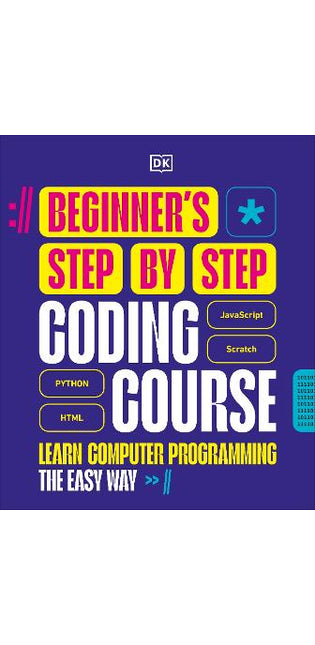
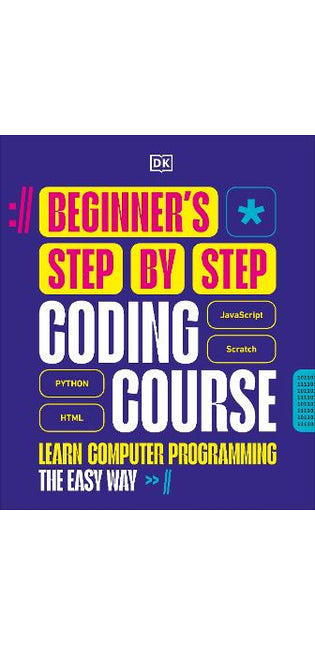
Beginner's Step-by-Step Coding Course
Learning to code has never been easier than with this innovative visual guide to computer programming for beginners.In our digital world, coding skills are in high demand and the need for programmers is still growing. Taking the first steps in learning to code may seem daunting but by using a graphic method to break code into small chunks, this book brings essential skills easily within reach.Each chapter explores one of the most popular languages, with practical programming projects to show you how programming works. You’ll learn to think like a programmer by breaking a problem down into parts, before turning those parts into lines of code. Short, easy-to-follow steps then show you, piece by piece, how to build a complete program. There are challenges for you to tackle to build your confidence before moving on.Written by a team of expert coders and coding teachers, the Beginner’s Step-by-Step Coding Course is the ideal way to get to grips with coding.
R 515.00
Coding For Dummies, All New Edition
Your first step toward thinking like a coder Coding For Dummies is one of the most popular get-started guides for new coders. This all- new edition demystifies essential coding concepts before diving into building simple apps in Python and JavaScript. For anyone brand-new to writing code, this book is an ideal first step, because you'll get an overview of how coding works, the essential tools of coding, and how to apply coding in different ways. Plus, you'll get insight into how new tools like AI can quickly boost your coding know-how. Enter the world of code with this easy-to-follow Dummies guide! Learn the basics of coding, including key concepts you'll need in every coding languageGet a rundown of the most popular language, and start coding in JavaScript and PythonFollow step-by-step instructions to build your first appsDiscover how AI can help you become a better, faster coder Looking for a foundation in the basics of coding, plus simple tasks to help you get started? Coding For Dummies is the book for you.
R 730.00

Items we need to order for you
R 606.51
Code
The classic guide to how computers work, updated with new chapters and interactive graphics "For me, Code was a revelation. It was the first book about programming that spoke to me. It started with a story, and it built up, layer by layer, analogy by analogy, until I understood not just the Code, but the System. Code is a book that is as much about Systems Thinking and abstractions as it is about code and programming. Code teaches us how many unseen layers there are between the computer systems that we as users look at every day and the magical silicon rocks that we infused with lightning and taught to think." - Scott Hanselman, Partner Program Director, Microsoft, and host of Hanselminutes Computers are everywhere, most obviously in our laptops and smartphones, but also our cars, televisions, microwave ovens, alarm clocks, robot vacuum cleaners, and other smart appliances. Have you ever wondered what goes on inside these devices to make our lives easier but occasionally more infuriating? For more than 20 years, readers have delighted in Charles Petzold's illuminating story of the secret inner life of computers, and now he has revised it for this new age of computing. Cleverly illustrated and easy to understand, this is the book that cracks the mystery. You'll discover what flashlights, black cats, seesaws, and the ride of Paul Revere can teach you about computing, and how human ingenuity and our compulsion to communicate have shaped every electronic device we use. This new expanded edition explores more deeply the bit-by-bit and gate-by-gate construction of the heart of every smart device, the central processing unit that combines the simplest of basic operations to perform the most complex of feats. Petzold’s companion website, CodeHiddenLanguage.com, uses animated graphics of key circuits in the book to make computers even easier to comprehend. In addition to substantially revised and updated content, new chapters include: Chapter 18: Let’s Build a Clock!Chapter 21: The Arithmetic Logic UnitChapter 22: Registers and BussesChapter 23: CPU Control SignalsChapter 24: Jumps, Loops, and CallsChapter 28: The World Brain From the simple ticking of clocks to the worldwide hum of the internet, Code reveals the essence of the digital revolution.
R 898.00
R 1,343.00
R 611.00
R 1,148.45
R 611.00
R 458.00
R 611.00
R 458.00
R 1,110.37
R 1,343.00
R 641.00
R 611.00
R 611.00
Introduction to Coding Theory
This book is designed to be usable as a textbook for an undergraduate course or for an advanced graduate course in coding theory as well as a reference for researchers in discrete mathematics, engineering and theoretical computer science. This second edition has three parts: an elementary introduction to coding, theory and applications of codes, and algebraic curves. The latter part presents a brief introduction to the theory of algebraic curves and its most important applications to coding theory.
R 2,879.13
R 554.01
R 762.00
R 803.17
R 458.00
Power of Patterns: Coding
Have you ever wondered how a GPS knows the fastest route to take? Or how a video game knows when to stop performing an action? The answer is coding. Discover the fundamentals for computer programming, such as conditional statements, looping, and debugging. Who knows? You might even want to create a computer program of your own! Developed by Timothy Rasinski and featuring TIME content, this high-interest book includes essential text features like an index, captions, glossary, and table of contents. The intriguing sidebars, detailed images, and in-depth Reader's Guide require students to connect back to the text and encourage multiple readings. The Think Link and Dig Deeper! sections develop students' higher-order thinking skills. The Check It Out! section includes suggested books, videos, and websites for further reading. Aligned with state standards, this title features complex and rigorous content appropriate for students preparing for college and career readiness.
R 428.00
First Course in Coding Theory
Algebraic coding theory is a new and rapidly developing subject, popular for its many practical applications and for its fascinatingly rich mathematical structure. This book provides an elementary yet rigorous introduction to the theory of error-correcting codes. Based on courses given by the author over several years to advanced undergraduates and first-year graduated students, this guide includes a large number of exercises, all with solutions, making the book highly suitable for individual study.
R 4,254.00
Introduction to Coding Theory
It is gratifying that this textbook is still sufficiently popular to warrant a third edition. I have used the opportunity to improve and enlarge the book. When the second edition was prepared, only two pages on algebraic geometry codes were added. These have now been removed and replaced by a relatively long chapter on this subject. Although it is still only an introduction, the chapter requires more mathematical background of the reader than the remainder of this book. One of the very interesting recent developments concerns binary codes defined by using codes over the alphabet 7l.4• There is so much interest in this area that a chapter on the essentials was added. Knowledge of this chapter will allow the reader to study recent literature on 7l. -codes. 4 Furthermore, some material has been added that appeared in my Springer Lec ture Notes 201, but was not included in earlier editions of this book, e. g. Generalized Reed-Solomon Codes and Generalized Reed-Muller Codes. In Chapter 2, a section on "Coding Gain" ( the engineer's justification for using error-correcting codes) was added. For the author, preparing this third edition was a most welcome return to mathematics after seven years of administration. For valuable discussions on the new material, I thank C.P.l.M.Baggen, I. M.Duursma, H.D.L.Hollmann, H. C. A. van Tilborg, and R. M. Wilson. A special word of thanks to R. A. Pellikaan for his assistance with Chapter 10.
R 3,298.48
Introduction to Coding Theory
It is gratifying that this textbook is still sufficiently popular to warrant a third edition. I have used the opportunity to improve and enlarge the book. When the second edition was prepared, only two pages on algebraic geometry codes were added. These have now been removed and replaced by a relatively long chapter on this subject. Although it is still only an introduction, the chapter requires more mathematical background of the reader than the remainder of this book. One of the very interesting recent developments concerns binary codes defined by using codes over the alphabet 7l.4• There is so much interest in this area that a chapter on the essentials was added. Knowledge of this chapter will allow the reader to study recent literature on 7l. -codes. 4 Furthermore, some material has been added that appeared in my Springer Lec ture Notes 201, but was not included in earlier editions of this book, e. g. Generalized Reed-Solomon Codes and Generalized Reed-Muller Codes. In Chapter 2, a section on "Coding Gain" ( the engineer's justification for using error-correcting codes) was added. For the author, preparing this third edition was a most welcome return to mathematics after seven years of administration. For valuable discussions on the new material, I thank C.P.l.M.Baggen, I. M.Duursma, H.D.L.Hollmann, H. C. A. van Tilborg, and R. M. Wilson. A special word of thanks to R. A. Pellikaan for his assistance with Chapter 10.
R 2,491.19
Foundations of Coding
Although devoted to constructions of good codes for error control, secrecy or data compression, the emphasis is on the first direction. Introduces a number of important classes of error-detecting and error-correcting codes as well as their decoding methods. Background material on modern algebra is presented where required. The role of error-correcting codes in modern cryptography is treated as are data compression and other topics related to information theory. The definition-theorem proof style used in mathematics texts is employed through the book but formalism is avoided wherever possible.
R 8,953.00
R 601.00
Introduction to Coding Theory
Error-correcting codes constitute one of the key ingredients in achieving the high degree of reliability required in modern data transmission and storage systems. This 2006 book introduces the reader to the theoretical foundations of error-correcting codes, with an emphasis on Reed-Solomon codes and their derivative codes. After reviewing linear codes and finite fields, the author describes Reed-Solomon codes and various decoding algorithms. Cyclic codes are presented, as are MDS codes, graph codes, and codes in the Lee metric. Concatenated, trellis, and convolutional codes are also discussed in detail. Homework exercises introduce additional concepts such as Reed-Muller codes, and burst error correction. The end-of-chapter notes often deal with algorithmic issues, such as the time complexity of computational problems. While mathematical rigor is maintained, the text is designed to be accessible to a broad readership, including students of computer science, electrical engineering, and mathematics, from senior-undergraduate to graduate level.
R 5,340.64
Coding Theory
Coding theory is concerned with successfully transmitting data through a noisy channel and correcting errors in corrupted messages. It is of central importance for many applications in computer science or engineering. This book gives a comprehensive introduction to coding theory whilst only assuming basic linear algebra. It contains a detailed and rigorous introduction to the theory of block codes and moves on to more advanced topics like BCH codes, Goppa codes and Sudan's algorithm for list decoding. The issues of bounds and decoding, essential to the design of good codes, features prominently. The authors of this book have, for several years, successfully taught a course on coding theory to students at the National University of Singapore. This book is based on their experiences and provides a thoroughly modern introduction to the subject. There are numerous examples and exercises, some of which introduce students to novel or more advanced material.
R 7,510.06
Coding Theory
Coding theory is concerned with successfully transmitting data through a noisy channel and correcting errors in corrupted messages. It is of central importance for many applications in computer science or engineering. This book gives a comprehensive introduction to coding theory whilst only assuming basic linear algebra. It contains a detailed and rigorous introduction to the theory of block codes and moves on to more advanced topics like BCH codes, Goppa codes and Sudan's algorithm for list decoding. The issues of bounds and decoding, essential to the design of good codes, features prominently. The authors of this book have, for several years, successfully taught a course on coding theory to students at the National University of Singapore. This book is based on their experiences and provides a thoroughly modern introduction to the subject. There are numerous examples and exercises, some of which introduce students to novel or more advanced material.
R 3,703.67
R 765.55
Essays on Coding Theory
Critical coding techniques have developed over the past few decades for data storage, retrieval and transmission systems, significantly mitigating costs for governments and corporations that maintain server systems containing large amounts of data. This book surveys the basic ideas of these coding techniques, which tend not to be covered in the graduate curricula, including pointers to further reading. Written in an informal style, it avoids detailed coverage of proofs, making it an ideal refresher or brief introduction for students and researchers in academia and industry who may not have the time to commit to understanding them deeply. Topics covered include fountain codes designed for large file downloads; LDPC and polar codes for error correction; network, rank metric, and subspace codes for the transmission of data through networks; post-quantum computing; and quantum error correction. Readers are assumed to have taken basic courses on algebraic coding and information theory.
R 2,724.45
Source and Channel Coding
oW should coded communication be approached? Is it about prob H ability theorems and bounds, or about algorithms and structures? The traditional course in information theory and coding teaches these together in one course in which the Shannon theory, a probabilistic the ory of information, dominates. The theory's predictions and bounds to performance are valuable to the coding engineer, but coding today is mostly about structures and algorithms and their size, speed and error performance. While coding has a theoretical basis, it has a practical side as well, an engineering side in which costs and benefits matter. It is safe to say that most of the recent advances in information theory and coding are in the engineering of coding. These thoughts motivate the present text book: A coded communication book based on methods and algorithms, with information theory in a necessary but supporting role. There has been muchrecent progress in coding, both inthe theory and the practice, and these pages report many new advances. Chapter 2 cov ers traditional source coding, but also the coding ofreal one-dimensional sources like speech and new techniques like vector quantization. Chapter 4 is a unified treatment of trellis codes, beginning with binary convolu tional codes and passing to the new trellis modulation codes.
R 4,678.54
Coded Modulation Systems
Coded Modulation Systems is an introduction to the subject of coded modulation in digital communication. It is designed for classroom use and for anyone wanting to learn the ideas behind this modern kind of coding. Coded modulation is signal encoding that takes into account the nature of the channel over which it is used. Traditional error correcting codes work with bits and add redundant bits in order to correct transmission errors. In coded modulation, continuous time signals and their phases and amplitudes play the major role. The coding can be seen as a patterning of these quantities. The object is still to correct errors, but more fundamentally, it is to conserve signal energy and bandwidth at a given error performance. The book divides coded modulation into three major parts. Trellis coded modulation (TCM) schemes encode the points of QAM constellations; lattice coding and set-partition techniques play major roles here. Continuous-phase modulation (CPM) codes encode the signal phase, and create constant envelope RF signals. The partial-response signaling (PRS) field includes intersymbol interference problems, signals generated by real convolution, and signals created by lowpass filtering. In addition to these topics, the book covers coding techniques of several kinds for fading channels, spread spectrum and repeat-request systems. The history of the subject is fully traced back to the formative work of Shannon in 1949. Full explanation of the basics and complete homework problems make the book ideal for self-study or classroom use.
R 4,687.36
R 4,732.00
R 611.00
R 556.24
R 397.00
R 672.00
Source and Channel Coding
oW should coded communication be approached? Is it about prob H ability theorems and bounds, or about algorithms and structures? The traditional course in information theory and coding teaches these together in one course in which the Shannon theory, a probabilistic the ory of information, dominates. The theory's predictions and bounds to performance are valuable to the coding engineer, but coding today is mostly about structures and algorithms and their size, speed and error performance. While coding has a theoretical basis, it has a practical side as well, an engineering side in which costs and benefits matter. It is safe to say that most of the recent advances in information theory and coding are in the engineering of coding. These thoughts motivate the present text book: A coded communication book based on methods and algorithms, with information theory in a necessary but supporting role. There has been muchrecent progress in coding, both inthe theory and the practice, and these pages report many new advances. Chapter 2 cov ers traditional source coding, but also the coding ofreal one-dimensional sources like speech and new techniques like vector quantization. Chapter 4 is a unified treatment of trellis codes, beginning with binary convolu tional codes and passing to the new trellis modulation codes.
R 4,677.79
R 611.00
Coding Theory
One of the most important key technologies for digital communication systems as well as storage media is coding theory. It provides a means to transmit information across time and space over noisy and unreliable communication channels. Coding Theory: Algorithms, Architectures and Applications provides a concise overview of channel coding theory and practice, as well as the accompanying signal processing architectures. The book is unique in presenting algorithms, architectures, and applications of coding theory in a unified framework. It covers the basics of coding theory before moving on to discuss algebraic linear block and cyclic codes, turbo codes and low density parity check codes and space-time codes. Coding Theory provides algorithms and architectures used for implementing coding and decoding strategies as well as coding schemes used in practice especially in communication systems. Feature of the book include: Unique presentation-like style for summarising main aspectsPractical issues for implementation of coding techniquesSound theoretical approach to practical, relevant coding methodologiesCovers standard coding schemes such as block and convolutional codes, coding schemes such as Turbo and LDPC codes, and space time codes currently in research, all covered in a common framework with respect to their applications. This book is ideal for postgraduate and undergraduate students of communication and information engineering, as well as computer science students. It will also be of use to engineers working in the industry who want to know more about the theoretical basics of coding theory and their application in currently relevant communication systems
R 4,557.00
R 6,290.84
Programming: A Primer - Coding For Beginners
Have you ever wanted to learn how to program but never found quite the right book to get you started? Programming: A Primer gets you going straight away with the fundamentals of what programming is, basic programming with Python and the fundamental aspects of practical web development. In this book, you'll learn about:Programming: A Primer offers an easy way into coding for anyone with an interest in using technology to solve problems, whether a school or new undergraduate computer science student or a working professional. It gives everyone, regardless of background, the ideal foundations and motivation needed to get to grips with programming.A companion website can be found here: .
R 2,422.39
Art of Coding
As the title suggests, this book explores the concepts of drawing, graphics and animation in the context of coding. In this endeavour, in addition to initiating the process with some historical perspectives on programming languages, it prides itself by presenting complex concepts in an easy-to-understand fashion for students, artists, hobbyists as well as those interested in computer science, computer graphics, digital media, or interdisciplinary studies.Being able to code requires abstract thinking, mathematics skills, spatial ability, logical thinking, imagination, and creativity. All these abilities can be acquired with practice, and can be mastered by practical exposure to art, music, and literature. This book discusses art, poetry and other forms of writing while pondering difficult concepts in programming; it looks at how we use our senses in the process of learning computing and programming.Features:Introduces coding in a visual wayExplores the elegance behind coding and the outcomeIncludes types of outcomes and options for codingCovers the transition from front-of-classroom instruction to the use of online-streamed video tutorialsEncourages abstract and cognitive thinking, as well as creativityThe Art of Coding contains a collection of learning projects for students, instructors and teachers to select specific themes from. Problems and projects are aimed at making the learning process entertaining, while also involving social exchange and sharing. This process allows for programming to become interdisciplinary, enabling projects to be co-developed by specialists from different backgrounds, enriching the value of coding and what it can achieve.The authors of this book hail from three different continents, and have several decades of combined experience in academia, education, science and visual arts.Source Code: The source code for the book can be accessed here.
R 2,711.00



Banking Details
-
, by sungano kanjere Get the perfect gift from Exclusive Books
Find something special for your loved ones with an impressive selection of gifts from Exclusive Books!

