Search results for "David Solbach"
Items we need to order for you

R 435.25
R 290.78
R 435.12
R 272.74
R 446.71
R 436.72
R 889.00
David Braham
David Braham (1834-1905) was the musical director for the famous vaudeville team of Harrigan and Hart, writing music for many of their comic songs, including The Mulligan Guards, Paddie Duffy's Cart, and many more. His long career as a theatrical composer in New York helped establish a new style of Broadway musical. He came from a family well-entrenched in the music and theater worlds, and his story touches upon nearly all aspects of the history of American musical theater of this era.
R 1,217.29
Masters
Revered as the most prestigious tournament in golf, the Masters commands international attention, even among nongolfers. The first and second editions of The Masters: A Hole-by-Hole History of America’s Golf Classic took the unique approach of tackling Augusta National hole by hole. Each hole had its own chapter, with colorful stories on the greatest shots, biggest disasters, and most amazing events that took place on each. David Sowell returns to Augusta now with the third edition of The Masters, adding more history and updating each hole with additional stories of greatness and tales of woe for a new generation of golfers led by Jordan Spieth, Rory McIlroy, and Patrick Reed, as well as from an older guard represented by Bubba Watson, Adam Scott, and Sergio García. The legends of the Masters are in full force in this lively look at America’s golf classic. From Bobby Jones and Gene Sarazen to Arnold Palmer and Jack Nicklaus to Tiger Woods and Phil Mickelson to Bubba Watson and Jordan Spieth, all the greatest Masters moments of the greatest—and not so great—golfers are here in one book. This third edition provides a rich historical view of the course where success breeds legends and where failure can haunt even the most brilliant golfer’s career.Purchase the audio edition.
R 501.00
R 8,021.14
R 319.00
From Valuing to Value
Subjective accounts of well-being and reasons for action have a remarkable pedigree. The idea that normativity flows from what an agent cares about-that something is valuable because it is valued-has appealed to a wide range of great thinkers. But at the same time this idea has seemed to many of the best minds in ethics to be outrageous or worse, not least because it seems to threaten the status of morality. Mutual incomprehension looms over the discussion. FromValuing to Value, written by an influential former critic of subjectivism, owns up to the problematic features to which critics have pointed while arguing that such criticisms can be blunted and the overall view rendered defensible. In this collection of his essays David Sobel does not shrink fromacknowledging the real tension between subjective views of reasons and morality, yet argues that such a tension does not undermine subjectivism. In this volume the fundamental commitments of subjectivism are clarified and revealed to be rather plausible and well-motivated, while the most influential criticisms of subjectivism are straightforwardly addressed and found wanting.
R 5,221.00
R 408.91
Bach
Bach has remained a figure of continuous fascination and interest to scholars and readers since the original Master Musicians Bach volume's publication in 1983 - even since its revision in 2000, understanding of Bach and his music's historical and cultural context has shifted substantially. Reflecting new biographical information that has only emerged in recent decades, author David Schulenberg contributes to an ongoing scholarly conversation about Bach with clarityand concision.Bach traces the man's emergence as a startlingly original organist and composer, describing his creative evolution, professional career, and family life from contemporary societal and cultural perspectives in early modern Europe. His experiences as student, music director, and teacher are examined alongside the music he produced in each of these roles, including early compositions for keyboard instruments, the great organ and harpsichord works of later years, vocal music, and otherfamous instrumental works, including the Brandenburg Concertos. Schulenberg also illuminates how Bach incorporated his contemporary environment into his work: he responded to music by other composers, to his audiences and employment conditions, and to developments in poetry, theology, and even the sciences. Theauthor focuses on Bach's evolution as a composer by ultimately recognizing "Bach's world" in the specific cities, courts, and environments within and for which he composed. Dispensing with biographical minutiae and more closely examining the interplay between his life and his music, Bach presents a unique, grounded, and refreshing new framing of a brilliant composer.
R 1,643.69
R 554.00
R 3,192.00
R 2,117.00
From Valuing to Value
Subjective accounts of well-being and reasons for action have a remarkable pedigree. The idea that normativity flows from what an agent cares about-that something is valuable because it is valued-has appealed to a wide range of great thinkers. But at the same time this idea has seemed to many of the best minds in ethics to be outrageous or worse, not least because it seems to threaten the status of morality. Mutual incomprehension looms over the discussion. FromValuing to Value, written by an influential former critic of subjectivism, owns up to the problematic features to which critics have pointed while arguing that such criticisms can be blunted and the overall view rendered defensible. In this collection of his essays David Sobel does not shrink fromacknowledging the real tension between subjective views of reasons and morality, yet argues that such a tension does not undermine subjectivism. In this volume the fundamental commitments of subjectivism are clarified and revealed to be rather plausible and well-motivated, while the most influential criticisms of subjectivism are straightforwardly addressed and found wanting.
R 2,089.00
Oxford Studies in Political Philosophy Volume 9
This is the ninth volume of Oxford Studies in Political Philosophy. Since its revival in the 1970s political philosophy has been a vibrant field in philosophy, one that intersects with jurisprudence, normative economics, political theory in political science departments, and just war theory. OSPP aims to publish some of the best contemporary work in political philosophy and these closely related subfields.
R 4,447.00
Childhood and Nature
Childhood and Nature is a guide for educators looking to foster in their students a love of nature as well as an understanding of complex environmental issues. This second edition brings new material and fresh insights to David Sobel's foundational exploration of place-based education. Sobel articulates seven design principles that teachers can use to build learning experiences: adventure, fantasy and imagination, animal allies, maps and paths, special places, small worlds, and hunting and gathering,. Pulling from recurrent play themes and real-world examples from educators, Sobel details placed-based projects and lessons for each principle. Students learn and develop vital skills through engagement with their local environments and communities. Miniature ecosystems in the "small world" of a sandbox, for example, can help children grasp larger, abstract ideas. A timely and actionable resource, Childhood and Nature shows how centering the world around us in education can create a generation of nature students, explorers, and protectors.
R 852.00
Education, Liberal Democracy and Populism
Education, Liberal Democracy and Populism: Arguments from Plato, Locke, Rousseau and Mill provides a lucid and critical guide shedding light on the continuing relevance of earlier thinkers to the debates between populists and liberals about the nature of education in democratic societies. The book discusses the relationship Rousseau and Plato posited between education and society, and contrasts their work with the development of liberal thinking about education from John Locke, and John Stuart Mill’s arguments for the importance of education to representative democracy. It explores some of the roots of populism and offer a broader perspective from which to assess the questions which populists pose and the answers which liberals offer. The book makes a substantial contribution to the current debate about democracy, by emphasising the central importance of education to political thought and practice, and suggests that only an education system based on liberal democratic principles can offer the possibility of a genuinely free society. This book is ideal reading for researchers and post-graduate students in education, politics, philosophy and history. It will also be of great interest to Educational practitioners and policy makers.
R 2,464.48
R 455.00
R 588.70
R 1,073.00
R 575.60
Masters
Revered as the most prestigious tournament in golf, the Masters commands international attention, even among nongolfers. The first and second editions of The Masters: A Hole-by-Hole History of America’s Golf Classic took the unique approach of tackling Augusta National hole by hole. Each hole had its own chapter, with colorful stories on the greatest shots, biggest disasters, and most amazing events that took place on each. David Sowell returns to Augusta now with the third edition of The Masters, adding more history and updating each hole with additional stories of greatness and tales of woe for a new generation of golfers led by Jordan Spieth, Rory McIlroy, and Patrick Reed, as well as from an older guard represented by Bubba Watson, Adam Scott, and Sergio García. The legends of the Masters are in full force in this lively look at America’s golf classic. From Bobby Jones and Gene Sarazen to Arnold Palmer and Jack Nicklaus to Tiger Woods and Phil Mickelson to Bubba Watson and Jordan Spieth, all the greatest Masters moments of the greatest—and not so great—golfers are here in one book. This third edition provides a rich historical view of the course where success breeds legends and where failure can haunt even the most brilliant golfer’s career.Purchase the audio edition.
R 752.00
R 1,330.08
R 537.73
Oxford Studies in Political Philosophy, Volume 2
This is the second volume of Oxford Studies in Political Philosophy. Since its revival in the 1970s political philosophy has been a vibrant field in philosophy, one that intersects with jurisprudence, normative economics, political theory in political science departments, and just war theory. OSPP aims to publish some of the best contemporary work in political philosophy and these closely related subfields. This volume features eight papers and an introduction. The papers address a range of central topics and represent cutting edge work in the field. They are grouped into three main themes: ideal theory, the moral assessment of states, and issues in social reliations.
R 5,027.00
Revolutionary Hebrew, Empire and Crisis
Hebrew has survived as a continuously written literature for nearly 3,000 years. It is the oldest, and in some ways most successful, minority literature. While Hebrew is central to the social history of the Jews, its history also offers a panoramic window into the relationships of other minority literatures to their majority cultures. Until 1948, written Hebrew was created primarily under the rule of empires, notably those of ancient Mesopotamia, Rome, medieval Islam, and Tsarist Russia. In this controversial volume, David Aberbach analyzes Hebrew's development, arguing that several of the most original periods in its history coincided with--and resulted partially from--imperial crisis. During these periods, social and political instability set off violence against the Jews. In each case a revolutionary body of Hebrew literature emerged, influenced decisively by the dominant culture, but asserting Jewish separatism and, to varying degrees, nationalism. Revolutionary Hebrew offers a historical account of Judaism from biblical times to 1948, as exemplified through the growth or decline of Hebrew writing.Examining patterns in the social development of Hebrew, Aberbach explicates the role of Hebrew in the survival of Judaism and sheds light on the significance of literary creativity in ethnic survival.
R 3,149.00
R 537.73
R 852.14
Jewish Exiles and European Thought in the Shadow of the Third Reich
Hans Baron, Karl Popper, Leo Strauss and Erich Auerbach were among the many German-speaking Jewish intellectuals who fled Continental Europe with the rise of Nazism in the 1930s. Their scholarship, though not normally considered together, is studied here to demonstrate how, despite their different disciplines and distinctive modes of working, they responded polemically in the guise of traditional scholarship to their shared trauma. For each, the political calamity of European fascism was a profound intellectual crisis, requiring an intellectual response which Weinstein and Zakai now contextualize, ideologically and politically. They exemplify just how extensively, and sometimes how subtly, 1930s and 1940s scholarship was used not only to explain, but to fight the political evils that had infected modernity, victimizing so many. An original perspective on a popular area of research, this book draws upon a mass of secondary literature to provide an innovative and valuable contribution to twentieth-century intellectual history.
R 1,766.28
Imperialism and Biblical Prophecy
Imperialism and Biblical Prophecy is a radically new interpretation of prophetic poetry. Using more than thirty new translations from the Hebrew Bible, it shows that this poetry is inseparable from imperialism, that each of the three major waves of biblical prophecy which have survived in the Old Testament occurred in response to simultaneous waves of imperialist conquest.
R 2,774.98
Nationalism, War and Jewish Education
Nationalism, War and Jewish Education explores historical circumstances leading to the emergence of a Jewish religious school system lasting to modern times and the process by which this system was broken down and adapted in secular form as Jewish nationalism grew in the 19th and early 20th centuries. In the Roman period, education became an essential part of rabbinic pacifist accommodation following Jewish defeats, while in the modern period, secular education was associated with nationalism and increasing militancy of emerging states. In both periods there was a revival of Hebrew and the creation of an educational system based on Hebrew texts. Both revivals were responses to anti-Semitism, which pushed large numbers of Jews away from assimilation into the dominant culture to a renewed Jewish national identity. The book highlights the centrifugal and centripetal shifts in Jewish identity, from messianic militarism to pacifism and back. It shows how changes in Jewish education accompanied these shifts. While drawing on historical scholarship for background, this book is essentially a literary study, showing how literary changes at different times and places reflect historical, socio-psychological, economic and political change.Nationalism, War and Jewish Education is original in showing how ancient Jewish education affected modern Jewish society, therefore it is a valuable resource for students and researchers interested in Jewish history and literature, education, development studies and nationalism.
R 9,308.07
R 779.00
Ironic Defense of Socrates
This book offers a controversial interpretation of Plato's Apology of Socrates. By paying unusually close attention to what Socrates indicates about the meaning and extent of his irony, David Leibowitz arrives at unconventional conclusions about Socrates' teaching on virtue, politics, and the gods; the significance of his famous turn from natural philosophy to political philosophy; and the purpose of his insolent 'defense speech'. Leibowitz shows that Socrates is not just a colorful and quirky figure from the distant past but an unrivaled guide to the good life - the thoughtful life - who is as relevant today as in ancient Athens. On the basis of his unconventional understanding of the dialogue as a whole, and of the Delphic oracle story in particular, Leibowitz shows that the Apology is the key to the Platonic corpus, indicating how many of the disparate themes and apparently contradictory conclusions of the other dialogues fit together.
R 5,290.26
R 1,106.00
Keyboard Music of J.S. Bach
The Keyboard Music of J.S. Bach provides an introduction to and comprehensive discussion of all the music for harpsichord and other stringed keyboard instruments by Johann Sebastian Bach (1685-1750). Often played today on the modern piano, these works are central not only to the Western concert repertory but to musical pedagogy and study throughout the world.Intended as both a practical guide and an interpretive study, the book consists of three introductory chapters on general matters of historical context, style, and performance practice, followed by fifteen chapters on the individual works, treated in roughly chronological order. The works discussed include all of Bach's individual keyboard compositions as well as those comprising his famous collections, such as the Well-Tempered Clavier, the English and French Suites, and the Art of Fugue.
R 3,196.12
Grundlagen der Mathematik II
Der vorliegende Band schließt die Darstellung der Beweistheorie ab, die ich vor einigen Jahren zusammen mit P. BERNAYS begann. Auf meinen Wunsch hat P. BERNAYS wieder die Abfassung des Textes über nommen. Ich danke ihm für die Sorgfalt und Treue, mit der er meine Gedanken wiedergegeben hat, an deren Entwicklung er in jahrelanger Zusammenarbeit aufs stärkste beteiligt war. Ohne seine Mithilfe wäre die Vollendung dieses Buches unmöglich gewesen. Den Herren W. ACKERMANN, G. GENTZEN, A. SCHMIDT, H. SCHOLZ danke ich für ihre freundliche Mitwirkung bei den Korrekturen. Göttingen, im März 1939 HILBERT Zur Einführung Das vorliegende Buch soll einer eingehenden Orientierung über den gegenwärtigen Stoff der HILBERTschen Beweistheorie dienen. Wenn gleich das bisher hier Erreichte gemessen an den Zielen der Theorie sehr bescheiden ist, so liegt doch ein reichlicher Stoff an prägnanten Ergebnissen, an Gesichtspunkten und Beweisgedanken vor, die zur Kenntnis zu bringen als lohnend erscheint. Für die inhaltliche Gestaltung dieses zweiten Bandes waren durch den Zweck des Buches zwei Hauptthemata vorgezeichnet. - Es handelte sich einmal darum, die hauptsächlichen, an das e-Symbol sich knüpfenden beweistheoretischen Ansätze HILBERTS und ihre Durchführung zur ein gehenden Darstellung zu bringen.
R 2,275.70
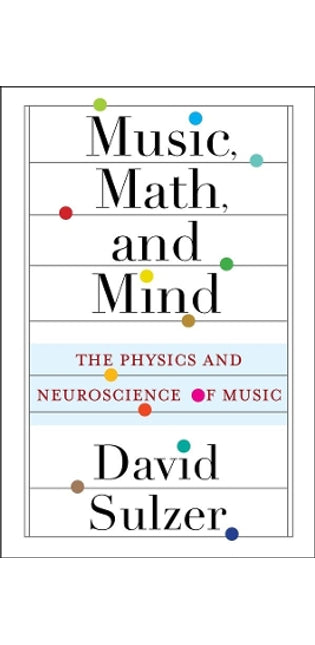
Music, Math, and Mind
Why does a clarinet play at lower pitches than a flute? What does it mean for sounds to be in or out of tune? How are emotions carried by music? Do other animals perceive sound like we do? How might a musician use math to come up with new ideas?This book offers a lively exploration of the mathematics, physics, and neuroscience that underlie music in a way that readers without scientific background can follow. David Sulzer, also known in the musical world as Dave Soldier, explains why the perception of music encompasses the physics of sound, the functions of the ear and deep-brain auditory pathways, and the physiology of emotion. He delves into topics such as the math by which musical scales, rhythms, tuning, and harmonies are derived, from the days of Pythagoras to technological manipulation of sound waves. Sulzer ranges from styles from around the world to canonical composers to hip-hop, the history of experimental music, and animal sound by songbirds, cetaceans, bats, and insects. He makes accessible a vast range of material, helping readers discover the universal principles behind the music they find meaningful.Written for musicians and music lovers with any level of science and math proficiency, including none, Music, Math, and Mind demystifies how music works while testifying to its beauty and wonder.
R 962.00
Truth's Debt to Value
Is something true because we believe it to be so or because it is true? How can a culturally bound community achieve scientific knowledge when values, attitudes, and desires shape its beliefs? In this book an eminent philosopher considers various schools of thought on the nature of truth. David Weissman argues that truth exists in the correspondence between statement and fact: what can be said about our world can be measured against a reality that has a character and existence independent of any property we ascribe to it.Weissman begins by evaluating the transcendental paradigm of Kant that has exercised enormous influence in the development of Western thought over the past two hundred years. He develops his critique of the Kantian model, in which value judgments underlie the perception or construction of truth, asserting that it is seriously flawed because it renders a determination of truth impossible. Weissman examines various value-driven perspectives on truth developed by such philosophers as Foucault, Derrida, and Rorty, for whom truth is only the set of affirmations, principles, and procedures sanctioned by power and value. However, says Weissman, truth is the required adjunct to desire. Knowing who we are, where we have been, and the consequences of what we have done is the essential preparation for choosing what to do next. We must respect the integrity of a world we have not made and find our way within it with the help of attitudes and desires that have been informed by truth.
R 1,501.00
Bloch, Schoenberg, and Bernstein
David Schiller's study of three works of Jewish music - Ernest Bloch's "Sacred Service" (1933), Arnold Schoenberg's "A Survivor from Warsaw" (1947), and Leonard Bernstein's "Kaddish" (1963) - reveals how, in the mid-20th century, the problem of assimilation was acutely felt as the unfinished business of European Jewry, at a time when American Jewry was creating its own distinctive culture (albeit with European roots) He shows how the business of "assimilating Jewish music" is as much a process audiences themselves engage in when they listen to Jewish music as it is something critics and musicologists do when they write about it. He further asserts that this process of assimilation is performed by the music itself - that Jewish music assimilates into the Western tradition of art music when it appears in the form of concert genres like the oratorio, cantata, and symphony. In rethinking the Jewish works of Bloch, Schoenberg, and Bernstein as part of the legacy of assimilation, David Schiller sheds light on an important aspect of their cultural and aesthetic achievements.
R 8,121.00
Animal Cannibalism
This is a study of the phenomenon of cannibalism in those animals known to prey upon and eat their own kind. The book is structured in accordance with conventional taxonomy and ranges from microbes to mammals.Where such information is available, the reasons for cannibalistic behaviour are presented for some 2000 species. These show that eating your own kind is very largely a result of the natural struggle for survival or procreation, and not an 'evil' aberration. The behaviours - unpleasant though it may appear - must be far more common in nature than might be imagined, and therefore, has probably evolved as an advantageous adaptation in many species.The book is unusual in its wide survey of cannibalism in nature and may be of use to animal breeders, conservationists, and those who study animal behaviour. Other readers with an interest in natural history, for whatever reason, may find useful information and some surprises in these pages. Even some very familiar household pets are included!
R 1,388.00
Errors, Blunders, and Lies
We live in a world that is not quite "right." The central tenet of statistical inquiry is that Observation = Truth + Error because even the most careful of scientific investigations have always been bedeviled by uncertainty. Our attempts to measure things are plagued with small errors. Our attempts to understand our world are blocked by blunders. And, unfortunately, in some cases, people have been known to lie.In this long-awaited follow-up to his well-regarded bestseller, The Lady Tasting Tea, David Salsburg opens a door to the amazing widespread use of statistical methods by looking at historical examples of errors, blunders and lies from areas as diverse as archeology, law, economics, medicine, psychology, sociology, Biblical studies, history, and war-time espionage. In doing so, he shows how, upon closer statistical investigation, errors and blunders often lead to useful information. And how statistical methods have been used to uncover falsified data. Beginning with Edmund Halley’s examination of the Transit of Venus and ending with a discussion of how many tanks Rommel had during the Second World War, the author invites the reader to come along on this easily accessible and fascinating journey of how to identify the nature of errors, minimize the effects of blunders, and figure out who the liars are.
R 4,004.24
R 1,720.00