Search results for "Dermot Turing"
Items we need to order for you

Misread Signals
'It is inspirational.’ – Helen Fry, author of Women in Intelligence'An important and exciting contribution to the history.’ – Clare Mulley, author of Agent ZoBletchley Park is remembered as a land of male intellectuals who were supported by a staff of women in menial roles, with figures such as Alan Turing, William Tutte and John Tiltman taking centre stage. These are the men who worked on the fearsome Enigma and Lorenz ciphering systems – the men who helped sway the course of the war in the Allies’ favour.But, as is often the case in the historical record, this is not the whole story. Women were not just secretaries and assistants: they had serious full-on codebreaking roles. And this was not just at Bletchley, or in the UK, or even only in the Second World War. These were women like Margaret Rock, who solved Enigma and other machine problems; Agnes Driscoll, the first US Navy codebreaker; and Asta Friedrichs, who postwar became a prime source for information on German Foreign Office codebreaking. Yet, when the histories were written, these women – and many more besides – somehow got left out.Who were they? What did they achieve? How did they ‘vanish’? In Misread Signals, expert codebreaking historian Dermot Turing turns his attention to these long-ignored women and puts their contributions back in the spotlight where they belong.
R 691.00
R 423.93
Turing's Cathedral
George Dyson's fascinating account of the early years of computers: Turing's Cathedral is the story behind how the PC, ipod, smartphone and almost every aspect of modern life came into being.In 1945 a small group of brilliant engineers and mathematicians gathered at the Institute for Advanced Study in Princeton, determined to build a computer that would make Alan Turing's theory of a 'universal machine' reality. Led by the polymath émigré John von Neumann, they created the numerical framework that underpins almost all modern computing - and ensured that the world would never be the same again.George Dyson is a historian of technology whose interests include the development (and redevelopment) of the Aleut kayak. He is the author of Baidarka; Project Orion; and Darwin Among the Machines.'Unusual, wonderful, visionary' Francis Spufford, Guardian'Fascinating . . . the story Dyson tells is intensely human . . . a gripping account of ideas and inventionFascinating . . . the story Dyson tells is intensely human . . . a gripping account of ideas and invention' Jenny Uglow'Glorious . . . as much a story of the personalities involved as of the discoveries they made, and you do not need any knowledge of computers or mathematics to enjoy the ride . . . a ripping yarn' John Gribbin, Literary Review
R 471.00
Turing's Children
This book explores the profound legacy of Alan Turing, and how his five great ideas have been developed by the winners of the Turing Prize to shape the digital world we live in today. These five groundbreaking concepts—universal computability and insolvability, cryptography, electronic digital computers and software, artificial intelligence (AI), and computational biology—serve as the pillars of the narrative. Turing's Children makes the complex ideas in the work of the Turing prize winners accessible to a broad audience. It traces the evolution of these ideas from abstract mathematical principles to their real-world applications, demonstrating their influence on everyday life. Readers will discover how Turing's legacy is woven into the fabric of modern technology: from the smartphones in our pockets and secure online banking, to the development of life-saving drugs and the conversational abilities of AI systems like ChatGPT.The book weaves together historical anecdotes, profiles of pioneering scientists, and vivid examples of current innovations. It offers a comprehensive view of how Turing's vision continues to inspire breakthroughs across science and technology. Turing's Children reveals the enduring relevance of Turing's ideas and the ongoing quest to push the boundaries of what machines—and humanity—can achieve.
R 2,115.00
Extraordinary Life of Alan Turing
Alan Turing was:A mathematician A scientist An inspirationAlan Turing was a mathematician, scientist and codebreaker who helped defeat the Nazis in the Second World War with his incredible decoding of secret messages from enemy soldiers.Discover his life story in this beautifully illustrated book, from his childhood as a quiet boy who loved maths, to becoming one of the most important scientists and codebreakers in history.Explore other extraordinary lives:The Extraordinary Life of Stephen HawkingThe Extraordinary Life of Michelle ObamaThe Extraordinary Life of Katherine JohnsonThe Extraordinary Life of Mahatma GandhiThe Extraordinary Life of Freddie Mercury The Extraordinary Life of Serena WilliamsThe Extraordinary Life of Nelson Mandela
R 283.00
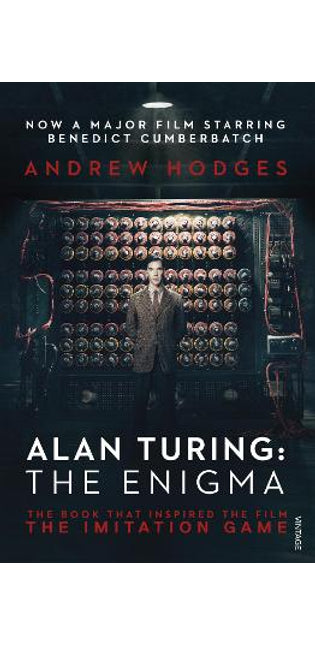
Alan Turing: The Enigma
The official book behind the Academy Award-winning film The Imitation Game, starring Benedict Cumberbatch and Keira Knightley Alan Turing was the mathematician whose cipher-cracking transformed the Second World War. Taken on by British Intelligence in 1938, as a shy young Cambridge don, he combined brilliant logic with a flair for engineering. In 1940 his machines were breaking the Enigma-enciphered messages of Nazi Germany’s air force. He then headed the penetration of the super-secure U-boat communications. But his vision went far beyond this achievement. Before the war he had invented the concept of the universal machine, and in 1945 he turned this into the first design for a digital computer.Turing's far-sighted plans for the digital era forged ahead into a vision for Artificial Intelligence. However, in 1952 his homosexuality rendered him a criminal and he was subjected to humiliating treatment. In 1954, aged 41, Alan Turing took his own life.
R 471.00
R 519.00
R 448.00
R 551.40
Goat's Song
Jack Ferris, playwright, drunk, is mired in contemplative misery in a fisherman's cottage on the windy bleak west coast of Ireland. Mourning his love affair with Catherine Adams, an actress and Protestant from the North, he summons her instead in his imagination. In doing so, he tells the story of her father Jonathan, failed parson and retired RUC man, shamed into exile by a moment of violence in Derry years ago. Masterly, elegiac, A Goat's Song conjures the contrasting landscapes and opposing myths of a nation divided.
R 346.00
Turing Test
This book gives the most comprehensive, in depth and contemporary assessment of this classic topic in artificial intelligence. It is the first to elaborate in such detail the numerous conflicting points of view on many aspects of this multifaceted, controversial subject. It offers new insights into Turing's own interpretation and is essential reading for research on the Turing test and for teaching undergraduate and graduate students in philosophy, computer science, and cognitive science.
R 6,560.77
R 564.59
Alan Turing: The Enigma
Alan Turing was a brilliant Cambridge mathematician who has been described as the father of the modern computer. He masterminded the cracking of the German Enigma code and was caught up in the secrecy and bureaucracy of World War II and afterwards - continually frustrated in his desire to build a machine which could think, as those with power over him feared both his homosexuality and indiscretion. This is an account of his life, which ended by his own hand.
R 471.00
R 611.00
R 699.00
R 313.00
R 911.00
Turing’s Connectionism
Christof Teuscher revives, analyzes, and simulates Turing's ideas, applying them to different types of problems, and building and training Turing's machines using evolutionary algorithms. In a little known paper entitled 'Intelligent Machinery' Turing investigated connectionist networks, but his work was dismissed as a 'schoolboy essay'and it was left unpublished until 1968, 14 years after his death. This is not a book about today's (classical) neural networks, but about the neuron network-like structures proposed by Turing. One of its novel features is that it actually goes beyond Turing's ideas by proposing new machines. The book also contains a Foreward by B. Jack Copeland and D. Proudfoot.
R 3,565.40
Alan M. Turing
'In a short life he accomplished much, and to the roll of great names in the history of his particular studies added his own.' So is described one of the greatest figures of the twentieth century, yet Alan Turing's name was not widely recognised until his contribution to the breaking of the German Enigma code became public in the 1970s. The story of Turing's life fascinates and in the years since his suicide, Turing's reputation has only grown, as his contributions to logic, mathematics, computing, artificial intelligence and computational biology have become better appreciated. To commemorate the centenary of Turing's birth, this republication of his mother's biography is enriched by a new foreword by Martin Davis and a never-before-published memoir by Alan's older brother. The contrast between this memoir and the original biography reveals tensions and sheds new light on Turing's relationship with his family, and on the man himself.
R 1,983.85
R 336.00
R 458.00
R 764.00
Turing Test Argument
This book departs from existing accounts of Alan Turing's imitation game and test by placing Turing's proposal in its historical, social, and cultural context.It reconstructs a controversy in England, 1946–1952, over the intellectual capabilities of digital computers, which led Turing to propose his test. It argues that the Turing test is best understood not as a practical experiment, but as a thought experiment in the modern scientific tradition of Galileo Galilei. The logic of the Turing test argument is reconstructed from the rhetoric of Turing’s irony and wit. Turing believed that learning machines should be understood as a new kind of species, and their thinking as different from human thinking and yet capable of imitating it. He thought that the possibilities of the machines he envisioned were not utopian dreams. And yet he hoped that they would rival and surpass chauvinists and intellectuals who sacrifice independent thinking to maintain their power. These would be transformed into ordinary people, as work once considered 'intellectual' would be transformed into non-intellectual, 'mechanical' work.The Turing Test Argument will appeal to scholars and students in the sciences and humanities and all those interested in Turing's vision of the future of intelligent machines in society and nature.
R 2,633.08
Alan M. Turing
'In a short life he accomplished much, and to the roll of great names in the history of his particular studies added his own.' So is described one of the greatest figures of the twentieth century, yet Alan Turing's name was not widely recognised until his contribution to the breaking of the German Enigma code became public in the 1970s. The story of Turing's life fascinates and in the years since his suicide, Turing's reputation has only grown, as his contributions to logic, mathematics, computing, artificial intelligence and computational biology have become better appreciated. To commemorate the centenary of Turing's birth, this republication of his mother's biography is enriched by a new foreword by Martin Davis and a never-before-published memoir by Alan's older brother. The contrast between this memoir and the original biography reveals tensions and sheds new light on Turing's relationship with his family, and on the man himself.
R 479.00
Essential Turing
Alan Turing, pioneer of computing and WWII codebreaker, is one of the most important and influential thinkers of the twentieth century. In this volume for the first time his key writings are made available to a broad, non-specialist readership. They make fascinating reading both in their own right and for their historic significance: contemporary computational theory, cognitive science, artificial intelligence, and artificial life all spring from this ground-breakingwork, which is also rich in philosophical and logical insight. An introduction by leading Turing expert Jack Copeland provides the background and guides the reader through the selection. About Alan TuringAlan Turing FRS OBE, (1912-1954) studied mathematics at King's College, Cambridge. He was elected a Fellow of King's in March 1935, at the age of only 22. In the same year he invented the abstract computing machines - now known simply as Turing machines - on which all subsequent stored-program digital computers are modelled. During 1936-1938 Turing continued his studies, now at Princeton University. He completed a PhD in mathematical logic, analysing the notion of 'intuition' in mathematics and introducing the idea of oracular computation, now fundamental in mathematical recursion theory. An 'oracle' is an abstract device able to solve mathematical problems too difficult for the universal Turing machine.In the summer of 1938 Turing returned to his Fellowship at King's. When WWII started in 1939 he joined the wartime headquarters of the Government Code and Cypher School (GC&CS) at Bletchley Park, Buckinghamshire. Building on earlier work by Polish cryptanalysts, Turing contributed crucially to the design of electro-mechanical machines ('bombes') used to decipher Enigma, the code by means of which the German armed forces sought to protect their radio communications. Turing's work on theversion of Enigma used by the German navy was vital to the battle for supremacy in the North Atlantic. He also contributed to the attack on the cyphers known as 'Fish'. Based on binary teleprinter code, Fish was used during the latter part of the war in preference to morse-based Enigma for the encryption ofhigh-level signals, for example messages from Hitler and other members of the German High Command. It is estimated that the work of GC&CS shortened the war in Europe by at least two years. Turing received the Order of the British Empire for the part he played.In 1945, the war over, Turing was recruited to the National Physical Laboratory (NPL) in London, his brief to design and develop an electronic computer - a concrete form of the universal Turing machine. Turing's report setting out his design for the Automatic Computing Engine (ACE) was the first relatively complete specification of an electronic stored-program general-purpose digital computer. Delays beyond Turing's control resulted in NPL's losing the race to build the world's first workingelectronic stored-program digital computer - an honour tha
R 1,473.84
Ad Infinitum... The Ghost in Turing's Machine
This ambitious work puts forward a new account of mathematics-as-language that challenges the coherence of the accepted idea of infinity and suggests a startlingly new conception of counting. The author questions the familiar, classical, interpretation of whole numbers held by mathematicians and scientists, and replaces it with an original and radical alternative—what the author calls non-Euclidean arithmetic.The author's entry point is an attack on the notion of the mathematical infinite in both its potential and actual forms, an attack organized around his claim that any interpretation of "endless" or "unlimited" iteration is ineradicably theological. Going further than critique of the overt metaphysics enshrined in the prevailing Platonist description of mathematics, he uncovers a covert theism, an appeal to a disembodied ghost, deep inside the mathematical community's understanding of counting.
R 5,027.00
Parsing the Turing Test
An exhaustive work that represents a landmark exploration of both the philosophical and methodological issues surrounding the search for true artificial intelligence. Distinguished psychologists, computer scientists, philosophers, and programmers from around the world debate weighty issues such as whether a self-conscious computer would create an internet ‘world mind’. This hugely important volume explores nothing less than the future of the human race itself.
R 6,040.82
R 550.78
R 1,134.00
Hierarchy of Turing Degrees
Computability theory is a branch of mathematical logic and computer science that has become increasingly relevant in recent years. The field has developed growing connections in diverse areas of mathematics, with applications in topology, group theory, and other subfields.In A Hierarchy of Turing Degrees, Rod Downey and Noam Greenberg introduce a new hierarchy that allows them to classify the combinatorics of constructions from many areas of computability theory, including algorithmic randomness, Turing degrees, effectively closed sets, and effective structure theory. This unifying hierarchy gives rise to new natural definability results for Turing degree classes, demonstrating how dynamic constructions become reflected in definability. Downey and Greenberg present numerous construction techniques involving high-level nonuniform arguments, and their self-contained work is appropriate for graduate students and researchers.Blending traditional and modern research results in computability theory, A Hierarchy of Turing Degrees establishes novel directions in the field.
R 3,405.08
Hierarchy of Turing Degrees
Computability theory is a branch of mathematical logic and computer science that has become increasingly relevant in recent years. The field has developed growing connections in diverse areas of mathematics, with applications in topology, group theory, and other subfields.In A Hierarchy of Turing Degrees, Rod Downey and Noam Greenberg introduce a new hierarchy that allows them to classify the combinatorics of constructions from many areas of computability theory, including algorithmic randomness, Turing degrees, effectively closed sets, and effective structure theory. This unifying hierarchy gives rise to new natural definability results for Turing degree classes, demonstrating how dynamic constructions become reflected in definability. Downey and Greenberg present numerous construction techniques involving high-level nonuniform arguments, and their self-contained work is appropriate for graduate students and researchers.Blending traditional and modern research results in computability theory, A Hierarchy of Turing Degrees establishes novel directions in the field.
R 7,427.19
Alan Turing and his Contemporaries
Secret wartime projects in code-breaking, radar and ballistics produced a wealth of ideas and technologies that kick-started the development of digital computers. This is the story of the people and projects that flourished in the post-war period. By 1955 computers had begun to appear in the market-place. The Information Age was dawning and Alan Turing and his contemporaries held centre stage. Their influence is still discernable deep down within today’s hardware and software.
R 1,246.00
Turing Machine Universality of the Game of Life
This book presents a proof of universal computation in the Game of Life cellular automaton by using a Turing machine construction. It provides an introduction including background information and an extended review of the literature for Turing Machines, Counter Machines and the relevant patterns in Conway's Game of Life so that the subject matter is accessibly to non specialists.The book contains a description of the author’s Turing machine in Conway’s Game of Life including an unlimited storage tape provided by growing stack structures and it also presents a fast universal Turing machine designed to allow the working to be demonstrated in a convenient period of time.
R 3,021.03
New Bruckner
The New Bruckner provides a valuable study of Bruckner's music, focusing on the interaction of biography, textual scholarship, reception history and analysis. Dr Dermot Gault conveys a broad chronological narrative of Bruckner's compositional development, interpolating analytical commentaries on the works and critical accounts of the notoriously complex and editorial issues. Gault corrects longstanding misconceptions about the composer's revision process, and its relationship with the early editions and widely-held critical opinions. Bruckner's constantly evolving engagement with symphonic form is traced by taking each revision in due order, rather than by taking each symphony on its own, and by relating the symphonies to other mature works such as the Te Deum, the three great Masses, and the Quintet, and argues that Bruckner's music became more organic and less schematic as the result of his revisions. The book will be essential reading for those studying Bruckner's compositions, the complex history of their reception, and late Romantic music in general.
R 9,318.65
Turing to the Death
A series of short stories written in 1995 from the author of "Fighting the Philosophical Leopard".
R 452.22
Turing's Man
Trained in both classics and computer science, Bolter considers the cultural impact of computers on our age, comparing the computer to earlier technologies that redefined fundamental notions of time, space, language, memory, and human creativity. Surprisingly, he finds that in many ways the outlook of the computer age bears more resemblance to that of the ancient world than to that of the Enlightenment. The classical philosopher and the computer programmer share share a suspicion of infinity, an acceptance of necessary limitations on human achievement, and a belief that results are more important than motives. Although Bolter fears that the growing use of computers may well diminish out culture's sense of the historical and intellectual context of human endeavor, he contends that the computer also offers new ways of looking at intellectual freedom, creativity, and the conservation of precious resources.
R 1,693.97
Turing Machine Universality of the Game of Life
This book presents a proof of universal computation in the Game of Life cellular automaton by using a Turing machine construction. It provides an introduction including background information and an extended review of the literature for Turing Machines, Counter Machines and the relevant patterns in Conway's Game of Life so that the subject matter is accessibly to non specialists.The book contains a description of the author’s Turing machine in Conway’s Game of Life including an unlimited storage tape provided by growing stack structures and it also presents a fast universal Turing machine designed to allow the working to be demonstrated in a convenient period of time.
R 3,020.11
Being Black and British
Being Black and British: Before, During and After Drama School is about being Black, being British and being an actor before, during and after training.Written by Black writers working in and around the British performative industries, this book offers practical and theoretical tools to take into the classroom, studio, rehearsal room, mind, body and heart, focalised unapologetically through being Black in Britain. Structured across three acts, it covers themes present on the road to drama school such as youth theatre, the texts studied and early experiences in theatre spaces; drama school training with practical suggestions to encourage and embolden Black actors; and the world of the profession, ensuring that mental health, making work and a sense of what can be offered by Black actors is made clear.This book is a call to action and a challenge to all those who teach, lecture, direct, parent, produce, cast and/or train Black performers in Britain – and those performers themselves, to listen more, ask more, feel more and be more.
R 2,482.25
Turing's Mistake
AI is sweeping away familiar cultures and we have no idea where it is taking us. The older generation tends to stick up for humanity and the younger generation for post-humanity. It is a serious tension. Everywhere there is a mood of unsettlement at not knowing where the unstoppable momentum of AI will go and whether we will like the outcome. For the first time in the history of humanity, we do not really have a good grip on what the role of humans is on the planet.This predicament can be traced to widespread acceptance of two assumptions proposed by Alan Turing in 1950 when he asked, “Can computers think?”: that intelligence is disembodied and its presence can be determined by the Turing test. The AI field has been obsessed by a quest for Artificial General Intelligence, abbreviated AGI, in fulfillment of Turing’s proposals. This book argues that AI has ignored a gaping hole: the issue of tacit knowledge, which is essential for human intelligence and can never by known by machines. The seekers of AGI have a long wait ahead.For the rest of us, non-human machine intelligence is already emerging in AI agentic nerworks and is well on its way of dragging us into an unwanted and unwelcome world where not-very-intelligent machines force conformity to their goals. We can escape this yoke by renouncing the idea that we are a form of machine. We can celebrate and reawaken the powers we have, such as care, understanding, and respect, that no machine can have.
R 1,172.00
Turing's Mistake
AI is sweeping away familiar cultures and we have no idea where it is taking us. The older generation tends to stick up for humanity and the younger generation for post-humanity. It is a serious tension. Everywhere there is a mood of unsettlement at not knowing where the unstoppable momentum of AI will go and whether we will like the outcome. For the first time in the history of humanity, we do not really have a good grip on what the role of humans is on the planet.This predicament can be traced to widespread acceptance of two assumptions proposed by Alan Turing in 1950 when he asked, “Can computers think?”: that intelligence is disembodied and its presence can be determined by the Turing test. The AI field has been obsessed by a quest for Artificial General Intelligence, abbreviated AGI, in fulfillment of Turing’s proposals. This book argues that AI has ignored a gaping hole: the issue of tacit knowledge, which is essential for human intelligence and can never by known by machines. The seekers of AGI have a long wait ahead.For the rest of us, non-human machine intelligence is already emerging in AI agentic nerworks and is well on its way of dragging us into an unwanted and unwelcome world where not-very-intelligent machines force conformity to their goals. We can escape this yoke by renouncing the idea that we are a form of machine. We can celebrate and reawaken the powers we have, such as care, understanding, and respect, that no machine can have.
R 6,118.00
Turing's Vision
Chat-GPT, humanoid robotics, and self-driving cars are just a few of the things that are changing our everyday lives. The rapid advancement of AI is eroding one by one all the cornerstones considered unique of human nature: language, consciousness, creativity, and moral responsibility. The book argues that the revolution we are facing is driven by Alan Turing's "vision". This vision rests on the idea that intelligence is not an intrinsic property of human beings, but is a way in which matter is functionally organized and an attribute we are naturally inclined to ascribe to certain entities. For decades we have pretended that this idea does not have the corrosive power that it actually does, perhaps more so than the Copernican and Darwinian revolutions. But now, given the achievements of new forms of computing based on deep learning and predictive coding, the most common intuitions can no longer avoid the dangerous Turing idea.The book is intended for scholars, researchers, and readers intrigued by the intersections across disciplines interested in understanding the philosophical, ethical, and social implications of Artificial Intelligence and its impact on human nature.
R 1,246.00
R 309.64