Search results for "Eric Rothstein"
Items we need to order for you

Systems of Order and Inquiry in Later Eighteenth-Century Fiction
This title is part of UC Press's Voices Revived program, which commemorates University of California Press’s mission to seek out and cultivate the brightest minds and give them voice, reach, and impact. Drawing on a backlist dating to 1893, Voices Revived makes high-quality, peer-reviewed scholarship accessible once again using print-on-demand technology. This title was originally published in 1975.
R 1,176.00
Emblems of Mind – The Inner Life of Music and Mathematics
One is a science, the other an art; one useful, the other seemingly decorative, but mathematics and music share common origins in cult and mystery and have been linked throughout history. "Emblems of Mind" is Edward Rothstein's classic exploration of their profound similarities, a journey into their "inner life." Along the way, Rothstein explains how mathematics makes sense of space, how music tells a story, how theories are constructed, how melody is shaped. He invokes the poetry of Wordsworth, the anthropology of Levi-Strauss, the imagery of Plato, and the philosophy of Kant. Math and music, Rothstein shows, apply comparable methods as they create their abstractions, display similar concerns with ratio and proportion, and depend on metaphors and analogies to create their meanings. Ultimately, Rothstein argues, they reveal the ways in which we come to understand the world. They are images of the mind at work and play; indeed, they are emblems of Mind itself. Jacques Barzun called this book "splendid." Martin Gardner said it was "beautifully written, marvelous and entertaining." It will provoke all serious readers to think in new ways about the grand patterns in art and life.
R 618.00
Rothstein
History remembers Arnold Rothstein as the man who fixed the 1919 World Series, an underworld genius. The real-life model for The Great Gatsby's Meyer Wolfsheim and Nathan Detroit from Guys and Dolls, Rothstein was much more- and less- than a fixer of baseball games. He was everything that made 1920s Manhattan roar. Featuring Jazz Age Broadway with its thugs, speakeasies, showgirls, political movers and shakers, and stars of the Golden Age of Sports, this is a biography of the man who dominated an age. Arnold Rothstein was a loan shark, pool shark, bookmaker, thief, fence of stolen property, political fixer, Wall Street swindler, labour racketeer, rumrunner, and mastermind of the modern drug trade. Among his monikers were "The Big Bankroll," "The Brain," and "The Man Uptown." This vivid account of Rothstein's life is also the story of con artists, crooked cops, politicians, gang lords, newsmen, speakeasy owners, gamblers and the like. Finally unraveling the mystery of Rothstein's November 1928 murder in a Times Square hotel room, David Pietrusza has cemented The Big Bankroll's place among the most influential and fascinating legendary American criminals. 16 pages of black-and-white photographs are featured.
R 765.00
R 456.00
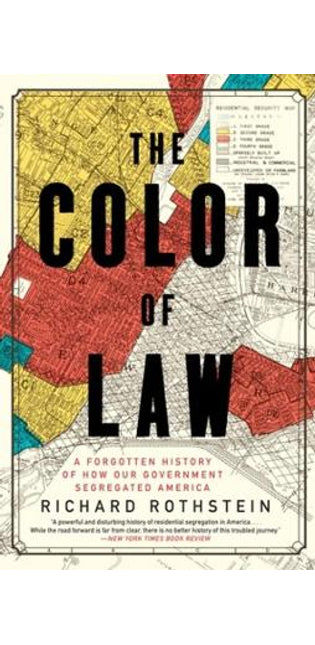
Color of Law
Widely heralded as a “masterful” (The Washington Post) and “essential” (Slate) history of the modern American metropolis, Richard Rothstein’s The Color of Law offers “the most forceful argument ever published on how federal, state, and local governments gave rise to and reinforced neighborhood segregation” (William Julius Wilson). Exploding the myth of de facto segregation arising from private prejudice or the unintended consequences of economic forces, Rothstein describes how the American government systematically imposed residential segregation: with undisguised racial zoning; public housing that purposefully segregated previously mixed communities; subsidies for builders to create whites-only suburbs; tax exemptions for institutions that enforced segregation; and support for violent resistance to African Americans in white areas. A ground-breaking, “virtually indispensable” (Chicago Daily Observer) study that has already transformed our understanding of twentieth-century urban history, The Color of Law is forcing Americans to face the obligation to remedy their unconstitutional past. • A The New York Times bestseller
R 410.00
R 458.00
R 940.95
Jesus Idea
This important new study examines Jesus as an idea of salvation, and not as an individual, gradually constituted and modified over a considerable timespan. Author Arnold M. Rothstein shows that we know next to nothing about the actual existence of Jesus, all efforts to recover the history of this individual ending in failure. Even though there are those who dispute the messiahship and divinity of a Jesus, they do not doubt that he was a man, and a most unusual one at that. There is rarely a question that the story is built around a fact of history. The Jesus Idea does not begin with the usual presupposition of a human existence. Rather than the tacit assumption that Jesus constitutes the name of an actual person, this book presents the thesis of the Jesus, or salvation personified. According to Rothstein, Jesus exists purely as a portrait of supreme innocence and purity, a composite of traditions dating back to a legendary Israelite figure of the fourteenth century B.C.E. That proto-divinity - whose name means Yah as Salvation, or Yah Saves or Helps - is known biblically as Yehosha (Joshua) bun Nun, the renowned conqueror of the fabled Jericho, located in the geographical area then called Canaan, now Israel. Rothstein maintains that the theory of salvation, or yeshua, represents a syncretism of ideas and dreams optimistically embraced by humans in response to the wretchedness and misery experienced in life. Yeshua, the Hebriac concept from which the Greek name Jesus emerged, involved a recurrent hope among humans that "all things can be made anew." That hope provided the thematic material for the sketching of a portrait - an attempt to express representationally, in literal terms, what is essentially symbolic. Rothstein painstakingly examines the Gospels and other early Church writings, as well as non-Christian sources for verification of a historical Jesus. Countering the approach that maintains if there is a historical Christendom, then there must be a historical central figure who established the movement, The Jesus Idea shows that the construction of a faith-community around a spectral figure is, in fact, part of the history of religions.
R 860.00
R 168.00
R 593.00
R 469.06
R 489.00
Just Institutions Matter
In this book Bo Rothstein seeks to defend the universal welfare state against a number of important criticisms which it has faced in recent years. He combines genuine philosophical analysis of normative issues concerning what the state ought to do with empirical political scientific research in public policy examining what the state can do. Issues discussed include the relationship between welfare state and civil society, the privatization of social services, and changing values within society. His analysis centres around the importance of political institutions as both normative and empirical entities, and Rothstein argues that the choice of such institutions at certain formative moments in a country's history is what determines the political support for different types of social policy. He thus explains the great variation among contemporary welfare states in terms of differing moral and political logics which have been set in motion by the deliberate choices of political institutions. The book is an important contribution to both philosophical and political debates about the future of the welfare state.
R 1,866.26
R 296.00
R 336.00
Identity and Ideology
Rothstein argues that schools in capitalist societies, and in all societies, inculcate students with understandings of themselves and their economic systems. Using a Freudo-Marxian approach, he shows how educational systems reproduce themselves and the social systems which fund them. Grounded in studies of American and European capitalist societies, this text traces the formation of the public and private identities, and illustrates how individuals are indoctrinated with capitalist ideology through linguistic and cultural transmissions. Rothstein concludes that education must be liberated from ideological effects by focusing learning on the processes which create them, thus giving students deeper insight into their own identities and roles in the social system.The book begins with an overview of sociocultural theories of schooling, in which the author demonstrates that schools reproduce social structures and values through the use of arbitrary ideological understandings and values. Rothstein then suggests that the State intervenes and regulates education in order to propagate politically and economically correct learnings and behavior. This inculcation of values and world views is an act of symbolic violence in which those in authority gain ideological mastery of their students from one generation to the next. This education of the individual also takes place in the worlds of the family and, later, at work, where the student or worker becomes a commodity who can be bought and sold. He or she exists as a cost of production. Rothstein concludes that to free the individual from the shackles of ideological and economic domination, families and schools must be liberated from their arbitrary practices and links with the labor market. Educators will find Rothstein's use of ideology and language valuable and provocative as they struggle to reform educational systems today.
R 2,354.00
When Good Jobs Go Bad
From Chinese factories making cheap toys for export, to sweatshops in Bangladesh where name-brand garments are sewn - studies on the impact of globalization on workers have tended to focus on the worst jobs and the worst conditions. But in When Good Jobs Go Bad, Jeffrey Rothstein looks at the impact of globalization on a major industry - the North American auto industry - to reveal that globalization has had a deleterious effect on even the most valued of blue-collar jobs.Rothstein argues that the consolidation of the Mexican and U.S.-Canadian auto industries, the expanding number of foreign automakers in North America, and the spread of lean production have all undermined organized labor and harmed workers. Focusing on three General Motors plants assembling SUVs - an older plant in Janesville, Wisconsin; a newer and more viable plant in Arlington, Texas; and a ""greenfield site"" (a brand-new, state-of-the-art facility) in Silao, Mexico - When Good Jobs Go Bad shows how global competition has made nonstop, monotonous, standardized routines crucial for the survival of a plant, and it explains why workers and their local unions struggle to resist. For instance, in the United States, General Motors forced workers to accept intensified labor by threatening to close plants, which led local unions to adopt ""keep the plant open"" as their main goal. At its new factory in Silao, GM had hand-picked the union - one opposed to strikes and committed to labor-management cooperation - before it hired the first worker.Rothstein's engaging comparative analysis, which incorporates the viewpoints of workers, union officials, and management, sheds new light on labor's loss of bargaining power in recent decades, and highlights the negative impact of globalization on all jobs, both good and bad, from the sweatshop to the assembly line.
R 1,507.00
R 435.25
Social Traps and the Problem of Trust
A 'social trap' is a situation where individuals, groups or organisations are unable to cooperate owing to mutual distrust and lack of social capital, even where cooperation would benefit all. Examples include civil strife, pervasive corruption, ethnic discrimination, depletion of natural resources and misuse of social insurance systems. Much has been written attempting to explain the problem, but rather less material is available on how to escape it. In this book, Bo Rothstein explores how social capital and social trust are generated and what governments can do about it. He argues that it is the existence of universal and impartial political institutions together with public policies which enhance social and economic equality that creates social capital. By introducing the theory of collective memory into the discussion, Rothstein makes an empirical and theoretical claim for how universal institutions can be established.
R 5,263.00
R 432.00
R 428.00
R 1,099.00
R 583.87
Social Traps and the Problem of Trust
A 'social trap' is a situation where individuals, groups or organisations are unable to cooperate owing to mutual distrust and lack of social capital, even where cooperation would benefit all. Examples include civil strife, pervasive corruption, ethnic discrimination, depletion of natural resources and misuse of social insurance systems. Much has been written attempting to explain the problem, but rather less material is available on how to escape it. In this book, Bo Rothstein explores how social capital and social trust are generated and what governments can do about it. He argues that it is the existence of universal and impartial political institutions together with public policies which enhance social and economic equality that creates social capital. By introducing the theory of collective memory into the discussion, Rothstein makes an empirical and theoretical claim for how universal institutions can be established.
R 1,756.76
Global Bargaining
Negotiations on an international commodity policy have been the central issue on the North-South agenda for the past three years. They also can be seen as the first major effort to give substantive meaning to the Third World's desire not only for a new regime for the world's raw commodity trade but also for a New International Economic Order. Yet various obstacles have impeded successful North-South bargaining, and the negotiations remain at a stalemate. Focusing on the bargaining process between developed and developing countries in the United Nations Conference on Trade and Development, Robert Rothstein analyzes the factors that have inhibited successful negotiation and suggests ways in which these obstacles might be removed. The first part of the book focuses on the specifics of the commodity debate, while in the second part the author attempts to explain the causes of delay, misunderstanding, and mistrust within the negotiating process. Assessing the possibility of devising an effective bargaining policy among unequal parties with conflicting values and interests, Professor Rothstein suggests a number of structural, institutional, and conceptual reforms.Originally published in 1979. The Princeton Legacy Library uses the latest print-on-demand technology to again make available previously out-of-print books from the distinguished backlist of Princeton University Press. These editions preserve the original texts of these important books while presenting them in durable paperback and hardcover editions. The goal of the Princeton Legacy Library is to vastly increase access to the rich scholarly heritage found in the thousands of books published by Princeton University Press since its founding in 1905.
R 4,995.81
R 2,354.00
R 934.00
R 579.00
R 3,384.00
R 554.00
R 865.00
R 1,255.61
R 197.00
R 886.08
R 518.00
Predicates and Their Subjects
Predicates and their Subjects is an in-depth study of the syntax-semantics interface focusing on the structure of the subject-predicate relation. Starting from where the author's 1983 dissertation left off, the book argues that there is syntactic constraint that clauses (small and tensed) are constructed out of a one-place unsaturated expression, the predicate, which must be applied to a syntactic argument, its subject. The author shows that this predication relation cannot be reduced to a thematic relation or a projection of argument structure, but must be a purely syntactic constraint. Chapters in the book show how the syntactic predication relation is semantically interpreted, and how the predication relation explains constraints on DP-raising and on the distribution of pleonastics in English. The second half of the book extends the theory of predication to cover copular constructions; it includes an account of the structure of small clauses in Hebrew, of the use of `be' in predicative and identity sentences in English, and concludes with a study of the meaning of the verb `be'.
R 4,665.77
R 648.49
R 543.86
Restructuring The Welfare State
The modern welfare state is under threat from a variety of fronts. Changing demographic patterns, declining public trust, interest group demands and growing international competition for capital and labour are presenting modern states with intense pressures. This volume examines these competing pressures and offers a coherent analyses of both institutional resilience and institutional change. Adopting an evolutionary approach, this innovative volume demonstrates both how past practices and policies significantly affect the current options and how social and economic forces impinge upon each of these societies in surprisingly different ways. Cross-national in scope and unified in approach, Restructuring the Welfare State examines core issues facing the contemporary welfare state while at the same time significantly advancing historical institutionalist theory.
R 1,254.00
R 485.00
Mexicans on the Move
This book describes and analyzes migration of individuals from San Cosme Mazatecochco in central Mexico to a new United States community in New Jersey. Based on four decades of anthropological research in Mazatecochco and among migrants in New Jersey Rothstein traces the causes and consequences of migration and who returned home, why, and how return migrants reintegrated back into their homeland.
R 1,582.73
R 245.00
R 166.00