



Search results for "Flaubert"
Items in stock - 4 working days delivery time

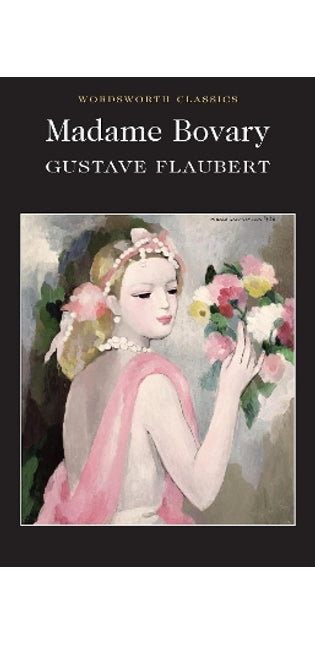
Madame Bovary
With an Introduction by Roger Clark, University of Kent at Canterbury. Translation by Eleanor Marx-Aveling.Castigated for offending against public decency, Madame Bovary has rarely failed to cause a storm. For Flaubert's contemporaries, the fascination came from the novelist's meticulous account of provincial matters. For the writer, subject matter was subordinate to his anguished quest for aesthetic perfection. For his twentieth-century successors the formal experiments that underpin Madame Bovary look forward to the innovations of contemporary fiction.Flaubert's protagonist in particular has never ceased to fascinate. Romantic heroine or middle-class neurotic, flawed wife and mother or passionate protester against the conventions of bourgeois society, simultaneously the subject of Flaubert's admiration and the butt of his irony - Emma Bovary remains one of the most enigmatic of fictional creations.Flaubert's meticulous approach to the craft of fiction, his portrayal of contemporary reality, his representation of an unforgettable cast of characters make Madame Bovary one of the major landmarks of modern fiction.
R 240.00
Items we need to order for you
R 618.00
Flaubert
From the highly acclaimed author of Zola: A Life comes the definitive biography of Gustave Flaubert, author of Madame Bovary.Gustave Flaubert (1821-1880), whose Madame Bovary outraged the right-thinking bourgeoisie, is now brought to life as the singular person and artist he was. As Frederick Brown reveals, Flaubert was fraught with contradiction--a sedentary man who took epic voyages through Egypt and the Middle East; a man of genius who could be flamboyantly uncouth, but was fanatically devoted to beautifully cadenced prose. While making much of his camaraderie with male friends, Flaubert depended upon the emotional nurture of maternal women, notably George Sand, with whom he engaged in a justly celebrated correspondence. His assorted mistresses--French, Egyptian, and English--fed both his richly erotic imagination and his fictional characters, and his letters provide a record of them.Flaubert's time and place literally put him on trial for portraying lewd behavior in Madame Bovary. His milieu also made him a celebrity and, indirectly, brought about his financial ruin. Flaubert died suddenly at the age of fifty-nine, and soon afterward, his beloved retreat near Rouen was torn down and converted into a distillery to cover his niece's debts. He privately dreamed of popular success, which he in fact achieved with Madame Bovary, but never sacrificed to it his ideal of artistic integrity. Frederick Brown's magisterial biography honors his subject's life, times, and legacy.
R 1,277.00
R 392.03
R 1,675.49
R 1,542.57
R 425.00
R 1,065.00
R 786.51
R 1,286.21
R 1,204.00
R 780.00
R 1,008.12
Flaubert: Writing the Masculine
Flaubert: Writing the Masculine offers a new approach to Flaubert's major writing and to gender studies as a whole. Through a combination of close reading with a knowledge of current gender studies and particular attention to the sociohistorical and legal contexts of nineteenth-century France, it examines the masculine in the six very different literary contexts which are Flaubert's fictions. His characters, male and female, are reassessed for theirmasculinity: Baudelaire's famous view of Emma Bovary as 'masculine', like other critical idées reçues which have propped up a canonical Flaubert, finds a new interpretation within the wider discussion of the book, as does the term 'masculine' itself. While it is mostly Flaubert's men, both those who conform topatriarchy's models and the non-conformists, who offer new insights into masculine identities in crisis, the structures of society that endorse male status–legal, social, institutional, and literary-critical–also come under scrutiny. The book challenges the primacy of gendered terms over sex, and provides various methodological resources to further scholarship in French Studies, Gender Studies, and masculinities theory, arguing strongly for the adroitness of literature toformulate representations which are as relevant today as in Flaubert's time.
R 8,314.00
R 1,445.00
R 780.00
Gustave Flaubert Encyclopedia
Gustave Flaubert is probably the most famous novelist of nineteenth-century France, and his best known work, Madame Bovary, is read in numerous comparative literature and French courses. His fiction set the standard to which other authors turned to learn their craft, and his cult of art and his unrelenting search for stylistic perfection inspired many later writers, such as Maupassant, Proust, Conrad, Faulkner, and Joyce. His denunciation of materialistic, corrupt society; his fascination with altered states of consciousness; his oscillation between metaphysical longings and a radical nihilism; and his deep-seated mistrust of the adequacy of words themselves anticipate the works of contemporary authors. This reference is a convenient guide to his life and writings.Included in this volume are several hundred alphabetically arranged entries on Flaubert's individual works and major characters; historical persons and events that shaped his life; the themes that run throughout his writings; the critical approaches employed by scholars studying his works; and related topics of interest. Each entry is written by an expert contributor and most close with a brief bibliography. All of his major works are treated at length, and the volume mentions nearly every unpublished project of his that has a title. The book concludes with a selected, general bibliography of major studies.
R 2,649.00
R 585.00
R 1,041.00
Cambridge Companion to Flaubert
This volume brings together a series of essays by acknowledged experts on Flaubert. It offers a coherent overview of the writer's work and critical legacy, and provides insights into the very latest scholarly thinking. While a central place is given to Flaubert's most widely read texts, attention is also paid to key areas of the corpus that have tended to be overlooked. Close textual analyses are accompanied by discussion of broader theoretical issues, and by a consideration of Flaubert's place in the wider traditions that he both inherited and influenced. These essays provide not only a robust critical framework for readers of Flaubert, but also a fuller understanding of why he continues to exert such a powerful influence on literature and literary studies today. A concluding essay by the prize-winning author Mario Vargas Llosa examines Flaubert's legacy from the point of view of the modern novelist.
R 1,612.93
R 1,450.88
Flaubert: Madame Bovary
Madame Bovary was one of the most influential literary achievements of the nineteenth century and gained immediate notoriety through its questioning of marriage, sex, and the role of women. Stephen Heath shows how this landmark text captures and articulates a fundamental experience of the post-romantic, commercial-industrial, emotional-democratic period. He explains how Madame Bovary represents Flaubert's intense personal engagement with the tragedy of bourgeois culture, while at the same time exemplyfying the author's commitment to the impersonality of Art and the transcendence of style. The novel is set in its literary and historical context and there is a guide to further reading.
R 1,743.81
R 1,212.37
R 842.86
Flaubert's Tentation
This is the first comprehensive study in English of Flaubert's least well-known masterpiece, the final version of his Temptation of Saint Anthony (1874) which, thanks to Foucault, has the reputation of being an arcane and erudite 'fantastic library' or, thanks to genetic criticism, is a 'narrative' of Flaubert's personal aesthetic ('oeuvre de toute ma vie'). By presuming instead no prior knowledge of the text, its versions or its contexts, Mary Orr providesnew readings of the seven tableaux which comprise Temptation, and new ways of interpreting the work as a whole, whether the reader is a newcomer to Flaubert or a specialist. Arguing that Flaubert was imagining his own epoch through the eyes of a visionary saint in the fourth century AD, Orr elucidates the dialogues between religion and science that are the dynamic of the work for the first time. She also insists on the meticulous accuracy and imaginative representations of the science of the work, proposing - in the 'remapping' analogy of her subtitle - that Flaubert's Temptation is a paradigm of nineteenth-century French, and indeed European, 'literaryscience'. For nineteenth-century French and Flaubert specialists, this book then challenges received critical wisdom on a number of fronts. Through his unlikely protagonist-visionary, Flaubert's 'realism', 'anti-clericalism' and 'orientalism' are all given new airings in the religious and scientific evidence of the 1874 Temptation , as indeed in his 'temptation' to write the life of his times.
R 5,801.00
R 1,014.00
Flaubert and the Gift of Speech
This is the first book-length study of Flaubert's use of dialogue, an important but neglected component of his fictional texts. Professor Haig's starting point is Sartre's observation that 'Flaubert does not believe that we speak: we are spoken'. Dialogue in Flaubert does not attempt to represent an individual style but to circumscribe a larger phenomenon of language. Speech defines man both in the sense that it describes him as a set of human characteristics, and inscribes him within a system of social values. The author explores the development of Flaubert's use of dialogue in Madame Bovary, L'Education Sentimentale (both versions), and Bouvard et Pécuchet.
R 1,748.80
R 1,324.87
R 320.00
R 1,120.58
R 911.00
R 1,001.88
R 345.00
Flaubert's Characters
This major new study takes issue both with the traditional critical view that Flaubert's central characters are weak and with the approach adopted by a number of contemporary critics who claim that character is deliberately undermined in the interests of non-representational writing. Rather, Dr Knight explores the relationship between the contents of Flaubert's stories and his practice as a writer, thereby reinstating the functional value of character in his work. She shows that essential aspects of Flaubert's aesthetic - the opaqueness of language, stupidity, fascination and reverie as the object of art - depend on the psychological make-up of fictional characters: their pathological relationship to language and reality mirrors Flaubert's conception of the readers' stupefied response to his own stylistic effects and to his wilfully naive stories. Flaubert emerges as a representational writer, but one who is supremely self-conscious of the fictional status of his representations.
R 1,736.62
R 730.00
R 1,537.00
R 1,023.28
R 2,898.21


