



Search results for "Frantzius"
Items in stock - 4 working days delivery time

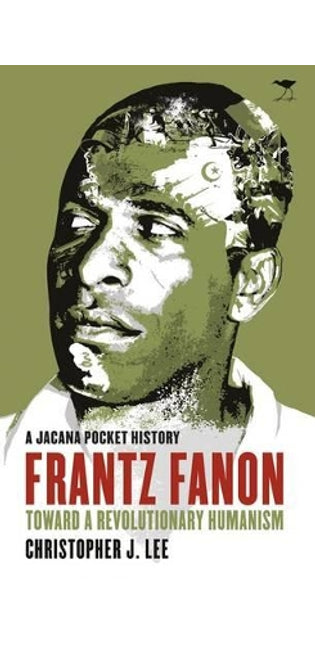
Frantz Fanon
Psychiatrist, revolutionary, writer and philosopher, Frantz Fanon (1925-1961) played many roles during his brief life. Born on the island of Martinique, he died in the United States from cancer, following a meteoric career that took him to France, Algeria, Tunisia, and numerous places in between. Best known for Black Skin, White Masks (1952) and The Wretched of the Earth (1961), Fanon drew upon psychology, European philosophy, and his own experience to articulate radical critiques of racism, colonialism, and nationalism that still vitally inform understandings of these issues. Yet Fanon remains controversial, given his advocacy of violent struggle, and, consequently, is often misunderstood. This biography - the most succinct and straightforward to date - demythologises Fanon by situating his life and ideas within the historical circumstances he encountered. Synthesising a range of secondary literature with readings of his work, it elevates enduring aspects of Fanon's legacy, while also countering interpretations of his writing that have granted uncritical omniscience to his views. Written with clarity and passion, Christopher J. Lee's account ultimately argues for the complexity of Frantz Fanon and his continued importance today.
R 202.00
Frantz Fanon
In this essential introduction to Fanon’s remarkable life and philosophy Gibson highlights Fanon’s philosophical commitments and the vision of revolution that he stood for.Revolutionary humanist and radical psychiatrist Frantz Fanon was one of the greatest Black thinkers of the twentieth century. Born in Martinique and known for his involvement in the Algerian liberation movement, his seminal books Black Skin, White Masks and The Wretched of the Earth are widely considered to be cornerstones of anti-colonial and anti-racist thought. In this essential introduction to Fanon’s remarkable life and philosophy, Nigel C. Gibson argues that Fanon’s oeuvre is essential to thinking about race today. Connecting Fanon’s writing, psychiatric practice, and lived experience in the Caribbean, France and Africa, Gibson highlights Fanon’s philosophical commitments and the vision of revolution that he stood for. Despite his untimely death, the revolutionary pulse of Fanon’s ideas has continued to beat ever more strongly in the consciousness of successive revolutionary generations, from the Black Panthers and Black Power to the Black Lives Matter and the Fallist student movements, as well as to grassroots resistance movements working to improve the lives of Black and indigenous people who are continuously oppressed by systems of capitalism, imperialism and colonialism. As Fanon’s thought comes alive to new activists thinking about their mission to ‘humanise the world,’ Gibson reminds us that Fanon’s revolutionary humanism is fundamental to all forms of anti-colonial struggles across the world.
R 465.00

Items we need to order for you
R 714.60
R 1,088.87
R 618.00
R 774.81
R 352.00
Frantz Fanon
Psychiatrist, philosopher, and revolutionary, Frantz Fanon is one of the most important intellectuals of the twentieth century. He presented powerful critiques of racism, colonialism, and nationalism in his classic books, Black Skin, White Masks (1952) and The Wretched of the Earth (1961). This biography reintroduces Fanon for a new generation of readers, revisiting these enduring themes while also arguing for those less appreciated—namely, his anti-Manichean sensibility and his personal ethic of radical empathy, both of which underpinned his utopian vision of a new humanism. Written with clarity and passion, Christopher J. Lee’s account ultimately argues for the pragmatic idealism of Frantz Fanon and his continued importance today.
R 587.00
Frantz Fanon
Frantz Fanon (1925-1961) was a Caribbean and African psychiatrist, philosopher and revolutionary whose works, including Black Skin, White Masks and The Wretched of the Earth are hugely influential in the fields of post-colonial studies, critical theory, and post-Marxism. His legacy remains with us today, having inspired movements in Palestine, Sri Lanka, the US and South Africa.This is a critical biography of his extraordinary life. Peter Hudis draws on the expanse of his life and work - from his upbringing in Martinique and early intellectual influences to his mature efforts to fuse psychoanalysis and philosophy and contributions to the anti-colonial struggle in Algeria - to counter the monolithic assumption that Fanon's contribution to modern thought is defined by the advocacy of violence.He was a political activist who brought his interests in psychology and philosophy directly to bear on such issues as mutual recognition, democratic participation and political sovereignty. Hudis shows that, as a result, Fanon emerges as neither armchair intellectual nor intransigent militant.
R 4,442.89
Frantz Fanon
Frantz Fanon (1925-1961) was a Caribbean and African psychiatrist, philosopher and revolutionary whose works, including Black Skin, White Masks and The Wretched of the Earth are hugely influential in the fields of post-colonial studies, critical theory, and post-Marxism. His legacy remains with us today, having inspired movements in Palestine, Sri Lanka, the US and South Africa.This is a critical biography of his extraordinary life. Peter Hudis draws on the expanse of his life and work - from his upbringing in Martinique and early intellectual influences to his mature efforts to fuse psychoanalysis and philosophy and contributions to the anti-colonial struggle in Algeria - to counter the monolithic assumption that Fanon's contribution to modern thought is defined by the advocacy of violence.He was a political activist who brought his interests in psychology and philosophy directly to bear on such issues as mutual recognition, democratic participation and political sovereignty. Hudis shows that, as a result, Fanon emerges as neither armchair intellectual nor intransigent militant.
R 930.83
R 538.80
King’s Governor and the Stars: Heinrich Rantzau’s Relationship with Astrology
Heinrich Rantzau (1526–1598), the Danish king’s governor in the duchies of Schleswig and Holstein, was a multifaceted and fascinating personality. His diverse activities as a landowner, financier, entrepreneur, patron, builder, and politician have repeatedly occupied historians. As a leading representative of humanistic education and culture, he achieved European fame, and with his passion for books was considered a black swan among contemporary noblemen. Rantzau was well versed in astrology, aligned his entire life with the stars, corresponded with numerous important scholars of his time, and edited several astrological textbooks.The book examines Heinrich Rantzau’s relationship with astrology in detail for the first time and treats historical horoscopes as a special source genre in the history of science.
R 7,927.00
Frantz Fanon
Frantz Fanon was one of the twentieth-century's most influential theorists and activists, whose work fighting against colonialism and imperialism has been an inspiration to today's decolonization and anti-racism movements. As the author of essential texts such as The Wretched of the Earth and Black Skin, White Masks, his impact on today's activists - from Rhodes Must Fall to Black Lives Matter - is indelible. Leo Zeilig here details the fascinating life of Fanon - from his upbringing in Martinique to his wartime experiences and work in Europe and North Africa - and frames his ideas and activism within the greater context of his career as a practising psychiatrist and his politically tumultuous surroundings. The book covers the period of the Algerian War of Independence, national liberation and what Fanon described as 'the curse of independence'. Highlighting Fanon's role as the most influential theorist of anti-colonialism and racial liberation, this book is an essential read for those interested in the roots of the modern day anti-racism and decolonization movements.
R 764.00
Frantz Fanon
Born in Martinique, Frantz Fanon (1925-61) trained as a psychiatrist in Lyon before taking up a post in colonial Algeria. He had already experienced racism as a volunteer in the Free French Army, in which he saw combat at the end of the Second World War. In Algeria, Fanon came into contact with the Front de Libération Nationale, whose ruthless struggle for independence was met with exceptional violence from the French forces. He identified closely with the liberation movement, and his political sympathies eventually forced him out the country, whereupon he became a propagandist and ambassador for the FLN, as well as a seminal anticolonial theorist.David Macey's eloquent life of Fanon provides a comprehensive account of a complex individual's personal, intellectual and political development. It is also a richly detailed depiction of postwar French culture. Fanon is revealed as a flawed and passionate humanist deeply committed to eradicating colonialism.Now updated with new historical material, Frantz Fanon remains the definitive biography of a truly revolutionary thinker.
R 911.00
R 703.71
R 611.70
R 6,274.56
R 685.00
R 1,073.00
R 763.00
R 1,046.97


