



Search results for "Human"
Items in stock - 4 working days delivery time

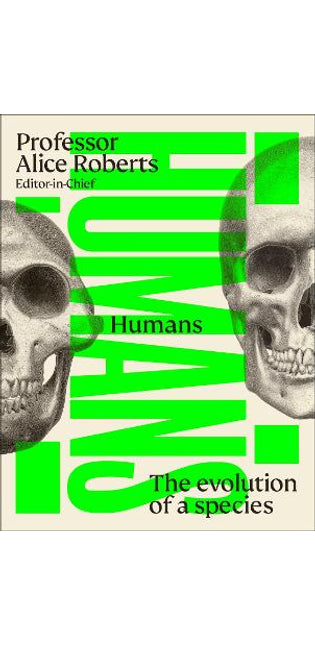
Humans
Humans – who are we? Physically, Homo sapiens is unremarkable in the animal world – a hairless ape. But somehow, in combination, our characteristics make us remarkable. With our dexterity and brain power, we discovered ways of finding food and beating the elements not only in our home on the African savanna, but in every habitat from jungle to Arctic waste. Humans tells the story of our evolution with beautiful illustrations of our seemingly ordinary anatomy alongside colourful, mind-expanding graphics of what we have achieved with it.This book is:shaped and guided by broadcaster and expert in anatomy and archaeology, Professor Alice Robertswritten by an international team of experts in many fields of human evolution, including archaeology, palaeontology, anthropology, and cognitive sciencebuilt from chapters about the evolution of different parts of the body, giving an instant, familiar way in to the topicThis thought-provoking book presents the latest advances in understanding human evolution, challenging old myths and baked-in misconceptions – all through the lens of the human body. Each chapter tackles a different body part, showing how it has evolved and the role it has played. The story of hands, for instance, begins with the first animals with limbs, which clambered onto land 375 million years ago, but goes on to show how humans use the unique precision and power in their grasping digits – and their ability to teach one another skills – to create ever-more sophisticated technology.Visually vibrant and rich, this book features not only beautiful illustrations, but also photos of prehistoric art, tools, jewellery, and recreations of all of these made by experimental archaeologists.Humans asks intriguing universal questions about our origins and nature. When did we invent clothes? Did we always form pair bonds? How did prehistoric people cross the ocean? Are we the only animals to become self-aware?Find out who we are, where we come from, and perhaps – where we’re going.
R 680.00
Items we need to order for you
R 324.07
Human
Why is it important to consider the human today? Exploring this question John Lechte takes inspiration from the interplay of two of Giorgio Agamben’s concepts: ‘ways of life’ and ‘bare life’.Stateless people, those who do not have a political community, such as asylum seekers and refugees, are no less human. However the European tradition, represented most clearly in Hannah Arendt’s thinking of the opposition between the oikos, as the satisfaction of basic needs, and the polis, as the realm of freedom and glory, proposes the opposite of this. Arendt’s famous phrase, ‘the right to have rights’, means that freedom and full human potential can only be realised in the context of civil society; in short, that only citizens can be fully human. Because Arendt’s view is so influential, yet often not acknowledged, it is necessary to undertake a full investigation of the nature and meaning of the human to establish that it is not reducible to the citizen, but is always characterised by a ‘way of life’ – life mediated by language. The human is never reducible to ‘bare life’ – a life with no other significance than physical survival. The implications of ‘bare life’ are investigated through important themes in relation to the human, such as: freedom and necessity, the animal, animality as nature, inclusion and exclusion in politics, the sacred, death and dying, technics and nature, the Same and the Other, the everyday as extraordinary. Journeying through Agamben, Arendt, Bataille, Derrida, Hegel, Heidegger, Husserl, Levinas, Schelling, Simondon, and Stiegler, this is a profound search to reveal the truly human.
R 1,411.00
Human
What does it mean to be human? Is there something that makes us distinct from computers, other great apes, Martians, gods? Is there philosophical, ethical, or political value in continuing to think in terms of a common human nature? Or should we rather throw this concept into the dustbin of history? A paradox of the concept of "human nature" is that it holds both the promise of universal equality—insofar as it takes us all to share a common nature—while all too often rationalizing exploitation, oppression, and even violence against other individuals and other species. Most appallingly, differences in skin color and other physiological traits have been viewed as signs of a "lesser" humanity, or of outright inhumanity, and used to justify great harms. The volume asks: is theconcept of human nature separable from the racist, sexist, and speciest abuse that has been made of it? And is it even possible—or desirable—to articulate a notion of human nature unaffected by race or gender or class, as if it were possible to observe humanity in a pure form?This volume traces the history of the concept "human" by examining the history of claims about distinctively human properties and capacities, and the ethical and political repercussions of such accounts. Spanning the history of philosophy, political science, religion, medical ethics, the history of art and science fiction, it illuminates how our self-understanding as "human" evolved across time and place—from ancient Greek, classical Chinese, and medieval Arabic accounts of humannature to contemporary evolutionary theory and the transhumanist movement. It examines problems ranging from the intelligibility of Incarnation (a relationship between divine and human beings) to problems posed by genetic engineering and artificial intelligence. Short pieces, or Reflections, are interspersedamong the chapters, which take up topics ranging from Frankenstein to Marx's concept of human nature.
R 2,011.00
R 565.00
R 416.00
R 1,069.00
R 396.00
R 428.00
Human
Being human is complicated! Our bodies, intellects and emotions are all God-given gifts, but we so often find them in varying states of disorder. How then, can we become the full bearers of God's image that we were made to be? In response to this profound question, Ros Clarke helpfully outlines what the Bible has to say about the nature of humanity. Addressing our status as created beings; our purpose in God’s world; our nature as body and soul; and our fall away from God, Human unpacks questions around the issues of identity, sexuality and gender. It then turns to Christ's example as the perfect human, and considers Jesus' teaching about each of us being loved, valued and redeemed. A teaching that remains foundational for all discussions around important topics like inclusivity, disability and race.Written with both humour and pastoral concern, and including a study guide to aid personal reflection and group discussion, this book will help you consider afresh what it means to be a human.
R 456.00
R 204.00
R 512.26
R 611.00
Human
The war is over. The Elites have arisen. The humans that survived are forced with a choice - serve their new found masters, or be forced to live in a desolate wasteland where it's a crime be human. Felicia was raised as the First Daughter of Supreme Leader Orson Krailo and lived a life of luxury. She realizes several truths about herself as well as who the Elites really are. And decides to take matters into her own hands. As the Elites prepare to finish what they stared - rid the planet of humans forever - Felicia is determined to save not only herself but also those she cares about. Even if it means losing the ones she is closest to. From the mind of Ajay Joseph, Human is an epic, dystopian, suspenseful thrill ride beginning to end that will leave you breathless.
R 467.00
R 486.00
Human
Why is it important to consider the human today? Exploring this question John Lechte takes inspiration from the interplay of two of Giorgio Agamben’s concepts: ‘ways of life’ and ‘bare life’.Stateless people, those who do not have a political community, such as asylum seekers and refugees, are no less human. However the European tradition, represented most clearly in Hannah Arendt’s thinking of the opposition between the oikos, as the satisfaction of basic needs, and the polis, as the realm of freedom and glory, proposes the opposite of this. Arendt’s famous phrase, ‘the right to have rights’, means that freedom and full human potential can only be realised in the context of civil society; in short, that only citizens can be fully human. Because Arendt’s view is so influential, yet often not acknowledged, it is necessary to undertake a full investigation of the nature and meaning of the human to establish that it is not reducible to the citizen, but is always characterised by a ‘way of life’ – life mediated by language. The human is never reducible to ‘bare life’ – a life with no other significance than physical survival. The implications of ‘bare life’ are investigated through important themes in relation to the human, such as: freedom and necessity, the animal, animality as nature, inclusion and exclusion in politics, the sacred, death and dying, technics and nature, the Same and the Other, the everyday as extraordinary. Journeying through Agamben, Arendt, Bataille, Derrida, Hegel, Heidegger, Husserl, Levinas, Schelling, Simondon, and Stiegler, this is a profound search to reveal the truly human.
R 5,150.00
R 764.00
R 290.00
R 320.00
R 497.98
R 275.00
R 222.00
R 797.00
R 521.00
R 486.00
Human, All Too Human
The question of what it means to be human has never before been more contested. The human, with a complicated social history that his rarely been examined, remains entrenched in traditional Enlightenment thinking. This text considers how we radicalize our notion of the human. Can the human be thought outside humanism? Any rethinking of the human places us immediately inside an ever-widening field of contrasting labels: animated and inanimated, natural and artificial, living and dead, organic and mechanistic. These and other boundary confusions at the frontier of the human are the subject of this volume, as each essay takes up one of three disputed border identities: animals, things or children. The author examines how we explain our interest in anthropomorphism and our fascination with species categorizations. Essays explore what we mean by "things" and how the integrity of the human may already be compromised by them. The nine essays in this volume all attempt to rethink the category of the human, challenging some of our most cherished cultural classifications.
R 9,312.77
R 486.00
Human Being Human
Human Being Human explores the classical question 'What is a human being?'In examining our human being, Christopher Hauke challenges the notion of human nature, questions the assumed superiority of human consciousness and rational thinking and pays close attention to the contradiction of living simultaneously as an autonomous individual and a member of the collective community. The main chapters include:who's in charge here? knowledge power and human being that thinking feeling is modern consciousness different? Modern consciousness and the quest for spirituality endings, the unconscious and time Orpheus, Dionysus and popular culture.The book is also structured around brief panel essays with a distinctly personal tone, such as: the rise of revulsion: spitting and the stones, what is the double when the original is gone? And 'I lived with the Speaking Clock'. All these themes are amplified by examples drawn from psychotherapy, film, literature and popular culture, and illustrated with many evocative photographs and film stills.Human Being Human provides an original perspective on what it is to be a human being, the value of popular culture, the relationship between the individual and the collective and our assumptions about truth, reality and power. Written in a highly accessible style, this book is both intellectually and emotionally satisfying and will fascinate anyone interested in contemporary psychology, cultural studies, film and media, social history and psychotherapy.
R 2,002.37
Egalitarians - Human and Chimpanzee
This innovative book challenges the perceived view, based largely on long observation of artificially-fed chimpanzees in Gombe and Mahale National Parks, Tanzania, of the typical social behaviour of chimpanzees as aggressive, dominance seeking, and fiercely territorial. In polar opposition, all reports from naturalistic (non-feeding) field studies are of non-aggressive chimpanzees living peacefully in non-hierarchical groups, on home ranges open to all. These reports have been ignored and downgraded by most of the scientific community. By utilising the data from these studies the author is able to construct a model of an egalitarian form of social organisation, based on a fluid role relationship of mutual dependence between many charismatic chimpanzees of both sexes and other more dependent members. This highly and necessarily positive mutual dependence system is characteristic of both (undisturbed) chimpanzees and (undisturbed) humans who live by the 'immediate-return' foraging system.
R 5,415.05
R 305.00
Human
A ship of refugees from the distant planet of Alokina suddenly appears above Los Angeles. When the alien's "Most High" leader tours the city, he discovers an unexpected connection with a young female "Earthborn" doctor, which had been set in play, unbeknownst to him, centuries earlier by a slightly rebellious planetary scout. The "Most Hight" seeks to recruit the young doctor to aid his interests, and she is reluctantly drawn into the conflict between the alien factions and the Earth interests determined to control them.
R 1,436.12
R 305.00
R 1,619.00
Humans
"Surekha Davies invites readers to imagine the lives of historical monsters and to empathize with their often-wretched treatment."―Science magazineA history of how humans have created monsters out of one another—from our deepest fears—and what these monsters tell us about humanity's present and future. Monsters are central to how we think about the human condition. Join award-winning historian of science Dr. Surekha Davies as she reveals how people have defined the human in relation to everything from apes to zombies, and how they invented race, gender, and nations along the way. With rich, evocative storytelling that braids together ancient gods and generative AI, Frankenstein's monster and E.T., Humans: A Monstrous History shows how monster-making is about control: It defines who gets to count as normal. In an age when corporations increasingly see people as obstacles to profits, this book traces the long, volatile history of monster-making and charts a better path for the future. The result is a profound, effervescent, empowering retelling of the history of the world for anyone who wants to reverse rising inequality and polarization. This is not a history of monsters, but a history through monsters.
R 808.00
Human
unveiled evolutions of a broken poet-life, love, those things that should have been..
R 47.00
R 305.00
R 474.00
Human Condition
This book summarizes the work of several decades, culminating in a revolutionary model of recent human evolution. It challenges current consensus views fundamentally, presenting in its support a mass of evidence, much of which has never been assembled before. This evidence derives primarily from archaeology, paleoanthropology, genetics, clinical psychology, neurosciences, linguistics and cognitive sciences. No even remotely similar thesis of recent human origins has ever been published, but some of the key elements of this book have been published by the author in major refereed journals in the last two years. Its implications are far-reaching and profoundly affect the way we perceive ourselves as a species. This book about what it means to be human is heavily referenced, with a bibliography of many hundreds of scientific entries.
R 6,550.18
R 537.25
Human By Nature
Representing a wide range of disciplines -- biology, sociology, anthropology, economics, human ethology, psychology, primatology, history, and philosophy of science -- the contributors to this book recently spent a complete academic year at the Center for Interdisciplinary Research (ZiF) discussing a plethora of new insights in reference to human cultural evolution. These scholars acted as a living experiment of "interdisciplinarity in vivo." The assumption of this experiment was that the scholars -- while working and residing at the ZiF -- would be united intellectually as well as socially, a connection that might eventually enhance future interdisciplinary communication even after the research group had dispersed. An important consensus emerged: The issue of human culture poses a challenge to the division of the world into the realms of the "natural" and the "cultural" and hence, to the disciplinary division of scientific labor. The appropriate place for the study of human culture, in this group's view, is located between biology and the social sciences. Explicitly avoiding biological and sociological reductionisms, the group adopted a pluralistic perspective -- "integrative pluralism" -- that took into account both today's highly specialized and effective (sub-)disciplinary research and the possibility of integrating the respective findings on a case-by-case basis. Each sub-group discovered its own way of interdisciplinary collaboration and submitted a contribution to the present volume reflecting one of several types of fruitful cooperation, such as a fully integrated chapter, a multidisciplinary overview, or a discussion between different approaches. A promising first step on the long road to an interdisciplinarily informed understanding of human culture, this book will be of interest to social scientists and biologists alike.
R 9,353.45
R 577.28
Human Infancy
Originally published in 1974, this volume is primarily devoted to what is known about human infancy from an ethological, evolutionary viewpoint. Included are discussions of pan-specific traits, presumably shared by all infants; individual genetic variations on these behaviours (as judged by twin-studies); sex differences, presumably shared by infants of all ethnic groups; and genetically based ethnic differences. However, the author favours neither biological determinism nor cultural determinism, and does not consider ‘interactionism’ to be a viable solution. Instead, a monistic position is taken, stressing the inseparability of the innate and the acquired, of genetics and environment, and of biology and culture.The heredity-environment issue is tackled head-on throughout the volume. The interaction between the two (an implied dualism) is described as a statistical abstraction from measured populations, while the position here is that heredity and environment are not separable in any single organism. In the same vein, the author argues that on logical grounds everything one does, every ‘cultural’ act, has within it some biological component.
R 9,307.92
Human Condition
This book summarizes the work of several decades, culminating in a revolutionary model of recent human evolution. It challenges current consensus views fundamentally, presenting in its support a mass of evidence, much of which has never been assembled before. This evidence derives primarily from archaeology, paleoanthropology, genetics, clinical psychology, neurosciences, linguistics and cognitive sciences. No even remotely similar thesis of recent human origins has ever been published, but some of the key elements of this book have been published by the author in major refereed journals in the last two years. Its implications are far-reaching and profoundly affect the way we perceive ourselves as a species. This book about what it means to be human is heavily referenced, with a bibliography of many hundreds of scientific entries.
R 6,551.08
R 274.00


-
, by sungano kanjere Enter the Kingsmead Young Writers' Competition 2026
All South African schoolchildren aged 6-18 are invited to enter the annual Young Writers’ Competition 2026. What happens when your imagination takes flight? This...
-
, by sungano kanjere Read an extract from It Always Seems Impossible: The Journey of James Urdang
When James Urdang sat down to write his memoir, It Always Seems Impossible, he wasn’t only telling the story of a life devoted to education.He...


