Search results for "Jonathan Slack"
Items we need to order for you

Genes: A Very Short Introduction
Very Short Introductions: Brilliant, Sharp, Inspiring In this exploration of the concept of the gene, Jonathan Slack looks at the discovery, nature, and role of genes in both evolution and development. By explaining the nature of genetic variation in the human population, how hereditary factors were identified as molecules of DNA, and how certain specific mutations can lead to disease, Slack highlights how DNA variants are used to trace human ancestry and migration, and can also be used by forensic scientists to identify individuals in crime. Healso explores issues such as the role of genetic heritability and IQ as well as the changes that occur in the genes of populations during evolution.An ideal guide for anyone curious about what genes are and how genetics can be put to use, this Very Short Introduction demonstrates the ways in which the gene concept has been understood and used by molecular biologists, population biologists, and social scientists around the world. This second edition has been fully updated and contains new sections on the CRISPR method for targeted genetic modification, on DNA profiling, and developments in our understanding of human ancestry usingancient DNA.ABOUT THE SERIES: The Very Short Introductions series from Oxford University Press contains hundreds of titles in almost every subject area. These pocket-sized books are the perfect way to get ahead in a new subject quickly. Our expert authors combine facts, analysis, perspective, new ideas, and enthusiasm to make interesting and challenging topics highly readable.
R 314.00
Stem Cells: A Very Short Introduction
The topic of stem cells has a high profile in the media. We've made important advances in our scientific understanding, but despite this the clinical applications of stem cells are still in their infancy and most real stem cell therapy carried out today is some form of bone marrow transplantation. At the same time, a scandalous spread of unproven stem cell treatments by private clinics represents a serious problem, with treatments being offered which are backed bylimited scientific rationale, and which are at best ineffective, and at worse harmful. This Very Short Introduction introduces stem cells, exploring what they are, and what scientists do with them. Introducing the different types of stem cells, Jonathan Slack explains how they can be used to treat diseases such as retinal degeneration, diabetes, Parkinson's disease, heart disease, and spinal trauma. He also discusses the important technique of bone marrow transplantation and some other types of current stem cell therapy, used for the treatment of blindness and of severeburns. Slack warns against fake stem cell treatments and discusses how to distinguish real from fake treatments. He also describes the latest scientific progress in the field, and looks forward to what we can expect to happen in the next few yearsVery Short Introductions: Brilliant, Sharp, Inspiring ABOUT THE SERIES: The Very Short Introductions series from Oxford University Press contains hundreds of titles in almost every subject area. These pocket-sized books are the perfect way to get ahead in a new subject quickly. Our expert authors combine facts, analysis, perspective, new ideas, and enthusiasm to make interesting and challenging topics highly readable.
R 314.00
R 244.00
R 260.00
Board Game Designer's Guide to Getting Published
Making a great board game and pitching it to publishers are two completely different things.If you’ve got a game that you want to share with the world but don’t know what to do next, this book will help you navigate through exactly what steps to take.You’ll discover: How to find the right publisher Exactly what publishers are looking for How to create a sell sheet that will actually sell your game How to negotiate the best deal and get paid more for your game What to look out for in contracts to make sure you don’t get exploitedYou’ll learn from Joe’s experiences as a full-time board game designer and instructor, along with tips and stories from a dozen other published designers, plus the exact things that publishers want. Direct from 16 established publishers.
R 5,636.86
Board Game Designer's Guide to Getting Published
Making a great board game and pitching it to publishers are two completely different things.If you’ve got a game that you want to share with the world but don’t know what to do next, this book will help you navigate through exactly what steps to take.You’ll discover: How to find the right publisher Exactly what publishers are looking for How to create a sell sheet that will actually sell your game How to negotiate the best deal and get paid more for your game What to look out for in contracts to make sure you don’t get exploitedYou’ll learn from Joe’s experiences as a full-time board game designer and instructor, along with tips and stories from a dozen other published designers, plus the exact things that publishers want. Direct from 16 established publishers.
R 1,963.16
R 365.00
R 518.00
R 306.00
R 518.00
R 428.00
R 428.00
R 585.00
R 798.00
R 865.00
R 422.00
R 496.93
R 380.00
R 585.00
R 755.09
R 847.00
R 960.28
R 774.00
Deported to Death
What happens to migrants after they are deported from the United States and dropped off at the Mexican border, often hundreds if not thousands of miles from their hometowns? In this eye-opening work, Jeremy Slack foregrounds the voices and experiences of Mexican deportees, who frequently become targets of extreme forms of violence, including migrant massacres, upon their return to Mexico. Navigating the complex world of the border, Slack investigates how the high-profile drug war has led to more than two hundred thousand deaths in Mexico, and how many deportees, stranded and vulnerable in unfamiliar cities, have become fodder for drug cartel struggles. Like no other book before it, Deported to Death reshapes debates on the long-term impact of border enforcement and illustrates the complex decisions migrants must make about whether to attempt the return to an often dangerous life in Mexico or face increasingly harsh punishment in the United States.
R 2,796.00
From Reformation to Improvement
Between the early sixteenth and the early eighteenth centuries, the character of English social policy and social welfare changed fundamentally. Aspirations for wholesale reformation were replaced by more specific schemes for improvement. Paul Slack's analysis of this decisive shift of focus, derived from his 1995 Ford Lectures, examines its intellectual and political roots. He describes the policies and rhetoric of the commonwealthsmen, godly magistrates, Stuartmonarchs, Interregnum projectors, and early Hanoverian philanthropists, and the institutions — notably hospitals and workhouses - which they created or reformed. In a series of thematic chapters, each linked to a chronological period, he brings together what might seem to have been disparate notionsand activities, and shows that they expressed a sequence of coherent approaches towards public welfare. The result is a strikingly original study, which throws fresh light on the formation of civic consciousness and the emergence of a civil society in early modern England.
R 7,347.00
Slacking
Prestige no longer ensures substance at Ivy League schools; students must navigate a maze of shallow, politicized courses to uncover the rare gems of a classical education, exposing the need for academic renewal."This book is a banquet of the absurdities that Ivy League universities serve up to their students under the rubric of general education. Anyone who wonders how the graduates of America’s elite institutions come by their jaundiced view of our country should start here. The few who refuse to “slack” are limited to the hard sciences and the few remaining excellent courses in the humanities."—Peter Wood, President, National Association of ScholarsIvy League universities can no longer be trusted to produce well-educated students. Even a cursory review of the course titles at top schools shows that these $320,000-plus diplomas may confer legacy prestige to graduates, but not necessarily knowledge or wisdom. At Cornell, for example, students can take Queer Girlhood, Beyoncé Nation, and Intersectional Disability Studies. The course list at Yale includes Pop Sapphism and Comparative Settler Geographies. At Princeton: Shoes. Penn offers Reality TV and Gender and Decolonizing French Food. Even worse, these courses actually fulfill general education requirements. It is still possible to earn a great education at Princeton, Harvard, Yale, Penn, Columbia, Brown, Cornell, or Dartmouth, but doing so requires prudence and persistence. In Slacking, Adam Kissel, Rachel Alexander Cambre, and Madison Marino Doan dedicate one chapter to each Ivy League college, providing specific information about the coursework that serious students should pursue to extract a real education from these decaying institutions. Every chapter concludes with two course lists, both of which meet the school’s general education requirements. One displays the worst collection of courses that an inveterate “slacker” could take to skate through the requirements for entertainment, reinforcement of political biases, and narrow specialization. The other lists the best choice of courses a dedicated striver could take to acquire a well rounded, content-rich liberal education. The contrast between the two sounds a rousing alarm bell for curriculum reform at America’s best-known colleges.
R 570.00
War on the American Republic
Americans often use the words progressive, liberal, and radical more or less interchangeably without understanding their place in American history. Kevin Slack describes the distinct aims of the movements they represent and weighs their consequences for the American republic.Each of the three movements rejected older republican principles of governance in favor of an administrative state, but there were substantial differences between Teddy Roosevelt’s Anglo-Protestant progressive social gospelers, who battled trusts and curbed immigration; Franklin Roosevelt’s and Lyndon Johnson’s secular liberals, who forged a government-business partnership and promoted a civil rights agenda; and the 1960s radicals, who protested corporate influence in the Great Society, liberal hypocrisy on race and gender, and the war in Vietnam. Each sought to overturn what came before. Following the revolution of the 1960s, elites on both left and right turned against the industrial middle class to erect an oligarchy at home and advance globalization abroad. Each side claimed to serve the interests of disadvantaged or underrepresented groups. Radicals ensconced themselves in bureaucracy and academia to advance their vision of social justice for women and minorities, while neoliberal elites promoted monopoly finance, open borders, and the outsourcing of jobs to benefit consumers. The administrative state became a global American empire, but the neoliberals’ economic and military failures precipitated a crisis of legitimacy. In the “great awokening” that began under Barack Obama, neoliberal elites, including establishment conservatives, openly broke with the populist base of the Republican Party, embraced identity politics, and used COVID-19 and a myth of insurrection to strip away the rights of American citizens. Today, an incompetent kleptocracy is draining the wealthiest and most powerful people in history, thus eroding the foundations of its own empire.
R 798.00
R 546.00
R 611.00
R 640.55
R 458.00
R 1,168.86
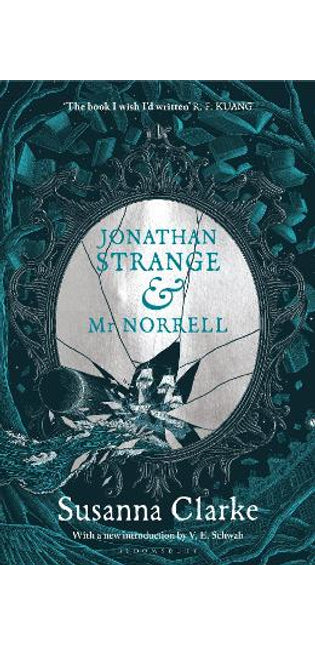
Jonathan Strange & Mr Norrell
The 20th anniversary edition of the fantasy classic, with an introduction by V E SchwabOver 4 million copies sold‘Susanna Clarke writes with an intelligence and beauty that seems at times miraculous’ Katherine Rundell ‘Unquestionably the finest English novel of the fantastic written in the last seventy years’ Neil Gaiman1806. England is beleaguered by the long war, and centuries have passed since magicians faded from view. But one remains: the reclusive Mr Norrell. Proceeding to London, he raises a woman from the dead and summons an army of ghostly ships to terrify the French.Yet the cautious Norrell is challenged by the emergence of another magician. Young, handsome and daring, Jonathan Strange is his very antithesis. So begins a dangerous battle between these two great men – which overwhelms that between England and France. And soon their own secret dabblings with the dark arts are going to cause more trouble than they can imagine…'Like Hilary Mantel, Clarke has made the very notion of genre seem quaint' Guardian
R 785.00
R 1,127.00
Jonathan Sacks: Universalizing Particularity
This volume features the thought and writings of Jonathan Sacks, one of today’s leading Jewish public thinkers. It brings together an intellectual portrait, four of his most original and influential philosophical essays, and an interview with him. This volume showcases the work of Sacks, a philosopher who seeks to confront and offer solutions to the numerous problems besetting Judaism and its confrontation with modernity. In addition, the reader will also encounter an important social philosopher and proponent of interfaith dialogue, who articulates how it is possible to cultivate a culture of civility based on the twin notions of the dignity of difference and the ethic of responsibility. Jonathan Sacks has been Chief Rabbi of the United Hebrew Congregations of the Commonwealth from September 1991 to September 2013 and a member of the House of Lords since 2009.
R 7,038.00
R 391.00
Bismarck
This is the life story of one of the most interesting human beings who ever lived. A political genius who remade Europe and united Germany between 1862 and 1890 by the sheer power of his great personality. It takes the reader into close proximity with a human being of almost superhuman abilities. We see him through the eyes of his secretaries, his old friends, his neighbours, his enemies and the press. Otto von Bismarck 'made' Germany but never 'ruled' it. For twenty eight years he acted as a prime minister without a party. He made speeches, brilliant in content but hesitant in delivery, and rarely addressed a public meeting. He planned three wars and after a certain stage in his career always wore military uniform to which he had no claim. The 'Iron Chancellor', the image of Prussian militarism, suffered from hypochondria and hysteria. Contemporaries called him a 'dictator' and several observers credited him with 'demonic' powers'. They were not wrong. The sheer power of his remarkable 'sovereign sel' awed even his enemies. William I observed that it was hard to be emperor under a man like Bismarck. He towered physically and intellectually over his contemporaries. His spoken and written prose sparkled with wit, insight, grand visions and petty malice. He united Germany and transformed Europe like Napoleon before and Hitlerafter him but with neither their control of the state nor command of great armies. He was and remained a royal servant. This new biography explores the greatness and limits of a huge and ultimately destructive self. It uses the diaries and letters of his contemporaries to explore the most remarkable figure of the nineteenth century, a man who never said a dull thing or wrote a slack sentence. A political genius who combined creative and destructive traits, generosity and pettiness, tolerance and ferocious enmity, courtesy and rudeness - in short, not only the most important nineteenth-century statesman but byfar the most entertaining.
R 1,005.00
R 1,352.20
R 679.00
R 1,740.00
R 618.00
R 683.00
R 846.00
R 696.00
R 1,269.00
R 367.00
R 1,270.80