



Search results for "Magnus Resch"
Items in stock - 4 working days delivery time

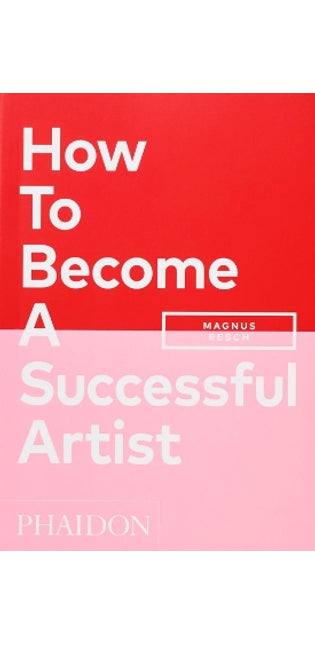
How To Become A Successful Artist
“[How to Become a Successful Artist] goes straight to the business of being an artist... Resch’s book offers practical advice to remind readers that there’s a lot more to being an artist than just making art.” – ArtNewsThe must-have business guide for all artists, written by the leading specialist in the global art marketWritten for artists of all levels, ages and mediums the latest book from bestselling author Magnus Resch explores how artists can have a career in the field they love. He answers the most important questions including: How do I find gallery representation? How do I write an artist statement? How should I price my artworks? And what's the best Instagram strategy? Case studies are drawn from interviews with leading experts and practitioners, including artists, gallerists, and curators. It's an invaluable resource to explain the core business principles of being an artist and reveals how to make it in the art market. This must-have guide includes business advice from the art world's leading experts, such as Hans Ulrich Obrist, Jeffrey Deitch, Simon de Pury, Mera & Don Rubell, Mr. Brainwash, Oscar Murillo, Sean Scully, Peter Halley, Kenny Scharf, Lucien Smith, Lisa Schiff, Julian Schnabel, Georgina Adam, Katherine Bernhardt, Shirin Neshat, Laurie Simmons, Jordan Wolfson, Jitish Kallat, Zhang Huan, Rashid Johnson, Marilyn Minter, Raymond Pettibon, and many more. “ [How to Become a Successful Artist] goes straight to the business of being an artist... Resch’s book offers practical advice to remind readers that there’s a lot more to being an artist than just making art.” - ArtNews
R 340.00
How to Collect Art
You must read this book before buying any artwork – written by the world’s leading art-market economist Navigating the world of collecting can be a tricky process, especially for one just starting out in the art market. The world’s leading art market expert Magnus Resch explains the core principles of the art market and reveals the secrets of how to build and grow an art collection. He answers questions such as: What art should I invest in? Where do I start? Which gallery should I visit? How do I get VIP tickets for Art Basel? Is this price fair? This This book is a comprehensive guide for anyone interested in collecting art, novice or expert.Readers will learn how the art market works and how to navigate it, as well as how to develop a sustainable collection strategy, for every budget. Featured alongside Magnus’s advice for collecting are quotes and case studies from esteemed art world professionals, including collectors, artists, gallery owners, and auctioneers. This book is for all levels of experience: art lovers who want to buy their first pieces; collectors who want to understand more about investing in art; and advisors and gallerists who want to refresh their knowledge. No-nonsense, clear prose makes this the perfect primer for anyone who is interested in collecting art and the book includes a foreword written by leading art collector Pamela Joyner. This book, with words of advice from the most accomplished experts in the field, is like carrying an art advisor in your pocket.Original quotes and words of wisdom from art-world figures including mega collectors Shelley and Philip Aarons, Beth Rudin DeWoody, Jorge M. Pérez, Howard E. Rachofsky, and Komal Shah; museum directors Adam Weinberg and Heidi Zuckerman; art fair founder Touria El Glaoui; mega art dealers Marc Glimcher, Adam Lindemann, Jeffrey Deitch, and Simon de Pury; leading art curator Hans Ulrich Obrist; superstar art advisor Amy Cappellazzo; and artist Julian Schnabel.
R 325.00

Items we need to order for you
Magnus Force
In December 2012 Magnus Carlsen won the prestigious London Chess Classic and in doing so he became the highest-rated chess player in the history of the game, beating Garry Kasparov's 13-year-old record. Carlsen followed up this performance with another phenomenal tournament win at Wijk aan Zee, pushing his peak rating to an astronomical 2872. He didn't lose a single game in either tournament. What is Carlsen's secret? How did an already world-class player succeed in reaching this unprecedented level where he was regularly beating the world's strongest grandmasters? In this book, International Master Colin Crouch provides answers to these questions. Crouch studies Carlsen's progress in recent years and demonstrates how he learned lessons from previous setbacks, turned weaknesses into strengths, losses into draws, and draws into wins. By doing so Carlsen was able to elevate his play to a stratospheric level, but any aspiring chess player can use similar methods to improve their game. *The story of Carlsen's record-breaking performances *In-depth analysis of Carlsen's games *Learn from the World's number one player
R 901.62
R 813.00
R 1,232.39
R 5,975.15
R 911.00
Schumpeter's Venture Money
Distinctively tying history with theory, political economist Joseph A. Schumpeter reached far back in time to understand what drives economic development and determines its course. Historical and empirical research provided a laboratory for learning. At the same time, he reached for a long-term vision through theoretical inspection and utmost abstraction, seeking to distil a phenomenon's essential nature and function. He believed that good theory can indicate wherethe economy is headed in the future. Schumpeter's attention to history and theory also informed the plan for this book. Part I trails the historical stream of financial innovations and the scholarly struggle to assimilate them in monetary thought, while Part II focuses on Schumpeter's own monetary theory. Its deliberate reconstruction from scattered sources reveals a strikingly original and still modern conception. Drawing from the detailed study of documents at various archives in Austria, Part III then concentrates on thebusiness history of Schumpeter's failed personal endeavours in banking and as a proto-venture capitalist. Finally, Part IV casts light on the legacy of Schumpeter's monetary ideas on contemporary thought. It depicts how monetary theory initially left them behind, yet has more recently set out to return tohis ideas on money, financial innovation, and growth. Overall, a surprisingly coherent picture emerges from the study of Schumpeter's neglected monetary theory, his personal history, and his intellectual legacy on the present day.
R 6,574.00
R 8,545.00
R 2,011.00
R 845.00
R 519.00
R 2,096.58
Portfoliomanagement im Konzern
Bernhard Resch verknüpft die Themenfelder Portfoliokonzepte, Mehrwertgenerierung und Strategien im Konzern und setzt sie zueinander in Beziehung. Vor dem Hintergrund verschiedener strategischer Rollen der Konzernleitung zeigt er, nach welchen Mustern Teileinheiten im Konzern zu entwickeln und zu konfigurieren bzw. ein- oder auszugliedern sind.
R 1,682.69
R 4,732.00
R 1,615.26
R 1,212.06
R 2,134.00
R 1,038.00
R 426.00
R 658.00
R 782.00
R 367.00
R 845.00
R 2,254.62
R 780.00
R 911.00
R 1,041.00
Magnus Maximus and the Priscillianists
Magnus Maximus and the Priscillianists analyses the Priscillianist controversy from the perspective of the imperial government, focusing on developments in imperial ideology and laws against sorcery, sexual immorality, and treason over the course of the fourth century in order to explain why Priscillian’s actions appeared so sinister to officials.A comparison of these laws to subcultural and religious activity in Hispania reveals diverse social norms and expectations often overlooked in scholarship. The interactions with and between officials during the controversy illustrate the methods of communication, varying personalities, interpersonal conflicts, and interconnectedness of those involved. These interactions collectively reveal that the Priscillianists exhibited the sort of "criminal" behaviours that had preoccupied emperors since the First Tetrarchy, which were repeatedly dealt with through mass trials. The Priscillianist trials, when compared to earlier fourth-century mass trials, indicate a high degree of consistency in how emperors dealt with perceived bad behaviour in this period of tremendous changes.This book is essential for scholars and students of Late Antiquity, Roman history, and religious studies, particularly those interested in imperial governance, legal history, and the intersection of law and religion. It is also valuable for researchers examining subcultural dynamics and the broader social and political contexts of the fourth century.
R 8,572.00
R 1,740.00


