Search results for "Mark Mattern"
Items we need to order for you

Putting Ideas to Work
In this innovative new text, Mark Mattern offers a unique alternative to the traditional approaches to the study and teaching of political philosophy. Rather than approaching it solely as a world of abstractions, Putting Ideas to Work emphasizes its practical task. Political ideas drawn from historical and analytical political philosophy are used to help rethink current public problems and imagine potential solutions to them. Putting Ideas to Work is organized around five central tensions in political theory and practice: individual and community, freedom and equality, justice and political order, democracy and capitalism, and power and citizenship. Each section begins with a description and analysis of several contemporary public problems arising from these tensions. Key political thinkers are then drawn upon to help understand the genesis of the public problems, and to offer alternative ways of thinking about them. The text is anchored throughout to an idea of strong democracy that functions as a standard against which theory and practice are measured.
R 5,862.00
R 407.15
R 642.00
R 456.00
R 399.63
R 340.16
R 228.00
Mark
The Gospel of Mark, more than any other Gospel, gives us precious glimpses into Christ's humanity. Pastor John MacArthur will take you through the book of Mark, passage by passage, so that you can better understand Mark's unique perspective and the astounding humanity of Christ. Jesus amazes His followers—those in the past as well as His disciples today—as He teaches, heals, performs miracles, casts out demons, and raises the dead. Mark's account shows Christ using every opportunity, despite resentment and persecution from His enemies, to show God's awesome power.Through Mark's writings, we follow Jesus' very human pain, joy, and fervent dedication as He walks the earth, touches lives, and ultimately conquers sin and death through His crucifixion and resurrection.—ABOUT THE SERIES—The MacArthur Bible Study series is designed to help you study the Word of God with guidance from widely respected pastor and author John MacArthur. Each guide provides intriguing examinations of the whole of Scripture by examining its parts and incorporates:Extensive, but straight-forward commentary on the text.Detailed observations on overriding themes, timelines, history, and context.Word and phrase studies to help you unlock the broader meaning and apply it to your life.Probing, interactive questions with plenty of space to write down your response and thoughts.
R 388.00
R 762.00
R 1,073.00
R 618.00
Great Day to Fight Fire
Mann Gulch, Montana, 1949. Sixteen men ventured into hell to fight a raging wildfire; only three came out alive. Searing the fire into the nation's consciousness, Norman Maclean chronicled the Mann Gulch tragedy in his award-winning book Young Men and Fire. Still, the silence of the victims' families robbed Maclean's account of an essential personal dimension. Shifting the focus from the fire to the men who fought it, Mark Matthews now provides that perspective.Not until 1999 - the fiftieth anniversary of the fire - did people begin to talk openly about Mann Gulch. Matthews has garnered those thoughts to reveal how devastating the fire was to the firefighters' family members, coworkers, and friends. In retelling the story of Mann Gulch, he draws on the testimony of the three survivors - including never-before-published insights from the last living member of the team - and interviews with former smoke jumpers of that era. The result is a moment-by-moment, heart-stopping re-creation of events.The Mann Gulch tragedy provoked the Forest Service to develop safety equipment and training programs, but fighting wildfires is still a perilous job.Matthews' stirring account renews our respect for one of nature's primal forces. A heartbreakingly human story, it still haunts a firefighting community - and keeps today's firefighters forever on guard.
R 501.00
R 397.00
R 1,160.00
R 657.84
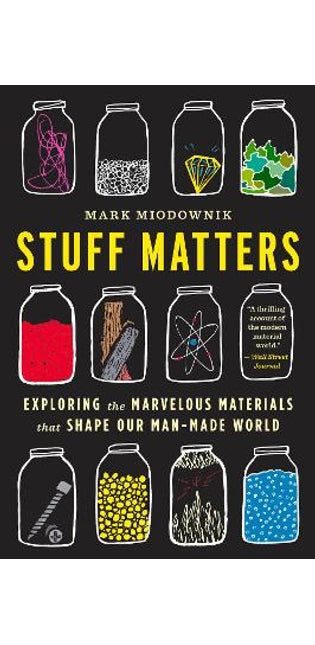
Stuff Matters
* * * Winner of the 2014 Royal Society Winton Prize for Science Books * * *Stuff Matters by Mark Miodnownik is a unique and inspiring exploration of human creativity.'Enthralling. A mission to re-acquaint us with the wonders of the fabric that sustains our lives' GuardianEverything is made of something...From the everyday objects in our homes to the most extraordinary new materials that will shape our future, Stuff Matters reveals the inner workings of the man-made world, the miracles of craft, design, engineering and ingenuity that surround us every day.From the tea-cup to the jet engine, the silicon chip to the paper clip, from the ancient technologies of fabrics and ceramic to today's self-healing metals and bionic implants, this is a book to inspire amazement and delight at mankind's creativity.'A certain sort of madness may be necessary to pull off what he has attempted here, which is a wholesale animation of the inanimate: Miodownik achieves precisely what he sets out to' The Times'Insightful, fascinating. The futuristic materials will elicit gasps. Makes even the most everyday substance seem exciting' Sunday Times'Wonderful. Miodownik writes well enough to make even concrete sparkle' Financial Times'I stayed up all night reading this book' Oliver Sacks'Expert, deftly written, immensely enjoyable' ObserverMark Miodownik is Professor of Materials and Society at UCL, scientist-in-residence on Dara O Briain's Science Club (BBC2) and presenter of several documentaries, including The Genius of Invention (BBC2). In 2010, he gave the Royal Institution Christmas Lectures, broadcast on BBC4. He is Director of the UCL Institute of Making, which is home to a materials library containing some of the most wondrous matter on earth, and has collaborated to make interactive events with many museums, such as Tate Modern, the Hayward Gallery and Wellcome Collection. In 2014 Stuff Matters won the Royal Society Winton Prize.
R 371.00
R 518.00
Marine Organic Matter: Biomarkers, Isotopes and DNA
The oceans contain a great biodiversity of marine organisms. They include a rich variety of unusual genes and biochemistries and hence a diverse array of organic compounds ranging from colourful carotenoids and chlorophylls to lipids with structures ranging from the simple to the complex. This volume brings together ten chapters on the occurrence and identification of the lipid biomarkers and of pigments in marine waters. It describes how they can be used in conjunction with stable isotopes and molecular biology to ascertain the sources and fate of organic matter (both natural and pollutant) in the sea and underlying sediments. The authors are each experts in their field and the chapters provide both an overview of the state-of-the-art and knowledge gaps together with abundant detail to satisfy the needs of specialists and non-specialists alike.
R 9,818.52
R 411.00
R 967.00
Make Marketing Matter
Stop justifying marketing. Start architecting growth.Too often, CMOs find they’re speaking a different language to the rest of the boardroom. Creativity and commerciality clash. Growth stalls. The exact opposite of what marketing leaders - and their CEOs - intended.There is a better way. Marketing leaders should be the architects of growth, operating strategically across three critical dimensions: resonating with the audience, translating boardroom priorities, and driving growth ambitions. More impact. More outcomes.For a decade, Emma Pownall was the only marketer in a high-performing tech company boardroom surrounded by leaders who didn’t understand marketing’s complexity or trust its value. Drawing on real-world examples of translating strategy into business language to secure investment, she shows marketing leaders - and their CEOs - how to elevate marketing’s strategic role, justify budgets and architect growth.
R 730.00
Make Marketing Matter
Stop justifying marketing. Start architecting growth.Too often, CMOs find they’re speaking a different language to the rest of the boardroom. Creativity and commerciality clash. Growth stalls. The exact opposite of what marketing leaders - and their CEOs - intended.There is a better way. Marketing leaders should be the architects of growth, operating strategically across three critical dimensions: resonating with the audience, translating boardroom priorities, and driving growth ambitions. More impact. More outcomes.For a decade, Emma Pownall was the only marketer in a high-performing tech company boardroom surrounded by leaders who didn’t understand marketing’s complexity or trust its value. Drawing on real-world examples of translating strategy into business language to secure investment, she shows marketing leaders - and their CEOs - how to elevate marketing’s strategic role, justify budgets and architect growth.
R 579.00
R 830.00
To Hell on a Fast Horse Large Print
"So richly detailed, you can almost smell the gunsmoke and the sweat of the saddles. " --Hampton Sides, New York Times bestselling author of Ghost Soldiers No outlaw typifies America's mythic Wild West more than Billy the Kid. To Hell on a Fast Horse by Mark Lee Gardner is the riveting true tale of Sheriff Pat Garrett's thrilling, break-neck chase in pursuit of the notorious bandit. David Dary calls To Hell on a Fast Horse, "A masterpiece," and Robert M. Utley calls it, "Superb narrative history." This is spellbinding historical adventure at its very best, recalling James Swanson's New York Times bestseller Manhunt--about the search for Lincoln's assassin, John Wilkes Booth--as it fills in with fascinating detail the story director Sam Peckinpah brought to the screen in his classic film Pat Garrett and Billy the Kid.
R 730.00
R 396.00
Slow Moon Climbs
A surprising look at the role of menopause in human history—and why we should change the ways we think about itAre the ways we look at menopause all wrong? Susan Mattern says yes and, in The Slow Moon Climbs, reveals just how wrong we have been. From the rainforests of Paraguay to the streets of Tokyo, Mattern draws on historical, scientific, and cultural research to show how perceptions of menopause developed from prehistory to today. Introducing new ways of understanding life beyond fertility, Mattern examines the fascinating “Grandmother Hypothesis,” looks at agricultural communities where households relied on postreproductive women for the family’s survival, and explores the emergence of menopause as a medical condition in the Western world. The Slow Moon Climbs casts menopause in the positive light it deserves—as an essential juncture and a key factor in human flourishing.
R 455.00
R 546.09
Living a Life That Matters
Money. Fame. Relationships. Knowledge. Having all these things—or even one—would make you happy, right? Well, maybe for a second. At least that’s what King Solomon learned—and he tried all those things on a HUGE scale and still wasn’t content. In fact, chasing those ideas and getting what he wanted actually made him more depressed. So what are we supposed to do if the wisest man in history couldn’t make those things work? Thankfully, Solomon left us a whole book of his trials and errors. Maybe you’ve looked at other people’s lives and thought, “If only I had that, my life would be perfect.” The problem is, those same people are asking the same question when they come across someone else. Even the wisest man in the world, Solomon, struggled with it. In Living a Life that Matters, author and “wisdom expert” Mark Matlock unpacks Solomon’s big “If only” questions on happiness in the book of Ecclesiastes to connect his timeless questions to yours, and explores what really makes a perfect life. Living a Life That Matters lets you gaze over Solomon’s shoulder as he indulges every pleasure, exercises every power, and emerges with a radical conclusion about how to live. You’ll also find ways that his search for meaning connects with yours today and how your story can connect with your friends’ as they seek meaning in the world.Living a Life that Matters:makes the book of Ecclesiastes relevant to teens’ lives—and also easy to understandcontains contemporary examples from pop culture and everyday lifeexplores what it means to live in the world today, as well as the real issue of depression and its effects
R 228.00
Market in Mind
A critical examination of translational medicine, when private risk is transferred to the public sector and university research teams become tech startups for global investors. A global shift has secretly transformed science and medicine. Starting in 2003, biomedical research in the West has been reshaped by the emergence of translational science and medicine-the idea that the aim of research is to translate findings as quickly as possible into medical products. In The Market in Mind, Mark Dennis Robinson charts this shift, arguing that the new research paradigm has turned university research teams into small biotechnology startups and their industry partners into early-stage investment firms. There is also a larger, surprising consequence from this shift: according to Robinson, translational science and medicine enable biopharmaceutical firms, as part of a broader financial strategy, to outsource the riskiest parts of research to nonprofit universities. Robinson examines the implications of this new configuration. What happens, for example, when universities absorb unknown levels of risk? Robinson argues that in the years since the global financial crisis translational science and medicine has brought about "the financialization of health." Robinson explores such topics as shareholder anxiety and industry retreat from Alzheimer's and depression research; how laboratory research is understood as health innovation even when there is no product; the emergence of investor networking events as crucial for viewing science in a market context; and the place of patients in research decisions. Although translational medicine justifies itself by the goal of relieving patients' suffering, Robinson finds patients' voices largely marginalized in translational neuroscience.
R 1,538.20
R 457.00
R 651.00
Droppers
Sex, drugs, and rock 'n' roll. In popular imagination, these words seem to capture the atmosphere of 1960s hippie communes. Yet when the first hippie commune was founded in 1965 outside Trinidad, Colorado, the goal wasn't one long party but rather a new society that integrated life and art. In Droppers, Mark Matthews chronicles the rise and fall of this utopian community, exploring the goals behind its creation and the factors that eventually led to its dissolution.Seeking refuge from enforced social conformity, the turmoil of racial conflict, and the Vietnam War, artist Eugene Bernofsky and other founders of Drop City sought to create an environment that would promote both equality and personal autonomy. These high ideals became increasingly hard to sustain, however, in the face of external pressures and internal divisions.In a rollicking, fast-paced style, Matthews vividly describes the early enthusiasm of Drop City's founders, as Bernofsky and his friends constructed a town in the desert literally using the ""detritus of society."" Over time, Drop City suffered from media attention, the distraction of visitors, and the arrival of new residents who didn't share the founders' ideals.Matthews bases his account on numerous interviews with Bernofsky and other residents as well as written sources. Explaining Drop City in the context of the counterculture's evolution and the American tradition of utopian communities, he paints an unforgettable picture of a largely misunderstood phenomenon in American history.
R 636.10
R 367.00
Do I Look at You with Love?
Do I Look at You with Love? were the words uttered by Mark Freeman’s mother when she learned, once again, that he was her son. This book explores the experience of dementia as it transpired during the course of the final twelve years of her life, from the time of her diagnosis until her death in 2016 at age 93. As a longtime student of memory, identity, and narrative, as well as the son of a woman with dementia, he had a remarkable opportunity to try to understand and tell her story. Much of the story is tragic. But there were other periods and other dimensions of relationship that were beautiful and that could not have emerged without her very affliction. In the midst of affliction there were gifts, arriving unbidden, that served to alert Freeman and his family to what is most precious and real. These are part of the story too. Part narrative psychology, part memoir, part meditation on the beauty and light that might be found amidst the ravages of time and memory, Freeman’s moving story is emblematic of nothing less than the bittersweet reality of life itself.
R 4,602.00
Matthew's Judaization of Mark
Creative imitation (Gk., mimesis; Lt., imitatio) was the primary literary convention of the ancient world of the first century CE. The first part of the book demonstrates that it was the principal means by which classical authors, such as Virgil, Seneca, Plutarch, and Livy, composed their works. An examination of the use of sources in both Jewish and Christian Sacred Scriptures in the light of this convention provides a new and fruitful approach to scripture scholarship. The Book of Tobit and Paul's First Letter to the Corinthians (1 Cor 8-10) are examined to demonstrate this thesis. This sets the context for an examination of Matthew's use of Mark as a literary source in the light of Graeco-Roman literary conventions in part two of the book. Such a use is entirely plausible when one considers that, "penned in Greek, probably to Diaspora audiences, the canonical gospels reflect Greco-Roman rather than strictly Palestinian Jewish literary conventions." Both the way in which Matthew incorporates his Markan source into his text, and the function and effect of this source in its new Matthean context are examined.This methodology provides compelling evidence that Matthew's use of Mark as a source was toward the Judaization of his Gospel.
R 6,474.00
R 244.00
Market Matters
Globalization of trade and organizational change increase the impact of markets in peoples' lives. But in what ways do markets matter? This book is about how financial analysts, marketing people, corporate leaders and other actors in Western market economies perceive, model, and use markets. It provides an ethnographic window into the cultural processes of contemporary markets; how people employ the market to solve problems, create capital, gain political ends, challenge economic processes, and delineate moral values and responsibilities.
R 3,029.98
R 214.00
R 1,059.78
R 667.94
Refiguring the Map of Sorrow
Recent decades have witnessed an explosion of interest in both autobiography and environmental literature. In Refiguring the Map of Sorrow, Mark Allister brings these two genres together by examining a distinct form of grief narrative, in which the writers deal with mourning by standing explicitly both outside and inside the text: outside in writing about the natural world; inside in making that exposition part of the grieving process.Building on Peter Fritzell's thesis in Nature Writing and America that the best American nature writing blends Aristotelian natural history and Augustinian confession, this work of literary interpretation draws on psychoanalytical narrative theory, studies of grieving, autobiography theory, and ecocriticism for its insights into how nature writing can become an autobiographical, healing act. Allister examines works by Terry Tempest Williams, Sue Hubbell, Peter Matthiessen, Bill Barich, William Least Heat-Moon, and Gretel Ehrlich in order to demonstrate the difficulty of hearing nature speak, and of translating terrain and self into language and form. As he focuses on the many ways in which humans connect--often deeply and urgently--to animals or the land, Allister vastly extends our understanding of "relational" autobiography.
R 2,031.00
R 458.00
R 184.00
Smoke Jumping on the Western Fire Line
During the Vietnam era, conscientious objectors received both sympathy and admiration from many Americans. It was not so during World War II. The pacifists who chose to sit out that war - some 72,000 men - were publicly derided as ""yellowbellies"" or extreme cowards. After all, why would anyone refuse to fight against fascism in ""the good war""?This book tells the story of one important group of World War II conscientious objectors: the men who volunteered for Civilian Public Service as U.S. Forest Service smoke jumpers. Based in Missoula, Montana, the experimental smoke-jumping program began in 1939, but before the project could expand, the war effort drained available manpower. In 1942, the Civilian Public Service volunteers stepped in. Smoke jumping soon became the Forest Service's first line of defense against wildfires in the West.Drawing on extensive interviews with World War II conscientious objectors and original documents from the period, Matthews vividly recreates the individual stories of Civilian Public Service smoke jumpers. He also assesses their collective contribution to the development of western wildfire management. By revealing an unknown dimension of American pacifism, Smoke Jumping on the Western Fire Line fills a gap in World War II history and restores the reputation of the brave men who, even in the face of public ostracism, held true to their beliefs and served their country with honor.
R 882.00
R 550.00
R 1,048.00