



Search results for "Matt Micros"
Items in stock - 4 working days delivery time

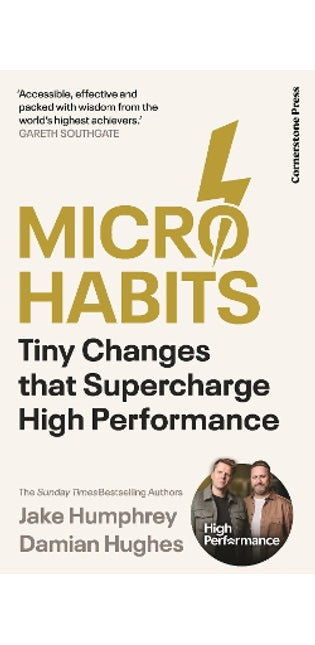
Micro-Habits
From the Sunday Times bestselling authors of High Performance'Packed with wisdom' ? GARETH SOUTHGATE'Extraordinary and empowering' ? LAURA KENNY'Full of tough love and practical wisdom' ? BEAR GRYLLS---What if you could change your life in less than five minutes?We assume that the highest-performing people are wired differently; that their success is down to nothing more than raw talent.But in the course of 400 conversations with the world's most remarkable individuals, Jake Humphrey and Damian Hughes have found the opposite: real success comes from small, often imperceptible changes in behaviour. They call them micro-habits.Drawing on exclusive interviews with leading high performers – from Olympic-medallists to billionaire entrepreneurs – Micro-Habits introduces the forty-eight simple tools that anyone can use to achieve excellence.The best thing? They work right away.---Drawing on conversations with . . .Ali Abdaal • Fernando Alonso • Usain Bolt • Stuart Broad • Dan Carter • Sabrina Cohen-Hatton • Brian Cox • Tom Daley • Jason Fox • Pippa Grange • Alex Honnold • Emily Maitlis • Joe Marler • Matthew McConaughey • Lando Norris • Sara Pascoe • Gordon Ramsay • Stephanie Shirley • Simon Sinek • Chris Voss • Sarina Wiegmanand many more . . .
R 455.00
Items we need to order for you
R 4,795.00
39 Microlectures
This work is a collection of minature stories, parables, musings and thoughts on the nature of reading, writing, art, collaboration, performance, life, death, the universe and everything. Matthew Goulish, founder member of performance group Goat Island, meditates on these and other diverse themes, proving, along the way, that the boundaries between poetry and criticism, and between creativity and theory, are a lot less fixed than they may seem.
R 9,336.27
R 1,247.68
R 458.00
Micro
Using luminous HUV printing, this immersive, intricately illustrated book takes readers on a tour of remarkable microscopic worlds, unseen by the naked eye. Offering close-up views of microscopic life in its original context, Micro takes the microscope out of the science lab and into the wild world. Meet mind-boggling organisms, like adorable 'water bears' who can survive in almost any conditions, even outer space; jewel-like diatoms that live in our oceans and help fight climate change; and alien-looking bacteria that keep our guts healthy. See the familiar become extraordinary, as we zoom in on soap bubbles, grains of sand and the eye of a fly to reveal the hidden beauty of everyday life. Highly-illustrated themed spreads focus on habitats and locations, including ponds, forests, deserts and even outer space, to reveal the microscopic creatures, plants and objects hidden within them. Readers will also discover exciting and unexpected uses for microscopes, looking at how forensic teams use them to solve crimes and how they have led to medical breakthroughs. The book features an introduction to microscope technology, with information about their history, how they work, and what they allow us to see. It also includes a practical guide on how to use one, so that children can explore microscopic worlds for themselves, at home or in school.
R 534.00
R 1,887.00
R 1,212.52
R 257.83
R 275.00
R 329.59
Social Practices and Microscopic Matter
This timely volume demonstrates the power and the potential of social theory, including theories of practice, histories and biographies of disease, and geographical accounts of cohabitation and contagion, to explore how biological, microbial and social processes constitute each other.It is widely recognised that biological, microbial and social processes constitute each other, but there is much less agreement about what this means, or about how this interweaving should be conceptualised and studied. Whilst recognising that there been huge growth in more-than-human approaches and in contributions from science and technology studies and feminist scholarship, this volume advocates that more ideas are needed if we are to address global threats, including the impacts of climate change, growing antimicrobial resistance, pandemics, the geographies and distribution of zoonoses, and other large biosocial phenomena.Contributors from disciplines including anthropology, geography, sociology and public health, bring these resources to bear on fundamental questions about scale and transmission, the place of human bodies in social and biological theory, and concepts of health, risk and disease. Informed by real-life examples relating to food, insects, water and air, the spread of disease and antimicrobial resistance, the result is an agenda-setting book positioned at the intersection of research and policy.It will appeal to scholars and academics with interested in social theory, microbes, and public health, and well as academics and advanced students of geography, anthropology, sociology, medical sociology, social studies of science, and the history of health.
R 2,235.00
Social Practices and Microscopic Matter
This timely volume demonstrates the power and the potential of social theory, including theories of practice, histories and biographies of disease, and geographical accounts of cohabitation and contagion, to explore how biological, microbial and social processes constitute each other.It is widely recognised that biological, microbial and social processes constitute each other, but there is much less agreement about what this means, or about how this interweaving should be conceptualised and studied. Whilst recognising that there been huge growth in more-than-human approaches and in contributions from science and technology studies and feminist scholarship, this volume advocates that more ideas are needed if we are to address global threats, including the impacts of climate change, growing antimicrobial resistance, pandemics, the geographies and distribution of zoonoses, and other large biosocial phenomena.Contributors from disciplines including anthropology, geography, sociology and public health, bring these resources to bear on fundamental questions about scale and transmission, the place of human bodies in social and biological theory, and concepts of health, risk and disease. Informed by real-life examples relating to food, insects, water and air, the spread of disease and antimicrobial resistance, the result is an agenda-setting book positioned at the intersection of research and policy.It will appeal to scholars and academics with interested in social theory, microbes, and public health, and well as academics and advanced students of geography, anthropology, sociology, medical sociology, social studies of science, and the history of health.
R 8,572.00
Microbial Mats
Microbial mats are benthic communities of a variety of microorganisms. Their investigation requires multidisciplinary studies and close cooperation between microbiologists, biogeochemists, and geologists.Reported here are recent advances in the study of structure, development and ecological relationships. The methodology described includes microsensors as well as new molecular techniques for the detection and identification of microorganisms. Increasing interest exists for applied aspects, e.g. the possibility to use natural or constructed microbial mats for the degradation of xenobiotics, for site remediation, etc.
R 3,068.49
Scanning SQUID Microscope for Studying Vortex Matter in Type-II Superconductors
Common methods of local magnetic imaging display either a high spatial resolution and relatively poor field sensitivity (MFM, Lorentz microscopy), or a relatively high field sensitivity but limited spatial resolution (scanning SQUID microscopy). Since the magnetic field of a nanoparticle or nanostructure decays rapidly with distance from the structure, the achievable spatial resolution is ultimately limited by the probe-sample separation. This thesis presents a novel method for fabricating the smallest superconducting quantum interference device (SQUID) that resides on the apex of a very sharp tip. The nanoSQUID-on-tip displays a characteristic size down to 100 nm and a field sensitivity of 10^-3 Gauss/Hz^(1/2). A scanning SQUID microsope was constructed by gluing the nanoSQUID-on-tip to a quartz tuning-fork. This enabled the nanoSQUID to be scanned within nanometers of the sample surface, providing simultaneous images of sample topography and the magnetic field distribution. This microscope represents a significant improvement over the existing scanning SQUID techniques and is expected to be able to image the spin of a single electron.
R 4,401.18
Optical Microscopy of Materials
Since Sorby published his observations on the structures of steels in 1863, the optical microscope has become one of the most widely used and versatile instruments for examining the structures of engineering materials. Moreover, to examine the diverse range of materials encountered, it must be used in both the reflected-light and transmitted-light forms, and with polarized light. It is complementary to, but not superseded by, the wide range of electron-optical instruments that are now used. Despite its extensive use, it has been described as the most misused, abused, and misunderstood of scientific instruments, for it will produce an image of a sort no matter how badly it is used. To use it effectively, even in its simplest applications, a knowledge of the simple theory of the microscope is necessary, for the theory shows and explains how it should be used. Thus my aim has been to give a simple and, where possible, quantitative account of both the theory and the use of the microscope, including the various special techniques for which it can be used. But, no matter how effectively the microscope is used, if the specimen is inadequately prepared the results of examination will be of doubtful value.
R 2,203.85
R 1,246.81
Microscopic Aspects of Nonlinearity in Condensed Matter
The collection of articles in this volume represents the proceedings of the inau- gural Conference of the Institute of Theoretical Matter Physics at the University of Florence, Italy, June 7-13, 1990. The aim of this Institute (sponsored by the Con- sorzio Interuniversitario di Fisica della Materia, INFM) is to foster interdisciplinary approaches to theoretical problems in Solid State, Electronics and Optics. Corre- spondingly, the Conference surveyed a broad scope of modern analytic techniques in nonlinear science and their application to novel liquids, solids and optical environ- ments. The Conference was held at Centro Studi CISL, a magnificent Villa up to Florence.The major topics addressed through survey and specialized lectures, discussions and posters were: Complexity and Coherence in spin glasses, associative distribu- tive memory, low dimensional electronic materials, magnets, Josephson junction ar- rays, optics, semiconductors, convection cells, material science, high-temperature superconductivity; Physics of Quantum Devices such as nonlinear feedback oscilla- tors, macroscopic quantum tunneling, hetero structures, quantum ballistic devices, tunneling in atomic devices; Field Theory and Statistical Mechanics, especially for soliton-bearing and quantum chaotic systems. Many exciting ideas and results were presented and debated in lively fashion. Perhaps two major themes were evident throughout the workshop.
R 1,596.25
Micromastery
'Micromastery is a triumph. I read it with delight, and instantly vowed to put more conviction into the latest thing I'm trying, which is using a plectrum when I play the guitar'Philip PullmanWant to learn how to cook? Start by making an omelette.Want to be able to dance? First learn the Tango Walk.Want to be more creative, smarter and happier? Read this book.Micromastery is the inspiring new way to approach any kind of challenge or skill. With this simple, accessible technique you can get a grip on new subjects quickly, then experiment and grow.Whether it's making a perfect soufflé, painting a door or lighting a fire -- just three of the thirty nine little skills this book will teach you -- you'll find that cultivating micro areas of expertise is life-changing. Become a fearless learner, spot more creative opportunities, and improve your brain health and wellbeing.Start small. Start specific. But start - and you'll be on the path to mastery.'A brilliantly smart, cunningly simple idea. Conquering every skill, talent, and life hack in seconds is what the modern man yearns for'Jim Allen, MD, RDF Television'Robert Twigger is an inspiring author. Read this book!'Nick Hodgson, Kaiser Chiefs'Brilliant. . . . mastering a series of small tasks has created pockets of perfection through my day, and made me calmer and happier in the process'Rachel Kelly, author of Walking on Sunshine: 52 Small Steps to HappinessRobert Twigger is an author, adventure traveller and apprentice micromaster. His first book, Angry White Pyjamas, about a year spent in a Japanese martial arts dojo, won the William Hill Sports Book of the Year Award and the Somerset Maugham Award. He has lectured on risk management, polymathics and leadership at Oxford Brookes Business School, Oxford University, the Royal College of Art, and to companies including P&G, Maersk shipping, Oracle computing and SAB Miller.
R 314.00
R 3,451.51
Statistical Disclosure Control for Microdata
This book on statistical disclosure control presents the theory, applications and software implementation of the traditional approach to (micro)data anonymization, including data perturbation methods, disclosure risk, data utility, information loss and methods for simulating synthetic data. Introducing readers to the R packages sdcMicro and simPop, the book also features numerous examples and exercises with solutions, as well as case studies with real-world data, accompanied by the underlying R code to allow readers to reproduce all results. The demand for and volume of data from surveys, registers or other sources containing sensible information on persons or enterprises have increased significantly over the last several years. At the same time, privacy protection principles and regulations have imposed restrictions on the access and use of individual data. Proper and secure microdata dissemination calls for the application of statistical disclosure control methods to the data before release. This book is intended for practitioners at statistical agencies and other national and international organizations that deal with confidential data. It will also be interesting for researchers working in statistical disclosure control and the health sciences.
R 3,297.00
From Small Talk to Microaggression
A provocative and eye-opening history of how we have studied and theorized social interaction. In this ambitious, wide-ranging book, anthropologist Michael Lempert offers a conceptual history that explores how, why, and with what effects we have come to think of interactions as “scaled.” Focusing on the sciences of interaction in midcentury America, Lempert traces how they harnessed diverse tools and media technologies, from dictation machines to 16mm film, to study communication “microscopically.” In looking closely, many hoped to transform interaction: to improve efficiency, grow democracy, curb racism, and much else. Yet their descent into a microworld created troubles, with some critics charging that these scientists couldn’t see the proverbial forest for the trees. Exploring talk therapy and group dynamics studies, social psychology and management science, conversation analysis, “micropolitics,” and more, Lempert shows how scale became a defining problem across the behavioral sciences. Ultimately, he argues, if we learn how our objects of study have been scaled in advance, we can better understand how we think and interact with them—and with each other—across disciplinary and ideological divides. Even as once-fierce debates over micro and macro have largely subsided, Lempert shows how scale lives on and continues to affect the ethics and politics of language and communication today.
R 3,384.00
Why Gut Microbes Matter
Given the at times confusing new information concerning the human microbiome released over the last few years, this book seeks to put the research field into perspective for non-specialists. Addressing a timely topic, it breaks down recent research developments in a way that everyone with a scientific background can understand.The book discusses why microorganisms are vital to our lives and how our nutrition influences the interaction with our own gut bacteria. In turn, it goes into more detail on how microbial communities are organised and why they are able to survive in the unique environment of our intestines. Readers will also learn about how their personal microbial profile is as unique as their fingerprint, and how it can be affected by a healthy or unhealthy lifestyle. Thanks to the open and easy-to-follow language used, the book offers an overview for all readers with a basic understanding of biology, and sheds new light on this fascinating and important part of our bodies.
R 2,392.17
R 611.00
Integrated Microsystems
As rapid technological developments occur in electronics, photonics, mechanics, chemistry, and biology, the demand for portable, lightweight integrated microsystems is relentless. These devices are getting exponentially smaller, increasingly used in everything from video games, hearing aids, and pacemakers to more intricate biomedical engineering and military applications.Edited by Kris Iniewski, a revolutionary in the field of advanced semiconductor materials, Integrated Microsystems: Electronics, Photonics, and Biotechnology focuses on techniques for optimized design and fabrication of these intelligent miniaturized devices and systems. Composed of contributions from experts in academia and industry around the world, this reference covers processes compatible with CMOS integrated circuits, which combine computation, communications, sensing, and actuation capabilities.Light on math and physics, with a greater emphasis on microsystem design and configuration and electrical engineering, this book is organized in three sections—Microelectronics and Biosystems, Photonics and Imaging, and Biotechnology and MEMs. It addresses key topics, including physical and chemical sensing, imaging, smart actuation, and data fusion and management. Using tables, figures, and equations to help illustrate concepts, contributors examine and explain the potential of emerging applications for areas including biology, nanotechnology, micro-electromechanical systems (MEMS), microfluidics, and photonics.
R 5,988.91
Super-Resolution Microscopy for Material Science
Optical microscopy is one of the most frequently used tools in chemistry and the life sciences. However, its limited resolution hampers the use of optical imaging to many other relevant problems in different disciplines. Super-Resolution Microscopy (SRM) is a new technique that allows the resolution of objects down to few billionth of meters (nanometers), ten times better than classical microscopes, opening up opportunities to use this tool in new fields.This book describes the theory, principles, and practice of super-resolution microscopy in the field of materials science and nanotechnology. There is a growing interest in the applications of SRM beyond biology as new synthetic materials, such as nanoscale sensors and catalysts, nanostructured materials, functional polymers, and nanoparticles, have nanoscopic features that are challenging to visualize with traditional imaging methods.SRM has the potential to be used to image and understand these cutting-edge man-made objects and guide the design of materials for novel applications.This book is an ideal guide for researchers in the field of microscopy and materials science and chemistry as well as graduate students studying physics, materials science, biomedical engineering, and chemistry.Key Features:• Contains practical guidance on Super-Resolution Microscopy (SRM), an exciting and growing tool that was awarded the Nobel Prize for chemistry in 2014.• Provides a new perspective targeting materials science, unlike existing books which target readers in chemistry, life science, and biology.• Targets both students, in its core chapters, with more advanced material for professionals and researchers within later chapters.Lorenzo Albertazzi is Associate Professor at Eindhoven University, The Netherlands, within the department of Biomedical Engineering. He obtained a MSc in Chemistry (2007) and a PhD in Biophysics (2011) from Scuola Normale Superiore (Pisa, Italy). He then joined Eindhoven University of Technology as postdoctoral researcher and in 2014 he became a NWO/VENI fellow. In 2015, he moved to Barcelona (Spain) to the Institute of Bioengineering of Catalonia (IBEC) to start the 'Nanoscopy for Nanomedicine' group. Since 2018 he is associate professor at TU/e leading the research group Nanoscopy for Nanomedicine. Peter Zijlstra is an Associate Professor at Eindhoven University, The Netherlands, in the research group Molecular Biosensing within the department of Applied Physics. He studied Applied Physics at the University of Twente (Enschede, The Netherlands), where he obtained his MSc degree in 2005. In 2009, he received his PhD from Swinburne University of Technology (Melbourne, Australia), where he studied the photothermal properties of single plasmonic nanoparticles with applications in optical data storage. After a postdoctoral fellowship in the lab of Prof. Michel Orrit at Leiden University (The Netherlands) he moved to Eindhoven University of Technology (TU/e, The Netherlands). He is a cor
R 7,193.82
LECTURES ON MICROMECHANICS OF MATERIALS: DEFORMATION AND FAILURE
This book guides readers through topics on unidirectional microstructures, short fiber composites, particle composites, and an introduction on homogenization and localization. Each chapter builds in complexity to explore the deformation and failure of multiphase materials, firmly placing micromechanical modeling at the heart of modern materials engineering. The comprehensive series of example problems provide a roadmap for solving complex issues related to both elastic properties and material failure. Lectures on Micromechanics of Materials: Deformation and Failure provides the definitive bridge for readers transitioning from foundational material mechanics to the specialized study of multiphase systems and composite structures. It is suitable for advanced undergraduate and graduate courses on Micromechanics, Composite Mechanics, Strength of Materials and Materials Engineering.
R 1,759.00
R 748.00
Microbial Mats
This book provides information about microbial mats, from early fossils to modern mats located in marine and terrestrial environments. Microbial mats – layered biofilms containing different types of cells – are most complex systems in which representatives of various groups of organisms are found together. Among them are cyanobacteria and eukaryotic phototrophs, aerobic heterotrophic and chemoautotrophic bacteria, protozoa, anoxygenic photosynthetic bacteria, and other types of microorganisms.These mats are perfect models for biogeochemical processes, such as the cycles of chemical elements, in which a variety of microorganisms cooperate and interact in complex ways. They are often found under extreme conditions and their study contributes to our understanding of extremophilic life. Moreover, microbial mats are models for Precambrian stromatolites; the study of modern microbial mats may provide information on the processes that may have occurred on Earth when prokaryotic life began to spread.
R 8,119.11
LECTURES ON MICROMECHANICS OF MATERIALS: DEFORMATION AND FAILURE
This book guides readers through topics on unidirectional microstructures, short fiber composites, particle composites, and an introduction on homogenization and localization. Each chapter builds in complexity to explore the deformation and failure of multiphase materials, firmly placing micromechanical modeling at the heart of modern materials engineering. The comprehensive series of example problems provide a roadmap for solving complex issues related to both elastic properties and material failure. Lectures on Micromechanics of Materials: Deformation and Failure provides the definitive bridge for readers transitioning from foundational material mechanics to the specialized study of multiphase systems and composite structures. It is suitable for advanced undergraduate and graduate courses on Micromechanics, Composite Mechanics, Strength of Materials and Materials Engineering.
R 3,224.00
micro
Aprende a programar en Python divirti ndote con tu micro: bit. M s de 35 programas con explicaciones. Todo el c digo de los programas es descargable desde internet. La mayor parte de los ejemplos solo necesitan disponer de una micro: bit y un ordenador al que conectarlo. Sobre el autor: J.C. Bautista ha sido profesor de tecnolog a, inform tica, matem ticas y ciencias en Educaci n Secundaria durante m s de 15 a os. Es autor tambi n del libro Matem ticas y Programaci n en Python. Actualmente trabaja como editor de libros de texto de ciencias, matem ticas y tecnolog a para educaci n primaria y secundaria.
R 352.40
R 1,805.57
Microscopy of Semiconducting Materials
The 14th conference in the series focused on the most recent advances in the study of the structural and electronic properties of semiconducting materials by the application of transmission and scanning electron microscopy. The latest developments in the use of other important microcharacterisation techniques were also covered and included the latest work using scanning probe microscopy and also X-ray topography and diffraction.
R 9,468.96
Microstructural Characterization of Materials
Microstructural characterization is usually achieved by allowing some form of probe to interact with a carefully prepared specimen. The most commonly used probes are visible light, X-ray radiation, a high-energy electron beam, or a sharp, flexible needle. These four types of probe form the basis for optical microscopy, X-ray diffraction, electron microscopy, and scanning probe microscopy. Microstructural Characterization of Materials, 2nd Edition is an introduction to the expertise involved in assessing the microstructure of engineering materials and to the experimental methods used for this purpose. Similar to the first edition, this 2nd edition explores the methodology of materials characterization under the three headings of crystal structure, microstructural morphology, and microanalysis. The principal methods of characterization, including diffraction analysis, optical microscopy, electron microscopy, and chemical microanalytical techniques are treated both qualitatively and quantitatively. An additional chapter has been added to the new edition to cover surface probe microscopy, and there are new sections on digital image recording and analysis, orientation imaging microscopy, focused ion-beam instruments, atom-probe microscopy, and 3-D image reconstruction. As well as being fully updated, this second edition also includes revised and expanded examples and exercises, with a solutions manual available at http://develop.wiley.co.uk/microstructural2e/ Microstructural Characterization of Materials, 2nd Edition will appeal to senior undergraduate and graduate students of material science, materials engineering, and materials chemistry, as well as to qualified engineers and more advanced researchers, who will find the book a useful and comprehensive general reference source.
R 2,962.00
Applications of Microscopy in Materials and Life Sciences
This book comprises the proceedings of the 12th International Conference on Asia-Pacific Microscopy Conference (APMC12) focusing on emerging opportunities and challenges in the field of materials sciences, life sciences and microscopy techniques. The contents of this volume include papers on aberration corrected TEM & STEM, SEM – FIB, ion beam microscopy, electron diffraction & crystallography, microscopy and imaging associated with bio-nanotechnology, medical applications, host-pathogen interaction, etc. This book will be beneficial to researchers, educators, and practitioners alike.
R 6,228.00
In-Situ Microscopy in Materials Research
2. High Temperature UHV-STM System 264 3. Hydrogen Desorption Process on Si (111) Surface 264 4. (7x7) - (1 xl) Phase Transition on Si (111) Surface 271 Step Shifting under dc Electric Fields 275 5. 6. Conclusions 280 Acknowledgements and References 281 12. DYNAMIC OBSERVATION OF VORTICES IN SUPERCONDUCTORS USING ELECTRON WAVES 283 by Akira Tonomura 1. Introduction 283 2. Experimental Method 284 2. 1 Interference Microscopy 284 2. 2 Lorentz Microscopy 287 Observation of Superconducting Vortices 288 3. 3. 1 Superconducting Vortices Observed by Interference Microscopy 288 3. 1. 1 Profile Mode 288 3. 1. 2 Transmission Mode 291 3. 2 Superconducting Vortices Observed by Lorentz Microscopy 293 3. 3 Observation of Vortex Interaction with Pinning Centers 294 3. 3. 1 Surface Steps 295 3. 3. 2 Irradiated Point Defects 296 4. Conclusion 298 References 299 13. TEM STUDIES OF SOME STRUCTURALLY FLEXIBLE SOLIDS AND THEIR ASSOCIATED PHASE TRANSFORMATIONS 301 by Ray L. Withers and John G. Thompson 1. Introduction 301 2. Tetrahedrally Comer-Connected Framework Structures 302 3. Tetragonal a-PbO 311 4. Compositionally Flexible Anion-Deficient Fluorites and the "Defect Fluorite" to C-type Sesquioxide Transition 320 5. Summary and Conclusions 327 Acknowledgements and References 327 Author Index 331 Subject Index 333 List of Contributors A. ASEEV Institute of Semiconductor Physics, Russian Academy of Sciences Novosibirsk, 630090, pr. ac. , Lavrentjeva 13, RUSSIA E. BAUER Department of Physics and Astronomy, Arizona State University Tempe, AZ 85287-1504, U. S. A. G. H.
R 4,664.01
Microbial Mats
This book provides information about microbial mats, from early fossils to modern mats located in marine and terrestrial environments. Microbial mats – layered biofilms containing different types of cells – are most complex systems in which representatives of various groups of organisms are found together. Among them are cyanobacteria and eukaryotic phototrophs, aerobic heterotrophic and chemoautotrophic bacteria, protozoa, anoxygenic photosynthetic bacteria, and other types of microorganisms.These mats are perfect models for biogeochemical processes, such as the cycles of chemical elements, in which a variety of microorganisms cooperate and interact in complex ways. They are often found under extreme conditions and their study contributes to our understanding of extremophilic life. Moreover, microbial mats are models for Precambrian stromatolites; the study of modern microbial mats may provide information on the processes that may have occurred on Earth when prokaryotic life began to spread.
R 7,397.99
Applications of Microscopy in Materials and Life Sciences
This book comprises the proceedings of the 12th International Conference on Asia-Pacific Microscopy Conference (APMC12) focusing on emerging opportunities and challenges in the field of materials sciences, life sciences and microscopy techniques. The contents of this volume include papers on aberration corrected TEM & STEM, SEM – FIB, ion beam microscopy, electron diffraction & crystallography, microscopy and imaging associated with bio-nanotechnology, medical applications, host-pathogen interaction, etc. This book will be beneficial to researchers, educators, and practitioners alike.
R 7,156.36
In-Situ Microscopy in Materials Research
2. High Temperature UHV-STM System 264 3. Hydrogen Desorption Process on Si (111) Surface 264 4. (7x7) - (1 xl) Phase Transition on Si (111) Surface 271 Step Shifting under dc Electric Fields 275 5. 6. Conclusions 280 Acknowledgements and References 281 12. DYNAMIC OBSERVATION OF VORTICES IN SUPERCONDUCTORS USING ELECTRON WAVES 283 by Akira Tonomura 1. Introduction 283 2. Experimental Method 284 2. 1 Interference Microscopy 284 2. 2 Lorentz Microscopy 287 Observation of Superconducting Vortices 288 3. 3. 1 Superconducting Vortices Observed by Interference Microscopy 288 3. 1. 1 Profile Mode 288 3. 1. 2 Transmission Mode 291 3. 2 Superconducting Vortices Observed by Lorentz Microscopy 293 3. 3 Observation of Vortex Interaction with Pinning Centers 294 3. 3. 1 Surface Steps 295 3. 3. 2 Irradiated Point Defects 296 4. Conclusion 298 References 299 13. TEM STUDIES OF SOME STRUCTURALLY FLEXIBLE SOLIDS AND THEIR ASSOCIATED PHASE TRANSFORMATIONS 301 by Ray L. Withers and John G. Thompson 1. Introduction 301 2. Tetrahedrally Comer-Connected Framework Structures 302 3. Tetragonal a-PbO 311 4. Compositionally Flexible Anion-Deficient Fluorites and the "Defect Fluorite" to C-type Sesquioxide Transition 320 5. Summary and Conclusions 327 Acknowledgements and References 327 Author Index 331 Subject Index 333 List of Contributors A. ASEEV Institute of Semiconductor Physics, Russian Academy of Sciences Novosibirsk, 630090, pr. ac. , Lavrentjeva 13, RUSSIA E. BAUER Department of Physics and Astronomy, Arizona State University Tempe, AZ 85287-1504, U. S. A. G. H.
R 4,663.11
Microscopy of Semiconducting Materials
The 14th conference in the series focused on the most recent advances in the study of the structural and electronic properties of semiconducting materials by the application of transmission and scanning electron microscopy. The latest developments in the use of other important microcharacterisation techniques were also covered and included the latest work using scanning probe microscopy and also X-ray topography and diffraction.
R 8,059.00


