Search results for "Pinker"
Items in stock - 4 working days delivery time

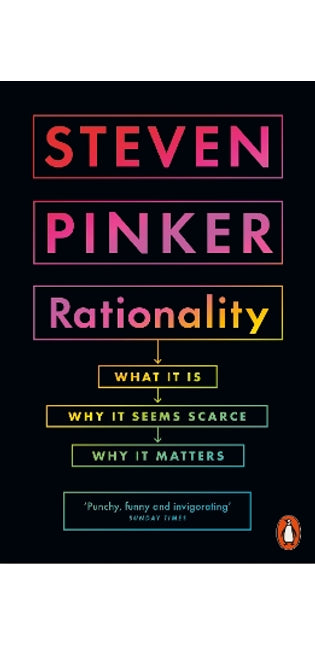
Rationality
A TIMES BOOK OF THE YEAR 2021 'Punchy, funny and invigorating ... Pinker is the high priest of rationalism' Sunday Times 'If you've ever considered taking drugs to make yourself smarter, read Rationality instead. It's cheaper, more entertaining, and more effective' Jonathan Haidt, author of The Righteous Mind In the twenty-first century, humanity is reaching new heights of scientific understanding - and at the same time appears to be losing its mind. How can a species that discovered vaccines for Covid-19 in less than a year produce so much fake news, quack cures and conspiracy theorizing? In Rationality, Pinker rejects the cynical cliché that humans are simply an irrational species - cavemen out of time fatally cursed with biases, fallacies and illusions. After all, we discovered the laws of nature, lengthened and enriched our lives and set the benchmarks for rationality itself. Instead, he explains, we think in ways that suit the low-tech contexts in which we spend most of our lives, but fail to take advantage of the powerful tools of reasoning we have built up over millennia: logic, critical thinking, probability, causal inference, and decision-making under uncertainty. These tools are not a standard part of our educational curricula, and have never been presented clearly and entertainingly in a single book - until now. Rationality matters. It leads to better choices in our lives and in the public sphere, and is the ultimate driver of social justice and moral progress. Brimming with insight and humour, Rationality will enlighten, inspire and empower. 'A terrific book, much-needed for our time' Peter Singer
R 305.00
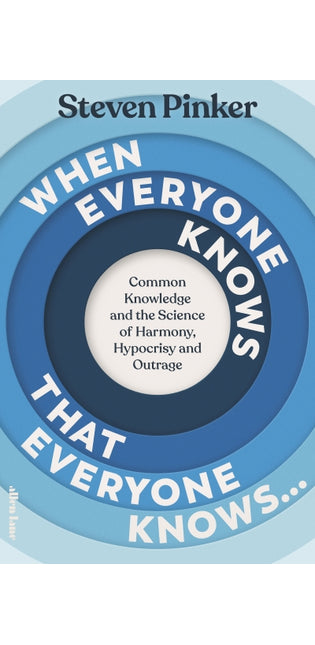
When Everyone Knows That Everyone Knows...
'One of the most insightful books I’ve read about what makes us human and how we understand each other' Bill GatesSteven Pinker, one of the world's greatest thinkers and bestselling author of Enlightenment Now, The Better Angels of Our Nature and The Language Instinct, reveals the power and perils of thinking alikeAs a cognitive scientist, the ultimate subject of Steven Pinker’s fascination is how we think about each other’s thoughts, ad infinitum. It sounds impossible, but Steven Pinker shows that we do it all the time. This awareness, which we experience as something that is public or “out there,” is called common knowledge, and it has a momentous impact on our social, political, and economic lives.Common knowledge, Pinker shows, can make sense of many of life’s enigmas: financial bubbles and crashes, revolutions that come out of nowhere, the posturing and pretence of diplomacy, the eruption of social media shaming mobs and academic cancel culture, the awkwardness of a first date. But people also go to great lengths to avoid common knowledge?to ensure that even if everyone knows something, they can’t know that everyone else knows they know it. And so we get rituals like benign hypocrisy, veiled bribes and threats, sexual innuendo, and pretending not to see the elephant in the room.In exploring the paradoxes of human behaviour, When Everyone Knows that Everyone Knows… invites us to understand the ways we try to get into each other’s heads, and the harmonies, hypocrisies, and outrages that result.Read less
R 355.00
When Everyone Knows That Everyone Knows
As a cognitive scientist, the ultimate subject of Steven Pinker’s fascination is how we think about each other’s thoughts, ad infinitum. It sounds impossible, but Steven Pinker shows that we do it all the time. This awareness, which we experience as something that is public or “out there,” is called common knowledge, and it has a momentous impact on our social, political, and economic lives. Common knowledge, Pinker shows, can make sense of many of life’s enigmas: financial bubbles and crashes, revolutions that come out of nowhere, the posturing and pretence of diplomacy, the eruption of social media shaming mobs and academic cancel culture, the awkwardness of a first date. But people also go to great lengths to avoid common knowledge—to ensure that even if everyone knows something, they can’t know that everyone else knows they know it. And so we get rituals like benign hypocrisy, veiled bribes and threats, sexual innuendo, and pretending not to see the elephant in the room. In exploring the paradoxes of human behaviour, When Everyone Knows that Everyone Knows… invites us to understand the ways we try to get into each other’s heads, and the harmonies, hypocrisies, and outrages that result.
R 510.00

Items we need to order for you
R 585.99
Blank Slate
A brilliant inquiry into the origins of human nature from the author of Rationality, The Better Angels of Our Nature, and Enlightenment Now. "Sweeping, erudite, sharply argued, and fun to read..also highly persuasive." --Time Updated with a new afterword One of the world's leading experts on language and the mind explores the idea of human nature and its moral, emotional, and political colorings. With characteristic wit, lucidity, and insight, Pinker argues that the dogma that the mind has no innate traits-a doctrine held by many intellectuals during the past century-denies our common humanity and our individual preferences, replaces objective analyses of social problems with feel-good slogans, and distorts our understanding of politics, violence, parenting, and the arts. Injecting calm and rationality into debates that are notorious for ax-grinding and mud-slinging, Pinker shows the importance of an honest acknowledgment of human nature based on science and common sense.
R 525.00
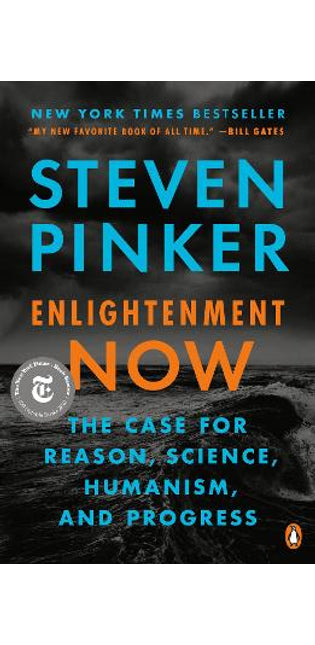
Enlightenment Now
INSTANT NEW YORK TIMES BESTSELLER A NEW YORK TIMES NOTABLE BOOK OF 2018 ONE OF THE ECONOMIST'S BOOKS OF THE YEAR "My new favorite book of all time." --Bill Gates If you think the world is coming to an end, think again: people are living longer, healthier, freer, and happier lives, and while our problems are formidable, the solutions lie in the Enlightenment ideal of using reason and science. By the author of the new book, Rationality. Is the world really falling apart? Is the ideal of progress obsolete? In this elegant assessment of the human condition in the third millennium, cognitive scientist and public intellectual Steven Pinker urges us to step back from the gory headlines and prophecies of doom, which play to our psychological biases. Instead, follow the data: In seventy-five jaw-dropping graphs, Pinker shows that life, health, prosperity, safety, peace, knowledge, and happiness are on the rise, not just in the West, but worldwide. This progress is not the result of some cosmic force. It is a gift of the Enlightenment: the conviction that reason and science can enhance human flourishing. Far from being a naive hope, the Enlightenment, we now know, has worked. But more than ever, it needs a vigorous defense. The Enlightenment project swims against currents of human nature--tribalism, authoritarianism, demonization, magical thinking--which demagogues are all too willing to exploit. Many commentators, committed to political, religious, or romantic ideologies, fight a rearguard action against it. The result is a corrosive fatalism and a willingness to wreck the precious institutions of liberal democracy and global cooperation. With intellectual depth and literary flair, Enlightenment Now makes the case for reason, science, and humanism: the ideals we need to confront our problems and continue our progress.
R 434.00
Enlightenment Now
THE TOP TEN SUNDAY TIMES BESTSELLER'Bristles with pure, crystalline intelligence, deep knowledge and human sympathy' Richard Dawkins Is modernity really failing? Or have we failed to appreciate progress and the ideals that make it possible?If you follow the headlines, the world in the 21st century appears to be sinking into chaos, hatred, and irrationality. Yet Steven Pinker shows that this is an illusion - a symptom of historical amnesia and statistical fallacies. If you follow the trendlines rather than the headlines, you discover that our lives have become longer, healthier, safer, happier, more peaceful, more stimulating and more prosperous - not just in the West, but worldwide. Such progress is no accident: it's the gift of a coherent and inspiring value system that many of us embrace without even realizing it. These are the values of the Enlightenment: of reason, science, humanism and progress.The challenges we face today are formidable, including inequality, climate change, Artificial Intelligence and nuclear weapons. But the way to deal with them is not to sink into despair or try to lurch back to a mythical idyllic past; it's to treat them as problems we can solve, as we have solved other problems in the past. In making the case for an Enlightenment newly recharged for the 21st century, Pinker shows how we can use our faculties of reason and sympathy to solve the problems that inevitably come with being products of evolution in an indifferent universe. We will never have a perfect world, but - defying the chorus of fatalism and reaction - we can continue to make it a better one.
R 534.00
Language, Cognition, and Human Nature
Language, Cognition, and Human Nature collects together for the first time much of Steven Pinker's most influential scholarly work on language and cognition. Pinker's seminal research explores the workings of language and its connections to cognition, perception, social relationships, child development, human evolution, and theories of human nature. This eclectic collection spans Pinker's thirty-year career, exploring his favorite themes in greater depth and scientific detail. It includes thirteen of Pinker's classic articles, ranging over topics such as language development in children, mental imagery, the recognition of shapes, the computational architecture of the mind, the meaning and uses of verbs, the evolution of language and cognition, the nature-nurture debate, and the logic of innuendo and euphemism. Each outlines a major theoryor takes up an argument with another prominent scholar, such as Stephen Jay Gould, Noam Chomsky, or Richard Dawkins. Featuring a new introduction by Pinker that discusses his books and scholarly work, this collection reflects essential contributions to cognitive science by one of our leading thinkersand public intellectuals.
R 826.00
R 397.00
Language, Cognition, and Human Nature
Language, Cognition, and Human Nature collects together for the first time Steven Pinker's most influential scholarly work on language and cognition. Pinker is a highly eminent cognitive scientist, and his research emphasizes the importance of language and its connections to cognition, social relationships, child development, human evolution, and theories of human nature. The thirteen essays in this eclectic collection span Pinker's thirty-year career,ranging over topics such as language acquisitions, visual cognition, the meaning and syntax of verbs, regular and irregular phenomena in language and their implications for the mechanisms of cognition, and the social psychology of direct and indirect speech. Each outlines a major theory - such as evolution, ornature vs. nurture - or takes up an argument with other prominent scholars such as Stephen Jay Gould, Noam Chomsky, or Richard Dawkins. Featuring a new introduction by Pinker that discusses his books and scholarly work, this book represents a major contribution to the field of cognitive science, by one of the field's leading thinkers.
R 2,168.85
When Everyone Knows That Everyone Knows . . .
From one of the world's most celebrated intellectuals, a brilliantly insightful work that explains how we think about each other's thoughts about each other's thoughts, ad infinitum. It sounds impossible, but Steven Pinker shows that we do it all the time. This awareness, which we experience as something that is public or "out there," is called common knowledge, and it has a momentous impact on our social, political, and economic lives. Common knowledge is necessary for coordination, for making arbitrary but complementary choices like driving on the right, using paper currency, and coalescing behind a political leader or movement. It's also necessary for social coordination: everything from rendezvousing at a time and place to speaking the same language to forming enduring relationships of friendship, romance, or authority. Humans have a sixth sense for common knowledge, and we create it with signals like laughter, tears, blushing, eye contact, and blunt speech. But people also go to great lengths to avoid common knowledge--to ensure that even if everyone knows something, they can't know that everyone else knows they know it. And so we get rituals like benign hypocrisy, veiled bribes and threats, sexual innuendo, and pretending not to see the elephant in the room. Pinker shows how the hidden logic of common knowledge can make sense of many of life's enigmas: financial bubbles and crashes, revolutions that come out of nowhere, the posturing and pretense of diplomacy, the eruption of social media shaming mobs and academic cancel culture, the awkwardness of a first date. Artists and humorists have long mined the intrigues of common knowledge, and Pinker liberally uses their novels, jokes, cartoons, films, and sitcom dialogues to illuminate social life's tragedies and comedies. Along the way he answers questions like: Why do people hoard toilet paper at the first sign of an emergency?Why are Super Bowl ads filled with ads for crypto?Why, in American presidential primary voting, do citizens typically select the candidate they believe is preferred by others rather than their favorite?Why did Russian authorities arrest a protester who carried a blank sign?Why is it so hard for nervous lovers to say goodbye at the end of a phone call?Why does everyone agree that if we were completely honest all the time, life would be unbearable? Consistently riveting in explaining the paradoxes of human behavior, When Everyone Knows That Everyone Knows... invites us to understand the ways we try to get into each other's heads and the harmonies, hypocrisies, and outrages that result.
R 684.00
Words And Rules
One of the world's science superstars presents a brilliantly illuminating, entertaining and cutting-edge account of how language actually works.How does language work? How do children learn their mother tongue? Why do languages change over time, making Chaucer's English almost incomprehensible? Steven Pinker explains the profound mysteries of language by picking a deceptively simple single phenomenon and examining it from every angle. That phenomenon - the existence of regular and irregular verbs - connects an astonishing array of topics in the sciences and humanities: the history of languages; the illuminating errors of children as they begin to speak; the sources of the major themes in the history of Western philosophy; the latest techniques in identifying genes and imaging the living brain. Pinker makes sense of all of this with the help of a single, powerful idea: that language comprises a mental dictionary of memorized words and a mental grammar of creative rules.
R 440.00
When Everyone Knows That Everyone Knows . . .
From one of the world's most celebrated intellectuals, a "fascinating" (Financial Times), brilliantly insightful work that explains how we think about each other's thoughts about each other's thoughts, ad infinitum. It sounds impossible, but "superlatively gifted science writer" (The Times) Steven Pinker shows that we do it all the time. This awareness, which we experience as something that is public or "out there," is called common knowledge, and it has a momentous impact on our social, political, and economic lives. Common knowledge is necessary for coordination, for making arbitrary but complementary choices like driving on the right, using paper currency, and coalescing behind a political leader or movement. It's also necessary for social coordination: everything from rendezvousing at a time and place to speaking the same language to forming enduring relationships of friendship, romance, or authority. Humans have a sixth sense for common knowledge, and we create it with signals like laughter, tears, blushing, eye contact, and blunt speech. But people also go to great lengths to avoid common knowledge--to ensure that even if everyone knows something, they can't know that everyone else knows they know it. And so we get rituals like benign hypocrisy, veiled bribes and threats, sexual innuendo, and pretending not to see the elephant in the room. Pinker shows how the hidden logic of common knowledge can make sense of many of life's enigmas: financial bubbles and crashes, revolutions that come out of nowhere, the posturing and pretense of diplomacy, the eruption of social media shaming mobs and academic cancel culture, the awkwardness of a first date. Artists and humorists have long mined the intrigues of common knowledge, and Pinker liberally uses their novels, jokes, cartoons, films, and sitcom dialogues to illuminate social life's tragedies and comedies. Along the way he answers questions like: -Why do people hoard toilet paper at the first sign of an emergency? -Why are Super Bowl ads dominated by crypto? -Why, in American presidential primary voting, do citizens typically select the candidate they believe is preferred by others rather than their favorite? -Why did Russian authorities arrest a protester who carried a blank sign? -Why is it so hard for nervous lovers to say goodbye at the end of a phone call? -Why does everyone agree that if we were completely honest all the time, life would be unbearable? Consistently riveting in explaining the paradoxes of human behavior, and "one of the most insightful books...about what makes us human" (Bill Gates), When Everyone Knows That Everyone Knows... invites us to understand the ways we try to get into each other's heads and the harmonies, hypocrisies, and outrages that result.
R 502.00
How the Mind Works
In this Pulitzer Prize finalist and national bestseller, one of the world's leading cognitive scientists tackles the workings of the human mind. What makes us rational—and why are we so often irrational? How do we see in three dimensions? What makes us happy, afraid, angry, disgusted, or sexually aroused? Why do we fall in love? And how do we grapple with the imponderables of morality, religion, and consciousness? How the Mind Works synthesizes the most satisfying explanations of our mental life from cognitive science, evolutionary biology, and other fields to explain what the mind is, how it evolved, and how it allows us to see, think, feel, laugh, interact, enjoy the arts, and contemplate the mysteries of life. This edition of Pinker's bold and buoyant classic is updated with a new foreword by the author.
R 525.00
When Everyone Knows That Everyone Knows...
'One of the most insightful books I’ve read about what makes us human and how we understand each other' Bill GatesSteven Pinker, one of the world's greatest thinkers and bestselling author of Enlightenment Now, The Better Angels of Our Nature and The Language Instinct, reveals the power and perils of thinking alike As a cognitive scientist, the ultimate subject of Steven Pinker’s fascination is how we think about each other’s thoughts, ad infinitum. It sounds impossible, but Steven Pinker shows that we do it all the time. This awareness, which we experience as something that is public or “out there,” is called common knowledge, and it has a momentous impact on our social, political, and economic lives.Common knowledge, Pinker shows, can make sense of many of life’s enigmas: financial bubbles and crashes, revolutions that come out of nowhere, the posturing and pretence of diplomacy, the eruption of social media shaming mobs and academic cancel culture, the awkwardness of a first date. But people also go to great lengths to avoid common knowledge—to ensure that even if everyone knows something, they can’t know that everyone else knows they know it. And so we get rituals like benign hypocrisy, veiled bribes and threats, sexual innuendo, and pretending not to see the elephant in the room.In exploring the paradoxes of human behaviour, When Everyone Knows that Everyone Knows… invites us to understand the ways we try to get into each other’s heads, and the harmonies, hypocrisies, and outrages that result.
R 785.00
Blank Slate
What is the truth about human nature? Are we each born a blank slate upon which experience is written? Steven Pinker argues that our usual explanations of human behaviour - stated most clearly in the human sciences of psychology, ethics and politics - tend to deny what is now undeniable: the role of an inherited human nature. Differences in personality or achievement, whether seen among races, ethnic groups, sexes or individuals, are routinely explained away as due not to differences in innate constitution but differences in experience. This work argues otherwise.
R 471.00
Stuff of Thought
In The Stuff of Thought: Language as a Window into Human Nature, Steven Pinker looks at how the relationship between words and thoughts can help us understand who we are. Why do so many swear words involve topics like sex, bodily functions or the divine? Why do some children's names thrive while others fall out of favour? Why do we threaten and bribe and seduce in such elaborate, often comical ways? How can a choice of metaphor damn a politician or start a war? And why do we rarely say what we actually mean? Language, as Steven Pinker shows, is at the heart of our lives, and through the way we use it - whether to inform, persuade, entertain or manipulate - we can glimpse the very essence of what makes us human. 'Awesome' Daily Mail 'Highly entertaining ... funny and thought-provoking' The Times 'Anyone interested in language should read The Stuff of Thought ... moments of genuine revelation and some very good jokes' Mark Haddon, Sunday Telegraph Books of the Year 'No one writes about language as clearly as Steven Pinker, and this is his best book yet' David Crystal, Financial Times Steven Pinker is the Johnstone Family Professor in the Department of Psychology at Harvard University. Until 2003, he taught in the Department of Brain and Cognitive Sciences at MIT. He conducts research on language and cognition, writes for publications such as The New York Times, Time and Slate, and is the author of six books, including The Language Instinct, How the Mind Works and The Blank Slate.
R 471.00
Rationality
NEW YORK TIMES BESTSELLER "In our uncertain age, which can so often feel so dark and disturbing, Steven Pinker has distinguished himself as a voice of positivity." - New York Times Can reading a book make you more rational? Can it help us understand why there is so much irrationality in the world? Steven Pinker, author of Enlightenment Now (Bill Gates's "new favorite book of all time") answers all the questions here Today humanity is reaching new heights of scientific understanding--and also appears to be losing its mind. How can a species that developed vaccines for Covid-19 in less than a year produce so much fake news, medical quackery, and conspiracy theorizing? Pinker rejects the cynical cliche that humans are simply irrational--cavemen out of time saddled with biases, fallacies, and illusions. After all, we discovered the laws of nature, lengthened and enriched our lives, and set out the benchmarks for rationality itself. We actually think in ways that are sensible in the low-tech contexts in which we spend most of our lives, but fail to take advantage of the powerful tools of reasoning we've discovered over the millennia: logic, critical thinking, probability, correlation and causation, and optimal ways to update beliefs and commit to choices individually and with others. These tools are not a standard part of our education, and have never been presented clearly and entertainingly in a single book--until now. Rationality also explores its opposite: how the rational pursuit of self-interest, sectarian solidarity, and uplifting mythology can add up to crippling irrationality in a society. Collective rationality depends on norms that are explicitly designed to promote objectivity and truth. Rationality matters. It leads to better choices in our lives and in the public sphere, and is the ultimate driver of social justice and moral progress. Brimming with Pinker's customary insight and humor, Rationality will enlighten, inspire, and empower.
R 434.00
Human Being and Vulnerability – Beyond Constructivism and Essentialism in Judith Butler, Steven Pinker, and Colin Gunton
Joseph Sverker explores the division between social constructivism and a biologist essentialism by means of Christian theology. For this, Sverker uses a fascinating approach: He lets critical theorist Judith Butler, psycholinguist Steven Pinker, and systematic theologian Colin Gunton interact. While theology plays a central part to make the interaction possible, the context is also that of the school and the effect of institutions on the pupil as a human being and learner. In order to understand what underlies the division between nature and nurture, or biology and the social in school, Sverker develops new central concepts such as a kenotic personalism, a weak ontology of relationality, and a relational and performative reading of evolution. He argues that most fundamental for what it is to be human is the person, vulnerability, bodiless, openness to the other, and dependence. Sverker concludes that the division between constructivism and essentialism discloses a deeper divide, namely that between fundamentally vulnerable persons on the one hand and constructed independent individuals on the other.
R 1,325.00
Words and Rules
How does language work? How do children learn their mother tongue? Why do languages change over time, making Shakespearean English difficult for us and Chaucer's English almost incomprehensible? Why do languages have so many quirks and irregularities? Are they all fundamentally alike? How are new words created? Where in the brain does language reside?In Words and Rules , Steven Pinker answers these and many other questions. His book shares the wit and style of his classic, The Language Instinct , but explores language in a completely different way. In Words and Rules , Pinker explains the profound mysteries of language by picking a deceptively simple phenomenon and examining it from every angle. The phenomenon,regular and irregular verbs,connects an astonishing array of topics in the sciences and humanities: the history of languages, the theories of Noam Chomsky and his critics the attempts to simulate language using computer simulations of neural networks the illuminating errors of children as they begin to speak the nature of human concepts the peculiarities of the English language major ideas in the history of Western philosophy the latest techniques in identifying genes and imaging the living brain.Pinker makes sense of all of this with the help of a single, powerful idea: that language comprises a mental dictionary of memorized words and a mental grammar of creative rules. The idea extends beyond language and offers insight into the very nature of the human mind. This is a sparkling, eye-opening and utterly original book by one of the world's leading cognitive scientists.
R 525.00
Analysis of Steven Pinker's The Better Angels of Our Nature
Reasoning is the critical thinking skill concerned with the production of arguments: making them coherent, consistent, and well-supported; and responding to opposing positions where necessary. The Better Angels of Our Nature offers a step-by-step class in precisely these skills. Author Steven Pinker's central thesis is simple: mankind has become increasingly less violent over the centuries, and will continue to do so. Pinker is aware, though, that many people instinctively believe the opposite, and Better Angels is devoted to marshalling data to support and illustrate this central argument, as well as a series of secondary arguments about how and why humanity has become less violent. Pinker's interpretative skills – understanding the meaning of the complex evidence from history – are also on display throughout, as he tackles the ambiguities of his data, the problems it presents, and the viable inferences one can draw from it.
R 328.00
R 489.00
Language Instinct
'Dazzling... Pinker's big idea is that language is an instinct...as innate to us as flying is to geese... Words can hardly do justice to the superlative range and liveliness of Pinker's investigations'- Independent'A marvellously readable book... illuminates every facet of human language: its biological origin, its uniqueness to humanity, it acquisition by children, its grammatical structure, the production and perception of speech, the pathology of language disorders and the unstoppable evolution of languages and dialects' - Nature
R 345.00
Better Angels of Our Nature
'The most inspiring book I've ever read' Bill Gates, 2017'A brilliant, mind-altering book ... Everyone should read this astonishing book' Guardian'Will change the way you see the world' Daily MailShortlisted for the Samuel Johnson Prize 2012Wasn't the twentieth century the most violent in history? In his extraordinary, epic book Steven Pinker shows us that this is wrong, telling the story of humanity in a completely new and unfamiliar way. From why cities make us safer to how books bring about peace, Pinker weaves together history, philosophy and science to examine why we are less likely to die at another's hand than ever before, how it happened and what it tells us about our very natures. 'May prove to be one of the great books of our time ... he writes like an angel' Economist'Masterly, a supremely important book ... For anyone interested in human nature, it is engrossing' The New York Times 'Marvellous ... riveting and myth-destroying' New Statesman'A marvellous synthesis of science, history and storytelling, written in Pinker's distinctively entertaining and clear personal style ... I was astonished by the extent to which violence has declined in every shape, form and scale' Financial Times'An outstandingly fruitful read, with fascinating nuggets on almost every page' Sunday Times, Books of the Year
R 628.00
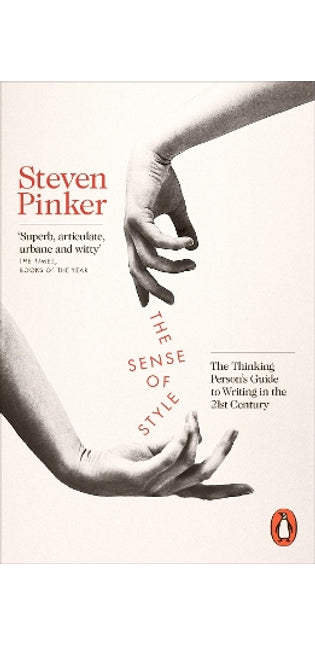
Sense of Style
Steven Pinker, the bestselling author of The Language Instinct, deploys his gift for explaining big ideas in The Sense of Style - an entertaining writing guide for the 21st centuryWhat is the secret of good prose? Does writing well even matter in an age of instant communication? Should we care? In this funny, thoughtful book about the modern art of writing, Steven Pinker shows us why we all need a sense of style.More than ever before, the currency of our social and cultural lives is the written word, from Twitter and texting to blogs, e-readers and old-fashioned books. But most style guides fail to prepare people for the challenges of writing in the 21st century, portraying it as a minefield of grievous errors rather than a form of pleasurable mastery. They fail to deal with an inescapable fact about language: it changes over time, adapted by millions of writers and speakers to their needs. Confusing changes in the world with moral decline, every generation believes the kids today are degrading society and taking language with it. A guide for the new millennium, writes Steven Pinker, has to be different.Drawing on the latest research in linguistics and cognitive science, Steven Pinker replaces the recycled dogma of previous style guides with reason and evidence. This thinking person's guide to good writing shows why style still matters: in communicating effectively, in enhancing the spread of ideas, in earning a reader's trust and, not least, in adding beauty to the world. Eye-opening, mind-expanding and cheerful, The Sense of Style shows that good style is part of what it means to be human.
R 408.00
Darker Angels of Our Nature
In The Better Angels of Our Nature Harvard psychologist Steven Pinker argued that modern history has witnessed a dramatic decline in human violence of every kind, and that in the present we are experiencing the most peaceful time in human history. But what do top historians think about Pinker’s reading of the past? Does his argument stand up to historical analysis? In The Darker Angels of our Nature, seventeen scholars of international stature evaluate Pinker’s arguments and find them lacking. Studying the history of violence from Japan and Russia to Native America, Medieval England and the Imperial Middle East, these scholars debunk the myth of non-violent modernity. Asserting that the real story of human violence is richer, more interesting and incomparably more complex than Pinker’s sweeping, simplified narrative, this book tests, and bests, ‘fake history’ with expert knowledge.
R 3,135.00
R 548.00
R 183.00
R 434.00
Darker Angels of Our Nature
In The Better Angels of Our Nature Harvard psychologist Steven Pinker argued that modern history has witnessed a dramatic decline in human violence of every kind, and that in the present we are experiencing the most peaceful time in human history. But what do top historians think about Pinker’s reading of the past? Does his argument stand up to historical analysis? In The Darker Angels of our Nature, seventeen scholars of international stature evaluate Pinker’s arguments and find them lacking. Studying the history of violence from Japan and Russia to Native America, Medieval England and the Imperial Middle East, these scholars debunk the myth of non-violent modernity. Asserting that the real story of human violence is richer, more interesting and incomparably more complex than Pinker’s sweeping, simplified narrative, this book tests, and bests, ‘fake history’ with expert knowledge.
R 939.00
R 501.00
How the Mind Works
Why do we laugh? What makes memories fade? Why do people believe in ghosts? How the Mind Works explores every aspect of mental life, showing that our minds are not a mystery, but a system of organs of computation designed by natural selection.
R 534.00
R 1,470.00
Visual Cognition
These essays tackle some of the central issues in visual cognition, presenting experimental techniques from cognitive psychology, new ways of modeling cognitive processes on computers from artificial intelligence, and new ways of studying brain organization from neuropsychology, to address such questions as: How do we recognize objects in front of us? How do we reason about objects when they are absent and only in memory? How do we conceptualize the three dimensions of space? Do different people do these things in different ways? And where are these abilities located in the brain? While this research, which appeared as a special issue of the journal Cognition, is at the cutting edge of cognitive science, it does not assume a highly technical background on the part of readers. The book begins with a tutorial introduction by the editor, making it suitable for specialists and nonspecialists alike.
R 1,240.91
Idea of Welfare
Originally published in 1979, The Idea of Welfare critically reviews the concepts of egoism and altruism as they are expressed in residual and intuitional models of social welfare. The book describes the way in which the scope and limits of obligation and entitlement are determined in practice by the interplay of familial, communal, national and international loyalties. It also looks at the similarities and differences between economic and social forms of exchange and mutual aid. These major themes are developed in a comparative review, which explores the effects of social change on the ways in which people seek to preserve and enhance their welfare through self-help and collective action. The book focuses on Britain, the USA and Russia, it challenges conventional definitions of welfare, largely concerned with formal social policies sponsored by government and uses historical material to illustrate the dominant forms of a mutual aid which were practised before the development of modern welfare states.
R 2,131.49
R 782.67
R 220.00
R 456.00
R 519.00
R 478.00
R 1,537.00
R 183.00