Search results for "Professor Tim Spector"
Items in stock - 4 working days delivery time

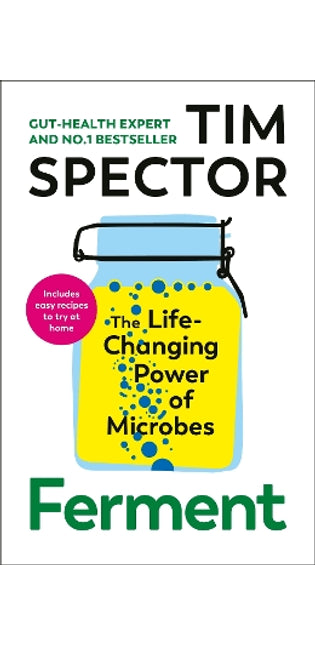
Ferment
**AS SEEN ON ITV THIS MORNING**‘A super healthy and tasty gift for you and your gut microbiome – discover the joy of fermenting’ Dr Clare Bailey MosleyFrom the world-leading gut scientist and no. 1 bestselling author of Food for Life, comes an introduction to the life-changing benefits of fermentation.Of all the ways to prepare food, fermenting is surely the most mysterious, miraculous and misunderstood. As Tim Spector shows in this groundbreaking book, the science is now clear that adding fermented foods to our diets brings an astonishing range of benefits for our health.Drawing on his own cutting-edge research, and including practical tips for buying and making fermented foods, Tim demystifies the world of ferments, and introduces us to some of his favourites – from homemade kombucha and kefir, to sourdough, miso and coffee.He explores the extraordinary science of fermentation and the transformative role of microbes, in our kitchens and in our guts – and reveals why fermenting is the key to good food and good health.Ferment is the ultimate gift for anyone who wants to eat better and feel better.Praise for Tim Spector:‘One of the visionaries leading the way. His writing is illuminating and so incredibly timely.’ Yotam Ottolenghi‘No fads, no nonsense, just practical, science-based advice on how to eat well’ DAILY MAIL‘Tim Spector has been exploding the myths around food and health for years’ THE TIMES‘The man changing how we eat’ TELEGRAPH
R 455.00
Ferment
‘The master of gut health and intelligent eating, Tim Spector makes the science of fermentation exciting to read about, and the recipes are so tempting and accessible that you’ll want to have a go for sure’ Hugh Fearnley-WhittingstallFrom world-leading gut scientist and no. 1 bestselling author Tim Spector comes an inspiring guide to the life-changing power of fermentation - as seen on Channel 4’s What Not to EatOnce misunderstood, and often overlooked, ferments are now recognised as some of the most beneficial foods we can eat. From kombucha and kefir to sourdough, miso and coffee, Tim explains what fermented foods are, what to look for when buying them, how to make them at home, and how adding simple ferments to everyday meals can transform your gut health and overall well-being.Blending cutting-edge science with practical, reassuring advice, Ferment shows how small changes to what’s on your plate can make a big difference to your health.‘By the end of the book, I had jars of kombucha and sauerkraut brewing in my pantry’ New Scientist‘A super healthy and tasty gift for you and your gut microbiome’ Clare Bailey Mosley
R 355.00
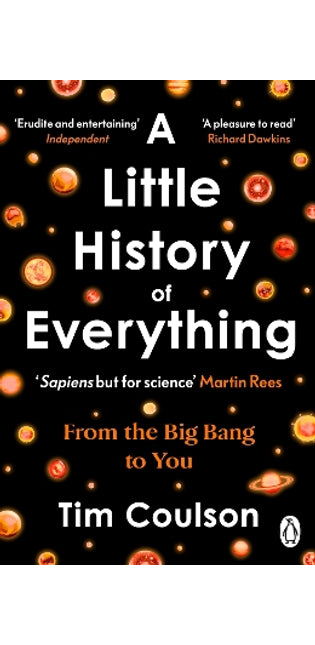
Little History of Everything
A COMPLETE, UNCOMPLICATED GUIDE TO THE SCIENCE OF LIFE, THE UNIVERSE AND EVERYTHING INBETWEEN‘Most scientists know only their own field. Tim Coulson is at home with science as an integrated whole. A pleasure to read, and a lasting accomplishment’ Richard Dawkins'Step aside Star Wars – ours is the most astonishing origin story you’ll ever hear and its beautifully told by Tim Coulson’ Professor Ken Norris, Deputy Director of Science at the Natural History Museum--What made the universe?How did we come to exist?Where are we going?Once, such questions belonged to religion or philosophy. But in the last century scientists have been uncovering astonishing answers to explain the wonder of ourselves, our world and our universe.Professor Tim Coulson takes us back to the beginning of everything – the Big Bang 13.8 million years ago – and tells us the epic story of how we came to be.From the emergence of the first atom to the mysteries of human consciousness, this book is, in short, the complete and utter history of everything.--'A highly readable and super enjoyable book . . . that takes us on a free-spirited intellectual romp through every aspect of what we know about our universe’ Peter Hudson FRS Willaman Professor of Biology at Penn State'A charming, engaging and erudite account' David Christian, author of New York Times bestseller Origin Story (2018)‘A gangbuster science book. A can't-put-down read. I don't think I have learned more from a single book' Douglas W. Smith, Former Senior Wildlife Biologist, Yellowstone National Park‘Exceptional. A highly infectious read. From the first page I found it impossible to put down’ Professor Baroness Kathy Willis, Professor of Biodiversity, University of Oxford‘Achieves something almost impossible, lucid explanation without dumbing down . . . can read this for fun and accidentally you will know as much general science as any Professor’ James H Naismith FRS FRSE FMedSci MAE, Head of the Mathematical, Physical and Life Sciences Division at Oxford, Professor of Structural Biology‘With wit, wisdom and humility. The prose is of a perfect weight, and an absolute joy to read’ Sunetra Gupta, Professor of Theoretical Epidemiology at the University of Oxford‘Will appeal to a broad variety of readers and inspire new generations of scientists for years to come' Quentin Paynter
R 305.00

Items we need to order for you
Diet Myth
Fully updated throughout and with a new foreword for this edition.Why do most diets fail? Why does one person eat a certain meal and gain weight, while another eating the same meal loses pounds? Why, despite all the advice about what to eat, are we all still getting fatter?The answers are much more surprising - and fascinating - than we've been led to believe. The key to health and weight loss lies not in the latest fad diet, nor even in the simple mantra of 'eat less, exercise more', but in the microbes already inside us. Drawing on the latest science and his own pioneering research, Professor Tim Spector demystifies the common misconceptions about fat, calories, vitamins and nutrients. Only by understanding what makes our own personal microbes tick can we overcome the confusion of modern nutrition, and achieve a healthy gut and a healthy body.
R 346.00
Food for Life
'Life-changing' DAVINA McCALL'A must-read' DR RUPY'Fascinating' NIGELLA LAWSON'Empowering' LIZ EARLE**AS HEARD ON THE DIARY OF A CEO PODCAST**Food is our greatest ally for good health, but the question of what to eat in the age of ultra-processed food has never seemed so complicated.Drawing on cutting-edge research and personal insights, Professor Tim Spector offers clear answers in this definitive, easy-to-follow guide to the new science of eating well.Empowering and practical, Food for Life is nothing less than a new approach to how to eat - for our health and the health of the planet.‘No fads, no nonsense, just practical, science-based advice on how to eat well’ Daily Mail, Books of the Year'A rigorously academic book that welcomes the layperson with open arms' The Times** A THE TIMES and SUNDAY TIMES BOOK OF THE YEAR**** WINNER OF THE FORTNUM & MASON SPECIAL AWARD **
R 345.00
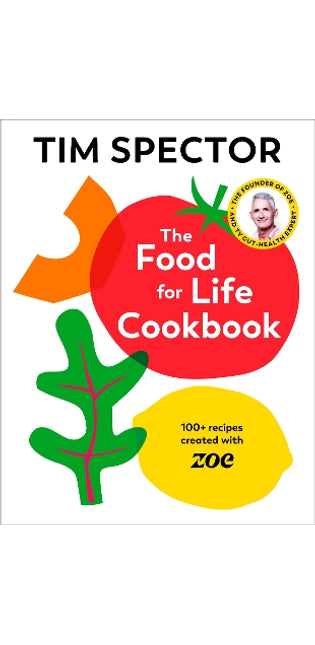
Food For Life Cookbook
** THE ONLY GUT-HEALTH COOKBOOK YOU NEED FROM THE #1 SUNDAY TIMES BESTSELLING AUTHOR OF FOOD FOR LIFE AND ITV LORRAINE’S GUT-HEALTH EXPERT **'A book full of fantastic recipes and ideas.' Yotam Ottolenghi‘Packed with food you will love – and that your microbes will, too’ Dr Clare Bailey Mosley'Flavours and recipes you’ll want to eat every day' Melissa Hemsley‘Delicious and astonishingly, life-changingly, simple’ Davina McCall'Tim’s principles for eating well are totally transformative' Hugh Fearnley-WhittingstallIn: 30 plants a week. Out: Calorie counting.In: Fermenting. Out: Ultra-processed foods.But, how?The Food For Life Cookbook takes the ground-breaking guidance in Tim Spector's #1 bestselling guide to the new science of eating well and, in over 100 delicious and achievable recipes created in collaboration with ZOE, the nutrition science company that he co-founded, shows just how simple and enjoyable it can be to adapt to a gut-friendly way of eating.Shaped by Tim's own experience of transforming the way he eats, as well as common requests from readers and ZOE members, chapters include 15-minute meals, ideas for eating well when the fridge looks bare, and generous feasts and sweet treats for special moments with friends.Packed with plant-led inspiration for delicious meals to feed you, your family and your microbiome, as well as tips for increasing plant diversity and science-based explanations for the nutritional benefits of the ingredients and recipes included, The Food For Life Cookbook is a must-have for every gut-loving home and kitchen.Cook for life. Join the food revolution.The ultimate gift for anyone who wants to eat better and feel better.PRAISE FOR FOOD FOR LIFE:'A fresh look at food' JAMIE OLIVER‘Fascinating’ NIGELLA LAWSON‘No fads, no nonsense, just practical, science-based advice on how to eat well’ Daily Mail, Books of the YearTim Spector, Number 1 Sunday Times bestseller, February 2024
R 745.00
Good Mood Food
Recipes to lift your energy, balance your mood, and feed your brain – the feel-good cookbook from the nation’s favourite gut-health scientist, as seen on Channel 4's What Not to EatThe science is now clear: the secret to better brain health and mental wellbeing starts with what we eat.With these delicious, plant-rich, satisfying recipes, Tim Spector shows how nourishing the trillions of microbes in our gut can support our mood, energy levels and long-term brain health.Packed with flavourful, budget-friendly recipes and practical ideas – from energy-boosting breakfasts and lunches on the go to soothing suppers and weekend batch-cooking – Good Mood Food is your shortcut to eating better and feeling better every day.
R 800.00
R 798.00
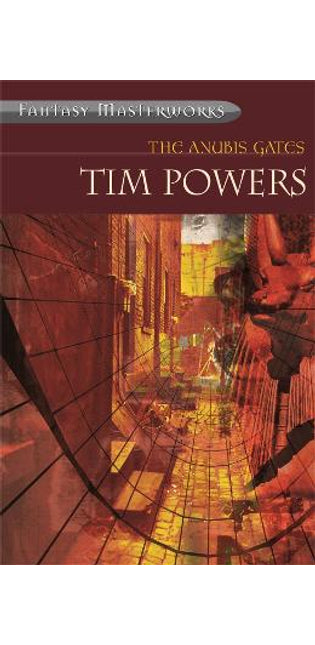
Anubis Gates
Brendan Doyle is a twentieth-century English professor who travels back to 1810 London to attend a lecture given by English romantic poet Samuel Taylor Coleridge. This is a London filled with deformed clowns, organised beggar societies, insane homunculi and magic.When he is kidnapped by gypsies and consequently misses his return trip to 1983, the mild-mannered Doyle is forced to become a street-smart con man, escape artist, and swordsman in order to survive in the dark and treacherous London underworld. He defies bullets, black magic, murderous beggars, freezing waters, imprisonment in mutant-infested dungeons, poisoning, and even a plunge back to 1684.Coleridge himself and poet Lord Byron make appearances in the novel, which also features a poor tinkerer who creates genetic monsters and a werewolf that inhabits others' bodies when his latest becomes too hairy.
R 408.00
R 458.00
R 396.00
Foundations of Educational Technology
Foundations of Educational Technology offers a fresh, interdisciplinary, problem-centered approach to educational technology, learning design, and instructional systems development. As the implementation of online, blended, hybrid, mobile, open, and adaptive learning systems rapidly expands, emerging tools such as learning analytics, artificial intelligence, mixed realities, serious games, and micro-credentialing are promising more complex and personalized learning experiences. This book provides faculty and graduate students with a conceptual, empirical, and practical basis for the effective use of these systems across contexts, integrating essential theories from the fields of human performance, learning and development, information and communications, and instructional design. Key additions to this revised and expanded third edition include coverage of the latest learning technologies, research from educational neuroscience, discussions about security and privacy, new attention to diversity, equity, and inclusion, updated activities, support materials, references, and more.
R 5,873.15
R 433.00
R 417.00
Constructing Crisis
There is no such thing as a crisis. Rather than an actual, corporeal thing, a crisis is a claim asserted from a position of power and influence, intended to shape the understanding of others. A constructed crisis by a leader may or may not be legitimate, and, legitimate or not, the content of a claim alone does not determine whether people decide to believe it. Rather than viewing crises as the result of objective events, Spector demonstrates that leaders impose crises on organizations to strategically assert power and exert control. Interpreting crisis through a critical lens, this interdisciplinary book encompasses not just management and organizational literature, but also sociology, history, cognitive science, and psychology. The resulting wide-ranging, critical, and provocative analysis will appeal in particular to students and academics researching leadership and crisis management.
R 4,782.81
R 371.49
Constructing Social Problems
There is no adequate definition of social problems within sociology, and there is not and never has been a sociology of social problems. That observation is the point of departure of this book. The authors aim to provide such a definition and to prepare the ground for the empirical study of social problems. They are aware that their objective will strike many fellow sociologists as ambitious, perhaps even arrogant. Their work challenges sociologists who have, over a period of fifty years, written treatises on social problems, produced textbooks cataloguing the nature, distribution, and causes of these problems, and taught many sociology courses. It is only natural that the authors' work will be viewed as controversial in light of the large literature which has established a "sociology of" a wide range of social problems-the sociology of race relations, prostitution, poverty, crime, mental illness, and so forth. In the 1970s when the authors were preparing for a seminar on the sociology of social problems, their review of the "literature" revealed the absence of any systematic, coherent statement of theory or method in the study of social problems. For many years the subject was listed and offered by university departments of sociology as a "service course" to present undergraduates with what they should know about the various "social pathologies" that exist in their society. This conception of social problems for several decades has been reflected in the substance and quality of the literature dominated by textbooks. In 'Constructing Social Problems', the authors propose that social problems be conceived as the claims-making activities of individuals or groups regarding social conditions they consider unjust, immoral, or harmful and that should be addressed. This perspective, as the authors have formulated it, conceives of social problems as a process of interaction that produces social problems as social facts in society. The authors further propose that this process and the social facts it produces are the data to be researched for the sociology of social problems. This volume will be of interest to those concerned with the discipline of sociology, especially its current theoretical development and growth.
R 9,303.07
Frontiers of Cyberlearning
This book demonstrates teachers’ and learners’ experiences with big data in education; education and cloud computing; and new technologies for teacher support. It also discusses the advantages of using these frontier technologies in teaching and learning and predicts the future challenges. As such, it enables readers to better understand how technologies can improve learning and teaching experiences. It is intended for graduates and scholars in educational technology disciplines and anyone interested in the applications of frontier technologies in education.
R 7,763.58
R 367.00
Our Two Gardens
For over 30 years, Tom Spector has been sharing his special gift for helping people resolve issues of stress, worry, anxiety, fear, guilt, and chronic pain, and restore self-esteem and inner peace. Our Two Gardens: How to Cultivate Healing evolved from Tom's teachings. The techniques really work! Their descriptions are clear and easy to follow. Tom combines profound meaning with light humor. His anecdotes are powerful and offer great imagery. In Part 1, you see how unhealthy reactions to normal everyday events and situations create suffering and misery. You then learn how to cultivate healthy responses that promote healing. Part 2 offers techniques to live your life to the fullest in the present moment and experience inner peace. You become free of limiting judgments and internal enemies. In Part 3, you explore effective ways of visiting with seriously ill people. You create helpful and meaningful interactions that benefit both you and the patient.
R 342.00
R 487.00
Discourse on Leadership
In a wide-ranging and provocative new study, Bert A. Spector provides a critical analysis of past and present theories of leadership. Spector asserts that our perception of leadership influences who we vote for, who we hire and promote, and ultimately, who we choose to grant our authority to. Focusing on leadership in discourse, the book sets out to explore how the notion of leadership has been articulated, studied and debated by academics, but also by practitioners, journalists, and others who seek to influence the thoughts of others. Paying particular attention to the social, economic, political, intellectual and historical forces that have helped shape the discussion, Discourse on Leadership offers an insightful historiography of leadership as a concept and considers how our understanding of it continues to evolve.
R 1,767.18
Discourse on Leadership
In a wide-ranging and provocative new study, Bert A. Spector provides a critical analysis of past and present theories of leadership. Spector asserts that our perception of leadership influences who we vote for, who we hire and promote, and ultimately, who we choose to grant our authority to. Focusing on leadership in discourse, the book sets out to explore how the notion of leadership has been articulated, studied and debated by academics, but also by practitioners, journalists, and others who seek to influence the thoughts of others. Paying particular attention to the social, economic, political, intellectual and historical forces that have helped shape the discussion, Discourse on Leadership offers an insightful historiography of leadership as a concept and considers how our understanding of it continues to evolve.
R 3,239.00
R 396.00
R 367.00
R 646.00
Integrated and Holistic Perspectives on Learning, Instruction and Technology
One outcome of recent progress in educational technology is strong interest in providing effective support for learning in complex and ill-structured domains. We know how to use technology to promote understanding in simpler domains (e.g., orientation information, procedures with minimal-branching, etc.), but we are less sure how to use technology to support understanding in more complex domains (e.g., managing limited resources, understanding environmental impacts, etc.). Such domains are increasingly significant for society. Technology (e.g., collaborative tele-learning, digital repositories, interactive simulations, etc.) can provide conceptually and functionally rich domains for learning. However, this introduces the problem of determining what works in which circumstances and why. Research and development on these matters is reflected in this collection of papers. This research suggests a need to rethink foundational issues in educational philosophy and learning technology. One major theme connecting these papers is the need to address learning in the large - from a more holistic perspective. A second theme concerns the need to take learners where and as they are, integrating technology into effective learning places. Significant and systematic progress in learning support for complex domains demands further attention to these important issues.
R 3,037.01
R 554.16
R 487.00
R 701.00
Differentiation in Teaching and Learning
In all areas of education, pupils have radically varying needs. How can a teacher accomodate his or her teaching and curriculum provision to ensure that all pupils prosper? This book supplies a detailed and comprehensive set of answers, showing how an understanding of differentiated practice principles succeed.
R 1,617.00
Integrated and Holistic Perspectives on Learning, Instruction and Technology
One outcome of recent progress in educational technology is strong interest in providing effective support for learning in complex and ill-structured domains. We know how to use technology to promote understanding in simpler domains (e.g., orientation information, procedures with minimal-branching, etc.), but we are less sure how to use technology to support understanding in more complex domains (e.g., managing limited resources, understanding environmental impacts, etc.). Such domains are increasingly significant for society. Technology (e.g., collaborative tele-learning, digital repositories, interactive simulations, etc.) can provide conceptually and functionally rich domains for learning. However, this introduces the problem of determining what works in which circumstances and why. Research and development on these matters is reflected in this collection of papers. This research suggests a need to rethink foundational issues in educational philosophy and learning technology. One major theme connecting these papers is the need to address learning in the large - from a more holistic perspective. A second theme concerns the need to take learners where and as they are, integrating technology into effective learning places. Significant and systematic progress in learning support for complex domains demands further attention to these important issues.
R 3,037.18
R 342.00
R 548.00
London Crowds in the Reign of Charles II
This study of the political attitudes of ordinary Londoners during the reign of Charles II examines not only the manifestations of public opinion - for example, riot and demonstration - but also the manner of its formation - religious experience, economic activity, and exposure to mass political propaganda. Professor Harris shows to be misleading the conventional view, that the whigs enjoyed the support of the London masses, and the tories were essentially anti-populist. Both sides had public support during the exclusion crisis, and this division stemmed from fundamental religious tensions within London political culture, dating back to 1660 and before. Attractively illustrated with polemical contemporary engravings, London Crowds demonstrates clearly the value of bringing together both high and low activity into a truly integrated social history of politics, and sheds important new light not just on urban agitation but on the nature of late-Stuart party conflict.
R 2,263.58
R 489.00
Left Turn
Dr. Tim Groseclose, a professor of political science and economics at UCLA, has spent years constructing precise, quantitative measures of the slant of media outlets. He does this by measuring the political content of news, as a way to measure the PQ, or "political quotient" of voters and politicians. Among his conclusions are: all mainstream media outlets have a liberal bias; and while some supposedly conservative outlets - such the "Washington Times" or Fox News' "Special Report" - do lean right, their conservative bias is less than the liberal bias of most mainstream outlets.
R 614.20
R 912.00
R 336.00
How to Read Nonfiction Like a Professor
The New York Times bestselling author of How to Read Literature Like a Professor uses the same skills to teach how to access accurate information in a rapidly changing 24/7 news cycle and become better readers, thinkers, and consumers of media.We live in an information age, but it is increasingly difficult to know which information to trust. Fake news is rampant in mass media, stoked by foreign powers wishing to disrupt a democratic society. We need to be more perceptive, more critical, and more judicious readers. The future of our republic may depend on it. How to Read Nonfiction Like a Professor is more careful, more attentive, more aware reading. On bookstore shelves, one book looks as authoritative as the next. Online, posts and memes don’t announce their relative veracity. It is up to readers to establish how accurate, how thorough, how fair material may be. After laying out general principles of reading nonfiction, How to Read Nonfiction Like a Professor offers advice for specific reading strategies in various genres from histories and biographies to science and technology to social media. Throughout, the emphasis will be on understanding writers’ biases, interrogating claims, analyzing arguments, remaining wary of broad assertions and easy answers, and thinking critically about the written and spoken materials readers encounter. We can become better citizens through better reading, and the time for that is now.
R 469.00
In Search of Responsibility as Education
Not to be conflated with systems of accountability, this book examines responsibility as a subject of educational inquiry. The author argues that responsibility in its most radical sense is not connected to a higher authority. Rather, responsibility summons the actor to do the right thing when no one else is there to announce what is right; it involves speaking the truth in a world that is increasingly characterized by organized lying and organized irresponsibility. The search for responsibility as education is explored through a wide range of issues including: studying the ways in which the bureaucratization of the world undermine ethical consciousness; cultivating the ethical imagination in education which is not only vital to sustaining democracy, but to counteracting indifference to crimes against humanity and crimes against the planet; critiquing the imperial nationalism of a wave of education legislation requiring American schools to provide instruction on genocides and other mass atrocities that take place by ‘others’ and ‘abroad’ but not at ‘home’ or by ‘us’; centralizing a curriculum of common sense in an era marked by a breakdown of common sense and disinformation narratives; and facing a reality that can never be experienced: the end of the human world. Reimagining education as an avenue for cultivating personal responsibility and global justice, this text will be of interest to students, scholars, and researchers working in curriculum studies, philosophy of education, educational policy, and teacher education.
R 7,558.97
R 458.00
R 519.00
R 675.00