



Search results for "Refka"
Items in stock - 4 working days delivery time

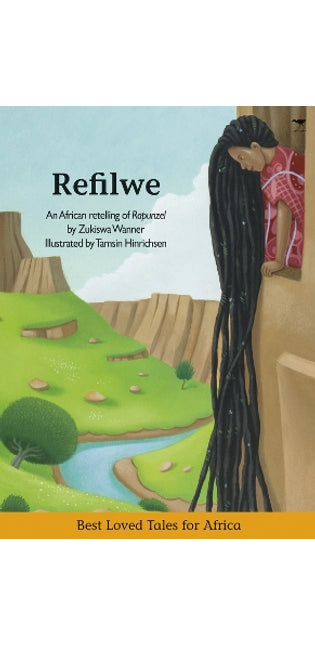
Refilwe
Through the Best loved tales for Africa, we aim to grow a love of reading. “Refilwe, Refilwe, let down your locks, So I can climb the scraggy rocks!” In a cave high up on a craggy cliff, beautiful Refilwe is allowed to see no one but the witch who locked her away. One day, Prince Tumi hears Refilwe singing as he is riding his horse near her cave and he searches for the owner of the magical voice. Will Refilwe ever be free from the evil witch? Will she ever find true love? An African retelling of the classic fairy tale Rapunzel by one of our best loved authors, Zukiswa Wanner, with magical illustrations by Tamsin Hinrichsen will keep all children entranced, and grow a love of reading. Read aloud, read together, read alone, read forever!
R 157.00
Items we need to order for you
R 279.00
R 305.00
R 1,989.94
R 1,989.94
R 1,659.00
R 1,659.00
R 1,659.00
R 1,659.00
R 627.13
R 841.00
Refik Anadol
This monograph presents a visually striking exploration of Refik Anadol’s data-driven installation, created for the opening of the new BRUSK museum in Bruges. The book offers exclusive visuals and reflections on the intersection of art, technology, and memory in Anadol’s work. Working at the intersection of art, science, and technology, Refik Anadol is best known for his large-scale immersive installations and public artworks that use machine learning, AI, and big data to visualize complex systems. Anadol’s work transforms raw data – ranging from urban landscapes to brainwaves – into dynamic, multi-sensory experiences, pushing the boundaries of how we perceive space, memory, and reality. For the inaugural programme at BRUSK, the new museum for contemporary art in Bruges, Belgium, Anadol presents a major site-specific installation that immerses visitors in a datadriven landscape unique to the city.
R 1,082.00
R 519.00
R 268.27
R 458.00
Refocus: The Films of Larisa Shepitko
Despite the brief span of her directorial career, lasting from 1963 to 1979, the Soviet Ukrainian director Larisa Shepitko produced a remarkable body of work, one that received an expansive national and international attention and led her to winning the Golden Bear Awards at the Berlin International Film Festival in 1977. Refocus: The Cinema of Larisa Shepitko is the first volume in English to offer a comprehensive, methodologically diverse analysis of Shepitko's oeuvre, demonstrating the ongoing significance of her work for filmmakers and scholars alike. The book not only considers the emergence of Shepitko's cinema within Soviet political and cultural history but examines its continued relevance for thinking about such pressing contemporary issues as war and trauma, history, memory and subjectivity, and ecology and the environment.
R 4,834.00
ReFocus: The Films of Larisa Shepitko
Despite the brief span of her directorial career, lasting from 1963 to 1979, the Soviet Ukrainian director Larisa Shepitko produced a remarkable body of work, one that received an expansive national and international attention and led her to winning the Golden Bear Awards at the Berlin International Film Festival in 1977. Refocus: The Cinema of Larisa Shepitko is the first volume in English to offer a comprehensive, methodologically diverse analysis of Shepitko's oeuvre, demonstrating the ongoing significance of her work for filmmakers and scholars alike. The book not only considers the emergence of Shepitko's cinema within Soviet political and cultural history but examines its continued relevance for thinking about such pressing contemporary issues as war and trauma, history, memory and subjectivity, and ecology and the environment.
R 1,159.00
Kafka: A Very Short Introduction
'When Gregor Samsa awoke one morning from troubled dreams he found himself transformed in his bed into a monstrous insect ...' So begins Franz Kafka's most famous story Metamorphosis.Franz Kafka (1883-1924) is among the most intriguing and influential writers of the twentieth century. During his lifetime he worked as a civil servant and published only a handful of short stories, the best known being The Transformation. All three of his novels, The Trial, The Castle, and The Man Who Disappeared [America], were published after his death and helped to found Kafka's reputation as a uniquely perceptive interpreter of the twentiethcentury.Kafka's fiction vividly evokes bizarre situations: a commercial traveller is turned into an insect, a banker is arrested by a mysterious court, a fasting artist starves to death in the name of art, a singing mouse becomes the heroine of her nation. Attending both to Kafka's crisis-ridden life and to the subtleties of his art, Ritchie Robertson shows how his work explores such characteristically modern themes as the place of the body in culture, the power of institutions over people, and thepossibility of religion after Nietzsche had proclaimed 'the death of God'. The result is an up-to-date and accessible portrait of a fascinating author which shows us ways to read and make sense of his perplexing and absorbing work.ABOUT THE SERIES: The Very Short Introductions series from Oxford University Press contains hundreds of titles in almost every subject area. These pocket-sized books are the perfect way to get ahead in a new subject quickly. Our expert authors combine facts, analysis, perspective, new ideas, and enthusiasm to make interesting and challenging topics highly readable.
R 309.00
R 458.00
R 883.00
R 641.00
R 525.00
Refracted Economies
Since the beginning of the twenty-first century, diamonds have been lauded as a "glistening" driver of the northern Canadian economy. Canadian diamonds are cast with an imagined purity as though they had emerged by magic. However, these diamonds are mined on Dene land and extracted by people who fly in from afar, separated from their families for long periods of time.Adopting a decolonizing and feminist approach to political economy, Refracted Economies analyses the impact of diamond mining in Yellowknife, Northwest Territories. The book centres on Indigenous women’s social reproduction labour – both at the mine sites and at sites of community, home, and care – as a means of understanding the diffuse impacts of the diamond mines. Grounded in ethnographic work, the narratives of northern Indigenous women’s multiple labours offer unique insight into the gendered ways northern land and livelihoods have been restructured by the diamond industry.Rebecca Jane Hall draws on documentary analysis, interviews, and talking circles in order to understand and appreciate the – often unseen – labour performed by Indigenous women. Placing this day-to-day labour at the heart of her analysis, Hall shows that it both reproduces the mixed economy and resists the gendered violence of settler colonialism as exemplified by extractive capitalism.
R 1,352.00
R 274.00
R 403.45
R 550.00
Refocus: the Films of Rakhshan Banietemad
Rakhshan Banietemad is one of the first female film directors in Iran. This book, the first English language study of her films and career, Iranian director Rakhshan Banietemad contains chapters by some of the most prominent scholars of Iranian cinema, as well as younger scholars with fresh points of view. Taking an interdisciplinary perspective, the book devotes special attention to Banietemad's understudied documentaries and films, including Under the Skin of the City (2000) and Tales (2014), while offering new perspectives on well-known works such as The Blue Veiled (1994) and The May Lady (1997). Focusing on questions of aesthetics and poetics, social realism, gender dynamics and the 'afterimages' and 'counter-memories' of revolution and war, the book also includes an in depth interview with Banietemad herself.
R 5,414.00
R 1,464.00
Kafka
Franz Kafka died in 1924, when he was not yet forty. During his life he published only seven small books, but he left behind three unfinished novels and a mass of stories, reflections and personal writings which were published after his death. His novels in particular, alongside short stories such as The Judgement and The Metamorphosis, have made him one of the most widely read, significant and influential writers of the twentieth century. His writings show an extraordinary ability to speak to the changing concerns of later generations.This collection of essays, illustrated with manuscripts, archival material, postcards and family photographs, not only sets Kafka in the context of his life and times but also shows how his own experiences nourished his imagination. Literal travel in Western Europe enabled him, as his notebooks reveal, to practise descriptive writing. Imaginative travel through reading strengthened his fascination with remote spaces and made him aware of European colonialism. Familiar settings in his fiction become alien and bewildering. When writing about animals, he sought to enter imaginatively into their non-human way of being. This book is a celebration not just of Kafka’s achievements and creativity, but also of how – even 100 years after his death – Kafka continues to inspire new literary, theatrical and cinematic creations around the world.
R 2,015.00
R 561.00
R 618.00
R 1,024.00
R 342.00
R 834.37
R 458.00
Graphic Refuge
Graphic Refuge is the first in-depth study of comics about refugees, asylum seekers, migrants, and detainees by artists from the Global North and South. Co-written by two leading scholars of nonfiction comics, the book explores graphic narratives about a range of refugee experiences, from war, displacement, and perilous sea crossings to detention camps, resettlement schemes, and second-generation diasporas.Through close readings of work by diverse artists including Joe Sacco, Sarah Glidden, Don Brown, Olivier Kugler, Jasper Rietman, Hamid Sulaiman, Leila Abdelrazzaq, Thi Bui, and Matt Huynh, Graphic Refuge shows how comics challenge dominant representations of the displaced and bring a radical politics of refugee agency and refusal into view. Rather than simply affirming the “humanity” of the refugee, these comics demand that we apprehend the historical construction of categories such as “citizen” and “refugee” through systems of empire, settler colonialism, and racial capitalism.Building on scholarship in critical refugee studies, architecture and infrastructure studies, and postcolonial theory, Davies and Rifkind argue that refugee comics move us through this wider recognition and towards more expansive ideas of refuge as a lived political relationship.
R 1,426.00
R 498.94
R 594.08
R 306.00


