



Search results for "Small"
Items in stock - 4 working days delivery time

Small Things Like These
** A Book of the Year in The Times - The New Statesman - Observer - Financial Times - Irish Times - Irish Independent - Times Literary Supplement **WINNER OF THE ORWELL PRIZE AND THE KERRY GROUP IRISH NOVEL OF THE YEAR AWARDSHORTLISTED FOR THE RATHBONES FOLIO PRIZE AND THE IRISH NOVEL OF THE YEAR AT THE DALKEY LITERARY AWARDS'Exquisite.' Damon Galgut'Masterly.' The Times'Miraculous.' Herald'Astonishing.' Colm Tóibín'Stunning.' Sunday Independent'Absolutely beautiful.' Douglas StuartIt is 1985, in an Irish town. During the weeks leading up to Christmas, Bill Furlong, a coal and timber merchant, faces into his busiest season. As he does the rounds, he feels the past rising up to meet him - and encounters the complicit silences of a people controlled by the Church.
R 315.00
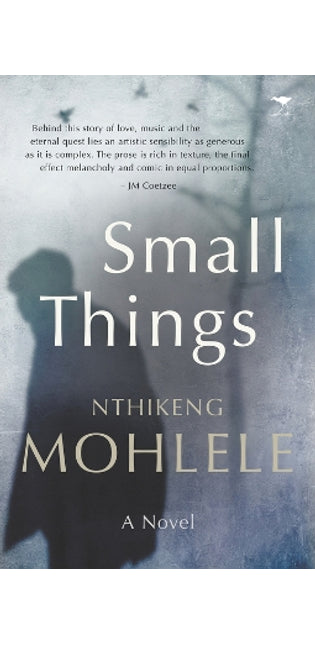
Small things
In this haunting tale of love and learning, the existential chaos of a life ravaged by circumstance takes on a rhythm of its own, one bound by loss and loneliness, but also an intelligent awareness of self. Sometimes melancholy, sometimes brutal, occasionally funny and infuriating, a journalist-comrade-lover caught up in the shade and shadow of politics and social injustice faces treachery and betrayal on every level. Set against the backdrop of a cityscape that taunts and tantalises, this is where love fails and passion wanes, “where suffering has no meaning”, where an individual escapes death only to find himself confronted with choices wrought by remorse and retribution, by conscience and character. And yet, with all trauma, there is a distinct musicality to the lyrical unpacking that follows a string of small things …
R 260.00

Items we need to order for you
Small
"Original, important, moving, witty and exquisitely-written. WHAT a feat." - BERNARDINE EVARISTO"Incredible... beautiful and funny and humane." - EMILIE PINE"Pristine poetry and prose." KATHERINE MAY, AUTHOR OF WINTERING"Babies who are this small, he says, have a good chance of survival. Small is not good for babies. It is not whimsical or cute or the cause of admiration. It is the first time it occurs to us that they might not survive. Babies die from smallness."Claire Lynch knew that having children with her wife would be complicated but she could never have anticipated the extent to which her life would be redrawn by the process.This dazzling debut begins with the smallest of life's substances, the microscopic cells subdividing in a petri dish in a fertility treatment centre. She moves through her story in incremental yet ever growing steps, from the fingernail-sized pregnancy test result screen which bears two affirmative lines to the premature arrival of her children who have to wear scale-model oxygen masks in their life-saving incubators. Devastatingly poignant and profoundly observant - and funny against the odds - Claire considers whether it is our smallness that makes our lives so big.
R 402.00
R 524.92
R 365.00
R 367.00
R 428.00
R 964.00
R 458.00
R 388.00
Small is Powerful
The author has found the true villain of the 20th century, and it is a concept—bigness. The answer to such disparate questions as why do we experience global wars, mass dictatorships, economic tornadoes, a population explosion and a mounting resource environment crisis lie, according to Papworth, far back in history. They are the direct result, he attempts to show, of the forces unleashed by the collapse in the 16th century of the laws against usury. Having diagnosed this problem as stemming from this destruction of the power of people to control their work, Papworth goes on to propound a new politics which is the politics of Small is Powerful—a new and hopeful approach to the problems of modern politics which merits the careful consideration of every person with any claim to political literacy.The author asserts that the way forward is not bigger units of government or, indeed, in any other units, but rather that all units which represent power in whatever form should be reduced to a size which makes them susceptible to genuine democratic citizen control. Mass society must be dismantled, local communities must be rebuilt in their stead, but above all people must take the power back that they have lost to the Giant State. Giant States have failed their inhabitants, Papworth contends, with records on human rights, economic well-being, and on general stability inferior to the records of the smaller nations of Europe. The way forward, according to Small is Powerful, is to restore localized community life, the extended family, the nuclear family, and thereby civilization itself through deliberately empowering people through neighborhood communities.
R 1,382.00
R 397.00
R 456.00
R 274.00
Small is Powerful
The author has found the true villain of the 20th century, and it is a concept—bigness. The answer to such disparate questions as why do we experience global wars, mass dictatorships, economic tornadoes, a population explosion and a mounting resource environment crisis lie, according to Papworth, far back in history. They are the direct result, he attempts to show, of the forces unleashed by the collapse in the 16th century of the laws against usury. Having diagnosed this problem as stemming from this destruction of the power of people to control their work, Papworth goes on to propound a new politics which is the politics of Small is Powerful—a new and hopeful approach to the problems of modern politics which merits the careful consideration of every person with any claim to political literacy.The author asserts that the way forward is not bigger units of government or, indeed, in any other units, but rather that all units which represent power in whatever form should be reduced to a size which makes them susceptible to genuine democratic citizen control. Mass society must be dismantled, local communities must be rebuilt in their stead, but above all people must take the power back that they have lost to the Giant State. Giant States have failed their inhabitants, Papworth contends, with records on human rights, economic well-being, and on general stability inferior to the records of the smaller nations of Europe. The way forward, according to Small is Powerful, is to restore localized community life, the extended family, the nuclear family, and thereby civilization itself through deliberately empowering people through neighborhood communities.
R 2,943.00
R 279.00
R 342.00
Small Business
This book, originally published in 1984, examines the role of small firms in Britain, Germany, France and Italy and critically appraises government policies towards them. It reassesses economic theories concerned with concentration and competition, theories which need some re-thinking to accommodate the growing importance of small business.
R 1,593.60
Small, Irrelevant Matters
Small, Irrelevant Matters is a collection of nine short stories that take place in rural Virginia. The stories touch on moments in the lives of farmers, college students, soldiers, foundry workers and store clerks. They explore the space in-between life's bigger events: car rides and lunch breaks where the simplest interaction, a brief gesture or a thoughtless remark, can change lives unexpectedly. These quiet vignettes are snapshots of the way we treat each other, day to day, when a few quickly uttered words, which may be forgotten by one, can remain forever etched in the consciousness of another.
R 391.97
Small Things
Three starred reviews called Small Things “monumental” (Booklist), “superb” (School Library Journal) and “intense” (Foreword Reviews). In this short, wordless graphic picture book, a young boy feels alone with his anxiety. He isn’t fitting in well at school. His grades are slipping. He’s even lashing out at those who love him. Talented Australian artist Mel Tregonning created Small Things in the final year of her life. In her emotionally rich illustrations, the boy’s worries manifest as tiny beings that crowd around him constantly, overwhelming him and even gnawing away at his very self. The striking imagery is all the more powerful when, overcoming his isolation at last, the boy discovers that the tiny demons of worry surround everyone, even those who seem to have it all together.
R 341.00
R 306.00
Small!: Sunday Times Best Books 2022
SHORTLISTED FOR THE 2023 WATERSTONES CHILDRENS BOOK PRIZE. 'FUNNY AND YUCKY..LIKELY TO BE A HIT READ ALOUD' Sunday Times, Book of the Week. Harvey is a small boy in a giant world. On stilts! When Harvey accidentally sets fire to his headteacher's trousers, Mum decides it's time for a BIG change and packs him off to Madame Bogbrush's School for Gifted Giants.But Harvey's not a giant. He's a boy on stilts. And if his classmates find out, they'll stomp him into a sandwich!- 'A GIANT triumph! A. F. STEADMAN, Skandar and the Unicorn Thief -'Vast in humour and heart. A giant of a book' ZILLAH BETHELL, The Shark Caller -'It's funny, it's silly and it's simply delightful. Fun with a giant-sized 'F' RASHMI SIRDESHPANDE, Never Show a T-Rex a Book --Packed with humour and heart' BOOKLOVER JO- 'It's epic. Massive fun, giant amounts of silliness and a huge heart. I loved every page of it.' TOM VAUGHAN, Bin Boy
R 217.00
Small Isn't Beautiful
"Eat local" has become a popular marketing slogan in recent years, based on the idea that food grown or raised nearby is better for you and friendlier to the environment than similar products shipped in from many miles away. That slogan reflects a broader worldview suggesting that everything local, including government and knowledge, is better than what originates somewhere else. Small Isn't Beautiful acknowledges that some things that are local are good, but denies that what's local is always or even often better than what's far away. "Localism" is based on an "undeserved aura of respectability, virtue, and good sense" and can produce results that are misguided or even dangerous. Particularly when it comes to public policies, decisions made at the local level are rarely superior and are sometimes unjust. Small Isn't Beautiful exposes the supposed "virtue" of localism as a hodgepodge of weak arguments and misleading hunches. Trevor Latimer engagingly written and provocative book will appeal to all readers who want to understand localism beyond slogans and marketing.
R 3,297.00
R 611.00
Small Countries
What is a small country? Is a country small because of the size of its territory or its population? Can smallness be relative, based on the subjective perception of a country's inhabitants or in comparison with one's neighbors? How does smallness, however it is defined, shape a country and its relations with other countries? Answers to these questions, among others, can be found in Small Countries, the first and only anthropological study of smallness as a defining variable.In terms of population size, some two thirds of the countries of the world can now be considered small countries, and they can be found in all world regions except North America and East Asia. They exhibit great diversity with regard to culture, history, and institutional arrangements, so there can be no model of any "typical" small country. Yet the essays collected by Ulf Hannerz and Andre Gingrich identify a range of family resemblances in such areas as internal connectivity and sensibilities of identity. Contributors describe a number of similar problems with which small countries must cope, on domestic levels as well as in their transnational and global encounters. For some small countries, challenges such as media organization and branding have a negative impact on real or perceived vulnerability, while for others, the same challenges facilitate success stories.Comparative case studies cover a diverse set of regions, including the Caribbean, Middle East, Africa, and Europe, and employ diverse anthropological approaches. Tacit assumptions about scale, identities, and networks in everyday social life are best revealed through close, interpretive effort. At times a sense of shared belonging comes to the fore with particular events, such as a national crisis or an unexpected success in international sports, offering scope for situational analyses. In showing how small countries confront globalization, Small Countries reveals how the sense of scale intensifies when the world as a whole shrinks.Contributors: Regina F. Bendix, Aleksandar Bošković, Virginia R. Dominguez, Thomas Hylland Eriksen, Andre Gingrich, Beng-Lan Goh, Ulf Hannerz, Sulayman N. Khalaf, Eva-Maria Knoll, Jacqueline Knörr, Orvar Löfgren, João de Pina-Cabral, Don Robotham, Cris Shore, Richard Wilk, Helena Wulff.
R 3,114.00
Small Is Beautiful
How does our economic system impact the way we live? Does it really affect what we truly care about? Oxford economist E. F. Schumacher provides an enlightening study of our economic system and its purpose, challenging the current state of excessive consumption in our society. Offering a crucial message for the modern world struggling to balance economic growth with the human costs of globalisation, Small Is Beautiful puts forward the revolutionary yet viable case for building our economies around the needs of communities, not corporations. ‘One of the 100 most influential books published since World War II’ The Times Literary Supplement
R 402.00
Small Mercies
Mercy needs to stand up for herself. She also needs a miracle.Eleven-year-old Mercy lives with her eccentric foster aunts – two elderly sisters so poor they can afford only one lightbulb. A nasty housing developer is eyeing their house, which suddenly starts falling apart – just as Aunt Flora does, too. She’s forgetting words, names and even how to behave in public. Mercy tries to keep her head down at school but when a classmate frames her for stealing the school’s raffle money, Mercy’s teachers decide to take a closer look at her home life. With the help of a neighbour, Mr Singh, who teaches Mercy about Gandhi and his principles of passive resistance, Mercy finds a tool that can help solve her problems. But first, like Gandhi, she needs to stand up for herself. She also needs a miracle. And to summon it she has to find her voice and tell the truth – and that truth is neither pure nor simple. A book that already feels like a classic, Small Mercies holds a strong message for children today. Full of heart, it will shine among the best children's literature for years to come.
R 250.00
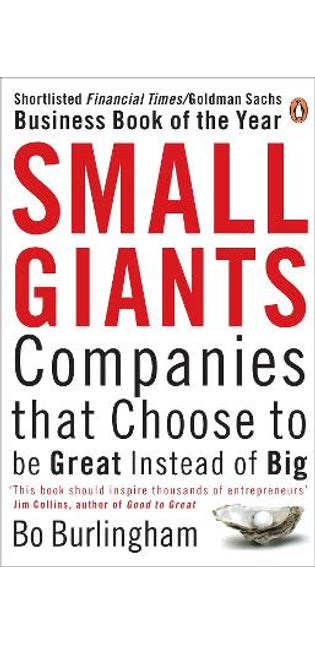
Small Giants
It's widely accepted in business that great companies grow their revenues and profits year after year - but bigger is not necessarily better. In Small Giants, journalist Bo Burlingham takes us deep inside fourteen remarkable privately held companies, from a brewery to a record label, that chose a different path to success. These organizations quietly rejected the pressure of endless growth, deciding to focus more on satisfying business goals - being the best at what they do, creating a stimulating place to work, providing perfect customer service and making important contributions to their communities.But what are the magic ingredients that make these companies unique? Why and how does their approach work in such widely varying industries? And what lessons can we learn from them? A fresh, inspirational guide to business strategy, Small Giants will help any entrepeneur consider new directions to make their company great.
R 402.00
R 275.00
R 408.20
R 397.00
R 245.00
Small Worlds
The 13 essays in ""Small Worlds"" treat children as active, influential participants in society. Here children and adolescents from the pre-Civil War generation to 1950 are seen as actors in their own right, shapers of their own history who not only mirror adult values, but also modify them. Editors Elliott West and Paula Petrik have organized the essays in ""Small Worlds"" around four topics: cultural and regional variations, toys and play, family life and the ways evolving memories of childhood shape how adults think of themselves. And, since photography provides the best record of childhood, they've added a photographic essay by Ray Hiner entitled ""Seen But Not Heard"". Young people, West and Petrik argue, performed many of the essential jobs in newly industrialized America, and they continued to play vital roles on their families' farms well into the 20th century. As a result, children have been increasingly influential in American economic life - as consumers. According to West and Petrik, the study of children also reveals how values evolve out of the mutual give-and-take between society and child in the socialization process. This enormously complex evolution continues as the child matures and, in turn, tries mightily to pass on values to a new generation of children who work just as strenuously to make up their own minds.
R 1,118.00
R 580.00
R 458.00
Small Batch
Artisanal foods are making a comeback as more and more people seek to stock their pantries, and their bellies, with handcrafted or locally grown and made foods. Specialty markets and sections at grocery stores are catering to this new desire for the special, the unique, the carefully made foods. Small Batch: Pickles, Cheese, Chocolate, Spirits and the Return of Artisanal Foods colorfully details the landscape of the newest wave of the artisanal food revolution by looking at four foods that whet our appetites for specialty. Considering the history and the cultural issues surrounding the resurgence of craft food, including the evolving definition of terroir, the importance of narrative in valuing artisanal food, and the way that these present food trends connect with—and upend—their rich history, Small Batch seeks to define and update the term "artisanal" and give insight into the influences, challenges, and identity of food artisans today.Suzanne Cope sumptuously surveys the collective history of the production of cheese, pickles, chocolate, and alcoholic spirits, and brings this narrative to the present by incorporating interviews with over fifty modern artisans. Cope details the influences, challenges, and evolving identity of these modern craft industries—and places them in context within the recent resurgence and growth of the artisanal segment of the market. Readers interested in craft foods, and what it means to be an artisan, will find here a fascinating history and updating of both.
R 2,125.00
Small Wonder
Small Wonder presents the dangers of the 'underside of modernity': the unleashing of unlimited lust for (global) power and wealth. Relying on leading critical intellectuals, Dallmayr offers a critique of the self-deceptions of our age, arguing in favor of the cultivation of the 'small wonder' of everyday life.
R 2,013.00
Small Community
In this age of large cities, mass culture, and ever more massive events, people must struggle against an overwhelming crowd of their own creations to maintain human integrity. In this manual for human survival, Arthur E. Morgan offers a solution: peaceful existence in the small, primary community where, more easily than anywhere else, people can find a way to live well. Ultimately striving to show that the small community is "the lifeblood of civilization," this volume examines the political organization, membership, economics, health, and ethics characteristics of small communities.Like Rousseau before him, Morgan observes that we have less control over our affairs than in the past. In increasing our control of the natural environment, human beings have built a social environment so out of scale that it becomes nearly impossible for people to maintain balance. The struggle now is less with the natural order than with the social order, and preserving human integrity against the plethora of our own creations is the core problem.The need to rediscover elementary forms of human existence has been accelerated by the efficiencies of centralized control and mass persuasion. In the face of this, small communities or intimate groups become the primary pattern in which human beings must live if the good life is to be a realistic goal. The timely nature of this volume has grown as the electronic displaces the mechanical as a moral rival to human community.
R 2,807.45
R 305.00
Small g
In unmistakable Highsmithian fashion, Small g, Patricia Highsmith's final novel, opens near a seedy Zurich bar with the brutal murder of Petey Ritter. Unraveling the vagaries of love, sexuality, jealousy, and death, Highsmith weaves a mystery both hilarious and astonishing, a classic fairy tale executed with a characteristic penchant for darkness. Published in paperback for the first time in America, Small g is at once an exorcism of Highsmith's literary demons and a revelatory capstone to a wholly remarkable career. It is a delightfully incantatory work that, in the tradition of Shakespeare's A Midsummer Night's Dream, shows us how bizarre and unpredictable love can be.
R 722.54
Small Power
An insider's look into the largely anonymous volunteers in local party organizations who make decisions in elections with profound implications for American democracy.Although scholars have long recognized that local American parties play an important role in elections, surprisingly little is known about the individuals who lead these typically small, volunteer-based organizations. As David Doherty, Conor M. Dowling, and Michael G. Miller show in Small Power, local party leaders influence the electoral process in myriad ways: They recruit and support candidates, interface with state-wide and federal campaigns, and get out the vote in theircommunities. Drawing from a survey of over 850 Democratic and Republican local party chairs, a nationally representative sample of voters, and dozens of in-depth interviews, the authors describe how parties are organized, who party chairs are, and how they serve the party. Leveraging novel experiments that illuminatehow chairs make choices about which individuals to recruit as candidates—as well as whether those choices reflect voters' preferences—Small Power sheds new light on how seemingly mundane local decisions can shape party goals, influence candidate pipelines, and affect who ends up winning elections. The book therefore offers unprecedented insight into the substantial influence that local parties and their chairpersons are positioned to wield and how they shape Americanpolitics.
R 1,508.00
R 184.00
Small World
The phenomenon of the small world, as in two new acquaintances discovering that they have an acquaintance in common, is of great scientific interest. The samll world phenomenon appears to be a fundamental property of social structure and function. Understanding it, its origin, and its implications can shed light on problems in sociology, sociometrics, political science, social psychology, and anthropology. This volume brings together much of what is understood about the small world problem, and the chapters indicate the quality, vitality, and scope of this area.
R 3,664.00




-
, by sungano kanjere WIN a Braai Hamper with Reuben Riffel this Heritage Month!
Celebrate the best of South African food and get behind the braai this Heritage Month for a chance to win a fabulous hamper, including: A...
-
, by sungano kanjere Celebrate Literacy Month and Heritage Month with top reads from Exclusive Books Recommends!
Get the top reads and recommendations for the month from Exclusive Books Recommends.


