



Search results for "The Language Library"
Items in stock - 4 working days delivery time

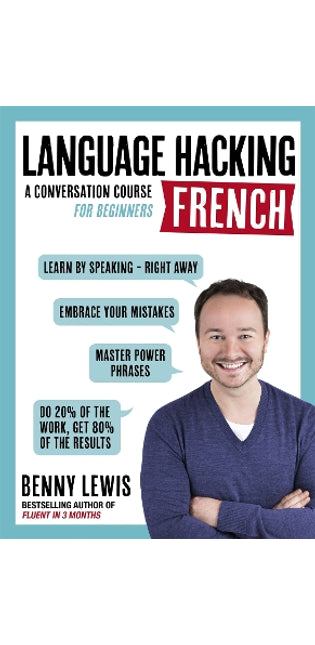
LANGUAGE HACKING FRENCH (Learn How to Speak French - Right Away)
Crack the Code and Get Fluent Faster!"I had to learn [a new language] in a handful of days for a TV interview. I asked Benny for help and his advice was invaluable." - Tim Ferriss What if you could skip the years of study and jump right to speaking French? Sound crazy? No, it's language hacking. It's about learning what's indispensable, skipping what's not - and using what you've learned to have real conversations in French - from day one!Unlike most traditional language courses that try to teach you the rules of a language, Language Hacking French, shows you how to learn and speak French immediately through proven memory techniques, unconventional shortcuts and conversation strategies perfect by one of the world's greatest language learners, Benny Lewis, aka the Irish Polyglot. The Method Language Hacking takes a modern approach to language learning, blending the power of online social collaboration and the 80/20 principle of learning (Benny's ten #languagehacks show you how to achieve more with less!). It focuses on the conversations and language that learners need to master right away, rather than presenting language in the order of difficulty like most courses. This means you can start having conversations immediately. Course FeaturesEach of the 10 units culminates with a speaking mission that you can choose to share on the italki Language Hacking learner community (www.italki.com/languagehacking) where you can give and get feedback and extend your learning beyond the pages of the book. The audio for this course is available for free on library.teachyourself.com or from the Teach Yourself Library app.You don't need to go abroad to learn a language any more.
R 710.00
Items we need to order for you
Introduction to Language and Linguistics
A clear and up-to-date introduction to linguistics. This best-selling textbook addresses the full scope of language, from the traditional subjects of structural linguistics (relating to sound, form, meaning and language change) to the more specialised subjects of contextual linguistics (including discourse, dialect variation, language and culture, and the politics of language). There are also separate chapters on language and the brain, computational linguistics, writing, and first and second language learning. Extensively classroom-tested, this second edition has been revised to further support student learning, with numerous new examples, exercises and textboxes to model and contextualise key concepts. Updated throughout to incorporate contemporary issues and events, it includes worked examples of phonological analyses and multiple examples of a variety of World Englishes. A rich collection of online resources completes the learning package.
R 2,862.00
Lessons from Good Language Learners
Lessons from Good Language Learners provides a reference base, addresses theoretical issues and considers pedagogical implications. It identifies gaps in our current understanding and suggests useful research initiatives and it considers how all of this relates to successful language learning by unique individuals in a variety of situations. The book is divided into 2 sections: the first deals with learner variables and has chapters on such topics as age, culture, motivation, personality and aptitude. The second covers learning variables such as vocabulary, pronunciation, grammar, reading and listening. The writers include many well-established names such as Anna Chamot, Paul Nation and Andrew Cohen as well as some of the best representatives of the new generation of applied linguists.
R 1,699.00
Applying Technology to Language and Translation
A cutting-edge collection of work on the influence and application of new technologies on the study and practice of language and translation. This book analyzes the relationship between technology, language, and translation in the digital age. Language issues covered include an automatic football commentary system, the use of digital humanities in the versification of Classical Chinese poetry, the application of corpus linguistics in identity construction in Hong Kong, Cantonese speech recognition, and the use of AI in a Chabot system. Other chapters look at translation matters, such as technologies for interpreting, neural machine translation for press releases, computer-aided annotation for translator and interpreter training, and artificial intelligence and translation. As language and translation are closely intertwined, together, these chapters illustrate the drastic changes that technology has brought to these combined areas. A vital resource for scholars and students studying the impact of technology on language and translation.
R 2,381.00
Literature, Language and Computing
This book brings together the selected revised papers representing a multidisciplinary approach to language and literature. The collection presents studies performed using the methods of computational linguistics in accordance with the traditions of Russian linguistic and literary studies, primarily in line with the Leningrad (Petersburg) philological school. The book comprises the papers allocated into two sections discussing the study of corpora in language, translation, and literary studies and the use of computing in language teaching and translation and in emotional text processing. A unique feature of the presented collection is that the papers, compiled in one volume, allow readers to get an understanding of a wide range of research conducted in Saint Petersburg State University and other Russian leading scientific institutions. Both the classical tradition of Saint Petersburg philology and the results obtained with the help of new computer technologies as a sample of the symbiosis of technologies and traditions, which bring research to a qualitatively new level to arouse interest.
R 6,555.32
Pictures for Language Learning
This book brings together a wealth of ideas on how to use pictures in a wide range of language learning situations. It discusses the contribution visuals can make to all the classroom settings in providing real opportunities for students to communicate, whether they are working as a class, in groups or in pairs. It includes over 200 practical suggestions for picture-generated language work, which make use of visual materials which are readily available to teachers anywhere, or easy-to-copy illustrations. The activities can be integrated into all stages of the language teaching process and advice is given on how to adapt the ideas to suit different teaching environments. The book ends with advice on setting up a picture library, including how to find visuals, how to categorise pictures, and storage methods.
R 1,419.00
Prefunctional Stage of First Language Acquistion (RLE Linguistics C: Applied Linguistics)
This book provides a theory of first language acquisition in the syntactic framework of the theory of Universal Grammar. It addresses issues related to the earliest stage of development which ends roughly around the child’s second birthday. The theory put forward capitalises on the traditional observation that early child grammars characteristically lack lexical and morphological elements which belong to the ‘closed-class’ system. This book provides an account of the grammatical differences between the set of functional categories and the substantive categories.
R 9,314.68
Our Little Library
Jump-start baby's exposure to first words using this beautifully designed board book box set—the perfect gift for newborns and baby showers!Designed by a professional watercolor artist and licensed speech therapist, Our Little Library features five board books that feature charming images and foundational vocabulary that will help you build your child's vocabulary. The durable materials and small book size also make them perfect for your baby's little hands. Our Little Library includes five board books featuring foundational words from the following categories:Farm AnimalsForest AnimalsFruits and VeggiesToysTransportationThe back of each board book in this first word series also includes a "seek and find" activity to help parents encourage their little ones to learn to identify the pictures on the page.Created by speech therapist Tabitha Paige, CCC-SLP, author of the bestselling set Our Little Adventures, this new box set of first words books features functional language and a timeless design that will look great in any nursery or child's room.
R 684.00
Applied Linguistics and Language Learning (RLE Linguistics C: Applied Linguistics)
Basing his arguments on the developments in theoretical linguistics as well as his own experience in teaching and research, the author proposes a model of learning which could resolve differences which have for centuries divided thinkers in philosophy and linguistics, between extreme and modified views of the way that language and thought interact, one determining the other; and in language teaching between proponents of contending methodologies. He shows that such distinctions as those between language learners and language users, first language learners and foreign language learners are misleading.
R 2,810.54
How to Talk Language Science with Everybody
Do you want to talk about the linguistic research that you think is important but you don't know where to start? Language is a topic that is relevant to everyone, and linguists are often asked to speak publicly about their research, to a range of lay audiences in the media, politics, festivals and fairs, schools, museums and public libraries. However, relaying this vital information in an engaging way can often feel like an insurmountable task. This accessible guide offers practical advice on how to talk about language to a range of non-academic audiences. It draws on the linguistics behind effective communication to help you have cooperative conversations, and to organize your information for a diverse range of people. It is illustrated with a wealth of examples from real-life scenarios, and includes chapter-by-chapter worksheets, enabling you to make your own fun and interesting language science activities to share with others.
R 3,806.00
Dictionary of the Suahili Language
Johan Ludwig Krapf (1810–81), a German-born member of the Church Missionary Society in East Africa, is regarded as the founder of Swahili studies in Europe. Having pursued an interest in Oriental culture from an early age, he first went to Abyssinia (Ethiopia) as a missionary. During his travels in Africa, he became the first European to see Mount Kenya; but he also considered the potential of Swahili as a lingua franca. Krapf published the first printed text in Swahili, and the first systematic Swahili grammar, as well as being the first to bring Swahili manuscripts to Europe. Another in a series of firsts is this lexicon, which was published posthumously in 1882. The Swahili dictionary, pioneering as it was in its day, is still of historical interest, especially because it contains notes on Swahili culture and customs, as well as an outline of the language's grammar.
R 2,582.55
Linking Theory and Practice of Digital Libraries
This book constitutes the refereed proceedings of the 29th International Conference on Theory and Practice of Digital Libraries on Linking Theory and Practice of Digital Libraries, TPDL 2025, held in Tampere, Finland, during September 23-26, 2025. The 14 full papers and 11 finding papers included in this book were carefully reviewed and selected from 103 submissions. The papers are organized in the following topical: Keynotes; Large Language Models; Scholarly Issues; Citation Management; Digital Archives; Digital Humanities and Cultural Heritage; Knowledge Graphs.
R 6,596.49
Language of French Symbolism
The traits that characterize the "language" of French Symbolism are the center of these essays. In interpreting major or previously neglected compositions by Mallarme, Verlaine, Rimbaud, Claudel, Valery, and Apollinaire, the author shows how each of these poets worked with the elements that distinguish this influential group of writers as a whole. Originally published in 1969. The Princeton Legacy Library uses the latest print-on-demand technology to again make available previously out-of-print books from the distinguished backlist of Princeton University Press. These editions preserve the original texts of these important books while presenting them in durable paperback and hardcover editions. The goal of the Princeton Legacy Library is to vastly increase access to the rich scholarly heritage found in the thousands of books published by Princeton University Press since its founding in 1905.
R 4,561.56
Language
Heidegger characterizes the relationship between language and Being as "language is the house of Being", negating the idea that language is merely a tool ready to be used at hand.Drawing on this idea, as well as ideas from anthropology, pragmatics, and folklore studies, the author argues that "language is the last homestead of human beings", meaning that mankind lives within language, has to live within language, and lives in formulaic speech events. The author takes Western classic works on the philosophy of language and his own insights of language use, rooted in traditional Chinese culture, in order to develop his own localized theory. In this title, the author explores the philosophical aspect of man’s survival by presenting day-to-day exchange routines such as weddings and fortune-telling dialogues in the Chinese context.Awarded the first prize for Academic Excellence in Philosophy and Social Sciences in Guangdong Province, and second prize in the second Xu Guozhang Award for Foreign Language Studies, this is a must-read for researchers interested in philosophy of language and pragmatics.
R 2,137.07
German Language and the Real World
This collection of specially commissioned essays focuses on the forms, functions, and uses of contemporary German in the period of dynamic change following reunification. Some contributors address broad issueslanguage and national identity, the status of German as an international language, language change and attempts to fix the form of the language, and sociolinguistic variationwhile others examine topics of particular significance in the current sociopoliticalclimate. These include social change and linguistic variation in Berlin after the Wall, the political language of the Right and Left, the speech of youth subcultures, language and gender, language and television, and language in intercultural communication. Reviews of the hardback edition `This volume fills a void in up-to-date English-language information on German linguistics. Highly recommended for all college and university collections, as well as public libraries.' Choice, 33: 3, November 1995`The appearance of this collection is timely. . .it updates us on important, immediate issues affecting German language and society'`. . .while this work will be appreciated most by those focusing on sociolinguistics in the German-speaking context, those searching for comparative sociolinguistic material will find it a valuable source as well.' `All in all, Stevenson has organized an interesting and useful volume for Germanophile sociolinguists and for those interested in a multidimensional real German.' Language Learning, 46:1, March 1996
R 1,895.00
Our Little Library Vol. 3
Designed by a professional watercolour artist and licensed speech therapist, Our Little Library Vol. 3 features charming watercolour illustrations and foundational first words that will help you build your child's vocabulary. The durable materials and small book size also make them perfect for your baby's little hands. Five board books that feature foundational words in these categories:SportsSpaceDinosaursTrucksBugsThe back of each book in this first word box set also includes a "seek and find" activity to help parents encourage their little ones to learn to identify the pictures on the page. Created by speech therapist Tabitha Paige, MS, CCC-SLP, author of the bestselling box sets Our Little Adventures and Our Little Library , this new box set of first words books features functional language and a timeless design that will look great in any nursery or child's room.
R 684.00
How to Talk Language Science with Everybody
Do you want to talk about the linguistic research that you think is important but you don't know where to start? Language is a topic that is relevant to everyone, and linguists are often asked to speak publicly about their research, to a range of lay audiences in the media, politics, festivals and fairs, schools, museums and public libraries. However, relaying this vital information in an engaging way can often feel like an insurmountable task. This accessible guide offers practical advice on how to talk about language to a range of non-academic audiences. It draws on the linguistics behind effective communication to help you have cooperative conversations, and to organize your information for a diverse range of people. It is illustrated with a wealth of examples from real-life scenarios, and includes chapter-by-chapter worksheets, enabling you to make your own fun and interesting language science activities to share with others.
R 1,281.00
Dynamics of the Language Classroom
Traditionally, the classroom has been seen as a place where language learning takes place in a linear manner on a fairly predictable input-output model. Recent research, however, has portrayed the classroom as a complex environment which is influenced by a wide range of attitudinal and contextual factors. The Dynamics of the Language Classroom examines the various conceptions of language, learning, and of the classroom, which influence participants' attitudes and actions. The interaction between methodology and context and the role of local cultures of learning is also examined. It concludes with recommendations as to how language educators may work constructively with the complex dynamics of classroom teaching and learning.
R 1,414.00
Affect in Language Learning
The affective domain and the emotional factors which influence language learning have been of interest in the field of language teaching for a number of years. By proposing a holistic approach to the learning process, Affect in Language Learning takes the position that the language learning experience will be much more effective when both affect and cognition are considered. The eighteen chapters discuss issues such as memory, anxiety, self-esteem, facilitation, autonomy, classroom activities, and assessment from the perspective of affect. The book will be of interest to teachers-in-preparation, teachers, teacher educators, curriculum designers, programme administrators and researchers and to those second language teaching professionals who wish to improve language teaching through a greater awareness of the role affect plays.
R 1,619.00
Library
A breathtakingly beautiful coffee table book that is the perfect gift for any book lover A library is not just a collection of books, but also the buildings that house them. As varied and inventive as the volumes they hold, such buildings can be much more than the dusty, dark wooden shelves found in mystery stories or the catacombs of stacks in the basements of academia. From the great dome of the Library of Congress, to the white façade of the Seinäjoki Library in Finland, to the ancient ruins of the library of Pergamum in modern Turkey, the architecture of a library is a symbol of its time as well as of its builders' wealth, culture, and learning. Architectural historian James Campbell and photographer Will Pryce traveled the globe together, visiting and documenting over eighty libraries that exemplify the many different approaches to thinking about and designing libraries. The result of their travels, The Library: A World History is one of the first books to tell the story of library architecture around the world and through time in a single volume, from ancient Mesopotamia to modern China and from the beginnings of writing to the present day. As these beautiful and striking photos reveal, each age and culture has reinvented the library, molding it to reflect their priorities and preoccupations--and in turn mirroring the history of civilization itself. Campbell's authoritative yet readable text recounts the history of these libraries, while Pryce's stunning photographs vividly capture each building's structure and atmosphere. Together, Campbell and Pryce have produced a landmark book--the definitive photographic history of the library and one that will be essential for the home libraries of book lovers and architecture devotees alike.
R 2,929.00
Society and the Language Classroom
Society and the Language Classroom provides a new perspective on classroom research. Through a series of case studies, it examines the ways that learners and teachers behave in English language classrooms in different parts of the world, including Australia, South Africa, Indonesia, Japan, Kenya, China and Pakistan, and at primary, secondary and tertiary level. Thought-provoking issues emerging from the case studies include the possibility that: - learners' expectations of what behaviour is appropriate in the classroom may thwart teachers' attempts to bring about change; - innovation may have unpredictable consequences unless careful study of classroom behaviour has been carried out. This approach to the interpretation of classroom behaviour has important implications, particularly for teachers, teacher educators and curriculum planners.
R 4,838.00
R 1,086.22
Indigenous Materials in Libraries and the Curriculum
Indigenous Materials in Libraries and the Curriculum: Latin American and Latinx Sources argues for a decolonial engagement with Indigenous peoples’ creative work to build awareness of divergent epistemologies and foster healing in the learning community.This book explores how faculty and librarians can collaborate to develop inclusive library collections and curricula by supporting Indigenous peoples’ reclamation of lands and languages. The authors present practices to build and disseminate collections that showcase the work of Indigenous creators from Latin America and compensate for historical erasure and misrepresentation. Consideration is also given to developing a non-hegemonic curriculum in Indigenous languages and cultures for faculty and students from multicultural backgrounds, particularly Latinx students of Indigenous descent. Above all, the book aspires to facilitate the participation of Indigenous peoples in the scholarly conversation to counteract epistemic and material extractivism and transform the scaffolding of higher education in the current global climate crisis.Indigenous Materials in Libraries and the Curriculum is inspired by a transhemispheric vision to elicit conversation between Indigenous peoples from Latin America (Abiayala) and North America (Turtle Island). The book will appeal to academics, librarians, students, and activists interested in Indigenous languages and cultures, decolonization, DEI initiatives, and library collection development policies that prioritize non-hegemonic narratives.
R 1,382.61
Linguistics: The Cambridge Survey: Volume 4, Language: The Socio-Cultural Context
Linguistics: The Cambridge Survey is a comprehensive introduction to current research in all branches of the field of linguistics, from syntactic theory to ethnography of speaking, from signed language to the mental lexicon, from language acquisition to discourse analysis. Each chapter has been written by a specialist particularly distinguished in his or her field who has accepted the challenge of reviewing the current issues and future prospects in sufficient depth for the scholar and with sufficient clarity for the student. Each volume can be read independently and has a particular focus. Volume I covers the internal structure of the language faculty itself, while Volume II considers the evidence for, and the implications of, a generativist approach to language. Psycholinguistics and neurolinguistics are covered in Volume III, and Volume IV concentrates on sociolinguistics and the allied fields of anthropological linguistics and discourse and conversation analysis. Several of the chapters in the work concentrate on the interface between different aspects of linguistic theory or the boundaries between linguistic theory and other disciplines. Thus in both its scope and in its approach the Survey is a unique and fundamental work of reference. It undoubtedly fulfils the editor's principal aim of providing a wealth of information, insight and ideas that will excite and challenge all readers with an interest in linguistics.
R 2,878.20
Exploring the German Language
If we want to understand how German speakers think about themselves and the world in which they live, then a useful place to begin is by looking at the language they use. This fully revised and updated edition provides a systematic approach to the study of the German language and an introduction to the social aspects of the language, including its dialects, its history and the uses of the language today. No previous knowledge of linguistics is assumed, and each chapter is accompanied by a series of practical exercises. This edition includes a brand new section on gender, purism and German unification, fresh examples for analysis and an updated chapter on the geography of Germany today. The book will help students not only to find new ways of exploring the German language, but also of thinking and talking about German-speaking cultures.
R 2,556.09
Ada 2012 Reference Manual. Language and Standard Libraries
The Ada 2012 Reference Manual is an enhanced version of the text of International Standard ISO/IEC 8652/2012(E) for the programming language Ada. The Ada 2012 Reference Manual combines all of the previous corrections of Technical Corrigendum 1 and Amendment 1 with changes and additions that improve the capabilities of the language and the reliability of programs written in the language. The Ada 2012 Reference Manual will replace the former versions as an indispensable working companion for anybody using Ada professionally or learning and studying the language systematically.
R 6,610.28
Language and the Study of Language
William Dwight Whitney (1827–94) was the foremost American philologist and Sanskrit scholar of the nineteenth century. After studying in Germany, then at the forefront of linguistic scholarship, he assumed the chair of Sanskrit at Yale in 1854, with comparative philology added to his professorship in 1869. As well as teaching modern languages, Whitney published over 300 scholarly papers and books, acted as chief editor of the ten-volume Century Dictionary, and co-founded the American Philological Association. This 1867 work is an expanded version of lectures he had given at the Smithsonian Institution and in Boston, rewritten for a wider audience and emphasising the importance of recent German philological scholarship. The first five lectures concentrate mostly on the English language and the study of languages in general, including discussion of regional dialects and American English. The lectures then go on to look at the Indo-European language family as well as methods of linguistic research.
R 2,623.18
Natural Language Processing
This textbook provides a contemporary and comprehensive overview of Natural Language Processing (NLP), covering fundamental concepts, core algorithms, and key applications such as AI chatbots, Large Language Models and Generative AI. Additionally, it includes seven step-by-step NLP workshops, totaling 14 hours, that offer hands-on practice with essential Python tools, including NLTK, spaCy, TensorFlow, Keras, Transformers, and BERT. The objective of this book is to provide readers with a fundamental grasp of NLP and its core technologies, and to enable them to build their own NLP applications (e.g. Chatbot systems) using Python-based NLP tools. It is both a textbook and NLP tool-book intended for the following readers: undergraduate students from various disciplines who want to learn NLP; lecturers and tutors who want to teach courses or tutorials for undergraduate/graduate students on NLP and related AI topics; and readers with various backgrounds who want to learn NLP, and more importantly, to build workable NLP applications after completing its 14 hours of Python-based workshops.
R 3,297.00
Elastic Language
Elastic language carries non-specific and stretchable meaning, as in 'He loves her, kind of'. It is used like a slingshot, targeting various strategic goals. Consolidating current research and charting new directions, this book develops a refreshing theory of elasticity, empirically attested by natural language data from tension-prone encounters between Australian Customs officers and passengers. The theory proposes three principles (fluidity, stretchability and strategy) and offers a systematic look at how elastic language, as a sliding scale, works to balance strengthening and weakening speech tones, to firm and soften a speaker's stance, and to reveal and evade the truth. The comparative analysis of forms, functions, and context confirms that elastic language is fluid, stretchable, and strategic. It serves both cooperative and competitive functions, and social and speech factors impact on its use. This book will appeal to students and researchers working in pragmatics, applied linguistics, sociolinguistics, discourse analysis, and communication.
R 1,756.76
Language
Among the most influential figures in the development of modern linguistics, the American scholar Edward Sapir (1884–1939) notably promoted the connection between anthropology and the study of language. His name is also associated with that of his student in the Sapir–Whorf principle of linguistic relativity, the hypothesis that the structure of a language affects how its speakers conceptualise the world. In this seminal work, first published in 1921, Sapir lucidly introduces his ideas about language and explores topics that remain fundamental to linguistics today, such as the relationship between language and culture, the elements of speech, grammatical processes and concepts, historical language development, and the question of how languages influence one another. Especially significant in the history of structural linguistics and ethnolinguistics, this clearly written text remains relevant and accessible to students and scholars across the social sciences.
R 1,866.26
Materials Development in Language Teaching
Materials Development in Language Teaching Second edition suggests new ideas and directions in materials development, which readers can pursue for themselves. It is accessible to readers with little previous experience in the field and is essential reading for all those involved in developing materials for language teaching. For the second edition, each chapter has been comprehensively revised and includes two chapters that assess the potential of electronic media for materials development. This book will be of interest to teachers everywhere who wish to look more closely at the relationship between their teaching materials and their language classes.
R 1,619.00
Child Language
This is the best book on the market for taking students from ‘how children acquire their first language’ to the point where they can engage with key debates and current research in the field of child language. No background knowledge of linguistic theory is assumed and all specialist terms are introduced in clear, non-technical language. It is rare in its balanced presentation of evidence from both sides of the nature–nurture divide and its ability to make this complicated topic engaging and understandable to everyone. This edition includes Exercises to foster an understanding of key concepts in language and linguistics A glossary of key terms so students can always check back on the more difficult terms Suggestions for further reading including fascinating TED Talks that bring the subject to life Access to Multiple Choice Quizzes and other online resources so students can check they′ve understood what they have just read
R 5,091.00
Discourse Analysis for Language Teachers
The book begins by answering the question 'What is discourse analysis?' and examines how discourse analysts approach spoken and written language. Different models of analysis are outlined and evaluated in terms of their usefulness to language teachers. This is followed by chapters on discourse-oriented approaches to grammar, vocabulary and phonology. The final section looks at spoken and written language in the light of native-speaker and learner data and considers examples of teaching approaches.
R 1,562.00
R 860.00
Psychology for Language Teachers
Psychology for Language Teachers begins with an overview of educational psychology and discusses how different approaches to psychology have influenced language teaching methodology. Following this, four themes are identified: the learner, the teacher, the task and the learning context. Psychological developments in each of these domains are discussed and implications are drawn for language teaching. Areas considered include approaches to learning, motivation, the role of the individual, attribution, mediation, the teaching of thinking, the cognitive demands of tasks and the learning environment.
R 1,562.00


