



Search results for "Van Mander"
Items in stock - 4 working days delivery time

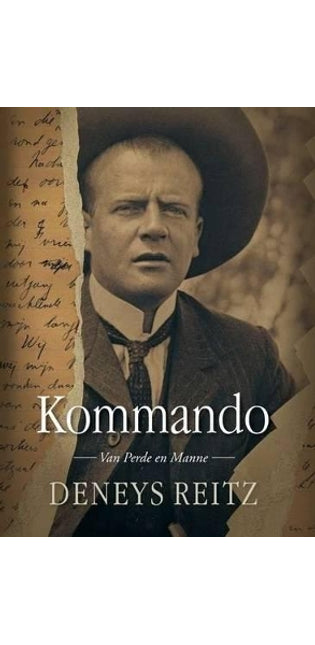
Kommando van Perde en Manne
Hierdie is die Afrikaanse weergawe van Deneys Reitz se joernaal, wat sy haas ongelooflike wedervaringe in die Tweede Vryheidsoorlog beskryf, asook - in hierdie uitgawe - die swaarkry tydens sy ballingskap in Madagaskar, en sy moeilike terugkoms na Suid-Afrika. Die eerste publikasie van Commando, deur Faber & Faber in 1929, was sedertdien 'n blitsverkoper in vele uitgawes en ander tale. Dit word wyd gerespekteer as 'n klassieke weergawe van die oorlog. Meer kopiee as van alle ander boeke oor die Anglo-Boereoorlog saam is reeds van die boek verkoop, in die woorde van vryskutresensent Ferdi Greyling: "eenvoudig omdat dit 'n briljante boek is". Greyling se van hierdie vertaling in moderne Afrikaans deur Hendrik Jansen: "Die vertaling lees gemaklik en hoewel ek soms gewonder het of die vertelstyl nie dalk hier en daar ietwat te ver gevoer is nie, besef ek ook dat 'vertel' die kern van Reitz se styl is. Die vertaling werk dus." Greyling se ook: "Reitz se skerp waarneming het hom in staat gestel om mense soos Paul Kruger, Piet Joubert, Koos de la Rey, Louis Botha, Jan Smuts, Christian de Wet, Siener van Rensburg en selfs Winston Churchill in 'n paragraaf of wat as lewende persoonlikhede weer te gee. Dis 'n kuns om die regte manerismes en stukkies gesprekke te onthou wat die mense as't ware opsom." Hy se van die skrywer: "Hy het 'n helder en ekonomiese styl wat die aksent van sy emosies afhaal en die leser met die gebeure laat wat intelligent en samehangend aangebied word. Dis 'n boek wat verdien om beskikbaar te wees vir elke nuwe geslag wat aan die lees gaan."
R 260.00
Items we need to order for you
R 1,496.00
R 1,260.09
Das Lehrgedicht des Karel van Mander
Dieser Buchtitel ist Teil des Digitalisierungsprojekts Springer Book Archives mit Publikationen, die seit den Anfängen des Verlags von 1842 erschienen sind. Der Verlag stellt mit diesem Archiv Quellen für die historische wie auch die disziplingeschichtliche Forschung zur Verfügung, die jeweils im historischen Kontext betrachtet werden müssen. Dieser Titel erschien in der Zeit vor 1945 und wird daher in seiner zeittypischen politisch-ideologischen Ausrichtung vom Verlag nicht beworben.
R 1,721.77
R 1,317.00
R 618.00
R 683.00
R 838.00
R 397.00
R 585.00
R 425.00
R 683.00
Unknowable
W. J. Mander presents a history of metaphysics in nineteenth-century Britain. The story focuses on the elaboration of, and differing reactions to, the concept of the unknowable or unconditioned, first developed by Sir William Hamilton in the 1829. The idea of an ultimate but unknowable way that things really are in themselves may be seen as supplying a narrative arc that runs right through the metaphysical systems of the period in question. These thought schemes maybe divided into three broad groups which were roughly consecutive in their emergence but also overlapping as they continued to develop. In the first instance there were the doctrines of the agnostics who developed further Hamilton's basic idea that fundamental reality lies for the great part beyondour cognitive reach. These philosophies were followed immediately by those of the empiricists and, in the last third of the century, the idealists: both of these schools of thought—albeit in profoundly different ways—reacted against the epistemic pessimism of the agnostics. Mander offers close textual readings of the main contributions to First Philosophy made by the key philosophers of the period (such as Hamilton, Mansel, Spencer, Mill, and Bradley) as well as some less well known figures(such as Bain, Clifford, Shadworth Hodgson, Ferrier, and John Grote). By presenting, interpreting, criticising, and connecting together their various contrasting ideas, this book explains how the three traditions developed and interacted with one another to comprise the history of metaphysics inVictorian Britain.
R 4,447.00
Philosophy of John Norris
Best known today as one of the earliest critics of John Locke, John Norris (1657-1711) incorporated ideas of Augustine, Malebranche, Plato, the Cambridge Platonists, and the scholastics into an original synthesis that was highly influential on the philosophy and theology of his day. W. J. Mander presents a much-needed study of this unjustly neglected thinker, and the different perspectives he offers on this seminal period in philosophical history.
R 4,447.00
R 1,442.06
Berlin, Hostage for the West
What is the real purpose of Soviet pressure on Berlin? Why has it been the scene of crisis after crisis ever since the Declaration of 1945? Mander reviews the events in Berlin over the past 17 years to illuminate the many faces of this intractable situation.
R 2,354.00
Corpus of Rembrandt Paintings V
This volume is the fifth volume of A Corpus of Rembrandt Paintings, a project devoted to all Rembrandt’s paintings. This is the work of ‘The Rembrandt Research Project’, consisting of a group of scholars led since 1993 by Professor Ernst van de Wetering. The project began in 1968 with the aim of separating Rembrandt’s own paintings from the vast number of Rembrandtesque paintings made by his many apprentices and followers. Having opted for a chronological approach to the cataloguing of Rembrandt’s paintings (from 1625 till 1642) in the first three volumes, it was decided in 1993 to adopt a thematic approach for further volumes. This was largely to facilitate the recognition of different hands. The new approach yielded much more information not only about Rembrandt’s working methods but also about the function and meaning of his works. This expanded field of view meant that etchings and drawings with similar themes also needed to be included. In 2005 Volume IV appeared, devoted to Rembrandt’s self-portraits, in painting, etching and drawing. Volume V consists of a catalogue and analysis of the so-called small-scale history and genre paintings. That theme was chosen because this type of complex work shows a variety of full-length protagonists acting in different narrative settings. For this reason, in the 17th century, painting, etching or drawing biblical and mythological scenes was looked upon as an artist’s greatest challenge. The choice of this theme proved to be highly fruitful in several ways. Small-scale history pieces reveal Rembrandt’s artistic ambitions most clearly. They also offer the authors a much more accurate view of the daily routine in Rembrandt’s studio; his apprentices mostly copied this type of work or used it as a starting point for their own. As a result it was easier to distinguish the works by the master himself from those of his pupils. All aspects of the skills necessary to create a pictorial illusion play a part in the creation of small-figured history paintings. These aspects were referred to as ‘the basis of the noble art of painting’ in Rembrandt’s days. Two seventeenth century painter/theoreticians discussed these principles systematically in two books which up till now have only sporadically been consulted in the context of 17th century studio practice. Karel van Mander wrote his Grond der edel vry schilder-const [Basis of the Art of Painting] in 1604 and Samuel van Hoogstraten produced his Inleyding tot de hooge schoole der schilderkonst [Academy of Painting] in 1678. Van Hoogstraten was a pupil of Rembrandt between 1642 and ’48. Comparing the two books and considering them in relation to Rembrandt’s oeuvre, gradually reveals his original views on painting and how these had developed during his career. Thus, the authors of this new Volume of A Corpus have gained an unexpected and profound insight into Rembrandt’s ideas and approach to his art. The ‘basic aspects’ of painting included the following topics: function
R 21,943.00
R 2,320.00
R 520.00
R 1,933.00
R 150.56
R 678.61
R 845.00
R 3,664.00
R 610.00
R 397.00
R 989.95
R 1,010.95


