



Search results for "Walter Lin"
Items we need to order for you

R 516.50
R 554.00
R 131.63
R 186.78
R 569.07
Walter Lingo, Jim Thorpe, and the Oorang Indians
At the beginning of the Roaring Twenties the NFL was just a footnote within the landscape of American sports. The early pro game was played on dirt fields by vagabond athletes who would beat up or punch out their opponent for fifty dollars a game. But one team was different than the rest: the Oorang Indians. Comprised entirely of Native Americans and led by star athlete Jim Thorpe, the Oorang Indians were an instant hit in almost every city they visited.In Walter Lingo, Jim Thorpe, and the Oorang Indians: How a Dog Kennel Owner Created the NFL's Most Famous Traveling Team, NFL historian Chris Willis tells the story of this unique and fascinating part of professional football history. In 1922 Walter Lingo, a dog kennel owner from tiny La Rue, Ohio, joined forces with Jim Thorpe, the country’s greatest athlete, to create the Oorang Indians. Willis recounts how Lingo used the football team, the star attraction of player-coach Thorpe, and the all Native-American squad to help advertise his kennel and sell dogs, putting the small town of La Rue on the map. With the complete cooperation of the Lingo family and unlimited access to family photos and archives, Walter Lingo, Jim Thorpe, and the Oorang Indians provides an up-close and behind-the-scenes view into the making of this little-known team. It is a remarkable story that will be enjoyed by football fans and historians alike.
R 2,015.00
R 1,382.42
Mathematical World of Walter Noll
would like to thank all those people in the life of Walter Noll I who helped me to write this book: Chancellor ofIndiana Univer- sity Professor Herman B. Wells, Dr. Klaus Andre, Professor Bemard D. Coleman, Stella DeVito, Dr. Peter Frankel, Professor Morton E. Gurtin, Studiendirektor i.R. Rudolf Hohensee, Faye Mark, Profes- sor Victor J. Mizel, Professor Dietrich Morgenstern, Professor Ralph Raimi, Professor Juan J. Schaffer, Professor Clifford A. Truesdell III, Professor Epifanio G. Virga, Dr. Paul Winkler and many oth- ers. I will be always indebted to Inge Lind, my teacher and friend, for a careful reading ofthe manuscript and her invaluable comments. This book would never have been written without the compas- sion and assistance of many people in Bochum and Marburg. I am especially grateful to Ursula Arras, Dieter and Karola Behm, Achim Buhl, Birgit Berger, Professor Klaus Bohmer, Ute Hagen, Irene Jo- raszik, Professor Hans-Heinrich Korle, Elke and Manfred Kuhne, Jutta Kuster, Johannes Lind, Inka Lins, Annemarie Matt, Astrid Milenz, Matthias Naher, Eckart Rosch, Manfred Schonsee, Profes- sor Werner von Seelen, Christa Seip, Heike Willig, Anita Wolf and many others.
R 1,254.00
Walter Benjamin
Walter Benjamin is often viewed as a cultural critic who produced a vast array of brilliant and idiosyncratic pieces of writing with little more to unify them than the feeling that they all bear the stamp of his "unclassifiable" genius. Eli Friedlander argues that Walter Benjamin's corpus of writings must be recognized as a unique configuration of philosophy with an overarching coherence and a deep-seated commitment to engage the philosophical tradition.Friedlander finds in Benjamin's early works initial formulations of the different dimensions of his philosophical thinking. He leads through them to Benjamin's views on the dialectical image, the nature of language, the relation of beauty and truth, embodiment, dream and historical awakening, myth and history, as well as the afterlife and realization of meaning. Those notions are articulated both in themselves and in relation to central figures of the philosophical tradition. They are further viewed as leading to and coming together in The Arcades Project. Friedlander takes that incomplete work to be the central theater where these earlier philosophical preoccupations were to be played out. Benjamin envisaged in it the possibility of the highest order of thought taking the form of writing whose contents are the concrete time-bound particularities of human experience. Addressing the question of the possibility of such a presentation of philosophical truth provides the guiding thread for constellating the disparate moments of Benjamin's writings.
R 1,589.00
Walter Chandoha. Cats. Photographs 1942–2018
On a winter’s night in 1949 in New York City, young marketing student and budding photographer Walter Chandoha spotted a stray kitten in the snow, bundled it into his coat, and brought it home. Little did he know he had just met the muse that would determine the course of his life. Chandoha turned his lens on his new feline friend—which he named Loco—and was so inspired by the results that he started photographing kittens from a local shelter. These images marked the start of an extraordinary career that would span seven decades.Long before the Internet and #catsofinstagram, Chandoha was enrapturing the public with his fuzzy subjects. From advertisements to greetings cards, jigsaw puzzles to pet-food packaging, his images combined a genuine affection for the creatures, a strong work ethic, and flawless technique. Chandoha’s trademark glamorous lighting, which made each cat’s fur stand out in sharp relief, would define the visual vocabulary of animal portraiture for generations and inspire such masters as Andy Warhol, who took cues from Chandoha’s charming portraits in his illustrated cat book.Cats leaps into the archives of this genre-defining artist, spanning color studio and environmental portraits, black-and-white street photography, images from vintage cat shows, tender pictures that combine his children with cats and more. This is a fitting tribute not just to these beguiling creatures but also to a remarkable photographer who passed away in 2019 at the age of 98; and whose compassion can be felt in each and every frame.
R 1,140.00
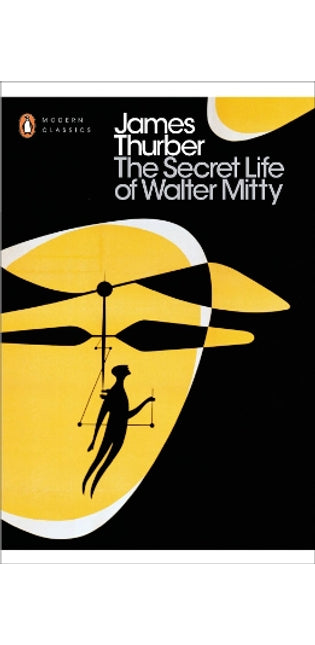
Secret Life of Walter Mitty
Walter Mitty is an ordinary man living an ordinary life. But he has dreams - vivid, extraordinary day dreams - in which the life he leads is one of excitement and even adventure, in which he - a weary, put upon middle-aged man - is the hero of his own story. A man can dream, can't he?The Secret Life of Walter Mitty is just one of the brilliant humorous and witty stories written by James Thurber and collected here.
R 314.00
Memoirs of the Life of Sir Walter Scott, Bart
As son-in-law and literary executor to Sir Walter Scott (1771–1832), John Gibson Lockhart (1794–1854) was uniquely placed to produce a definitive biography of the great poet and novelist. First published in 1837–8, shortly after Scott's death, this celebrated seven-volume work is based on personal memories, correspondence, and Scott's own autobiographical sketches. Wide-ranging in his purview, Lockhart is also detailed in his descriptions: the Aberdeen Journal of the day observed that the volumes trace Scott's life and literary efforts with 'the most minute distinctness'. Volume 1 opens with Scott's brief autobiography, written in 1808 and revised in 1825. Lockhart's biography proper opens with Scott's birth in 1771, provides an account of his education, and concludes here with his first contributions to the Edinburgh Review in 1804.
R 1,965.30
R 244.00
R 1,041.00
R 1,627.00
R 1,442.06
Platonism of Walter Pater
As a teacher of Plato in Oxford's Literae Humaniores, Walter Pater was informed by philosophy from his earliest essays to his last book. The Platonism of Walter Pater examines Pater's deep engagement with Platonism throughout his career. It overturns his reputation as a superficial aesthete known mainly for his 'Conclusion' to The Renaissance to reposition his contribution to literature and the history of ideas.In his criticism and fiction, including his studies on myth, Pater was influenced by several of Plato's dialogues. Phaedrus, Symposium, Theaetetus, Cratylus, and The Republic informed his philosophy of beauty, history, myth, knowledge, ethics, language, and style. As a philosopher, critic, and artist, Plato embodied what it meant to be an author to Pater, who imitated his creative practice from vision to expression. For Pater Platonism was also apoint of contact with his contemporaries, including Matthew Arnold and Oscar Wilde, offering a means to take new measure of their literary relationships. Using the interdisciplinary critical tools of Pater's own educational milieu which combined literature, philosophy, and classics, The Platonism of Walter Pater repositions the importance Pater's contribution to literature and the history of ideas.
R 5,027.00
R 1,560.86
R 1,303.27
Memoirs of the Life of Sir Walter Scott, Bart
As son-in-law and literary executor to Sir Walter Scott (1771–1832), John Gibson Lockhart (1794–1854) was uniquely placed to produce a definitive biography of the great poet and novelist. First published in 1837–8, shortly after Scott's death, this celebrated seven-volume work is based on personal memories, correspondence, and Scott's own autobiographical sketches. Wide-ranging in his purview, Lockhart is also detailed in his descriptions: the Aberdeen Journal of the day observed that the volumes trace Scott's life and literary efforts with 'the most minute distinctness'. Volume 7 covers the period from 1826 until Scott's death in 1832. This was perhaps the darkest chapter in Scott's life, during which his financial woes forced him to sell the copyright for the Waverley novels. This final volume also includes an appendix listing Scott's publications as well as an index of names.
R 2,477.86
R 1,615.00
R 1,521.30
Memoirs of the Life of Sir Walter Scott, Bart
As son-in-law and literary executor to Sir Walter Scott (1771–1832), John Gibson Lockhart (1794–1854) was uniquely placed to produce a definitive biography of the great poet and novelist. First published in 1837–8, shortly after Scott's death, this celebrated seven-volume work is based on personal memories, correspondence, and Scott's own autobiographical sketches. Wide-ranging in his purview, Lockhart is also detailed in his descriptions: the Aberdeen Journal of the day observed that the volumes trace Scott's life and literary efforts with 'the most minute distinctness'. Volume 3 opens in 1812 with an account of 'one of the busiest summers of Scott's busy life', during which he finally moved into his beloved Abbotsford. Incorporating extracts from Scott's correspondence with the English poet George Crabbe, this volume covers the period in which Scott finished Waverley (1814) and published in verse The Field of Waterloo (1815).
R 1,854.86
Walter Benjamin
An accessible and authoritative biography of Walter Benjamin that guides the reader through the complexity of his intellectual legacy and the turbulence of his time Walter Benjamin (1892–1940) is widely considered one of the most creative cultural critics of the twentieth century. Esteemed for his literary acumen and capacious imagination, he developed a unique style of criticism—his friend Hannah Arendt called it pearl-diving—that sought out fragments of redemption in the ruins of bourgeois civilization.Award-winning author Peter E. Gordon tells Benjamin’s story in a vivid and poetic style, inviting the reader to look beyond the image of Benjamin as a tragic figure of German-Jewish history and portraying him as a complex personality of unique and multifaceted gifts. Tracing Benjamin’s life from his Berlin childhood to his Parisian exile, through the romanticism of the youth movements and the conflicts over modernism and Marxism, Gordon brings Benjamin to life.
R 625.00
R 487.00
Memoirs of the Life of Sir Walter Scott, Bart
As son-in-law and literary executor to Sir Walter Scott (1771–1832), John Gibson Lockhart (1794–1854) was uniquely placed to produce a definitive biography of the great poet and novelist. First published in 1837–8, shortly after Scott's death, this celebrated seven-volume work is based on personal memories, correspondence, and Scott's own autobiographical sketches. Wide-ranging in his purview, Lockhart is also detailed in his descriptions: the Aberdeen Journal of the day observed that the volumes trace Scott's life and literary efforts with 'the most minute distinctness'. In volume 5, Lockhart examines Scott's personal and professional life during the years 1820–5. After introducing readers to the hospitality that Scott bestowed on his guests at Abbotsford, the author then turns the reader's attention to Scott's literary achievements with the publication of The Abbot (1820) and the commencement of St Ronan's Well (1823).
R 2,107.06
R 813.00
R 1,204.00




-
, by sungano kanjere Read an extract from It Always Seems Impossible: The Journey of James Urdang
When James Urdang sat down to write his memoir, It Always Seems Impossible, he wasn’t only telling the story of a life devoted to education.He...
-
, by Justine Stevens Giveaway Winners
Keep an eye on our social media pages for regular, fantastic giveaways! 2026 November TBC- TBC- TBC- October My Battlefield by Joyce Meyer- Sandy Phillips...


