Search results for "christopher wool"
Items we need to order for you

R 3,664.00
R 1,985.00
R 508.00
Country Merchant, 1495-1520
Around 1500 England's society and economy had reached a turning point. After a long period of slow change and even stagnation, an age of innovation and initiative was in motion, with enclosure, voyages of discovery, and new technologies. It was an age of fierce controversy, in which the government was fearful of beggars and wary of rebellions. The 'commonwealth' writers such as Thomas More were sharply critical of the greed of profit hungry landlords who dispossessedthe poor. This book is about a wool merchant and large scale farmer who epitomises in many ways the spirit of the period. John Heritage kept an account book, from which we can reconstruct a whole society in the vicinity of Moreton in Marsh, Gloucestershire. He took part in the removal of a villagewhich stood in the way of agricultural 'improvement', ran a large scale sheep farm, and as a 'woolman' spent much time travelling around the countryside meeting with gentry, farmers, and peasants in order to buy their wool. He sold the wool he produced himself, and the fleeces he gathered, to London merchants who exported wool through Calais to the textile towns of Flanders. The wool growers named in the book can be studied in their native villages, and their lives can be reconstructed in theround, interacting in their communities, adapting their farming to new circumstances, and arranging the building of their local churches. A Country Merchant has some of the characteristics of a biography, is part family history and part local history, with some landscape history. Dyer explores themes in economic and social history without neglecting the religious and cultural background. His central concern is to demonstrate the importance of the peasants' contribution to a changing economy.
R 8,314.00
Country Merchant, 1495-1520
Around 1500 England's society and economy had reached a turning point. After a long period of slow change and even stagnation, an age of innovation and initiative was in motion, with enclosure, voyages of discovery, and new technologies. It was an age of fierce controversy, in which the government was fearful of beggars and wary of rebellions. The 'commonwealth' writers such as Thomas More were sharply critical of the greed of profit hungry landlords who dispossessedthe poor. This book is about a wool merchant and large scale farmer who epitomises in many ways the spirit of the period. John Heritage kept an account book, from which we can reconstruct a whole society in the vicinity of Moreton-in-Marsh, Gloucestershire. He took part in the removal of a village which stood in the way of agricultural 'improvement', ran a large scale sheep farm, and as a 'woolman' spent much time travelling around the countryside meeting with gentry, farmers, and peasants in order to buy their wool. He sold the fleeces he produced and those he gathered to London merchants who exported throughCalais to the textile towns of Flanders. The wool growers named in the book can be studied in their native villages, and their lives can be reconstructed in the round, interacting in their communities, adapting their farming to new circumstances, and arranging the building of their local churches.A Country Merchant has some of the characteristics of a biography, is part family history, and part local history, with some landscape history. Dyer explores themes in economic and social history without neglecting the religious and cultural background. His central concerns are to demonstrate the importance of commerce in the period, and to show the contribution of peasants to a changing economy.
R 2,127.00
R 214.00
R 1,047.98
R 426.00
R 336.00
R 365.00
Beyond the Moon
The sequel to Brown's debut novel, 'Beyond the River' is finally here.
R 276.00
R 409.00
R 522.51
R 305.00
R 364.00
R 652.57
R 336.00
R 305.00
R 684.00
R 533.00
R 457.00
R 305.00
R 205.00
World Intellectual Property Organization (WIPO)
Covering the World Intellectual Property Organization, this volume introduces a much ignored element of the contemporary structure of global governance to scholars of international political economy. Christopher May discusses: how the World Intellectual Property Organization works, its antecedents and history the debates about the role and justification of intellectual property the role of WIPO within contemporary global politics the key elements of its relations with the World Trade Organization the Agreement on Trade Related Aspects of Intellectual Property Rights. The analysis then examines the recent political economy of the organization and argues that far from being the neutral or technical agency that it often presents itself as, the WIPO is highly politicized and acts to socialize policy makers and civil servants into a specific view of intellectual property. However, the recent proposal to establish a Development Agenda at the WIPO is an important development, and the book concludes by examining the problems which have promoted this agenda, suggesting that these reforms of the WIPO should be welcomed. The World Intellectual Property Organization is a clear and accessible volume that will confirm the WIPO as one of the global institutions which any student of global governance must understand.
R 2,342.11
Son of God
What do Christians mean when they call Jesus "son of God"? In this study of the phrase "son of God" as applied to Jesus of Nazareth, Christopher Bryan examines the testimony of various New Testament witnesses who used this expression to speak of him, and asks where they got it, what they meant by it, and how it might have been understood. In Bryan's view, any attempt to address these questions stands self-condemned if it does not point to both the words and works of Jesus himself in the memory of early Christians, and the Torah of Israel as then understood, centering on Israel's Scriptures. Of course Paul and his fellow believers did not proclaim Jesus in a vacuum. They proclaimed Jesus in the Roman Empire during the decades following the death of Augustus. With regard to the meaning of the phrase "son of God," what becomesclear, Bryan argues, is that whereas "Lord" (another expression frequently used in the New Testament for Jesus of Nazareth) reflects believers' sense of Jesus' relationship to them, "son of God" reflects their sense of his relationship to God. It is a title that reflects their consciousness of Jesus'holiness-that is, his "set-apartness," his consecration, and even his divinity. Readers of Son of God will gain a well-rounded understanding of classic and recent research in Christology and the New Testament, as well as an in-depth, historically situated view of the evidence that paints a clearer picture of what New Testament witnesses meant when they called Jesus "son of God."
R 5,414.00
Sleepwalkers
The pacy, sensitive and formidably argued history of the causes of the First World War, from acclaimed historian and author Christopher ClarkFINANCIAL TIMES BOOKS OF THE YEAR 2014SUNDAY TIMES and INDEPENDENT BOOKS OF THE YEAR 2012Winner of the Los Angeles Times History Book Prize 2014The moments that it took Gavrilo Princip to step forward to the stalled car and shoot dead Franz Ferdinand and his wife were perhaps the most fateful of the modern era. An act of terrorism of staggering efficiency, it fulfilled its every aim: it would liberate Bosnia from Habsburg rule and it created a powerful new Serbia, but it also brought down four great empires, killed millions of men and destroyed a civilization. What made a seemingly prosperous and complacent Europe so vulnerable to the impact of this assassination? In The Sleepwalkers Christopher Clark retells the story of the outbreak of the First World War and its causes. Above all, it shows how the failure to understand the seriousness of the chaotic, near genocidal fighting in the Balkans would drag Europe into catastrophe.Reviews:'Formidable ... one of the most impressive and stimulating studies of the period ever published' Max Hastings, Sunday Times'Easily the best book ever written on the subject ... A work of rare beauty that combines meticulous research with sensitive analysis and elegant prose. The enormous weight of its quality inspires amazement and awe ... Academics should take note: Good history can still be a good story' Washington Post'A lovingly researched work of the highest scholarship. It is hard to believe we will ever see a better narrative of what was perhaps the biggest collective blunder in the history of international relations' Niall Ferguson'[Reading The Sleepwalkers], it is as if a light had been turned on a half-darkened stage of shadowy characters cursing among themselves without reason ... [Clark] demolishes the standard view ... The brilliance of Clark's far-reaching history is that we are able to discern how the past was genuinely prologue ... In conception, steely scholarship and piercing insights, his book is a masterpiece' Harold Evans, New York Times Book Review'Impeccably researched, provocatively argued and elegantly written ... a model of scholarship' Sunday Times Books of the Year'Superb ... effectively consigns the old historical consensus to the bin ... It's not often that one has the privilege of reading a book that reforges our understanding of one of the seminal events of world history' Mail Online'A monumental new volume ... Revelatory, even revolutionary ... Clark has done a masterful job explaining the inexplicable' Boston Globe'Superb ... One of the great mysteries of history is how Europe's great powers could have stumbled into World War I ... This is the single best book I have read on this important topic' Fareed Zakaria'A meticulously researched, superbly organized, and handsomely written account Military HistoryClark is a masterly historian ... His acc
R 587.00
Preface to Mark
Christopher Bryan examines Mark's Gospel from the standpoint of newer critical methodologies. he has two purposes: to establish what kind of text Mark was seen to have been, by others as well as by Mark himself, when it was written; and to determine if Mark was written to be read aloud. Bryan's conclusions not only show Mark's Gospel in its original settings, but also suggest ways in which contemporary encounters with Mark can be enriched.
R 3,027.92
Principal Characters
As the grandson of actress Ivy Close and son of director Ronald Neame (Straight from the Horse's Mouth; Scarecrow, 2003), Christopher Neame's roots in the film business were already firmly established by the time he joined the family profession. In his first memoir, Rungs on a Ladder, Neame gave readers an insider's look into a number of productions of the 1960s and 70s produced by Hammer Studios. Christopher followed this with A Take on British TV Drama, in which he recounted the challenges and rewards of working on some of the most distinguished works of British television, including The Flame Trees of Thika, Monsignor Quixote, and Danger: U.X.B. In Principal Characters, Neame fills in the gaps of his illustrious career by providing brief intimate portraits of the many important film figures he has worked with. In this charming collection of anecdotes, he asks and answers questions about the stars, who reveal both their carefree and vulnerable moments alike: Was Richard Harris really such a hell-raiser as a young man? What was Peter Sellers like to work with? How did Robert Mitchum find himself in trouble? How many faces did Alec Guinness have? What was behind Peter O'Toole and a bomb threat in Paris? Looking behind the camera lens, Neame captures director Karel Reisz (This Sporting Life) wearing a producer's hat, marvels at cinematographer Geoffrey Unsworth 'painting' Cabaret with light, discloses Kenneth Tynan's unusual predilection, and weighs in on the culinary skills of Ismail Merchant (A Room with a View). Throughout these accounts, Christopher looks both acutely and often amusingly at many who are household names, and when he feels it is appropriate to do so, he doesn't pull punches. This work is a fitting conclusion to an autobiographical "trilogy," and will be of interest to all those curious about the film industry and especially the stars and directors Christopher Neame has worked with over the years.
R 2,746.00
Fugue for a Darkening Island
Survivors of a terrible African war flee their blighted continent, and look for refuge in the countries of the West. But Britain is falling into civil war and anarchy. One of Christopher Priest's earliest novels, FUGUE FOR A DARKENING ISLAND is a powerful work whose subject matter has become increasingly relevant in recent years.
R 340.00
I Never Knew That About Yorkshire
Bestselling author Christopher Winn takes us on an intriguing journey through Britain's largest county, uncovering the hidden places, legends, secrets and fascinating characters of this unique and compelling piece of England. From England's largest vale and northern Europe's largest gothic cathedral to Britain's oldest city, Yorkshire is home to some of Britain's best architecture, most ravishing scenery and is the cradle of some of our country's most influential and individual characters. You will discover the only clog factory in the world, the first English actor to win an Oscar, the world's oldest association football club and largest expanse of medievel stained glass. This gem of a book will act as a wonderfully surprising and highly entertaining guide to one of England's best loved counties.
R 587.00
R 559.17
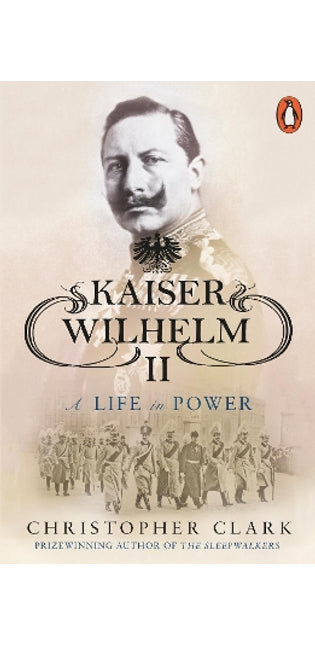
Kaiser Wilhelm II
Christopher Clark's Kaiser Wilhelm II: A Life in Power is a short, fascinating and accessible biography of one of the 20th century's most important figures.King of Prussia, German Emperor, war leader and defeated exile, Kaiser Wilhelm II was one of the most important - and most controversial - figures in the history of twentieth-century Europe. But how much power did he really have?Christopher Clark, winner of the Wolfson prize for his history of Prussia, Iron Kingdom, follows Kaiser Wilhelm's political career from his youth at the Hohenzollern court through the turbulent decades of the Wilhelmine era into global war and the collapse of Germany in 1918, to his last days. He asks: what was his true role in the events that led to the outbreak of the First World War? What was the nature and extent of his control? What were his political goals and his success in achieving them? How did he project authority and exercise influence? And how did his people really view him?Through original research, Clark presents a fresh new interpretation of this contentious figure, focusing on how his thirty-year reign from 1888 to 1918 affected Germany, and the rest of Europe, for years to come. 'Clark's fresh and enlightening history brings the Kaiser's life into critical and illuminating review' German History Christopher Clark is a lecturer in Modern European History at St Catharine's College, University of Cambridge. His book Iron Kingdom: The Rise and Downfall of Prussia 1600 to 1947 was the winner of the Wolfson Prize for History.
R 464.00
Poetical Works of Christopher Smart: Volume IV. Miscellaneous Poems, English and Latin
This volume contains miscellaneous verse, arranged in chronological order, showing the pattern of Smart`s evolution from both academic and popular roles into a poet dedicated to Christian service.
R 11,623.06
R 469.00
R 391.00
R 935.00
R 764.00
Drawings of Vincent van Gogh
A compelling and authoritative overview of the drawings of Vincent van Gogh, one of the most celebrated and intriguing figures in the history of art. The Drawings of Vincent van Gogh is a comprehensive account celebrating the genius and singularity of the artist’s achievements in this field. Arranged by theme – from drawings of humble harvesters to beautifully rendered depictions of landscape, pensive life studies to memorable sketches of the famous Yellow House in Arles and other places – Van Gogh’s works on paper are explored from a fresh perspective by art historian Christopher Lloyd, who records the artist’s successes, failures, experiments, trials and disappointments. Primarily self-taught, Van Gogh approached drawing instinctually, but soon recognized the importance of mastering the grammar of art – anatomy, modelling, foreshortening, perspective – as well as materials and techniques, in order to convey his emotional responses to a subject as vividly as possible. Using examples from the artist’s voluminous and highly charged family correspondence, sketchbooks, as well as comparative artworks by Rembrandt, Dürer and others, the resulting overview gives us a greater understanding of why drawing is so important within Van Gogh’s unique oeuvre and equals the intensity and reputation of his paintings.
R 773.00
R 864.00
R 562.28
R 678.00
Poetical Works of Christopher Smart: Volume III. A Translation of the Psalms of David
The third of a five-volume edition of Smart's original poems and verse translations, which is particularly concerned to show how Smart attempted to adapt the Psalms for his eighteenth-century English Christian audience.
R 12,285.83
Theology in a Suffering World
In this book, Christopher Southgate proposes a new way of understanding the glory of God in Christian theology, based on glory as sign. Working from the roots of the concept in the Hebrew Bible, Theology in a Suffering World: Glory and Longing shows that 'glory' is not necessarily about beauty or radiance, but is better understood as a sign of the unknowable depths of God. Southgate goes on to show how John and Paul transform the concept of glory in the light of the cross. He then explores where glory may be discerned in the natural world, including in situations of pain and suffering. In turn glory is explored in the poetry of R. S. Thomas and the writings of the Jewish mystic Etty Hillesum. Finally, the book considers what it might mean for Christians to be 'transformed from one degree of glory to another': that might mean becoming a sign of the great sign of God that is Christ, and conforming their longing to God's longing for the Kingdom to come.
R 1,761.74
Poetical Works of Christopher Smart: Volume V. The Works of Horace, Translated Into Verse
Published here for the first time since 1767, Christopher Smart's verse translation of Horace was made in the prodigiously creative years between his release from the madhouse and his death. The translation strengthens the impression made by all Smart's later verse of a poet of remarkable lyrical virtuosity and boldness of expression.The translation now emerges as testimony to Smart's tireless creativity and poetic energy, and as a significant contribution to the present reappraisal of Horace's influence on English literature. Smart's contemporaries, however, either ignored the project, or treated it with contempt, and it was never reprinted. This edition includes Smart's own critical preface, which is important for its declaration of the writer's principles as translator, and for its unorthodox ideas about poetic language.Karina Williamson's informative introduction discusses Smart's principles and methods in the context of eighteenth century attitudes to the translation of clasical works. Full scholarly apparatus is provided, together with a detailed and clarifying commentary which explains Smart's more obscurepassages.
R 10,269.60
R 521.00