Search results for "feight"
Items we need to order for you
R 665.78

R 735.69
R 529.54
R 343.00
Loving Thought
Complete collections of poems by Joyce Feight, who was diagnose with Muscular Dystrophy. The illustrations are done by Shirl Feight owner of Feight Designs and also her neice.
R 504.11
R 427.31
Shadow of a Dark Queen
The astonishing first volume in Raymond E. Feist’s bestselling Serpentwar Saga… A nest of vipers is stirring. . . Ancient powers are readying themselves for a devastating confrontation. A dark queen has raised her standard and is gathering armies of unmatched might. Into this battleground of good and evil a band of desperate men are forced, whose only hope for survival is to face this ancient power and discover its true nature. Among them are some unlikely heroes – Erik, a bastard heir denied his birth right, and his friend Roo, an irrepressible scoundrel with a penchant for thievery. They are accompanied by the mysterious Miranda, upon whom all must wager their lives.
R 346.00
R 228.00
R 903.74
R 428.00
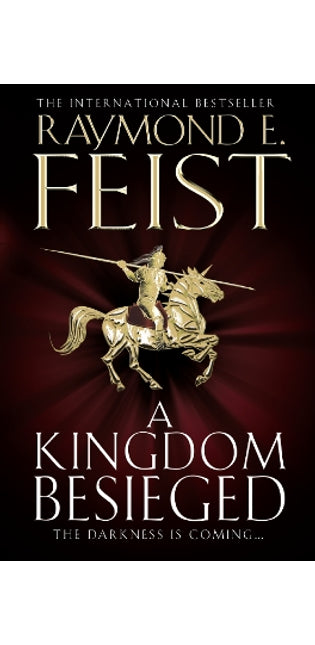
Kingdom Besieged
Discover the fate of the original black Magician, Pug, and his motley crew of agents who safeguard the world of Trigia, as prophecy becomes truth in the first book of the last ever Midkemian trilogy. THE KINGDOM BESIEGED The Darkness is coming… The Kingdom is plagued by rumour and instability. Kingdom spies in Kesh have been disappearing - either murdered, or turned to the enemy side. Information has become scant and unreliable; but one thing appears clear. Dark forces are on the move… Since Pug and the Conclave of Shadows enforced peace after the last Keshian invasion, the Empire has offered no threat. But now factions are rising and Jim Dasher reports mobilizations of large forces in the Keshian Confederacy. As the men of the West answer the King's call to muster, Martin conDoin - left as caretaker of Crydee Keep - will suddenly be confronted with the vanguard of an invading army. He reminds himself that he is a year older than his legendary ancestor, Prince Arutha, was when he stood firm against the Tsurani invasion, but Arutha had an army to command, and Martin is left with old men and young boys. Massive events are about to unfold, events which threaten the future of all human life in Midkemia…
R 346.00
Eyewitness to the Fetterman Fight
The Fetterman Fight ranks among the most crushing defeats suffered by the U.S. Army in the nineteenth-century West. On December 21, 1866 - during Red Cloud's War (1866-1868) - a well-organized force of 1,500 to 2,000 Oglala Lakota, Northern Cheyenne, and Arapaho warriors annihilated a detachment of seventy-nine infantry and cavalry soldiers - among them Captain William Judd Fetterman - and two civilian contractors. With no survivors on the U.S. side, the only eyewitness accounts of the battle came from Lakota and Cheyenne participants. In Eyewitness to the Fetterman Fight, award-winning historian John H. Monnett presents these Native views, drawn from previously published sources as well as newly discovered interviews with Oglala and Cheyenne warriors and leaders. Supplemented with archaeological evidence, these narratives flesh out historical understanding of Red Cloud's War. Climate change in the mid-nineteenth century made the resource-rich Powder River Country in today's Wyoming increasingly important to Plains Indians. At the same time, the discovery of gold in Montana encouraged prospectors to pass through the Powder River region on their way north, and so the U.S. Army began to construct new forts along the Bozeman Trail. In the resulting conflict, the Lakotas and Cheyennes defended their hunting ranges and trade routes. Traditional histories have laid the blame for Fetterman's 1866 defeat and death on his incompetent leadership - and thus implied that the Indian alliance succeeded only because of Fetterman's personal failings. Monnett's sources paint another picture. Narratives like those of Miniconjou Lakota warrior White Bull suggest that Fetterman's actions were not seen as rash or reprehensible until after the fact. Nor did his men flee the field in panic. Rather, they fought bravely to the end. The Indians, for their part, used their knowledge of the terrain to carefully plan and execute an ambush, ensuring them victory. Critical to understanding the nuances of Plains Indian strategy and tactics, the firsthand narratives in Eyewitness to the Fetterman Fight reveal the true nature of this Native victory against regular army forces.
R 646.00
R 1,205.92
Eyewitness to the Fetterman Fight
The Fetterman Fight ranks among the most crushing defeats suffered by the U.S. Army in the nineteenth-century West. On December 21, 1866 - during Red Cloud's War (1866-1868) - a well-organized force of 1,500 to 2,000 Oglala Lakota, Northern Cheyenne, and Arapaho warriors annihilated a detachment of seventy-nine infantry and cavalry soldiers - among them Captain William Judd Fetterman - and two civilian contractors. With no survivors on the U.S. side, the only eyewitness accounts of the battle came from Lakota and Cheyenne participants. In Eyewitness to the Fetterman Fight, award-winning historian John H. Monnett presents these Native views, drawn from previously published sources as well as newly discovered interviews with Oglala and Cheyenne warriors and leaders. Supplemented with archaeological evidence, these narratives flesh out historical understanding of Red Cloud's War. Climate change in the mid-nineteenth century made the resource-rich Powder River Country in today's Wyoming increasingly important to Plains Indians. At the same time, the discovery of gold in Montana encouraged prospectors to pass through the Powder River region on their way north, and so the U.S. Army began to construct new forts along the Bozeman Trail. In the resulting conflict, the Lakotas and Cheyennes defended their hunting ranges and trade routes. Traditional histories have laid the blame for Fetterman's 1866 defeat and death on his incompetent leadership - and thus implied that the Indian alliance succeeded only because of Fetterman's personal failings. Monnett's sources paint another picture. Narratives like those of Miniconjou Lakota warrior White Bull suggest that Fetterman's actions were not seen as rash or reprehensible until after the fact. Nor did his men flee the field in panic. Rather, they fought bravely to the end. The Indians, for their part, used their knowledge of the terrain to carefully plan and execute an ambush, ensuring them victory. Critical to understanding the nuances of Plains Indian strategy and tactics, the firsthand narratives in Eyewitness to the Fetterman Fight reveal the true nature of this Native victory against regular army forces.
R 970.00
R 489.00
Give Me Eighty Men
“With eighty men I could ride through the entire Sioux nation.” The story of what has become popularly known as the Fetterman Fight, near Fort Phil Kearney in present-day Wyoming in 1866, is based entirely on this infamous declaration attributed to Capt. William J. Fetterman. Historical accounts cite this statement in support of the premise that bravado, vainglory, and contempt for the fort’s commander, Col. Henry B. Carrington, compelled Fetterman to disobey direct orders from Carrington and lead his men into a perfectly executed ambush by an alliance of Plains Indians. In the aftermath of the incident, Carrington’s superiors—including generals Ulysses S. Grant and William T. Sherman—positioned Carrington as solely accountable for the “massacre” by suppressing exonerating evidence. In the face of this betrayal, Carrington’s first and second wives came to their husband’s defense by publishing books presenting his version of the deadly encounter. Although several of Fetterman’s soldiers and fellow officers disagreed with the women’s accounts, their chivalrous deference to women’s moral authority during this age of Victorian sensibilities enabled Carrington’s wives to present their story without challenge. Influenced by these early works, historians focused on Fetterman’s arrogance and ineptitude as the sole cause of the tragedy. In Give Me Eighty Men, Shannon D. Smith reexamines the works of the two Mrs. Carringtons in the context of contemporary evidence. No longer seen as an arrogant firebrand, Fetterman emerges as an outstanding officer who respected the Plains Indians' superiority in numbers, weaponry, and battle skills. Give Me Eighty Men both challenges standard interpretations of this American myth and shows the powerful influence of female writers in the nineteenth and twentieth centuries.
R 432.00
Give Me Eighty Men
“With eighty men I could ride through the entire Sioux nation.” The story of what has become popularly known as the Fetterman Fight, near Fort Phil Kearney in present-day Wyoming in 1866, is based entirely on this infamous declaration attributed to Capt. William J. Fetterman. Historical accounts cite this statement in support of the premise that bravado, vainglory, and contempt for the fort’s commander, Col. Henry B. Carrington, compelled Fetterman to disobey direct orders from Carrington and lead his men into a perfectly executed ambush by an alliance of Plains Indians. In the aftermath of the incident, Carrington’s superiors—including generals Ulysses S. Grant and William T. Sherman—positioned Carrington as solely accountable for the “massacre” by suppressing exonerating evidence. In the face of this betrayal, Carrington’s first and second wives came to their husband’s defense by publishing books presenting his version of the deadly encounter. Although several of Fetterman’s soldiers and fellow officers disagreed with the women’s accounts, their chivalrous deference to women’s moral authority during this age of Victorian sensibilities enabled Carrington’s wives to present their story without challenge. Influenced by these early works, historians focused on Fetterman’s arrogance and ineptitude as the sole cause of the tragedy. In Give Me Eighty Men, Shannon D. Smith reexamines the works of the two Mrs. Carringtons in the context of contemporary evidence. No longer seen as an arrogant firebrand, Fetterman emerges as an outstanding officer who respected the Plains Indians' superiority in numbers, weaponry, and battle skills. Give Me Eighty Men both challenges standard interpretations of this American myth and shows the powerful influence of female writers in the nineteenth and twentieth centuries.
R 1,464.00
R 554.00
R 499.93
R 523.00
R 428.00
Coastwatchers: Operation Ferdinand and the Fight for the South Pacific
The Coastwatchers is the fascinating story of the unsung heroic civilian spotters of World War 2 who roamed the coastlines of their home islands and reported back enemy sightings to Allied Intelligence. Author Eric Feldt led Operation Ferdinand, part of the build-up to the Normandy landings, in which the Coastwatchers, by this time on the US Navy's payroll, played a critical role. His intimate knowledge of Ferdinand, and his familiarity with the Coastwatchers of the Pacific islands, provides a unique perspective on this little known but important chapter of military history.
R 456.00
Fight
NEW YORK TIMES BESTSELLER Your playbook to becoming who God created you to be: a man who knows how to fight for what's right. Pastor, bestselling author, husband, and father Craig Groeschel helps you uncover who you really are--a powerful man with the heart of a warrior. With God's help, you'll find strength to fight the battles you know you must win: the ones that determine the state of your heart, the quality of your marriage, and the spiritual health of those you love most.Groeschel examines the life of Samson--a strong man with glaring weaknesses. Like many men, Samson taunted his enemy and rationalized his sins. The good news is God's grace is greater than your worst sin. By looking at Samson's life, you will . . .Learn to defeat the demons that make strong men weakTap into a strength you never knew was possibleBecome who God made you to be--a man who knows how to fight for what's rightDon't just fight like a man. Fight like a man of God. For God's sake . . . FIGHT!Spanish edition also available, as well as a video study and study guide.
R 399.00
R 397.19
Feast, Famine or Fighting?
The advent of social complexity has been a longstanding debate among social scientists. Existing theories and approaches involving the origins of social complexity include environmental circumscription, population growth, technology transfers, prestige-based and interpersonal-group competition, organized conflict, perennial wartime leadership, wealth finance, opportunistic leadership, climatological change, transport and trade monopolies, resource circumscription, surplus and redistribution, ideological imperialism, and the consideration of individual agency.However, recent approaches such as the inclusion of bioarchaeological perspectives, prospection methods, systematically-investigated archaeological sites along with emerging technologies are necessarily transforming our understanding of socio-cultural evolutionary processes. In short, many pre-existing ways of explaining the origins and development of social complexity are being reassessed. Ultimately, the contributors to this edited volume challenge the status quo regarding how and why social complexity arose by providing revolutionary new understandings of social inequality and socio-political evolution.
R 7,326.00
Love and the Fighting Female
The fighting female archetype--a self-reliant woman of great physical prowess--has become increasingly common in action films and on television. However, the progressive female identities of these narratives cannot always resist the persistent and problematic framing of male-female relationships as a battle of the sexes or other source of antagonism.Combining cultural analysis with close readings of key popular American film and television texts since the 1980s, this study argues that certain fighting female themes question regressive conventions in male-female relationships. Those themes reveal potentially progressive ideologies regarding female agency in mass culture that reassure audiences of the desirability of empowered women while also imagining egalitarian intimacies that further empower women. Overall, the fighting female narratives addressed here afford contradictory viewing pleasures that reveal both new expectations for and remaining anxieties about the "strong, independent woman" ideal that emerged in American popular culture post-feminism.
R 1,176.00
R 367.00
R 492.00
Fighting for Foreigners
Although stereotypically homogenized and hostile to immigrants, Japan has experienced an influx of foreigners from Asia and Latin America in recent decades. In Fighting for Foreigners, Apichai W. Shipper details how, in response, Japanese citizens have established a variety of local advocacy groups—some faith based, some secular—to help immigrants secure access to social services, economic equity, and political rights.Drawing on his years of ethnographic fieldwork and a pragmatic account of political motivation he calls associative activism, Shipper asserts that institutions that support illegal foreigners make the most dramatic contributions to democratic multiculturalism. The changing demographics of Japan have been stimulating public discussions, the political participation of marginalized groups, and calls for fair treatment of immigrants. Nongovernmental organizations established by the Japanese have been more effective than the ethnically particular associations formed by migrants themselves, Shipper finds. Activists who initially work in concert to solve specific and local problems eventually become more ambitious in terms of political representation and opinion formation.As debates about the costs and benefits of immigration rage across the developed world, Shipper's research offers a refreshing new perspective: rather than undermining democracy in industrialized society, immigrants can make a positive institutional contribution to vibrant forms of democratic multiculturalism.
R 1,088.00
R 611.00
R 620.22
R 531.01
Fighting Words and Feuding Words
Anger is central to the Homeric epic, but few scholarly interventions have probed HomerOs language beyond the study of the IliadOs first word: menis. Yet Homer uses over a dozen words for anger. Fighting Words and Feuding Words engages the powerful tools of Homeric poetic analysis and the anthropological study of emotion in an analysis of two anger terms highlighted in the Iliad by the Achaean prophet Calchas. Walsh argues that kotos and kholos locate two focal points for the study of aggression in Homeric poetry, the first presenting HomerOs terms for feud and the second providing the native terms that designates the martial violence highlighted by the Homeric tradition. After focusing on these two terms as used in the Iliad and the Odyssey, Walsh concludes by addressing some post-Homeric and comparative implications of Homeric anger.
R 1,617.00
R 397.00
Heavyweight Title Fights of the 1980s
Though a much-maligned period in heavyweight boxing history, the 1980s remains a decade well worth revisiting. It was bookended by two all-time greats in Larry Holmes and Mike Tyson. Holmes dominated the first half of the decade, but the "Easton Assassin" struggled to escape the shadow of Muhammad Ali. Holmes did go on to create his own historic legacy of greatness despite stumbling in his attempt to surpass Rocky Marciano's unbeaten record of 49-0. The second half of the decade saw the meteoric rise of Mike Tyson, who cleaned out and unified a fractured heavyweight division through the HBO unification tournament. The 80s was also the decade of fighters collectively known as the "lost generation" of heavyweights. That included the likes of Greg Page, Tony Tubbs, Tim Witherspoon, and Michael Dokes, who, for various reasons, couldn't sustain a period at the top of the game. However, they still deserve to be remembered for more than their failings. This book presents a thorough history of a stunning decade in heavyweight boxing, covering all 46 world title fights in detail.
R 1,176.00
R 305.00
When I Was Eight
Bestselling memoir Fatty Legs for younger readers. Olemaun is eight and knows a lot of things. But she does not know how to read. Ignoring her father's warnings, she travels far from her Arctic home to the outsiders' school to learn. The nuns at the school call her Margaret. They cut off her long hair and force her to do menial chores, but she remains undaunted. Her tenacity draws the attention of a black-cloaked nun who tries to break her spirit at every turn. But the young girl is more determined than ever to learn how to read. Based on the true story of Margaret Pokiak-Fenton, and complemented by stunning illustrations, When I Was Eight makes the bestselling Fatty Legs accessible to younger readers. Now they, too, can meet this remarkable girl who reminds us what power we hold when we can read.
R 501.00
Fighting Words and Feuding Words
Anger is central to the Homeric epic, but few scholarly interventions have probed Homer’s language beyond the study of the Iliad’s first word: menis. Yet Homer uses over a dozen words for anger. Fighting Words and Feuding Words engages the powerful tools of Homeric poetic analysis and the anthropological study of emotion in an analysis of two anger terms highlighted in the Iliad by the Achaean prophet Calchas. Walsh argues that kotos and kholos locate two focal points for the study of aggression in Homeric poetry, the first presenting Homer’s terms for feud and the second providing the native terms that designates the martial violence highlighted by the Homeric tradition. After focusing on these two terms as used in the Iliad and the Odyssey, Walsh concludes by addressing some post-Homeric and comparative implications of Homeric anger.
R 4,414.00
R 305.00
R 168.00
Feminist Fight Club
'Engaging, hilarious and practical - I will proudly proclaim myself a card-carrying member of the FFC' - Sheryl Sandberg, COO of Facebook and bestselling author of Lean InThis is a call to arms.Are you aged zero to infinity? Finished with the sexist status quo? Ready to kick ass and take names?Welcome to the Feminist Fight Club. You have lifetime membership.Feminist Fight Club provides an arsenal of weapons for surviving in an unequal world. You will learn how to fight micro-aggressions, correct unconscious bias, deal with male colleagues who can't stop 'manterrupting' or 'bro-propriating' your ideas - and how to lean in without falling the f*ck over.Every woman needs this book - and they needed it yesterday.This is not a drill.
R 346.00
R 444.13
R 458.00