



Search results for "gary lachman"
Items in stock - 4 working days delivery time

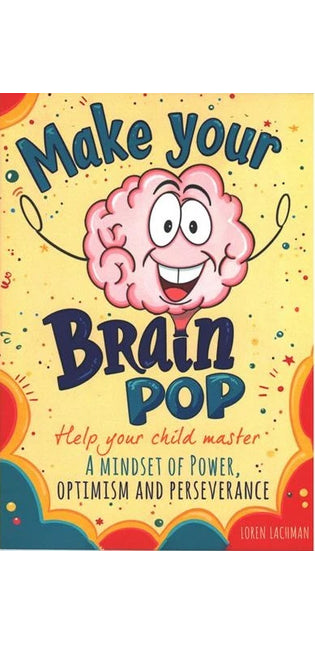
Make Your Brain POP
Make your Brain POP is a practical, easy-toread guide for parents focused on developing a growth mindset in children through mindful communication and purposeful parenting. Thisbook draws from personal experience and research-backed concepts, particularly CarolDweck’s work on mindset psychology, to help set our children up for mental success.
R 260.00
Items we need to order for you
Touched by the Presence
A memoir of magic, rock and roll, and becoming who you are• Traces the author’s journey from bassist and founding member of Blondie to writer on consciousness and the esoteric tradition • Explores his involvement in Gurdjieff’s Fourth Way, Crowley’s Thelema, and his relationship with the bestselling author Colin Wilson • Reveals how an early love of comic books, science fiction, and fantasy led him to the esoteric tradition Not many members of the Rock and Roll Hall of Fame are also recognized authorities on the western inner tradition. Gary Lachman is. In 1978, Blondie released the top-ten hit, “(I am Always Touched by Your) Presence, Dear.” Gary Lachman (then Gary Valentine) had written the song for his girlfriend after the series of shared dreams and telepathic experiences they had. Thus started his life-long obsession with the potentials of consciousness. In this memoir, Gary recounts how he went from being a successful rock and roller to a writer on consciousness and the western inner tradition. He shares encounters with rockers such as the Ramones, New York Dolls, Patti Smith, the Rolling Stones, David Bowie, Iggy Pop and also Timothy Leary, William Burroughs, and Allen Ginsberg. Living with Blondie’s Debbie Harry and Chris Stein on New York’s Bowery, a block from the birthplace of punk rock, CBGB, Gary discovered occultism via a follower of Aleister Crowley. Post rock and roll, Gary’s occult studies brought him to the Golden Dawn, Manly P. Hall, Gnosticism, and a stint in Crowley’s O.T.O. He details his time in the Fourth Way, including a visit to the site of Gurdjieff’s Institute for the Harmonious Development of Man in France, and his years studying philosophy and literature and working as a Science Writer, while managing a famous metaphysical bookshop at the height of the New Age. Excursions to Stonehenge, Avebury, and Glastonbury in search of ley lines, and pilgrimages to Colin Wilson’s home in Cornwall, are a few of the highlights of this introspective, humorous account of a nascent writer’s struggle from rock and roll to individuation.
R 883.00
Secret History of Consciousness
-- What is consciousness like?-- How can consciousness be achieved?Gary Lachman argues that consciousness is not a result of neurons and molecules, but is actually responsible for them. Meaning, he proposes, is not imported from the outer world, but rather creates the world.He shows that consciouness is a living, evolving presence whose development can be traced through different historical periods. Concentrating on the late nineteenth-century onwards, Lachman exposes the 'secret history' of consciousness through thinkers such as P. D. Ouspensky, Rudolf Steiner, and Colin Wilson, as well as more mainstream philosophers like Henri Bergson, William James, Owen Barfield and psychologist Andreas Mavromatis.Two little known but important thinkers play a major role in Lachmans argument: Jurij Moskvitin, who showed how our consciousness relates to the mechanisms of perception and to the external world; and Jean Gebster, who presented perhaps the most impressive case for the evolution of consciousness.This is a far-reaching book from an exciting contemporary thinker.
R 781.00
R 502.00
R 704.00
R 958.00
R 858.86
R 190.00
R 550.48
Maurice Nicoll
A biography of the influential teacher of the Fourth Way In 1922, Maurice Nicoll (1884-1953) abandoned his successful London psychiatry practice and his direct studies with Carl Jung to move his family just outside of Paris to the Institute for the Harmonious Development of Man, a center recently opened by philosopher, mystic, and spiritual guru G.I. Gurdjieff, the founder of the esoteric system that became known as the “Fourth Way.” Nicoll went on to become one of the most passionate teachers of the Fourth Way, committing the final three decades of his life to teaching “The Work” in his own unorthodox style. In this revealing biography, Gary Lachman draws on recently uncovered diaries to explore the unusual, syncretic approach Nicoll brought to his teaching of the Fourth Way. He shows how Nicoll is unique in having Jung, Gurdjieff, and Ouspensky as teachers and to have known each of these important figures in esoteric history personally, yet—as Lachman reveals—Nicoll was not a blind devotee by any stretch. The author shows how he incorporated elements of Jungian psychology and Emanuel Swedenborg-inspired mysticism into his exploration and teaching of both Gurdjieff’s and Ouspensky’s ideas, as well as into his best-known work, Psychological Commentaries on the Teaching of Gurdjieff and Ouspensky. Lachman reveals the unorthodox side of Nicoll in fuller detail than ever before through excerpts from recently shared diaries, in which Nicoll included detailed accounts of his own solitary “self-sex” erotic experimentations to reach visionary states, along with recordings of his dreams and other personal and mystical reflections. The social details of Nicoll’s life are also examined, including vivid portraits of the occult scene in the early-to-mid-20th century and the communal living situations in which Nicoll sometimes resided. Drawing on his familiarity with hermetic practices and his own experiences with “The Work,” Lachman comprehensively explores the significance of Nicoll and the novelty of his thought, offering a profound, needed, and sympathetic but critical study of this man so instrumental to the development and legacy of the Fourth Way.
R 920.00
R 304.00
R 616.05
R 622.52
Mind Parasites
Wilson has blended H.P. Lovecraft s dark vision with his own revolutionary philosophy and unique narrative powers to produce a stunning, high-tension story of vaulting imagination. A professor makes a horrifying discovery while excavating a sinister archeological site. For over 200 years, mind parasites have been lurking in the deepest layers of human consciousness, feeding on human life force and steadily gaining a foothold on the planet. Now they threaten humanity s extinction. They can be fought with one weapon only: the mind, pushed to and beyond its limits. Pushed so far that humans can read each other s thoughts, that the moon can be shifted from its orbit by thought alone. Pushed so that man can at last join battle with the loathsome parasites on equal terms."
R 387.00
They Shall Not See the Dawn
An “Army of Werewolves” and the greatest manhunt in history. . . . After Hitler’s suicide, American intelligence feared that surviving Third Reich leaders were plotting a comeback with hidden weapons, rocket programs, and their Führer's final testament. May 1945. The Reich is in ruins. Hitler is dead. Yet for the US Army’s Counter Intelligence Corps, the real war has just begun. They Shall Not See the Dawn is the true historical thriller following a unit of American agents, drawn from every walk of life, hunting Hitler’s dangerous henchmen still at large and feared to be carrying their Führer’s final political testament, orders for a guerilla resistance, and plans for rocket and nuclear programs hidden in mountain strongholds. It was a race against time to capture World War II’s most notorious Nazis before they could vanish or rally a new resistance. The CIC men were college students, linguists, an actor, young draftees, and refugees armedwith guns, intellect, intuition, and sheer daring. Their quarry included Ernst Kaltenbrunner, the monstrous Gestapo chief; Julius Streicher, Hitler’s notorious “Jew-baiter”; Robert Ley, master of slave labor; and other war criminals desperate to escape justice. Against all odds, the CIC brought them down, ensuring their places in the dock at Nuremberg. Timed for publication during the 80th anniversary of the Nuremberg verdict and hangings, They Shall Not See the Dawn resurrects the heroic exploits of America’s “G-men in khakis,” the men who ensured that the architects of Nazi horror would never walk free.
R 785.00
R 780.00
R 228.00
R 550.00
Robert Lachmann’s Letters to Henry George Farmer (from 1923 to 1938)
Robert Lachmann’s letters to Henry George Farmer, from the years 1923-38, provide insightful glimpses into his life and his progressive research projects. From an historical perspective, they offer critical data concerning the development of comparative musicology as it evolved in Germany during the early decades of the twentieth century. The fact that Lachmann sought contact with Farmer can be explained from their mutual, yet diverse interests in Arab music, particularly as they were then considered to be the foremost European scholars in the field. During the 1932 Cairo International Congress on Arab Music, they were selected as presidents of their respective committees.
R 5,569.00
Codename Nemo
The white-knuckled saga of a maverick captain, nine courageous sailors, and a US Navy task force who achieved the impossible on June 4, 1944—capturing Nazi submarine U-505, its crew, technology, encryption codes, and an Enigma cipher machine.Two days before D-Day—the course of World War II was forever changed. The hunters of the Atlantic Ocean had become the hunted, and US antisubmarine Task Group 22.3 seized a Nazi U-boat, its crew, and all its secrets. Led by a nine-man boarding party and Captain Daniel Gallery, “Operation Nemo” was the first seizure of an enemy warship in battle since the War of 1812, a victory that shortened the duration of the war. But at any moment, the mission could have ended in disaster. Charles Lachman tells this thrilling cat-and-mouse game through the eyes of the men on both sides of Operation Nemo—German U-boaters and American heroes like Lieutenant Albert David (“Mustang”), who led the boarding party that took control of U-505 and became the only sailor to be awarded the Medal of Honor in the Battle of the Atlantic. Three thousand American sailors participated in this extraordinary adventure; nine ordinary American men channeling extraordinary skill and bravery finished the job; and then—like everyone involved—breathed not a word of it until the war was over. In Berlin, the German Kriegsmarine assumed that U-505 had been blown to bits by depth charges, with all hands lost at sea. They were unaware that the U-boat, its Enigma machine, and its Nazi coded messages were now in American hands. They were also unaware that 59 German sailors captured on the high seas were imprisoned in a POW camp in Ruston, Louisiana, until their release in 1946. A deeply researched, fast-paced World War II narrative for the ages, Charles Lachman’s Codename Nemo traces every step of this historic pursuit on the deadly seas.
R 565.00
R 457.00
R 780.00
Primetime
Leading lifespan psychologist Margie Lachman creates an inspiring new framework for midlife, based on her landmark thirty years of research and work on the MIDUS study, as the defining years of life. We've all heard the term "midlife crisis" and the stereotypes that come with it. But what if everything you think you know about midlife is a myth? In Primetime, Dr. Margie Lachman draws on her decades of research to debunk these myths and rebrand midlife as the optimal time for personal growth and satisfaction. A professor of psychology at Brandeis University and the director of the Lifespan Lab, Dr. Lachman has spent thirty years studying midlife from a lifespan developmental perspective. Her research reveals the myth of the midlife "crisis", and other misconceptions such as people in their middle years can't change and that it is the unhappiest time of life. In reality, only a small percentage of people report experiencing a midlife crisis; personality can change during midlife and many people have a higher sense of well-being and control. It is a time when most are still healthy, highly functioning, mentoring those younger and caring for those older combined with increased knowledge and experience and stronger emotion regulation. This book reveals midlife as a critical time in the life cycle with high generativity and peak responsibility, as well as when we make choices that can impact our later years. With a focus on debunking myths, navigating changes, and planning for the future, she guides readers through making sense of the past and imagining future possibilities. She also covers the physical, psychological, cognitive, and social changes that accompany the middle years and illuminates the potential to harness a sense of control in the face of the challenges, constraints, and transitions.
R 628.00
Lachman's Case Studies in Anatomy
The fifth edition of Lachman's Case Studies in Anatomy is a thoroughly revised edition of a popular collection of 50 anatomical cases. Each chapter starts with a clinical case presentation, followed by diagnosis and therapy and then an extensive discussion of the anatomy that is relevant to the case. The patient presentations provide the history and physical examination findings in a format consistent with that which the student will utilize in clinical training. Diagnostic and therapeutic procedures that are discussed have been brought up-to-date and are consistent with current medical practice. Cases represent clinical encounters required in clerkship curricula. This should allow students to draw from this book throughout their four years in medicalschool. The scope of the book has been expanded to include embryological development by including three new cases of developmental abnormalities. Many new figures and have included many diagnostic images including radiographs, CT scans, MRIs and ultrasounds. To help the reader feel confident that the major anatomical points have been mastered, review questions and answers have been added at the end of each unit.
R 2,366.74
David LaChapelle. Lost + Found
TASCHEN presents Lost + Found and Good News, the latest and final publications from artist David LaChapelle. The books are the fourth and fifth installments of LaChapelle’s five-book anthology, which began with LaChapelle Land (1996), continued with Hotel LaChapelle (1999), and followed by Heaven to Hell (2006).Lost + Found is a visual recording of the times we live in and the issues we face, expressed through David LaChapelle’s unique and distinctive vision. Featuring a monumental curation of images that have never before been published in book form, it chronicles LaChapelle’s strongest images as a visionary to date while encapsulating our time in history. This fourth volume also introduces a decade of unseen work from LaChapelle’s creative renaissance, where he offers a bridge into paradise and the sublime, leading viewers into volume two: Good News.Lost + Found features: Pamela Anderson, Julian Assange, Isabella Blow, David Bowie, Naomi Campbell, Hillary Clinton, Frances Bean Cobain, Miley Cyrus, Lana Del Rey, Lady Gaga, Sharon Gault, Daphne Guinness, Whitney Houston, Kris Jenner, Kendall Jenner, Bruce Jenner, Kylie Jenner, Dwayne Johnson, Khloe Kardashian, Kim Kardashian, Eartha Kitt, David LaChapelle, Amanda Lepore, Nicki Minaj, Katy Perry, Sergei Polunin, Keith Richards, Rihanna, Chris Rock, Amber Rose, Britney Spears, Uma Thurman, Andy Warhol, Kanye West, Pharrell Williams, Amy Winehouse, and many others...Lost + Found and Good News are sold separately.
R 1,140.00
R 306.00
R 515.66
Rafael Garcia: Henchman
What if life in a super-villain organization was less like a James Bond movie and more like working at Walmart Corporate? Imagine The Office but with more explosive, action-packed adventure, sex, food and general stupidity crossed with superheros.Welcome to the world of Rafael Garcia, a low-level henchman for hire. It's a dead-end job but someone's got to do it.With office politics, team building workshops, drug testing, helping to increase his villainous boss' social media standing - and all the soul-sucking problems of working in middle management. Can Rafael cut through the BS, prove himself, and succeed? Can he handle the dark secret at the heart of Maverick, Inc.?Rafael Garcia: Henchman is a high-octane action comedy that brings all the old familiar tropes of a dark workplace comedy by way of a brand-new cinematic superhero universe. From Emmy-Award winning Writer Peter Murrieta (Wizards of Waverly Place / Mr.Iglesias) and Writer/Filmmaker David Schrader (Baby Badass), comes an action comedy that mixes the daily grind of The Office with the slacker absurdity of Stripes -- if the General in charge was more like Lex Luthor.The series is brought to you by lifelong readers of comics with a deep love for the world of superheroes. A love that planted the seed for questions like "Who provides the janitorial services at JLA Headquarters? And do they have a benefits package?" And when is it not appropriate to bitch about your work colleagues, while your taking part in a billion-dollar heist.
R 471.00
Understanding Ludwig Lachmann's Economics
Ludwig Lachmann is a central but underappreciated figure within the Austrian school of economics. Although his understanding of institutions, his appreciation of the heterogeneity of capital, his emphasis on subjectivity, and his focus on the dynamism and uncertainty of the real world have become dominant positions amongst Austrian economists, he is still viewed as something of an outsider. As such, the contributions of Lachmann's economics are arguably misunderstood. This Element attempts to tease out and discuss the critical contributions of Lachmann's economics. Arguably, one way in which to understand Lachmann's economics is by seeing it as unified in considering, in various ways, a single conceptual 'problem' – the apparent tension between the dynamic nature of social reality and the intelligible nature of the social world. Approaching Lachmann with this theme in mind allows us to put things together more coherently than other exegetical strategies.
R 2,800.22
R 336.00
Digital Wisdom
Taking an active role in reshaping technology is at the core of Digital Wisdom: Searching for Agency in the Age of AI. The book helps you understand more about the underlying issues of AI, social media, and data analytics, so we all can pick a better path together. This book explores how fundamental aspects of today's digital technology intersect with our rights and assumptions about private life, individual autonomy, and social boundaries.This exploration begins with a discussion about what all that data collected about us is for, and how companies, governments, and ourselves (as people who also work for those companies and governments) might want to alter the dynamic. The book looks at our changing sense of privacy, and how data is not just recorded but fused, correlated, shared, and acted upon in ways that seem fundamentally different than our laws or principles once assumed. It talks about technology’s role in making us seem to be more divided than ever, affecting our politics, our pastimes, and even our basic ability to connect with one another. Examining ways in which technology is used to change our minds—sometimes for our benefit, and sometimes to our detriment—the book breaks down the increasing use of algorithms that impact our everyday lives, so we can build a more ethical practice of digital technology.This exploration about our digital future ends with a discussion about Digital Wisdom. It makes an argument for how we can use this wisdom to live more fully in the ways we want, with the features of technological advancement we choose. It suggests how our educational systems, industries, and governments could shift to better support Digital Wisdom. These ideas are not exhaustive; Digital Wisdom is a mindset rather than a simple set of steps to follow. Applying this mindset is going to take creativity from all of us, but, in the end, the Digital Wisdom mindset will guide us in taking concrete steps towards a more responsible digital future.
R 1,603.43
R 660.67
Understanding Ludwig Lachmann's Economics
Ludwig Lachmann is a central but underappreciated figure within the Austrian school of economics. Although his understanding of institutions, his appreciation of the heterogeneity of capital, his emphasis on subjectivity, and his focus on the dynamism and uncertainty of the real world have become dominant positions amongst Austrian economists, he is still viewed as something of an outsider. As such, the contributions of Lachmann's economics are arguably misunderstood. This Element attempts to tease out and discuss the critical contributions of Lachmann's economics. Arguably, one way in which to understand Lachmann's economics is by seeing it as unified in considering, in various ways, a single conceptual 'problem' – the apparent tension between the dynamic nature of social reality and the intelligible nature of the social world. Approaching Lachmann with this theme in mind allows us to put things together more coherently than other exegetical strategies.
R 901.87
R 737.03
Digital Wisdom
Taking an active role in reshaping technology is at the core of Digital Wisdom: Searching for Agency in the Age of AI. The book helps you understand more about the underlying issues of AI, social media, and data analytics, so we all can pick a better path together. This book explores how fundamental aspects of today's digital technology intersect with our rights and assumptions about private life, individual autonomy, and social boundaries.This exploration begins with a discussion about what all that data collected about us is for, and how companies, governments, and ourselves (as people who also work for those companies and governments) might want to alter the dynamic. The book looks at our changing sense of privacy, and how data is not just recorded but fused, correlated, shared, and acted upon in ways that seem fundamentally different than our laws or principles once assumed. It talks about technology’s role in making us seem to be more divided than ever, affecting our politics, our pastimes, and even our basic ability to connect with one another. Examining ways in which technology is used to change our minds—sometimes for our benefit, and sometimes to our detriment—the book breaks down the increasing use of algorithms that impact our everyday lives, so we can build a more ethical practice of digital technology.This exploration about our digital future ends with a discussion about Digital Wisdom. It makes an argument for how we can use this wisdom to live more fully in the ways we want, with the features of technological advancement we choose. It suggests how our educational systems, industries, and governments could shift to better support Digital Wisdom. These ideas are not exhaustive; Digital Wisdom is a mindset rather than a simple set of steps to follow. Applying this mindset is going to take creativity from all of us, but, in the end, the Digital Wisdom mindset will guide us in taking concrete steps towards a more responsible digital future.
R 4,447.38
R 9,287.86
R 610.00
R 914.20
Oxford Professional Practice: Handbook of Quality Improvement in Healthcare
Quality of care is an essential outcome in modern healthcare, and improving this care is an integral part of the daily work of all healthcare professionals.The Handbook of Quality Improvement in Healthcare systematically covers the most modern theories and methods of improvement and implementation science in a practical and easy to follow format. It focusses on key challenges in healthcare, such as developing safe person-centred care, ensuring equity of care, meeting the challenge of climate change, and ensuring that care is safe, effective, timely, and delivered efficiently.By using helpful case studies throughout, and providing ethical, psychological, and practical advice on quality of care, this pocket-sized handbook is the ideal guide to all in healthcare today.
R 1,624.00


